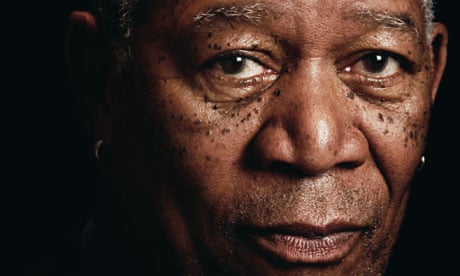
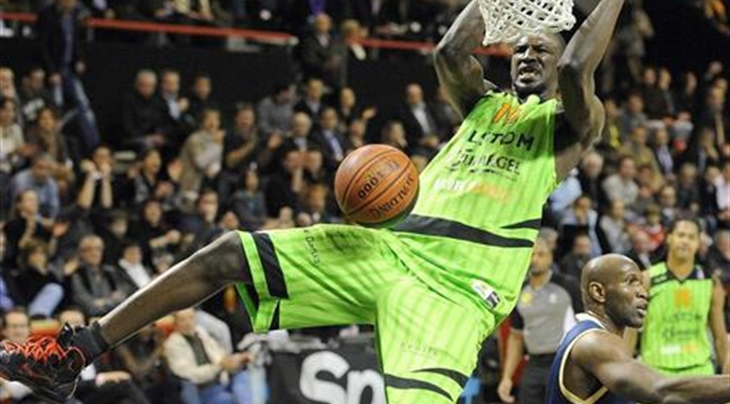
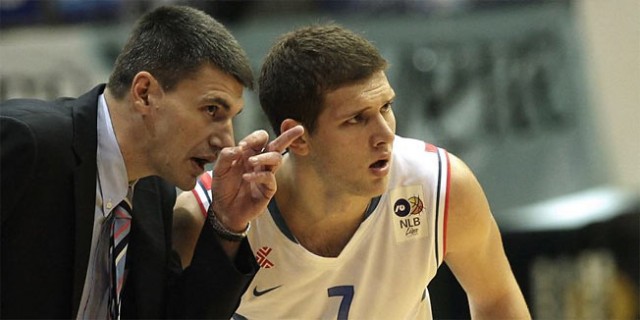
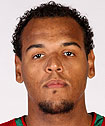
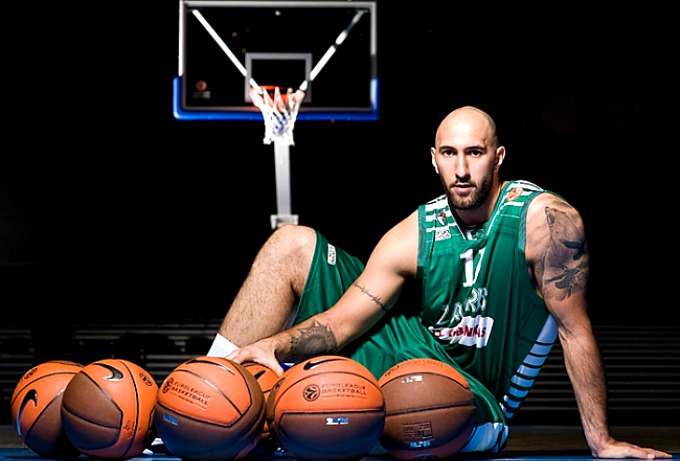
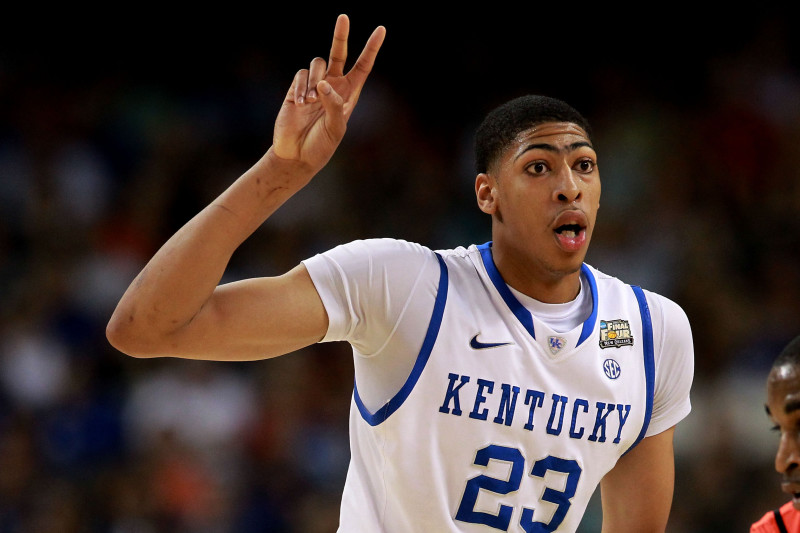
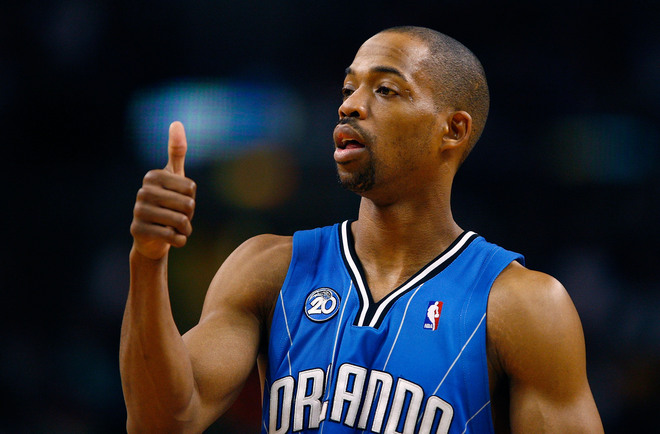
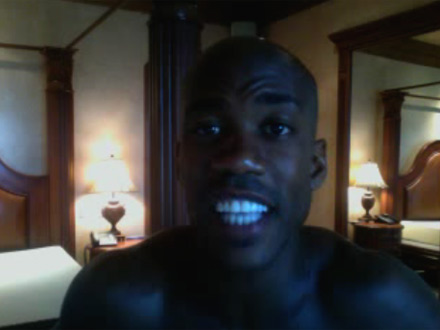
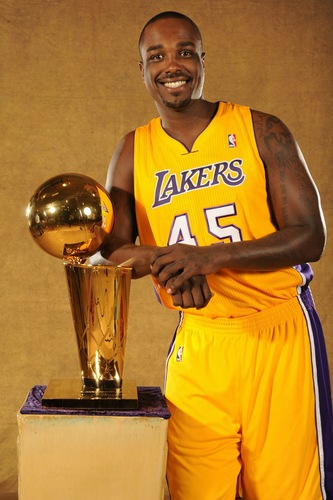
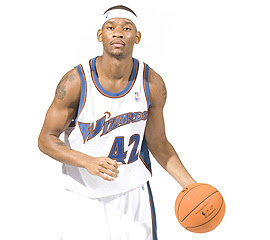
The only beardless picture of Rashard Lewis I could find. It’s a part of him now.
“Creative financing.” A fun term, one that’s actually employed by financiers and accountants, yet one brought into the world of the NBA when it was used, once, in a pre-emptive justification for one of the least creatively financed transactions of a generation. Nevertheless, even if the man who gave reverence to the phrase isn’t the role model for its usage, creative financing does exist in the NBA.
Or at least, it did. In amongst the lockout, the protracted negotiations, and the almost complete loss of a season/confidence in the NBA’s product, a new Collective Bargaining Agreement was drawn up that sought to curb spending, introduce more payroll parity, and get the league back into the black.
For those of us who enjoy looking at, and looking for, means to creatively manipulate, it was a confusing time.
Of course, some teams acted like nothing had happened. Detroit gave $25.5 million to Rodney Stuckey to come back, gave $18 million to Jonas Jerebko to come back, gave $28 million to Tayshaun Prince to come back, and gave $14.5 million to Rip Hamilton to go away, committed as they were to retaining the core of a team that’s gone 57-107 over the last two seasons. Meanwhile, Philadelphia spent only what it cost to re-sign Thaddeus Young and replace Darius Songaila with Nikola Vucevic; hamstrung as they were by incumbent contracts, the team had too little wiggle room to do very much, something which will likely continue to be the case for the final 18 months of the Elton Brand era.
Most others, however, recognised the changing environment, and were willing (or able) to adapt accordingly.
Perhaps the most prominent example of this is the defending champion, Dallas Mavericks. Dallas won the title last year because of two factors – Dirk Nowitzki and their incredible depth. This offseason, however, they dismantled the latter. This was a team so deep that players like Corey Brewer and Roddy Beaubois – who, lest we forget, had a 40 point game as a rookie – spent their time getting DNP-CD’d. And yet this winter, it was all let go. Historically the biggest of all the spenders, Dallas has been profoundly cutting payroll, with an eye to being under the cap for the first time in the Mark Cuban era. With Jason Kidd and Jason Terry aged and expiring, the Mavericks front office have decided to go from old to young, and from expensive to cheap (rentals of Lamar Odom and Vince Carter notwithstanding). So emphatic have they been in the pursuit of salary savings that they traded away a player they had acquired just that draft night for the cost a first-round pick (and potential steal of the draft, Jordan Hamilton), salary dumping onto the Nuggets before so much as letting him practice with them. When the new rules came in, Dallas’s old plan went out.
Rightly or wrongly, the Mavericks devised a strategy and are working towards it. A perennial tax paying team are not likely to be so any longer. Indeed, in the early going, the NBA’s aim of reducing spending on payroll is working charmingly, as evidenced by its potential luxury tax payers. Or lack of them.
As of the time of writing, seven NBA teams stand to be taxpayers this season.
[* = players with less than two years experience that are signed to the minimum salary are, for luxury tax purposes only, counted as having the minimum salary of a two year veteran/third year player. Therefore, Greg Stiemsma’s $762,195 salary and cap hit is treated as $854,389 for tax calculations, and only for tax calculations. The same is true of the first- or second-year minimum salaries being paid to Mickell Gladness and Terrel Harris of Miami, Donald Sloan and Ivan Johnson of Atlanta, and Gary Neal and Malcolm Thomas of San Antonio, hence the deviation between the above figures and the salary charts they link to.]
Even after trading Lamar Odom, the Lakers have no chance of getting under the luxury tax. Indeed, they never did – they traded Odom to alleviate some of the burden, not to completely remove it. Boston has similarly little chance, barring being part of a far larger roster upheaval, which isn’t entirely impossible. Miami doesn’t want or need to, and San Antonio, by not amnestying Richard Jefferson, have made it very unlikely that they’ll manage to dip back under. Nevertheless, with comparatively few teams over by comparatively little margins, we are barely a few months into the tougher luxury tax era and yet we’re already seeing less big spending then before. If this was what the owners wanted, it seems as though they’re going to get it.
Making the teams who can afford to spend more, spend less, doesn’t seem to address the NBA’s core problem of teams who struggle to stay in the black even at minimum payroll levels. But that’s an argument for another day.
Tyler Hansbrough, thinking of victims.
There’s also leftover cap space. Quite a lot of it, in fact.
At the bottom of the pile are the Indiana Pacers. Finally free from the payroll problems that have plagued them since the Brawl at the Palace, the Pacers entered the offseason with more cap space than anybody, and they’ve still got most of it left. Their big cap space plans involved signing David West, re-signing Jeff Foster….and that was it. For the most part, the cap space sits untouched, the same team returned, with just West and George Hill for upgrades.
This is perhaps unsurprising. The eminently reputable David Aldridge claimed in the summer that the Pacers lose $15 million annually – it is perhaps therefore unsurprising that they sit $15 million below the salary cap. They’re also doing so with a pretty good team – despite the strange and often incorrect methodology over the recent years, the last few months combined with a couple of good draft picks have seen the Pacers go from the doldrums of the late lottery to being one of the better teams in the Eastern conference. No point spending for the sake of spending.
(Perhaps a lesson there for other moribund teams. You don’t have to completely pull the plug to build something. Something to note for, say, Washington.)
That said, the Pacers really do have to spend some more money. And that is simply because the rules will make them. In addition to a maximum amount of spending (the salary cap), teams also have a minimum level. This is pretty much never relevant – although Sacramento came very close to not meeting it last season – but as a part of the new CBA, the minimum salary cap level was raised from 75% of the salary cap, to 80% for this season, 85% for next season, and 90% thereafter. 85% of the current salary cap of $58,044,000 is $46,435,200; ergo, the Pacers, with their payroll currently at $43,773,036, are $2,662,164 short of it.
In addition to Indiana, a few other teams are below the maximum salary cap. Some, like Golden State ($286,463) and Houston ($777,210) are less than a minimum salary under, but under it nonetheless; furthermore, whilst technically over it because of cap holds, Toronto ($4,301,302) and Cleveland ($6,847,207) could get under it for the right deal. Washington ($1,700,748) and Minnesota ($1,199,661) also have a smattering left, while Sacramento have a very significant $9,429,746 chunk remaining.
As ever, there is scope and logic for a unison between the capspacers and the taxpayers. Trades of spare parts from taxpayers to non-taxpayers happen every year – see moves such as Marquis Daniels to Sacramento, Sasha Vujacic to New Jersey, Steve Francis to Memphis, and many others – and possibilities exist once again.
Having not amnestied him for whatever reason, the Lakers continue to own the determined but redundant Luke Walton, who won’t take a medical retirement and thus burdens the Lakers cap for two more years (and who, with a trade kicker mentioned below, is even harder to deal than it looks). The possibility of Boston being able to shift Jermaine O’Neal, Chris Wilcox, or both, in a bid to save some luxury tax money at the expense of all their frontcourt depth, is vaguely possible albeit an extreme long shot. Meanwhile, Josh Davis has stuck around with the Grizzlies against the odds, providing some front court depth when they had none earlier in the year; however, even without Zach Randolph due to long term injury, Davis is now redundant and taking up cap space. (His non-guaranteed deal can be cut – however, if is traded, thereby removing the already-paid portion of his salary from the Grizzlies’s tax number too, then that’s even better. This is rather easy to do with minimum salary players and happens fairly often.) And Atlanta’s 15 man roster consists of 8 minimum salary contracts, due directly to the less-than-creative contract they gave Joe Johnson. Trading and/or cutting a couple of those dips them just below the luxury tax line, where they had best hope that all the performance bonuses in their incumbent contracts don’t conspire to push them back over it.
The most obvious union, however, is O.J. Mayo and Indiana. The team that owns O.J. Mayo is over the tax. The team that wants him is easily far enough under the cap to absorb him. The two teams have come so close to making this deal that it has been falsely reported as being falsely completed TWICE before (once here, and once here, before it was edited. Smooth.) And Memphis still doesn’t need or use Mayo to any great effect, while Dahntay Jones still needs upgrading.
It writes itself. If you can get $30,000 on O.J. Mayo being a Pacer by March, do so.
….yeah, no. Just no.
There follows an updated list of all the trade kickers currently in existence in the NBA.
Either because they’re already earning the maximum, or because they’re highly unlikely to ever be traded, or both, a few of those are perhaps nothing more than arbitrary. It appears, then, that trade kickers aren’t in vogue right now. NBA salary trends tend to oscillate, the NBA being as it is a copycat league, and trade kickers just aren’t as popular as they were five years ago for whatever reason.
However, as spending decreases, contracts are getting shorter. It seems that this year, more than ever, one year contracts were in vogue. This, strangely, gives us a whole new realm of trade kickers to consider, and for people they wouldn’t otherwise be applicable to.
Out-and-out no-trade clauses are incredibly rare in the NBA, as the criteria for being eligible for one are not easy to meet in this day and age. To receive one in a new contract, a player has to have been in the NBA for at least eight seasons, and has played for the team with which he is signing for at least four of them. It is therefore perhaps no great surprise that only two conventional no-trade clauses exist in the league, belonging to Kobe Bryant and Dirk Nowitzki. Not even Tim Duncan has one. (And nor does Paul Pierce, contrary to some reports.)
Yet a mere technicality effectively creates de facto no-trade clauses for a group of players not even nearly meeting those criteria. In a little-known rule made incredibly famous by Devean George, players who sign one year contracts (or multi-year contracts with only one non-option year), who will have early or full Bird rights upon completion of that contract, have the right to veto any trade they may be in, as, if they were to be traded, they would lose their Bird rights and become mere non-qualifying veteran free agents.
Put into practice, if a player earning $4 million on a one year contract will have Bird rights at the end of it, he can re-sign for up to the max when it ends. But if he’s traded and loses his Bird rights, he can re-sign for only 120% of that previous amount, a considerably less impressive $4.8 million. Ergo, they have the right to veto, to preserve their rights and thus their pay day.
At a loss to explain why that rule exists and they would lose their Bird rights in the first place – it probably has something to do with qualifying offers, but this is a mere guess – we can nonetheless document to whom it currently applies.
With respect to all parties involved, when read against the names of Dirk Nowitzki and Kobe Bryant, that list is quite funny. The Devean George rule has only been used once, and isn’t likely to be used again any time soon, especially since most of the people who could possibly invoke it are veteran minimum salary types to whom the potential loss of Bird rights is meaningless anyway.
Nevertheless, comedy potential exists.
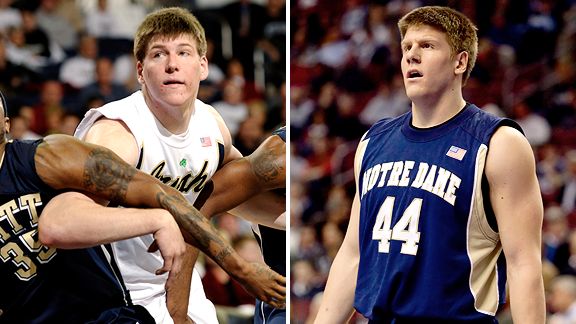
After 12 long and glorious years, Mate Skelin’s NBA career is finally at an end. He’s the one on the right, by the way.
In one final act of bookkeeping, here is a list of players whose free agent cap holds were renounced this summer by teams looking for cap space.
A full list of free agent cap holds can be found here. After Indiana’s long-overdue clearout, that is pretty much it for 90’s relics with Keith Van Horn-like sign-and-trade potential. Only Boston, Dallas, Phoenix, San Antonio and the L.A. Lakers can threaten something like that any more. And with the middle three all looking for cap space some day soon, the list is soon to be further pruned.
Alas.
You can pause any game that Kyle Korver is in, at any moment, and he’s guaranteed to be doing something ridiculous.
[…] Of note on this list is the curious case of Channing Frye, the former Blazers and Knicks forward whose transformation from the next Dirk Nowitzki to the next Malik Allen is almost complete. The Suns signed Frye last month to a 2 year, $4,139,200 contract; not coincidentally, that is the same amount as the full value of the Bi-Annual Exception. However, the Suns didn’t actually use their Bi-Annual Exception to sign him. Knowing that they wouldn’t be using the full MLE to sign somebody due to their payroll concerns, the Suns cleverly (and creatively) used an equivalent chunk of their mid level exception instead. As the name would suggest, you get to use the Bi-Annual Exception a maximum of once every two years, so if the Suns used it this year, they wouldn’t get it next year. But if they roll it over, they do. It’s pretty shrewd, when you think about it.
(Teams that should have done this but didn’t include Washington – who used their BAE on Fabricio Oberto, and who won’t use their MLE – and Chicago – who used their BAE on Jannero Pargo and who also won’t use their MLE; however, if their plan for 2010 cap space comes off, it won’t matter.)
[…] It turns out that it didn’t matter. As was extremely obvious, Chicago went the cap space route, and after Washington’s fourth annual explosive decompression, so did they. By both going the cap space route, the two teams thereby ensured that the exceptions they might have lost never actually mattered. (Had Washington not finally decided it was the right time to blow it up, they would have been down a BAE this summer for no good reason. It wasn’t a good idea, but they got away with it.)
Only two teams this summer have used their Bi-Annual Exceptions so far. Milwaukee used theirs on ShamSports.com favourite Keyon Dooling, while Detroit used theirs to re-sign Ben Wallace (whose lack of effort during his time with the Bulls has permanently sullied any affection I once had for him). However, while Milwaukee used their BAE because they’d spent their MLE on Drew Gooden, Detroit used their BAE while their MLE sits there untouched. That MLE is probably going to stay untouched all summer, because they’ve certainly shown no inclination to use it thus far, and all the MLE calibre free agents have gone. They could have used it on Wallace so that they could carry over their BAE; they should have used it on Wallace so that they could carry over their BAE. But they didn’t.
As was the case with Washington, this might turn out to be completely insignificant. But what if it isn’t? What was the point of that?
Detroit didn’t have any cap space this year, instead choosing to spend their money re-signing their own team. As such, whereas they could have potentially used the BAE on someone, they couldn’t, because they had unnecessarily used it the year before. It is not a deal breaker or a particularly big deal, but it is a misappropriation of assets for a team with scant few.
It’s also happened again.
Contrary to an ever-more prevalent myth, the Bi-Annual exception was NOT gotten rid of in the new CBA. It still exists; the only significant change to its existence was that taxpaying teams are no longer allowed to use it. Everyone else, however, is.
Few have, though. Indeed, only two teams have cracked the seal on their Bi-Annual exceptions this year, and neither team used all of it. Memphis gave two years and $2 million to Jeremy Pargo, while Toronto one-upped that with two years and $3 million for Gary Forbes.
Both teams also received the non-taxpayer mid-level exception this year of $5 million, and both teams have used part of it. Rather bizarrely, Toronto gave Aaron Gray $2.5 million for one year, where he’s been unlucky enough to miss most of it with a heart problem, while Memphis gave Dante Cunningham $6.27 million over three years for the right to battle it out with Quincy Pondexter and Sam Young for the scant few available backup forward minutes, while also using $550,000 of it to give rookie Josh Selby a three year contract.
You can probably see where this is going. Memphis now have an unusable $900,000 of their Bi-Annual Exception in remainder, while Toronto has an even more unusable $400,000 left over. Yet the two teams sit with a combined $4.95 million in untouched mid-level exception which could easily have accommodated the players on whom they used their Bi-Annual exceptions.
Toronto will likely have cap space next season, rendering this null and void. Memphis, however, won’t. And even if their significant spending in recent months – $245,806,454 in the last 18 months on Marc Gasol, Rudy Gay, Mike Conley and Zach Randolph alone – has greatly handicapped their ability to spend in the future, potentially rendering usage of the BAE impossible anyway, it would still have been more beneficial to retain its usage for next year, however marginally, rather than leaving a chunk of MLE unused that you can’t carry over.
Trivial details, perhaps, but still hard to justify.
Terrible wristband.
Something never before seen happened on May 30th 2011, as Ricky Rubio signed his rookie contract with the Timberwolves.
If you’re into salaries and the like – which, if you’re reading this post, it is assumed you are – you’ll see an obvious problem there. Minnesota’s season was done with by that times from a games-played standpoint, yet seasons officially change from one to the next on July 1st every year (which is why that was the date that the lockout starts, and that the moratorium normally starts). Ergo it appeared that Rubio had signed for the final month of the season, and the final month of the season only, even though there was no game action in it.
But he didn’t.
In a move I have never seen before – and which I didn’t even know was possible – Rubio seems to have signed his contract in advance – that is to say, Rubio signed a four year contract, yet it did not begin until after the NBA lockout. Normally, contracts signed for part-seasons count as full seasons, even if they leave it as late as signing on the last day of the regular season. In Rubio’s case, however, it was adjudged that the end of the 2010/11 season didn’t count – therefore, his four year contract began when this season did, and will run until 2015.
Furthermore, the previous CBA contained rookie scale figures for the 2011/12, even though there was an option to terminate the agreement before that season began (which is what inevitably happened). So when Rubio signed his deal in May 2011, under the old CBA, he signed for the scale amount for the 2011/12 5th pick under the OLD CBA’s figures, rather than the new ones. This is noteworthy for one reason: the 2011/12 figures under the old CBA were slightly higher.
Thus, even though those figures are otherwise not in use, they apply to Rubio. And instead of earning the $15,239,922 over four years that he would have done had he signed under the new CBA’s scale amounts, Ricky will instead get $16,294,046 over that time span, an increase of $1,054,124. Score a point for his agent.
I have no idea what provision in the CBA, what piece of language from whence it came, where said Rubio mechanism can be found. But for the purposes of us as outsiders, that matters not. It matters only to know what Rubio is signed for, and for how long.
And even that doesn’t really matter either.
But it is different.
[Something similar has happened for Patrick Beverley. Last training camp, Beverley signed a fully guaranteed two year minimum salary contract with a drunken Miami Heat front office that was so happy with their 2010 haul that they were throwing money away, even giving $250,000 to Kenny Hasbrouck. Beverley did not make the team and was cut, but nevertheless still stood to make his two years of minimum salary money, since it was guaranteed. The 2005 CBA contained minimum salary values for a potential 2011/12 season, in the same way as it had rookie scale amounts for that year also drawn up. In those minimum salary values, second year players stood to make $788,872. However, when the new CBA was drawn up, it was agreed that all minimum salary values were frozen for two years, and that therefore the 2010/11 amounts are to be used both this season and next. That means that the two year minimum is the same as it was before, $762,195. Beverley, however, will uniquely get the $788,872 that he was promised. A quirk of the system, perhaps, but a welcome $26,677 for Pat. Score one for his agent too.]
I don’t understand the panning of Hasheem Thabeet. He averaged a double double only three years ago.
In the run-up to the lockout, many third and fourth year contract options were exercised by teams on their incumbent rookie scale contracts, a process which normally doesn’t happen until October. Indeed, almost all of them were, to the point that it’s easier to list the ones that weren’t.
Due to the lockout, the usual October 31st deadline for these options was put back to January 25th. So there’s still time.
[NB: Despite no customary press release saying so, Detroit did in fact exercise their options for Greg Monroe and Austin Daye back in June.]
Furthermore, the largely arbitrary nature of rookie scale contracts can cause one other conflict. As we found out last year – described AT LENGTH here – having performance incentives in rookie scale contracts is a controversial topic. It is, however, normally for trivial matters, such as participation in summer leagues, summer conditioning programs, and the like. Rare is the day that actual on-court performance bonuses are included in rookie scale contracts. However, as that study found out, it does happen.
(A very thorough breakdown of the situation can be found by reading that post, as well as the one its first sentence links to.)
What we also found in there was that only on a scant few occasions has a rookie been given less than the maximum 120% of the rookie salary scale. Indeed, as best as can be ascertained, it has happened five times prior to this season: Donte Greene, Sergio Rodriguez, James Anderson, George Hill and Ian Mahinmi.
Add two more to that list.
Predictably, one of them is a Spur. While Kawhi Leonard got his full 120%, Cory Joseph didn’t. He can earn it by meeting his incentives – and, as best as can be ascertained, there are no on-court performance bonuses included in his deal – yet as of right now, he’s at only 100%. Considering that the Spurs are responsible for three of the five previous non-120%ers, and that there was absolutely no chance that Joseph was going in the first round were it not for San Antonio, this is not surprising. They had all the leverage.
The other non-120%er, though, is from a more surprising source. Despite his blistering start to the season, with averages of 15.1 points and 4.4 rebounds at the time of writing, MarShon Brooks is doing so for only 115% of his possible rookie scale amount. He stands to gain 120% in all future years – however, this season, he is earning only $1,063,865 of the $1,110,120 that he could be. The reason why is not apparent, but also perhaps not important.
Of course, saving $46,255 on MarShon Brooks’s contract is less impressive when you then re-invest it all on three weeks of Dennis Horner. Or when you decided that, despite being a mere shell of his former self, Mehmet Okur was totally worth $10,890,000 for one season of backup-calibre play.
But I digress. For whatever reason, and via whatever methodology, the Nets creatively found some extra cap space.
(Incidentally, how favourable has time been to Memphis’s infamous attempt to offer less to Xavier Henry and Greivis Vasquez? Somewhat. Amidst other criteria, the main stipulation that the pair had to meet was averaging 15 mpg in a minimum of 70 games played. Vasquez came close, playing in the 70 games yet averaging only 12.3mpg, while Henry wasn’t even in the same ballpark, averaging 13.9mpg but in only 38 games. Furthermore, neither is even with the team any more. So the Grizzlies’s intent to save money by not giving it to those who did not deserve it with their play was not baseless. But then again, it never was. That doesn’t change that the fact that, however justifiable the conduct on a wider scale, it was the wrong team at the wrong time. You’ve got to pick your battles.)
Add them all up, and you get……a number that isn’t 32.
Four of them have landed elsewhere. The Knicks signed Davis for the minimum, and not for the non-taxpayer MLE as was initially widely reported. Bell meanwhile returned to Italy, the home of his best years, where he’s shot 6-28 in three games. But the other two were the first and thus far only two recipients of the new amnesty waive claim procedure.
The amnesty claims procedure allows those under the cap to enter into an MLB-like blind bidding procedure for their services. Several wondered whether this would lead to MLB-like incredibly specific bid amounts.
With only two bids in, it already looks like we will. One of them is normal enough, if rather regretful – for some reason, Sacramento bid an even $12 million for Outlaw, bidding up themselves and getting lumbered with an average backup on a guaranteed four year contract at a position where they were already set for averageness. A confusing move salvaged only by its novelty.
Billups, however, was the more beautiful novelty. In bidding for his services, the Clippers served up a bid for the very specific amount of $2,000,032. Not only is this amount an undeniable bargain when compared to the $4.25 million Randy Foye is getting to back him up – or the $3 million Outlaw is getting to shoot 24% from the field – it’s also beautifully unique. Is the additional $32 supposed to be representative of a number special to Billups? If so, why? If not, and it’s a random number they just chose, why 32? Why not $25? Why not $825? And was any team out there stymied by it, unlucky enough to serve up a losing bid of exactly $2 million?
That, there, is creative financing in action. After all, we were never going to be completely denied it.
In lieu of having any NBA transactions to talk about, we’ll look at the world at large instead.
Of all the players to have finished last season on an NBA roster, six have already signed abroad. One of the first to go was Mustaka Shakur, who started the year with the New Orleans Hornets and ended it with the Washington Wizards. For whatever reason, the Wizards did not offer him a qualifying offer, seemingly moving on from Shakur’s prolonged tryout. He thus moved to France to sign with Pau Orthez, the fallen giant who continue to rebuild.
Also signing in France was Hilton Armstrong, a somewhat forgettable inclusion in the Kirk Hinrich trade whose NBA days might now be numbered. In five years of trying, Armstrong has never demonstrated much NBA talent outside of having a long neck; given that he spent much of those five years in the New Orleans Hornets rotation, he can’t lament not being given an opportunity.
(ASVEL have a strong youth regime that often churns out good prospects. Bangaly Fofana, whose starting spot Armstrong looks likely to take, was a draft-and-stash prospect in the most recent draft, albeit a faint one, and Edwin Jackson is a solid candidate for next year’s one. But if Jackson is a legitimate draft candidate, or if Fofana had been picked 59th this year instead of Adam Hanga, isn’t it a conflict of interest for them to be taken by the Spurs? After all, Tony Parker is the Spurs’s starting point guard, and also ASVEL’s Vice President of Basketball Operations with a 20% shareholding. Even if it is done with the very best of intentions, isn’t it an automatic violation if a player goes from one of his teams to the other? Someone must have an answer for this, but I see no precedent. Anyway, this does not apply to Hilton Armstrong.)
Sonny Weems. Or Joey Graham. Or Stephen Graham. It’s definitely one of the three.
The oft-reported story is that Sonny Weems, currently a restricted free agent of the Raptors, will sign with a European team next season. However, nowhere has anyone actually reported which one it is yet. One transaction that has definitely been finalised, though, is Dajuan Summers’s move to Montepaschi Siena. The death knell for Summers’s Pistons career was the recent drafting of Kyle Singler; like Shakur, Summer did not receive a qualifying offer this summer, for doing so would have meant offering guaranteed money to a 14th man who had made no discernible progress in two seasons. [Qualifying offers are guaranteed for the same percentage as the previous season’s salary, and Summers’s 2010/11 contract was 65.6% guaranteed. Thus, his qualifying offer would have been, too.]
Summers is assumed to replace Malik Hairston, who is widely speculated to be leaving Montepaschi Siena and joining fellow Italian team AJ Milano. Whether Hairston wants to leave Siena, or Siena wants Hairston to leave, is unclear. Whichever it is, it does not make sense – Siena is one of Europe’s very best, emphatically Italy’s very best, and Hairston was a versatile and productive player for them. He won’t get anything better, and they’ll be bloody lucky to. Nevertheless, Summers’s arrival rather predicates Malik’s departure. Montepaschi are also reported to have agreed to terms with David Andersen, although no move has been finalised, for Andersen is – or was, pre-lockout – still under contract with New Orleans. His contract is largely unguaranteed and he will inevitably be cut, but it hasn’t happened yet. [Siena were previously close to signing Boston College’s Joe Trapani, but he will now instead sign with Casale Monferrato. They also re-signed Bo McCalebb to a three year contract, further increasing the likelihood that Bo will never play in the NBA. Which seems silly.]
In addition to Trapani, some of the other more high profile undrafted NCAA players are finding homes. Florida’s Alex Tyus has done what many rookies do, and gone to Israel, signing with Maccabi Ashdod; furthermore, Jonathan Givony tweets that Tyus’s transfer comes with the added bonus of a conversion to Judaism and a subsequent Israeli passport. (Shalom.) VCU’s Jamie Skeen will join Hilton Armstrong at ASVEL Villerbanne, which, if their wild card bid is accepted, will mean EuroLeague action in his rookie season. Ben Hansbrough joined German side Bayern Munich, a team with great ambition that threw money at quality players last season in a successful bid to win promotion to the Bundesliga. Pittsburgh’s Gilbert Brown joined him there, joining the other recently promoted club, Wuerzburg. The oft-overlooked Macedonian league made some moves, as last year’s runners-up MZK Skopje landed both Oklahoma’s Cade Davis and Wofford’s Noah Dahlman. Dogus Balbay did the inevitable and returned to Turkey, joining Anadolu Efes Istanbul, the team formerly known as Efes Pilsen (forced to rename due to new Turkish government legislation about alcohol sponsorship). Antonio Pena, formerly of Villanova, quickly hooked on in the Dominican Republic and signed with Metros de Santiago in the LNB, whose season begins next week. Tai Wesley of Utah State moved to EiffelTowers Den Bosch, who play in Holland, despite the name. And Virginia Tech’s Malcolm Delaney moved to actual France, hooking on with Chalon.
Two EuroLeague mainstays are undergoing great upheaval.
After eight consecutive final fours, CSKA Moscow’s age caught up with them last season, and they underperformed wildly. They just about held on to win the inaugural season of the new Russian PBL, but an early EuroLeague exit was, by their own standards, underwhelming. With that in mind, there’s been much roster turnover, albeit not all of it intended.
The backcourt of Trajan Langdon and J.R. Holden and their combined 15 years with the team came to an end, as both announced their retirement – Holden also declined to play for the Russian national team this summer, leaving the team in a bind. CSKA replaced them by bringing back national team starting point guard Anton Ponkrashov, who spent last season with Spartak St. Petersburg averaging 11.4 points and 4.4 assists per game, and who exercised a buyout clause to return to the team who spent four years developing him in the first place. They also brought in former Pistons draft pick Sammy Mejia from Cholet in France – where he’s been one of the best players these past two seasons, averaging 18.0ppg last year – and released midseason reinforcement Sani Becirovic (who ultimately played only six minutes for the team). In more backcourt makover action, CSKA also released the underwhelming Sergey Bykov (who doesn’t help without the ball in his hands, and who wasn’t good enough to have it), brought in national team defensive specialist Eugeny Voronov from cross-town rivals Dynamo Moscow (bankrupted and forcefully relegated this summer), and re-signed Ramuntas Siskausas for another two years, thereby giving CSKA the world’s biggest backcourt since the days when LeBron James played point guard alongside Ricky Davis and Darius Miles. 6’7 Ponkrashov, 6’6 Siskauskas, 6’7 Mejia. Add some lashings of the 6’4 Voronov, some 6’5 Alexey Shved action, and possibly some 6’9 Viktor Khryapa at small forward, and you’re looking at real size.
CSKA’s retooling also extended into the frontcourt. The aging Matjaz Smodis, whose career has been undercut by injuries, was released after six years with the team; replacing him is Nenad Krstic, the sixth 2011 NBA player to have crossed the Atlantic thus far this offseason. [This number isn’t any bigger than it is in any year. It’s just foregrounded this time around, for obvious reasons. It’s also all happening somewhat quicker, due to the lack of summer league.] They also brought in Darjus Lavrinovic, who joins from Fenerbahce and who moves onto his fifth team in five seasons, a veteran of Russian play after time with both Unics Kazan and Dynamo Moscow, and let one time prospect Boban Marjanovic – who had spent half of last season on loan to Zalgiris – move to Nizhny Novgorod. (Zalgiris wanted to keep him, but deemed him to be too expensive.) With Milos Teodosic supposedly on the way, and Sasha Kaun seemingly safe from signing with the Cavaliers considering the lockout situation, CSKA have rebuilt and improved their team, and it’s not even the second week of July yet.
Giannis Bourousis, getting slightly closer than Lighty.
On the flip side, it’s all going horribly wrong for Olympiacos. It’s going wrong for Greek basketball in general, and indeed for the whole of Greece, but it’s going particularly wrong for Olympiacos.
The wealthy Angelopoulos brothers, whose magnanimity and free-spending is what has built such a powerhouse team in the first place, have left the team. And they’ve let it with financial problems. The European business model for basketball teams is largely sponsorship-based – which is why teams are normally named after companies and/or their stuff, rather than animals, musical genres or weather phenomenon – and yet with the wider economic problems in Greece, no one has this sponsorship money to burn any more. Pretty much every Greek team owes money, and Olympiacos are no exception; they spend big, and always have, and have had many a contract dispute in recent years when they feel they’re not getting sufficient return for their money. But now, they have no Angelopoulos brothers to foot the bill. They need a hugely rich benefactor to run the club as a play-thing. But Greece is fresh out of those. They now face the problems Manchester City will face when Sheikh Mansour gets bored – huge liabilities, and not nearly enough revenue to cover them.
As a result, it seems to be nobody in, everybody out. Teodosic is set to leave. Offers abound for Vassilis Spanoulis. The Pelican looks as though he’s on his way to Montegranaro. Jamon Gordon has already gone, signing with an ambitious Galatasaray team that also brought in Jaka Lakovic from Barcelona. And one of the biggest scalps of all has been Ioannis/Giannis Bourousis, who has left the club under acrimonious circumstances. Bourousis has become entangled in an alleged doping scandal, itself an unintended but intriguing off-shoot of a wider investigation by Greek police into match-fixing. In a conversation with Kavala FC owner Makis Psomiades, a key figure of the investigation, Bourousis is heard to call the Angelopoulos brothers “idiots”, while also asking Psomiades for “more medicine.” The two are indelibly linked, since Bourousis is also dating Psomiades’s daughter. (A translated transcript of the conversation, as well as a picture of the unique looking Psomiades, can be found here.)
Of course, Panathinaikos have not brought in anybody, either, and Antonis Fotsis was a noteworthy departure from that team when he joined AJ Milano. But at least they’ve still got an owner.
Olympiacos’s implosion is testament to the fact that the NBA-to-Europe emigration, taken too lightly by many critics and players alike, will not be much more noticeable than usual. There simply is not a lot of money in basketball anywhere at the moment, except for perhaps Turkey and Asia, and there’s no teams that can afford the rotation-calibre NBA players who believe (or believed) that they can waltz into top level European gigs. It’s not worth it for a player who earns $8 million a year to go to a decent quality European club and earn $250,000, and the number of teams who can offer more than that have already pretty much plugged their caps. As was forewarned here, the two markets, both textually and contextually, are just too different. There will not be a mass exodus. There cannot be a mass exodus.
The main benefactor may be the D-League. The elite talents won’t make it to Europe, but some decent ones will, and for every player that gets a good European gig, one more gets pushed down the ladder. There are more players than there are spots, and whenever somebody gets bumped down one, the sanctity of the D-League beckons, at least until something better comes along later. After all, it worked for Alan Anderson.
The other main benefactor may be China, who needn’t chance the Steve Francis types any more.
What Happened Prior to July 1st Other Than A Bunch Of Ultimately Unproductive CBA Negotiations
July 2nd, 2011
Even though a lockout is upon us, one which might last us through until the very end of existence in late 2012, there’s still some bookkeeping to be done. July 1st is (or should be) the date on which one season ends and the next one begins, and thus June 30th is an important cut-off date for certain transactions.
Players with player or early termination options had to decide if they were coming back; the few players with team options awaited an uncertain future; players eligible for QO’s had to see if they got them. We also had the added bonus of 2012/13 team options for rookie scale contracts being decided considerably earlier than usual – after all, when the usual end of October deadline comes around, the lockout may still be going on.
All the results are in now, however, and there follows a list of who did what before July 1st.
(No one really gives out team options any more. For an explanation as to why, read the opening of this. Well, read the whole thing, but only the opening pertains to the team options.)
The following players were eligible for a qualifying offer, and got one:
David Stern and Billy Hunter drive towards a cliff. Hand down, man down.
After one of the best seasons ever comes one of the worst drafts ever. With the NBA riding a wave of talent, a draft comes along that sees not a lot more talent being added. There’s no getting around the fact that, relative to years past, the talent level of this draft is not very good.
There’s also no getting around the fact that this is the last dollop of NBA we are going to see for a while. There’s going to be a lockout starting in nine days time; after today, everything is into the realms of the unknown. That fact will make this draft the last NBA action in the foreseeable future. It also will make children cry. This is what they want. They want your children to cry.
The former of these things makes the draft a bit of a downer. But the latter of these things actually makes it more exciting. When you can only get one more taste of something before it is taken away from you forever, then you’re going to enjoy that final thing. This is the reason behind Death Row last meals, and was also a key philosophical plot vehicle within the seminally dreadful movie, Thelma And Louise. With the impending stench of bureaucratic disappointment blowing gustily in our face, dammit, we’re going out in style.
(This post is long. Very long. If you don’t have 90 minutes to kill, skip to a certain pick number below. Once there, click the pick number to return to the top)
This year’s ESPN broadcast of the event features some changes to the usual format, the most notable of which is the location. No longer is the draft held at the unsubstantiated Mecca of basketball, Madison Square Garden. Due to renovation at the Garden, the spectacle has instead been moved to the new Prudential Center in Newark, New Jersey. The renovation work at MSG is expected to last three summers, which seems rather a lot, considering that you can build entire new stadia in half that time. Unless said renovation work involves drilling and installing a portal directly to the underworld – which, in light of recent CBA renegotiations, it might – then that alloted time frame seems rather ambitious. Nevertheless, we are here now, cracking Pru’s virginity.
ESPN have further tweaked the coverage in simple yet important ways, partly by ditching the pseduo-living room in which post-selection interviews normally take place. Gone are the wingback chairs, soft furnishings, big mahogany table, bearskin rugs, pipes and slippers, glasses of Chardonnay and the creepy unnecessary Batphone thing of last year – instead, sideline interviewee Mark Jones will be interviewing the candidates from a standing position near some stairs. Mark Jones stands only about 6’0 tall, which later proves to be awkward.
The presenter lineup remains the same. Stu Scott returns, as do Jay Bilas, Jeff Van Gundy and Jon Barry. Heather Cox returns as the token female, whose role it is to hop around the green room and feel genuinely good for other people, a role perfected by Doris Burke. Andy Katz is elsewhere in the room, ready to drop informative transaction snippets several minutes after Adrian Wojnarowski and Marc Spears had already done the same. Ric Bucher is also around, duplicating Katz’s role, and looking rather frustrated by it all. And in some darkened corner of the building, Tom Penn returns to dispense sage financial wisdom with the aid of a big screen that later proves to be not nearly big enough.
For the third straight year, Dick Vitale does not video call in from his home. I guess he’s not going to come back.
If this is a before-and-after picture, have the procedure.
This is a particularly galling year for Dickie to be missing, for it’s going to be a Duke laden draft. Kyrie Irving is the clearcut number 1 pick, and any pretense that says that a decision was still being made is what we in England refer to as “bollocks.” Irving is the most complete player in the draft, and it is inevitable that he will be picked first.
Nevertheless, we are forced to dance the will-he-won’t-he dance for a while. Indeed, a huge chunk of the half an hour preview show is dedicated to the Cavaliers drafting Irving, both talking about how great it will be, and how uncertain it all still is. ESPN went as far as sending Jeanine Edwards all the way to Ohio to the Cleveland war room, where the Cavaliers do the chivalrous thing and make her stand outside without telling her anything whatsoever. This all proves to be somewhat worth it for everyone except Jeanine, when Jon Barry claims that Cleveland “don’t even need a point guard,” subsequently invoking the names of Baron Davis, Ramon Sessions and Boobs Gibson. Jon Barry started as he meant to go on tonight.
Ric Bucher kicks the night off with the announcement of a three team trade between Charlotte, Sacramento and Milwaukee, one which highlights the futility of ever trying to predict trades. [No one alive predicted this. No one even predicted the framework of it.] Bucher tells of how Charlotte will trade Stephen Jackson, Shaun Livingston and the #19 pick to Milwaukee, in exchange for Corey Maggette from Milwaukee and the #7 pick from Sacramento, thereby ending my own Stephen Jackson-based aspirations.
The trade also includes John Salmons and the #10 pick being sent from Milwaukee to Sacramento, in addition to Beno Udrih going the other way, thereby making the deal from the Kings perspective a swap of Salmons for Udrih, and a trading down of three spots. Salmons was a King between July 2006 and February 2009, when he was traded to Chicago along with Brad Miller in exchange for Andres Nocioni’s lengthy contract, Drew Gooden’s expiring contract, and some peripheries. Sacramento’s motivation to deal was to save short term money by taking on long term money. They then did the opposite, taking on short term money to open up long term cap space, when they traded Nocioni and Spencer Hawes last summer for Samuel Dalembert. And now they have used that cap space…….on John Salmons. It is, needless to say, a baffling trade, and one that could have been avoided had the Kings done more than 5 seconds of Googling and checked to see if Salmons had gotten much worse since he left.
The rest of the deal is fairly simple to comprehend. Charlotte moves up big by giving up two decent but excess guards, and accelerates a long moribund rebuilding process. Milwaukee beings the long process of undoing their own expensive mistakes, gaining some contributors in the process. But as for Sacramento……..what was the point? What was the aim? What does this deal hope to achieve? The answers get no clearer throughout the evening.
(Stephen Jackson is reported to be unhappy about being traded to Milwaukee. Him and a thousand others. Wait until the day comes that he’s traded to somewhere where he’s not allowed to wear a headband. It’s going to kick off.)
This photo was taken some time before the trade.
Jay Bilas peels off a quick dissemination of the games of Irving and Derrick Williams, the likely number two pick. As a professional college basketball analyst and part-time dinosaur assassin, this sort of thing is right in his wheelhouse, and he nails it. After a quick break, he is straight back on the horse with more break downs of Kemba Walker and Alec Burks, deliberately and wisely ignoring the non-NCAA players along the way. You can mock Jay Bilas if you want, particularly for his excessive clichés and strange obsession with the length of people’s limbs, but he’s right. Normally.
For reasons not immediately obvious, the coverage tonight is interspersed with clips of the upper echelon draft picks playing a set of drums made out of household objects. It is first debuted by Jimmer Fredette, who is dress like the compelling male protagonist in a Bob Knight golf porno, and is regularly revisited throughout the course of the evening. This narrative vehicle is never explained, is never understood, and never, ever works.
A legitimate discussion is raised about what Minnesota intends to do at number two. Unlike the number one pick, this is genuinely in doubt – Minnesota’s painfully transparent front office spent the last month calling up random house numbers, starting a leafleting campaign, and stopping people in the street, so desperate were they to let everyone know that they wanted to trade the pick. And when they couldn’t find an acceptable deal, they floated the possibility of taking Enes Kanter instead. As of the start of the draft, this was still a legitimate possibility – if a decision had been made, it had not been leaked.
Predictably, Jon Barry cites the presence of Anthony Randolph as a reason not to take Derrick Williams. Even more predictably, Jeff Van Gundy uses that as a means to rant about something else, namely the lameducking of incumbent coach Kurt Rambis, who knows he’s going to be fired but doesn’t know when. Van Gundy’s non-sequitirs are justified when he is absolutely right.
Minnesota’s motivation for veteran help is simple. They owe next year’s first-round pick, unprotected, to the L.A. Clippers, and thus they don’t stand to benefit from another shocker of a season. They can’t afford to win 17 games again. And more than likely, they won’t. 27 seems much more likely.
After some more filler about Jimmer Fredette, the CBA and Jimmer Fredette, the draft itself finally begins.
Pick 1: After having 38 days to decide who to pick first overall, Cleveland are given five minutes to finalise a decision, which obviously they completely need. Jeff Van Gundy goes out of his way to tell Cleveland fans not to compare Kyrie Irving to LeBron James. They weren’t. Jon Barry again cites the presence of Baron Davis as a hinderance. It isn’t. Indeed, Baron has been nothing but good for Cleveland – acquiring his contract, and the unprotected pick that came with it, is what got them Irving in the first place. And if they really want to get rid of it later on, the inevitable amnesty clause would allow them do to so. If only the Clippers had thought of that.
[Supposedly, a part of the Clipper logic behind the deal was to open up $6 million in 2012 cap room. If 2012 cap room was a big deal, why did they give Ryan Gomes $4 million guaranteed for 2012/13?]
Stu Scott leaves an innocuous Jay Bilas sentence hanging in the air for three unnecessary seconds. This will become a theme.
Irving is finally selected, and he exchanges six alpha hugs with those around him, one of which is Derrick Williams. He is greeted by a very talkative Stern, geed up early from a round of vociferous booing, and is ushered off to meet Mark Jones, who is so far to the left of the stage that he’s not even on it. Meanwhile, Heather Cox interviews Irving’s dad, former Simpsons boxer Drederick Tatum, a moment that causes yet another forced LeBron comparison that no one is making. It goes without saying that Kyrie is not LeBron. But he is the most complete player in the draft, and he just went 1st overall. That feels normal.
It soon becomes apparent that the “Must Improve” captions, which used to show up after a draftee’s highlight video, are not in play this year. This is a shame, because they were hilarious. Nevertheless, with their demise, Ian Mahinmi’s caption of “Must Improve: Overall Skills” can now never be surpassed. (Any intonation as to whether Mahinmi has really done that is in the mind of the viewer only.)
Due to Irving’s not-exactly-thoroughbred-but-it-counts Australian heritage, Australia is now one of only two non-US nations to have had two number 1 overall picks, the other being Nigeria, which can boast Hakeem Olajuwon and Michael Olowokandi. Michael Olowokandi was a bust, but drafting Michael Olowokandi would have been better that gifting the pick away for nothing, like the Clippers just did. I don’t think enough is being made of this. They traded the first overall pick in a salary dump. They didn’t even want the two players they got back, Jamario Moon and Mo Williams. This is much worse than the Otis Thorpe/Darko Milicic deal of 1997 and 2003. We must stress this more.
Pick 2: Minnesota eventually yields to the inevitable and chooses Derrick Williams at number two, to the great contentment of Bilas. The selection is accompanied by a shot of the Timberwolves’ executives in their “war room,” clapping themselves. It is normally customary for the team picking 1st overall to be burdened with this strangely mandatory shot, yet seemingly Cleveland have been so secretive that they wouldn’t let it happen. Someone owes Jeanine Edwards a weekend.
Derrick Williams’s highlight montage speaks to the versatility and skill level of his game, yet at no point does it show him making a pass. This probably was not deliberate, yet it does inadvertently make a point – Williams really does not pass the ball much. Then, during his interview with Mark Jones, Williams sways from side to side throughout in a very distracting way. Is this a testament to his activity level on the court? It might be. Or he might just need a wee.
Ultimately, despite the kerfuffle, Minnesota made the right move. They tried to get a star for him, and when they couldn’t, they rightly settled on the guy with potential, and the most potential at that. Williams isn’t a franchise player, ranking somewhere between David West and Antawn Jamison, but he’s better than the trade options. You should always take the best player available, particularly when you won 17 games. You can worry about the fit later.
It is possible that all the transparency was actually just David Kahn playing the bait-and-switch to perfection. It is not likely, however.
Derrick Williams has a massive head.
Let’s not get it confused – Williams will be better than Beasley, if he’s not already. It’s Beasley that they don’t need now, not Derrick.
Pick 3: Again following the script, Utah takes Enes Kanter at #3 to replace Mehmet Okur, whose career is essentially over. Kanter does the usual round of hugs, including getting one from John Calipari, who is remarkably subdued this evening. Last year at this time, in the midst having 19 of the his players drafted in the first, Calipari literally threw himself over chairs to get some airtime. Not so tonight. He let his player take the moment.
In a lengthy breakdown of Kanter’s game, Fran Frascilla managed to not mention Kanter’s rebounding at any point. This is odd, because he’s a damn fine rebounder, and it is one of his biggest plus points.
Another big plus point is his size. While Kanter is largely an unknown given his body of work so far, it is immediately obvious that he is a sheer monster of a man. With his huge upper body and rather dour suit, Kanter looks more like the event’s security, albeit the kind of security that rocks a top pocket handkerchief. (Security at a boating regatta, perhaps.) The suit is somewhat of a tight cut, thereby enhancing Kanter’s frame; he is unfathomably big for a 20 year old, so big that he has a gravitational pull. Stu Scott’s trivia sheet tells us that Kanter wants to be a wrestler after his basketball career is finished. And I believe that he can.
There may be a team or two with a better big man rotation than Utah, who now sport Al Jefferson, Paul Millsap, Kanter and Sexual Favors. But I doubt there’s three.
Kanter makes absolutely no attempt to answer the first question Mark Jones put to him. Indeed, the whole interview is rather awkward. He is so much bigger than Jones, and the camera so unnervingly close, that Jones isn’t actually in the shot, despite being close enough to Kanter to be legally considered “grinding.” Chairs would have helped with both these problems.
Cleveland picks again next, and the panel, in unison agreeing that they should pick a big, discusses the validity of Jonas Valanciunas’s candidacy. Jeff Van Gundy fails so hard on a pronounciation of his name that he ridicules himself, to save Stu Scott from leaving it hanging awkwardly. Nevertheless, Stu finds a way to make it awkward, leaving four seconds of dead air after an unfunny comment from Barry. I’d like to think he was doing this to show up Barry – the truth, however, seems to be that Scott cannot listen to his earpiece and talk out loud at the same time. Must Improve: Organ Synergy.
Bilas raises the debate as to how big of an issue it is that Valanciunas may not join the NBA for a year or two. This, however, is an easy answer. Valanciunas is the second best big in this draft, behind only the Turkish security guard. You certainly wait a year for him. You’d wait two. Three. Five, if he truly pans out. You wait as long as it takes for the appropriate talent. This is reinforced by how much Jonas has improved in the last two years. Two more years like that, and he’ll be even better when he does come over. Executives often make short term decisions for the simple reasons that they are on short term contracts themselves, and need to win games in a results-driven industry. But Cleveland can afford to wait it out, and thus they should.
Pick 4: They don’t. Cleveland throws the first spanner in the draft’s works by taking Tristan Thompson of Texas, at a spot where not even Texas fans’s mocks dared to list him.
Bilas talks about Thompson for 45 consecutive seconds, 10 seconds of which were spent on an analysis of his feet. It was a largely favourable analysis, particularly the bit about the feet, but he also drops the ominous sentence, “he needs to learn how to play.” The last time this was said about a top five pick, it was Hasheem Thabeet. Hasheem Thabeet did not learn how to play.
That is not to say that Thompson is anything like Thabeet. His skill set is rather unpolished, yet his athleticism, rebounding, intensity and finishing should translate. It is a bit of a reach, perhaps, but it is a reach with potential, and Cleveland may have filled up one position for the long term here. But they still should have taken Jonas.
Bilas also gets a word wrong, inadvertently stating that Thompson “doesn’t surrender to a blackout.” Straight away, this becomes the best one sentence draft analysis of the past 40 minutes. Tristan Thompson can apparently handle his drink, and his house is well catered for torches.
Thompson’s outfit is amazingly well colour co-ordinated with his swanky new Cavaliers hat, and he seems remarkably unsurprised at his selection. He was the only one. Perhaps Cleveland did let one thing be known. It’s a shame that Jeanine Edwards didn’t get it.
ESPN cut to a commercial break before Jon Barry is allowed to speak on Thompson, sparing us from a speech about how Antawn Jamison will be an obstacle to his success.
Whoever that defender is, dude’s totally jacked.
Pick 5: Toronto pick at #5, which is unfortunate. The team mocked for its president’s excessive affection for European players (as well as Americans with European experience) is now looking at a draft board where the best remaining player is European. Worse still, he’s a European who won’t give any short term assistance to a executive who only just managed to save his job in time for this draft. In the eyes of many, they will now be damned if they do and damned if they don’t. Not picking Valanciunas is a mistake, while picking him is the continuation of a cycle of flawed decision making that has held back the franchise for years.
Nevertheless, the Raptors pick Valanciunas anyway. And they were right to do so. Even if Valanciunas cannot join the NBA immediately, it is not because he doesn’t want to. He is not pulling the Vazquez. These circumstances will untangle themselves eventually. Valanciunas also fits a need for the Raptors – he does not have the athleticism and defensive dominance that the long-coveted Tyson Chandler does, but you can draw a line with the two both on it. It’s not a perfect comparison, but there is one. It’s the right pick. A Chandler-type who doesn’t panic when it’s time to take a layup is a very good type indeed.
(Incidentally, why does Fran Fraschilla, a Big 12 analyst by trade, draw the international specialist role? It is demonstrably true that he does his research, and I know he does some international commentary, but there’s a good many people who watch the European game for a living, even if none of them are on ESPN’s books.)
When asked by Mark Jones whether Dirk Nowitzki’s success has been an influence on he and other international players, Valanciunas responds with “ummmm, he shows, like, uh, international players, can, can, did…did great job in this league, so…I hope, I hope I can, can make it.” When Jones asks Valanciunas how he compares to the departed Chris Bosh, Valanciunas retorts “I don’t know. I’m…I have….erm…not, not not not so strong body, so….I don’t know. I..I-I-I-I-I-I-I can make faster, so, I think like this.” Jones then humiliates Jonas for his bad English. I’d rather have broken disjointed forthrightness than eloquent bloviating cliches, but that’s just me.
Pick 6: The draft reaches a high point to which it will never return. The Wizards rightly draft Jan Vesely at number 6, and Jan rises to make the podium walk. But rather than performing in the usual custom of hugging every man in a 10 yard radius and cuddling a tearful mother, Vesely is far more alpha about it all. He forgoes the tradition and implicit rules of the event, and instead just kisses a hot blonde. A proper full-on tongues Frenchy, at that.
After a quick perv, Fraschilla takes Vesely’s inability to consistently create in the halfcourt, and instead turns it into an ability to score without needing plays for him, something which he lauds as “great.” The point is taken, but the point is exaggerated. Fran goes on to pronounce that Vesely will win an NBA dunk contest one day. It is certainly true that he will be the token big guy entrant on at least one occasion.
Mark Jones asks another question to another non-English speaker that elicits the response “I don’t know.” Jones is good at what he does, and he’s also finally forced his way back into the camera shot, but he may need to reign in the verbiage when dealing with a European. We don’t speak American over here, you know.
The chemistry of this draft panel is awful.
Pick 7: Jon Barry theorizes that Charlotte needs to pick a scoring two guard, for they have a gaping lack of offence. Naturally, not 30 seconds later, Charlotte takes an offenceless power forward – Bismack Biyombo. The next Serge Ibaka, sort of.
Whereas Jan Vesely kissed a tall hot blonde girl twice, Biyombo immediately finds a short bald old man and kisses him twice. Over the top, Fraschilla stresses that Biyombo “can’t score at all.” Welcome to the 2011 NBA Draft – the number 7 pick can’t make a shot, and the number 4 pick can’t play the game.
Biyombo is as raw as anyone except the similarly named Qatari guy, to whom we will soon arrive. But he’s come very far very quickly, as explained here. His development will take a while, but Charlotte has got a while. And at the very least, Tyrus Thomas gets to be a regular NBA starter now. (Also note: lest there were any doubt, Boris Diaw is now a goner.)
For the third time in a row, Mark Jones asked a non-English speaker a question to which they can only answer “I don’t know.”
Jeff Van Gundy should probably shave the remainder.
Pick 8: Detroit, who have been mismanaged in pretty much every conceivable way for a couple of years now, catch a break. Brandon Knight, the next Jason Terry, has fallen to them in a way that they probably did not expect, and they snap him up. Knight’s presence in an already crowded backcourt serves only to further confuse the issue, but this would have been the case no matter who they drafted. Right now, nobody is a good fit in Detroit.
I wonder if they still have Brevin Knight’s draft name board thing to recycle for Brandon. It has happened before, when Alade Aminu’s (unused) board was salvaged for Al-Farouq Aminu the following season. If 22 of 30 NBA teams really were losing money, you would think that these kind of austerity measures would be in force. The financial crunch has already seen Mark Jones lose his chair for the evening. If they kept Kenny Walker’s for Kemba, even better.
(The “B. Biyombo” one can probably be eBayed.)
In his one minute round-up of Knight’s abilities, Jay Bilas calls him “good” ten times, and a “guy” five times.
Pick 9: Charlotte selects Kemba Walker to a very warm reception by the Prudential Center crowd. He takes to the stage, and immediately begins crying. Maybe kissing a hot blonde would help.
Walker might go down as the best draft pick in Bobcats franchise history, both at the time and in hindsight. I’ve called that way too early, but the competition for the award is not hot.
In keeping with the apparent need to embarrass draftees as soon as they are drafted, a pincer movement of Stu Scott’s trivia sheet and some arcane 90’s video footage shows a young Kemba Walker throwing some shapes on some stage or other. Ever eager to make strangers cringe, we shall reproduce that here now.
When interviewed by Heather Cox, Kemba’s mother Andrea compares the sight of him being drafted to “the day I gave birth to him.” That’s just a weird way to phrase it.
Pick 10: Without ever really citing why, Jon Barry decides that Sacramento – picking here as a result of the aforementioned three team deal – should take Jimmer Fredette. It turns out that he’s right – they do.
Personally, I do not see the attraction with Jimmer. The thing he’s best at is hitting tough shots, but unless someone is going to encourage him to take tough shots, this isn’t as big of a virtue as it sounds. Fredette can hit open shots too, of course, but you don’t pick spot-up shooters at #10. And not to put too fine a point on it, but what are the chances that Fredette is ever as good as Beno Udrih, the man who he will now try to replace? It is certainly not a given. Udrih is a good NBA player.
The story early this week was that Sacramento were talking about dealing the #7 pick to San Antonio in exchange for Tony Parker and Richard Jefferson. Instead, they use and Beno Udrih to land John Salmons and Jimmer Fredette. They tried to land two former all-stars, and instead landed two probable backups.
Jimmer Fredette has Dwyane Wade’s jaw.
Giggidy.
Heather Cox interviews Jimmer’s brother, T.J, while Stu Scott speaks of simpler times when he and Jimmer would play at a local prison, just to get a game. Stu Scott mentioned that Jimmer scored 44 in his first such prison game. Who keeps score in a prison game?
Pick 11: Addressing their self-diagnosed problem of a lack of size in the backcourt, Golden State drafts sizey wing Klay Thompson out of Washington State, Mychal’s son. Stu Scott insists the two look alike. He could not be more wrong.
Thompson is the right pick, a good fit and great value for Golden State. He should be the best two guard in the draft, and projects somewhere like Rip Hamilton and Mike Dunleavy. But where did all the good shooting guards go?
Pick 12: Minutes after the first shooting guard goes, Stern emerges from his portal to the underworld to announce the second has gone straight after him. Utah drafts Alec Burks of Colorado, who instantly becomes their best shooting guard. During his interview with Mark Jones, Burks licks his lips a lot.
Rather than have the panel talk about Burks, Stu Scott throws it over to an outside broadcast, where Mark Jackson is on hand to field some corporate questions. Jackson is wearing a shirt with an alternate Warriors logo on it, which is supposed to show an outline of California, but which actually looks more like a sock. Jackson then claims, again, that the Warriors will make the playoffs next season, but stops short of emphatically guaranteeing it. Probably wise.
Stu Scott then asks Jeff Van Gundy, Mark Jackson’s former coach and long time broadcast partner, for impartial Mark Jackson analysis. Jeff is surprisingly optimistic of Mark’s chances! Whaddya know!
For the teams who wanted to move up, there’s not a lot to move up for any more.
Pick 13: Phoenix makes what is maybe the second surprising pick of the night when they drafted Markieff Morris, and not Marcus. Despite it being universally agreed and demonstrably true that Marcus has been the better player in their lives to date, Markieff is taken first. And it is likely because he is slightly bigger. Markieff may be the Jason to Marcus’s Jarron, the Brook to Marcus’s Robin, the Scarlett to Marcus’s Hunter. And all because of a one inch height advantage.
Markieff takes about 14 minutes to make his way to the stage, stopping for more and more hugs, resisting the ushering of the draft’s utility man, the guy whose job it is to give out the hats and get the players to the church on time. Kieff is stoic if fragile, but the same is not true of Marcus, who breaks down crying. Immediately, Heather Cox is dispatched to interrogate him, and asks him to elucidate on the painful reality of being separated from the man he has been inseparable from for the previous 21 years. Marcus responds sombrely with “it’s not the end of the world. I’ll send him some flowers and some fruit,” without a hint of irony. He meant it. The idea of any two NBA players sending each other flowers and fruit would be funny, were it not for how sad Marcus looks. It must be a beautiful thing to have that kind of a bond with another human being. And yet it must be the most heartbreaking thing to have that bond tested, particularly in so public a forum as this.
Jay Bilas helpfully points out that Phoenix now has two halfs of identical twin pairs in the same frontcourt. Re-sign Jarron Collins, trade for a Graham brother, and it’s a plan coming together.
Pick 14: Things quickly brighten up for Marcus, as he was made the very next pick by Phoenix. The sombre tone surrounding Markieff’s selection is replaced with man hugs and chest pounds, Marcus completing a journey through the entire emotional spectrum in a span of less than seven minutes.
David Stern announces Marcus’s selection with a little “yes they do!” flair. The man is always aware of the story angle.
What Phoenix intends to do with both Marcus Morris and Patrick Patterson is not immediately obvious, but you can never have too much quality. This marks the first occasion that brothers have ever been drafted back to back, let alone twins being drafted back to back – the previous closest that it has come, as Stu Scott points out, were the Grant twins Horace (#10) and Harvey (#12) in 1987.
(Does it not seem as though there’s a disproportionate number of identical twins in basketball?)
All draftees thus far have rocked a top pocket handkerchief, because there’s nothing wrong with looking the part. The suits so far have been fairly tame affairs – lowlighted by the work of Jan Vesely, who spent a maximum of $4.95 on an ill-fitting unco-ordinated skinny tie number that made him look a bit like Eddie Hitler – but Marcus has the first wardrobe malfunction of the night, brought about by his pocket silk. It sticks so far out of his pocket that it is almost draped over his shoulder like a sweat towel, and looks rather silly. Mark Jones, now concealed bashfully behind a fan, immediately congratulates him on his outfit.
Are players in the draft governed by the dress code if they aren’t really in the NBA yet? Could someone rock up in a sombrero and carpet slippers? I guess we won’t know until someone tests the rule.
Heather Cox sees fit to point out that the Morris’s mother gave birth to them.
Ric Bucher, barely heard from tonight, chimes in to report that Yao Ming will not play for any team other than Houston Rockets, and that he may also never play again. Jeff Van Gundy tries to brighten the mood by reflecting upon how good Yao was and how nice of a person he is, but it’s futile. The NBA has lost one of its most unique and entertaining players. It’s going to be a hell of a long time before we see another even slightly like Yao.
I’ve really enjoy Yao Ming, and it’s a shame we could never enjoy him more.
Pick 15: Indiana takes Kawhi Leonard from San Diego State, the discussion for whom is immediately focused on his hands. After his rather pernickety analysis of Tristan Thompson’s feet earlier, Bilas is straight in there with a comment about the size of these hands, which admittedly are freaking enormous. It is the first clip in his montage, too, so magnetic are these things. When the NBA draft degenerates into a series of biological field notes and quick games of “Look at the weird thing!”, that’s when it truly shines.
It also shines when confronted by a high quality suit, and Leonard does not disappoint.
Leonard’s answer to Mark Jones’s question is hereby quoted verbatim:
“You know, it means a lot. Just being at San Diego State, the coaching staff, coach Fisher, all my team mates, just helped me as well, and I thank God for putting me in this situation.”
Short of a reference to “playing hard,” Leonard has achieved the most template answer possible.
Stu Scott informs us that Kawhi’s mother will move to Indianapolis to be near her son, now a Pacer. Hold that thought, Ma’am – even though ESPN’s broadcast does not get to the news for about half an hour, the internet is already running the news that Leonard will instead be traded to the Indiana Pacers in exchange for George Hill. Within a week of trying to move Tony Parker to get into the lottery, the Spurs instead move his backup and get into the first pick immediately after the lottery, an immeasurably better deal. Indiana, meanwhile, gives up a player who would otherwise have been something of a steal, purely so that they can get a backup point guard. Hill is a solid, talented and entertaining two-way player, but he’s also a backup point guard. You can get other backup point guards. Apparently they didn’t want to.
Pick 16: – The Sixers take Nikola Vucevic from USC, whose stock skyrocketed when he was measured – seemingly for the first time in four years – and found to be absolutely bloody enormous. Measuring in at a well built 7’0 tall, Vucevic is up there with Valanciunas and Kanter as the biggest player in the draft, as well as being amongst the most skilled bigs available.
With his selection out of the way, this draft just ran out of centres.
Vucevic kisses a couple of men on his way to the podium, the complete opposite of the Vesely approach. All draftees should heartily tongue a lady friend on their way to the podium. If they didn’t bring one, they should heartily tongue Jan Vesely’s lady friend instead. Speaking of Vesely, he has ditched the lady to go backstage and meet the media, as is mandatory at this event. While back there, he takes this photo.
Yeah, you look it.
The Knicks pick next, and the atmosphere inevitably swells. We may be in New Jersey, but New York fans still run the draft. The camera pans to a shout of some prepubescent Knicks fans holding up a signs which says “WE MAY OVERPAY PLAYERS, BUT NO OVERSEAS PLAYERS! GO NYK!” Xenophobia, jingoism and borderline racism were the foundations upon which the draft were built.
Pick 17: Donnie Walsh’s final act as capo de regime sees him oblige the juvenile bigots by drafting an American player. But it wasn’t the American player the crowd wanted. Predictably, the selection of Iman Shumpert is treated to a chorus of boos, for every Knicks draft pick since Maciej Lampe has been vociferously booed. It’s the rule. They want whatever they can’t have. Just as long as it’s pure blooded American.
The Knicks are the first team to pick from outside of the green room (which is neither green nor a room. Annoys me every year.) Indeed, there’s only one player still left in the green room – Chris Singleton of Florida State, whom it appears the Knick fans would have preferred. (They certainly would have preferred him over Donatas Motiejunas, who is just too damn foreign.) Shumpert is not in the building this evening. Perhaps he didn’t know he was going to be drafted, or perhaps he didn’t want the best moment of his life to date to be ruined by having to field a chorus of boos from a roomful of strangers. Whichever it is, the Knicks did something unpopular again.
It is perhaps not that bad, though. The Knicks need to improve their defence; that much is self-evident. Yet you can only improve your defence if you have players committed to playing defence, with the physical tools to be able to do it well. Shumpert is one such player, and just by being there, he is going to be a help to the Knicks defence.
Of course, so would Singleton.
Jay Bilas cites that Shumpert has improved at “coming to work like a man every day.” He previously came to work a woman every second Monday.
In lieu of having a draftee for Mark Jones to interview, ESPN counters by having Heather Cox interview Spike Lee. Heather points out that the Knicks had a steal in last year’s draft with Landry Fields, whom she calls Carl Landry. Spike Lee counters by saying that he doesn’t know who Iman Shumpert is. For about 28 years now, Spike Lee has dined out on the idea that he’s the number one Knicks fan, yet apparently the number one Knicks fan doesn’t Google players his team might draft. This was a low point of the evening that just needn’t have happened.
The sixteenth Stu Scott’s earpiece-induced awkward silence is the longest yet, lasting a full half an hour after a fairly solid breakdown of Iman Shumpert by Jon Barry. Jon is having a solid night by his own standards, by which I mean he’s only wrong 70% of the time. Stu eventually throws it over to an extremely happy Rachel Nichols – perhaps mindful of how good of a gig she drew compared to Jeanine Edwards – who interviews “future interim Knicks GM” Glen Grunwald. “Future interim GM.” It’s essentially temping.
Pick 18:Chris Singleton’s slide down the draft board is ended before it becomes embarrassing, as Washington stops the rot at #18. Washington earlier had a choice between Singleton and Jan Vesely, and now they’ve wound up with both. They’re happy. They should be.
On his way to the podium, Singleton needs two goes at putting his hat on. Must Improve: Putting On Hats. In his interview with a now completely invisible Mark Jones, Singleton touts his ability to defend all spots 1 through 4. It’s more likely to be 3 through 5, but Singleton and Vesely combine to be a hell of an imposing forward pairing. Add that to JaVale McGee, and it’s a tough unit to score on. Singleton’s offensive role is less apparent, and struggles when asked to create half court offence, but that shouldn’t happen in the NBA. If the Wizards push the tempo, he’ll find a niche offensively.
I don’t think Washington needs Yi Jianlian any more.
Has Yi Jianlian played his last ever NBA game?
Pick 19: Picking on behalf of Milwaukee as a part of the agreed-upon-but-not-yet-ratified three way trade, Charlotte selects Tobias Harris of Tennessee. Tobias is immediately given, and wears, a Bobcats hat, despite everyone on the broadcast being repeatedly made aware throughout the broadcast that this pick is being traded to the Bucks. This lack of hat synergy happens many times throughout the course of the evening, as is the case every year, and detracts from both the broadcast. They also ruin the podium photos, which should rank amongst the player’s life highlights, undermined by a clerical error.
The question, I guess, is simple – why wear the hats at all?
Tobias’s role on the Bucks is not immediately obvious, given the presence of Stephen Jackson, Carlos Delfino and Turk Nowitzki on the wings, with Drew Gooden at power forward, and with Cucumber Amootay expected (and sorely needing) to be re-signed. Chris Douglas-Roberts may also be in the mix again, too, and there doesn’t appear to be a single minute for Tobias anywhere. Nevertheless, despite being the youngest NCAA player in the draft, Tobias plays like one of the oldest. He has good size, good versatility, great smarts, and has a long shot at Shane Battier-like potential. Or, if he goes in a different direction, Corliss Williamson.
The Timberwolves pick next, which prompts a Ricky Rubio discussion. Stu Scott mentions that Ricky played only 20 minutes per game for Barcelona last season, the implication being that there’s something wrong with him. But this is misleading. Leaving aside all further discussion of the Rubio issue for a moment – for it has previously been discussed here – Ricky’s minutes per game are not in question. He played only 20 minutes per game because everybody only plays about 20 minutes per game. There follows Barcelona’s minutes per game breakdown in ACB play last year.
[Incidentally, as a throw-in to the Kawhi Leonard trade, Lorbek managed to get his draft rights traded to San Antonio, and sign an extension with Barcelona, on the same day. Big day for Erazem Lorbek.]
Of that list, five players (Perovic, Navarro, Anderson, Morris, N’Dong) have played in the NBA. A further four (Vazquez, Lorbek, Mickeal, Rubio) were drafted into it, although they have not played in it. Joe Ingles was damn near drafted a couple of years ago, and Jaka Lakovic has long been a high calibre European and international player. Sada and Grimau are solid domestic role players, too, and thus get their minutes. While Mickeal played only 8 ACB games all season due to a modicum of illnesses, the rest played almost every game. It is clear to see, then, that Barcelona went 12 deep with regularity. And it’s not a trait limited to them. All European teams with big enough budgets do this. For example, Efes Pilsen went 14 deep last year. Because they could.
Fran Vazquez is the best centre in Europe, and yet he played only 16 minutes per game. The 16 minutes per game has no bearing on the fact that he’s the best centre in Europe; he is not robbed of that title just because he plays less than half the game, nor is he undeserving of it. Vazquez could certainly play more, a lot more. But he doesn’t, because it’s not the European way. The European way, for whatever reason, is to play as many guys as possible in a 40 minute game, changing your rotation and your starting lineup every damn night. Even Juan Carlos Navarro – the closest thing the ACB has to a superstar – only churns out 25mpg. It is very silly, yet it is the unwritten rule.
The question as to why they do this in the upper echleons of the European game – i.e, those who can afford it – is not something I can answer. Perhaps it is done to prevent any player becoming a diva. Perhaps, in many other cases, it is their best means of combating the lack of star power. Yet star power should not be an issue for Barcelona. They sport Navarro, Vasquez and Rubio, three of Spain’s best and three of Spain’s most exciting. While it’s good to get players the calibre of Anderson and N’Dong if you can, there’s no obvious reason other than habit as to why benches run excessively deep. I can only theorise as to why. But it’s not especially relevant to the case study of Ricky Rubio to know why it happens. It’s just important to know that it does happen.
In short, Ricky Rubio’s 20 minutes per game is not something that is to be held against him.
No, the thing you should hold against him is his inability to make a shot.
And now back to the draft diary.
Pick 20: With their second pick of the night, the Timberwolves draft Donatas Motiejunas from Benetton Treviso, the last truly talented truly big player remaining. Inevitably, though, before the pick is announced officially, the internet carries news that the pick will be traded to Houston. The details take some time to put together – ultimately, however, the final deal reads Brad Miller, the #23 and a future first-round pick to Minnesota in exchange for the #20 and Jonny Flynn.
Between Flynn, and the recently acquired duo of Terrence Williams and Hasheem Thabeet, it appears as though Houston now deals solely in reclamation projects. And Yao Ming is not one of them. At least they get the young big man they have long coveted.
(Miller is out indefinitely after surgery and is pretty much a trade filler/funny bench jokes specialist. He’ll not contribute much as a player, will be waived next summer, and may even retire. Essentially, Jonny Flynn was traded for a future pick.)
I’d try to express how bad Motiejunas is defensively, but you simply would not believe me. Fran Frascilla does a pretty good job of it, though, when he calls Motiejunas a “conscientious objector on the glass.” This phrase would work in popular usage.
Motiejunas’s highlight film may have been designed to show off his offensive skillset, but it also served as a Brian Skinner boxout instruction DVD.
Jay Bilas does not pause well.
Even the panel were pocket-silked this year. All except Jeff Van Gundy, that is, whose suit didn’t even have a pocket.
Pick 21: The internet rumour mill is again doing its thing, speculating about a possible Blazers trade with Denver of Andre Miller for Raymond Felton. It is initially said that the two will swap first-round draft picks as a part of the deal, and this is the prevalent rumour when Portland drafted Nolan Smith at #21. Ultimately, however, the draft picks were not included in the trade.
It is not out of the realms of possibility that the initial agreement was to swap picks with Denver, and that Portland drafted Smith for the Nuggets with this in mind. This might have to suffice as an explanation, because if that wasn’t the case, then the reasons for taking Nolan are unclear. I say that as a fan of Smith’s, having championed him as a late first round as recently as two weeks ago. Yet #21 is a little high for him, especially with Jordan Hamilton and Kenneth Faried still on the board, both of whom are likely to be more productive than Smith, with higher upside. Furthermore, Smith also plays a position of no need for Portland, who already boast a excess of guards in Felton, Armon Johnson, Patty Mills, Brandon Roy, Wesley Matthews, and the forgotten man Elliot Williams. A guard spot is cleared when it is discovered that Rudy Fernandez goes to Dallas as a part of the trade [more on this later], yet there is still no clearcut need nor reason for choosing Smith in that spot.
That said, it’s not too bad of a reach. Picks 20 through 40 are about equal in this draft. They’re likely all backups.
(It is also not out of the realms of possibility that Denver waives Miller, whose contract for year is unguaranteed. If/when Nene opts out, the Nuggets will then have HUGE cap space, particularly if they amnesty Chris Andersen or Al Harrington. Of course, much of that money will have to be spent on retaining their own free agents. And the idea has already been shot down once. But it’s a possibility until it isn’t.)
If Dick Vitale was here, he’d be being forcefully restrained as this moment, so overwhelmed with glee would he be. You see, Nolan Smith stayed in school for four years, where he had fun and learned the game. It is only possible to have fun and learn the game by staying in school. Everyone knows that things are only fun to do when you do them for free, having others profit greatly off of your abilities while you see none of the monetary rewards. And of course, the only way to truly learn the game is to play considerably less of it, while having to divide your time with a completely unnecessary degree that you won’t ever need that serves only to take away time that could be spent learning the game. College basketball, truly, is the only way to learn. No one ever learns outside of college. (Unless you’re Jonas Valanciunas, Jan Vesely, or any other non-collegiate player picked tonight. Or any of the thousands of players to have improved markedly once they joined the NBA. But they just got lucky.)
Stu’s trivia sheet again comes through in the clutch, revealing that Nolan Smith has a tattoo of his father’s face on his arm. Which is weird.
Jon Barry decides who teams should pick based purely on depth charts, rather than talent.
Pick 22: Denver makes the very correct pick, choosing Kenneth Faried from Morehead State. Earlier in the evening, Jon Barry had suggested to Jay Bilas that Faried was “possibly” the best remaining rebounder in the draft, a juicy hanging slurve that Jay emphatically dispatched. Kenneth Faried was not possibly the best rebounder in the country last season. Kenneth Faried was the best rebounder in the country last season, and it was not, even, freaking, close.
Faried is in the building, holding a small baby, presumably his own. For all his innate, endless hustle on the court, he does not exactly hustle to the stage, but this gives time for Mark Jones – who might have thought his night was over – to resume his thoroughly awkward position off to the side of the stage. In his post-pick interview, Faried talks about the size of the party he is going to throw tonight. If you don’t like Kenneth Faried, I don’t understand you.
Pick 23: While ESPN goes to commercial, the internet announces that the next pick – which has already been traded once, from Houston to Minnesota – will be traded again, moved on to Chicago in exchange for the #28 and #43. The pick itself is used on Nikola Mirotic, the best remaining player and a top 10-15 talent in this draft, who has fallen due to a contractual situation.
Naturally, while the rest of the world analyses the deal for Chicago, Fran Fraschilla talks about Mirotic’s fit on the Rockets. When Fran has finished, Ric Bucher finally reports the #20/#23 swap, yet he is still one step behind. ESPN is the self-professed worldwide leader in sports, but in the Twitter era, when word can be syndicated around the globe within five minutes (and which it must be competed with, if a conglomerate is to retain a competitive advantage), ESPN is trailing the game. Must Improve: Twitter Synergy.
As far as I understand it – and confirmation awaits – Mirotic signed an extension with Real Madrid through the 2014 back at the start of May. He doesn’t necessarily have to stay there until then, since contracts are broken all the time, when the right incentive is in play. But it is definite that he will not join the NBA next season, and thereafter, it is unclear yet unlikely. Even though he won’t join the NBA for a good while, though, Mirotic is a great get for the Bulls. No one in this draft other than Valanciunas and Vesely has played at, and achieved at, the kind of standard of competition that Mirotic has. Kemba Walker winning a national title is not the same thing. Mirotic forced his way into the rotation of one of the world’s best, by being too damn good to ignore, and he’s only 20. His play was so good that it forced the releases of both Jorge Garbajosa and once-prized prospect Novica Velickovic, who just couldn’t be justified ahead of him. Put simply, Mirotic was better than them, and his rise is so meteoric that had he waited another season to declare, he would probably be a lottery pick. And yet the Bulls just got him with the de facto #28.
If you can get a talent like that with the #28 pick in a crap draft, you’ve played a belter. Did San Antonio pass on Tiago Splitter back in 2007 because they overly prioritised shoehorning mediocre young solutions into their few short term problems? No. And nor should they have. It is really not that important that Mirotic is not a shooting guard, the Bulls position of greatest need, despite what the Jon Barry perspective on the subject might say. The position can and will be addressed elsewhere. And probably by Michael Redd.
Mirotic is not comparable to Toni Kukoc as a player, but these circumstances are comparable.
Pick 24: Oklahoma City makes a noteworthy pick when they choose Reggie Jackson of Boston College. Jackson wanted to go to one particular place so badly that he blew off workouts with absolutely everyone – the problem was, no one knew who it was. Rumours abounded, from Portland to Miami, via Boston. Only Reggie knew, and he was determined to get what he wanted. So he decided to be a ninja, disappearing off the face of the earth, not working out, not getting measured at the combine, not appearing on the radar. He made it clear that he was only going to one team.
Either that one team was Oklahoma City, or the Thunder just called someone’s bluff. It seems odd that they would give him a draft promise, given that the presence of Eric Maynor gives Jackson no role in the rotation, yet if they concluded that Reggie was the best player available, then that is all that matters.
Lest there was ever any doubt, Nate Robinson will be on the move again this summer.
Serge Ibaka is in the building, and watches on in a dead salmon-coloured blazer, somehow combining pocket silk and jeans.
Pick 25: The internet wins another race as it is announced that the Celtics, picking 25th, will trade down to 27th with the New Jersey Nets, picking up a future second-round pick along the way. The player they end up picking is Marshon Brooks, who boasts the draft’s best (and only) mini afro.
Jay Bilas describes Brooks as having “tremendous scoring ability” and “one-on-one ability that not many players have.” He also describes his defence as “matador.” For one with such a supposedly rare ability to go so low in a draft so weak, the defence is going to have to be a whole lot worse than “matador.”
Brooks is at the Pru, where the usual happens. He takes too long to get to the podium, hugs lots of other people, and wears the wrong hat. The draft is starting to drag, and the Adam Silver version of the Batman symbol is being warmed up.
Pick 26: One guy falls a long way every year, and this year it was Jordan Hamilton, whose slump is getting Rashard Lewis-esque here. It finally ends, however, when he is picked by Dallas at #26.
Dallas just won the NBA championship, and they did it without Rodrigue Beaubois (injured, then DNP-CD) or Caron Butler (out for the year) playing in the second half of the season. They had enough depth even without those two players, who, conceivably, would be a pretty strong starting wing rotation in their own right. And now they’ve added to that depth with both Corey Brewer and Jordan Hamilton. Hamilton is a lottery talent that should never have fallen this far. With no buyout or injury issue, it’s bizarre why he did. He’s somewhat selfish on the court, but not THAT selfish. Dallas gets a steal.
…..At least, they briefly get a steal. The Mavericks later make an entirely unexpected deal – they wriggle their way into the aforementioned Blazers/Nuggets deal, and trade Hamilton’s draft rights to Portland [edit: Denver], in exchange for Rudy Fernandez and the draft rights to Petteri Koponen. Koponen is largely irrelevant – there is not a great chance that he ever joins the NBA, and even if he does, Nick Calathes is better – and so the inclusion of Rudy is the main one. It is also a bizarre one. Assuming Jub Jub Barea is re-signed – and he surely must be – the Mavericks will now have a five guard rotation of Barea, Rudy, Beaubois, Jason Terry and Jason Kidd. Shawn Marion and Corey Brewer are at small forward; if Butler is retained, as well as perhaps Peja Stojakovic, then the depth becomes ridiculous. And that all assumes that there’s no chance DeShawn Stevenson, who started the vast majority of their championship season, returns.
Where, exactly, is Rudy going to play? And why would you give up what may go on to be the draft’s biggest steal just to get a 37% shooting temperamental Spaniard who doesn’t play much defence and who is fully committed to returning to Spain at the earliest possible opportunity? Not a Mavs-like move. Portland salvage an underwhelming draft day that had previously seen them make an underwhelming sideways trade, and later take the wrong guy. It is good for their team. Luke Babbitt, however, has not had a good draft day. [EDIT – Jordan actually went to Denver in the end. That’s how confusing it all got.]
None of this is mentioned on ESPN, obviously, for they are half an hour behind.
Pick 27: Finalising the Celtics/Nets trade, New Jersey picks JaJuan Johnson on Boston’s behalf. Just prior to Stern’s appearance, Andy Katz announces the trade, catching up the viewing public with reality for a brief second. However, it still has not been announced by ESPN that Chicago will acquire Nikola Mirotic, despite that taking place almost half an hour ago. Maybe next year, run a Twitter ticker across the bottom of the screen.
Jay Bilas’s JaJuan Johnson spiel makes him sound like a far better rebounder than he actually is. In reality, JaJuan is better in this regard, yet he is not good. A frontcourt pairing of he and Glen Davis is going to struggle to get the boards.
The panel run through what Chicago might want from this next pick, blissfully unawares that Chicago doesn’t have it. Jeff Van Gundy interweaves some much needed perspective when he interrupts Jon Barry to point out that a 62-win Conference Finals-calibre team is not likely to obtain its starting shooting guard from the arse end of one of the worst drafts ever. Were we expecting the Bulls to obtain a starting shooting guard from the arse end of one of the worst drafts ever? I know many who were. One of whom is apparently Jon Barry.
Pick 28: The internet takes an insurmountable 14 stories to 0 lead over ESPN with the announcement that the number 28 pick is going to be traded yet again, this time from Minnesota to Miami, in exchange for the #31 pick, a future second-round pick and cash. Miami instructs Minnesota to pick Norris Cole for them, a man who more than likely would have fallen anyway. Presumably, they got word that he wouldn’t.
Stu Scott makes a very awkward joke about a Michael Jordan comeback, phrasing it so coyly that no one else knew what the hell he was insinuating. Seconds after completing it, Andy Katz announces the #23/#28 trade. Only one trade behind now.
From Cole to #31, Minnesota traded down three spots, saved on a guaranteed rookie scale deal, and picked up a future second in the process. Not bad, unless they screw up the #31.
It doesn’t take long to mention that Cole had a 41 point, 20 rebound game last season, against the damp squib that was Youngstown State. This is easy enough to default to, and certainly beats the alternative of making “yet another point guard goes to Minnesota!” jokes. Stu Scott does this anyway.
In a bitter irony, Cole is from Cleveland [State]. Miami just couldn’t help themselves.
He doesn’t have it any more, sadly, but Norris Cole used to rock a very hi-top fade.
This is a great hairstyle that must return to prominence.
Pick 29: San Antonio, seeking to replace George Hill, make a selection reminiscent of the one that got them Hill in the first place. In a fairly shocking pick, they select Cory Joseph out of Texas, a man who was a legitimate threat to go undrafted tonight. Joseph is not a talentless player by any stretch, and having completed only one year at Texas before declaring, he has plenty of time left to prosper. But he’s also not really any better than Curtis Jerrells.
Joseph’s decision to declare was pretty shocking, given that he wasn’t certain to get picked at all, let alone in the first round. And yet now he’s gone in the first round to a team within the same state. Perhaps he had a hunch.
I really don’t think Jay Bilas and Jon Barry like each other.
Pick 30: With the last pick of the first round, Chicago takes Jimmy Butler from Marquette, a fairly athletic slashing small forward converted from a power forward. This still does not address the two guard situation. But Michael Redd still could. (I put the chances of Chicago signing Redd this offseason at around 60%, if he is healthy.)
Butler’s highlight montage and scouting report is put on hold for a brief description of his life story, a human interest story, which includes homelessness and an unofficial foster family. The selection of Butler is perhaps a reach for Chicago – Butler is not really a first round talent, a quirky but underwhelming role player without even the physical tools of someone such as Linton Johnson. That said, Chicago traded away their second-round pick to Minnesota, so this was the only way to get their guy.
Stu Scott’s trivia sheet says that Butler faxed in his letter of intent to commit to Marquette from McDonalds. What kind of McDonald’s has a fax machine?
David Stern is lustily booed on his way to the podium for what will be his final significant TV appearance before the lockout. He acknowledges the boos with a wry “thank you for that,” which only encourages more boos. The boos build and build and build, as Stern rushes through a short good bye speech, finally crescendoing just before Stern invokes the name of Adam Silver, at which point they give way to cheers. Adam Silver is cheered simply for not being David Stern. It’s good work if you can get it.
Pick 31: The ever-busy Minnesota Timberwolves make yet another move. What started out as the #20 pick, became the #23 pick, then became the #28 pick, then became the #31 pick……and now they’ve gotten rid of it altogether, trading it to New Jersey for a 2013 second-round pick and cash. Minnesota have been craftier here than it may appear – rather than just selling the unwanted late first-round pick, they turned it into three seconds (one each from Chicago, Miami and New Jersey), as well as at least two instances of cash considerations. And they also managed to stay in the just-about-relevant part of this draft by collecting the #43 along the way. As annoying as it’s been to try and keep track of, Minnesota has turned a not very good asset into a series of helpful smaller ones, and gotten their way out of an unwelcome guaranteed rookie scale contract in the process. They have done better than the easily influenced common consensus would have you believe.
However, gifting away Mirotic is another matter entirely. That’s a very large negative side-effect of what they’ve done. And the reason for it is, sadly, financially related. The Timberwolves lose lots of money, so they trade things they don’t need to get money. That’s the crux of it all, romanticising be damned. Why else did the team end a 17 win season with a 13 man roster, and not look for any call-ups/extended tryouts? Same reason – money. If they’re going to lose, they will lose as cheaply as possible.
Before the pick was made, Ric Bucher chimed in to announce the #28 for #31 trade, stating that the #31 pick would no longer be made by Miami. The panel then spent the next three minutes debating what Miami will do with it.
Tom Penn makes his first appearance for three hours, talking about Miami’s financial situation, on a screen with illegibly small writing. He has probably been standing this screen for three hours, in anticipation of the speech; something as trivial as Miami not picking next should not get in the way. So he proceeds on with it regardless. (Penn is considerably more comfortable in front of the camera in this draft than the last one. Admittedly, this time around, he’s had a year’s practice, rather than a week’s.)
New Jersey sold the #31 pick in last season’s draft (Tibor Pleiss) to Oklahoma City for cash. This season, they are buying the #31 pick instead. That right there is the Prokhorov effect. They use the pick to draft Bojan Bogdanovic, an intriguing offensive prospect with versatile and sufficient size, but who signed with Fenerbahce a couple of weeks before the draft and who therefore won’t be joining the NBA this season. Bojan Bogdanovic’s name is spelt suitably near to “Mr Bojangles” that the nickname is just going to have to be forced upon him.
The announcement of Bogdanovic’s selection is heavily booed by the watching Nets fans, who still think Miami are making it. Little do they know that they just booed a future Net.
Pick 32: Cleveland re-appear and take Justin Harper, a stretch power forward who would have made more sense as Chicago’s pick. They later trade him to Orlando in exchange for two future second-round picks, where he will backup Brandon Bass, who will (or should) back up Ryan Anderson. Two second rounders for a third stringer is a little ambitious, but Harper was the right pick for this slot.
Jay Bilas lauds Harper’s “touch” and “feel,” which is funny if you’re five. Stu Scott announces that Harper used to play the saxophone in a marching band, but gave it up when he outgrew the band’s uniform. How on earth do you have a saxophone in a marching band?
Pick 33: Kyle Singler, largely assumed to be a first rounder, slumped to the second, but not for long. Detroit picks him at #33, a move which probably closes the door on Dajuan Summers’s really rather unproductive Pistons career.
The first play in Singler’s highlight montage is a hustle play, in which Singler fails to save the ball from going out of bounds and jumps into the lap of a fat guy that looks a bit like John Daly. Heart. Hustle. Desire. Love. Passion. Duke. White. Etc. The same highlight film then evolves into a series of shots of Singler hitting trick shots, involving shooting while jumping off a diving board and from the top of an apartment complex, linked by a short segway clip of Kyle driving a truck filled with bricks. This actually happened and you can draw your own conclusions.
Jay Bilas follows this up by calling Singler a “complete player” who is not a knockdown shooter. This is the exact opposite of how his NBA career will be. Jeff Van Gundy then doubts the veracity of the Singler video, to Jay’s mock outrage. Jon Barry stays quiet.
Picks 34 and 35: Washington make a good value pick when they choose Shelvin Mack from Butler at #34. Sacramento immediately follows this up with Tyler Honeycutt at #35, both of which are the correct pick. Versatile, talented, decently sized, two way, probably-should-have-been-first-rounder types who could make the very end of an active list right away.
Tyler is in the building, but he’s a long way up in the stands. With only two minutes to hug the world and shake Sexy Silver’s hand, Tyler shows hustle and a quick first step in breaking through the mob and getting to Silver, whom he hugs. If anything, Silver initiated the hug. I really like Adam Silver and I want one for Christmas.
While there’s absolutely no minutes for him in Sacramento, Honeycutt is a good pick, a sophomore with some innate skills and the combination of age and athleticism that makes you want to work with him. Meanwhile, Mack may get minutes straight off the bat – in the midst of all their recent roster turnover, which at one point saw a ridiculous guard excess, Washington doesn’t actually have a backup point guard at the moment, aside from the unsuitable Jordan Crawford. They could and should still acquire a veteran option, but there’s a contributing role for Mack in there somewhere.
Pick 36: New Jersey plumps for some size as they pick Jordan Williams from Maryland. This is about 10 to 15 spots higher than Williams may have been expected to go, but in this particular second round, you can pretty much do what you like. Williams has enough rebounding and offence to churn out a few years, even with his physical disadvantages. To be honest, one year would do.
Jay Bilas compares Williams to Michael Sweetney. I assume he meant Omar Samhan. The two are often confused for each other.
Since 2004, the New Jersey Nets have played host to all of Shawne, Jordan, Sean, Aaron, Eric, Terrence, Deron and Marcus E. Williams. It may by the second round, but bugger me if we ain’t still cramming in the hard hitting in-depth analysis for which this aptly sloganed site is known.
Jeff Van Gundy asks why players only get in shape after their final collegiate season. He knows the answer, but no one dares say it.
Picks 37 and 38: The L.A. Clippers, picking next, take a look at their roster and decide that Brian Cook needs upgrading. So they take Trey Thompkins out of Georgia, who has plenty of talent but has shown scant little discipline with it thus far. He will now join up with Vinny Del Negro, who famously maximizes the talent of every player he coaches.
When talking about Thompkins, Jay Bilas fires out the burn of the night: “He got his body fat measured at the combine. It came out at fifteen and a half percent, which is pretty good if you’re a sea lion.” Jeff Van Gundy follows up when he notes that the Clippers have “earned their way” to futility. The Clippers are not being made to look good tonight. Luckily, given the debacle behind the #1 overall pick, no Clippers fans are watching tonight anyway.
Before announcing the 38th pick, Adam Silver announces the three team Milwaukee/Charlotte/Sacramento trade of 12,000 words ago. He is even more behind than ESPN. Silver then announces Houston’s selection of Chandler Parsons, who figures to push Terrence Williams further down the depth chart.
As popular as Adam Silver is, and should be, I could handle if it second-round picks were announced by an assortment of random celebrities. While drunk.
Specifically, this guy. Or Danny Dyer.
Pick 39: Even though it is increasingly hard to get ahead of the game now that the picks are two minutes apart, the internet is still in control as it announces in advance that Charlotte will pick Jeremy Tyler. Two minutes later, Jeremy Tyler is picked. Two minutes after that, it is announced that Charlotte will trade Tyler’s rights to the Golden State Warriors for cash. Charlotte’s earlier trade saw them add about $3 million in total committed salaries once the rookie scale contracts had been factored in, and apparently they want some of it back.
Tyler, one of the biggest projects in the draft, is an eclectic choice for a guaranteed playoff team.
Fraschilla describes Tyler’s to-do list as “going from cautionary tale to fairy tale.” Fran has enjoyed himself tonight.
Picks 40 and 41: Off camera, Milwaukee picks hometown boy Jon Leuer, who has even less playing time available to him than Tobias Harris. The Lakers follow this up with the first of their four picks, Darius Morris, who is in the building. He too hugs Adam Silver. Adam Silver is inherently huggable.
Adam Silver also officially announces the Celtics/Nets trade, at which point it becomes apparent that Marshon Brooks actually spells his name MarShon. That mid-word capitalisation is completely unnecessary. But then, the owner of a website called ShamSports can’t complain about that.
Jeff Van Gundy expands his resume by breaking some news, when he announces that Golden State will buy the rights to Jeremy Tyler from Charlotte. Of course, half of the internet already knew that. So either Jeff Van Gundy gets some sneaky Twitter action while on the panel, or Mark Jackson just texted him. Probably not a tough one to guess.
After a short Jon Barry speech, Stu Scott gets another message in his ear, and leaves another five seconds of dead air out to dry.
…..oh good, Stu’s finally ready. Let’s NBA.
Pick 42: For some bizarre reason, as a part of the George Hill/Kawhi Leonard deal, Indiana are the team giving up the extra assets. They ship the number 42 pick to the Spurs in the deal, where San Antonio used it to take Davis Bertans, the ultimate draft-and-stash candidate who really should have gone about ten picks previously. Bertans is only 18 years old, and could well be amongst Europe’s best when he hits 24. Will Jon Leuer be among Europe’s best when he hits 24?
Picks 43 and 44: Picking for Minnesota, Chicago takes Malcolm Lee, and the Timberwolves get some depth at their weakest position. Chad Ford reports that the Wolves considered taking Lee at 20, and yet still managed to get him after trading down four times. And they made/saved a lot of money in the process. A decent bit of business for Minnesota, but overshadowed by the Mirotic thing, which they will be reminded of in 2014. Mainly by me, unless I’ve shut up and gotten a life by then.
Immediately following Lee, Adam Silver announces with a huge smile that Charles Jenkins finally goes to Golden State at #44. Jenkins had fallen a little far, has more talent that a #44 pick, and should get some good run in replacing Acie Law in next season’s Warriors backcourt. He also helps further scratch the backcourt size itch.
The drums motif returns after a couple of quiet hours, and is still terrible. (Seriously, not even an inference as to the point of it?)
Pick 45: With their only pick in the draft, the New Orleans Hornets draft Josh Harrellson. They then immediately sell him to the Knicks for $750,000. The Hornets are owned by the league, so it is not hard to see which asset the league would rather them have.
Harrellson was always going to be drafted because he’s a centre in a draft with scant few of them. The fact that he played at high profile Kentucky with a coach who makes it his life mission to get every one of his players drafted is also something that counted heavily in his favour. I still maintain that a team interested in Josh Harrellson could have just signed Brian Zoubek and saved their money, but New York need centres and can afford to speculate. So they did.
Josh Harrellson is not at the draft, so we don’t get to see him take to the podium in a pair of jorts. For shame. Perhaps this will happen at media day instead. Jay Bilas nevertheless tips his cap to the jorts issue, stating “he brought jean shorts back into fashion for men, and for that we should all be eternally grateful, I’m sure.”
You know what this draft panel needs? Hubert Davis. It really needs Hubert Davis.
Hubert Davis has an infectious smile. This isn’t it, though.
Picks 46, 47 and 48: With their second pick, the Lakers select Andrew Goudelock, a 6’2 shooting specialist guard whom ESPN’s caption immediately calls a forward. It has been a few years since Jannero Pargo left the Lakers, and apparently the Lakers need him again. In analysing Goudelock, Bilas champions his ability to “keep his mouth shut,” which is an odd thing to hear about a draft pick. At least it beats hearing about secondjumpability or sticktoitiveness. Or feet.
Off camera, the L.A. Clippers pick Travis Leslie from Georgia, a 6’4 freak athlete who could make it as a defender. LAC have now picked both of the prematurely declaring Georgia juniors, from which they may get one decent NBA bench player. Leslie is lauded as another future dunk contest participant, so apparently we’re destined to have more dunk contestants than ever next season. This will certainly help with the originality of the never-repetitive event.
Atlanta then uses their only pick of the night to take Keith Benson, the last remaining capable collegiate big. There proved to be quite the gap between the draftings of JaJuan Johnson and Keith Benson; twenty one spots in all. And yet they’re really not that different. JaJuan is slightly better at everything, but it’s not a huge gap.
Chad Ford tweets that Josh Selby, the highest profile name remaining theorised at going at the start of the second round, is sliding due to medical concerns. He does not elaborate on what these are. Solomon Alabi slid down the draft for much the same reasons due to suspected hepatitis. Shouldn’t think it’s hepatitis with Selby.
Andy Katz gives the fourth update of the night on the Andre Miller/Raymond Felton swap, which continues to evolve. Not only are Dallas now included in the deal, but a further modification sees Portland gain the 57th overall pick this year from the Mavericks, in exchange for a future second-round pick. Katz claims that the trade is now finally completed. SPOILER ALERT: It isn’t. There’s one more modification left in the gun.
Picks 49 and 50: Josh Selby finally goes, chosen by a Memphis team who lands a once top rated talent with their late second-round pick in a bad draft. He is a question mark for many reasons, including now, seemingly, medical ones. But this is the 49th pick in a bad draft. No one else left has a higher ceiling. Warts and all, it’s worth a gamble.
The Sixers then take Lavoy Allen, a man not featured on many draft boards, at #50. The quickfire picks of college players back to back to back to back to back to back to back to back have seen Jay Bilas dominate the broadcast, giving only a minute’s respite between minute-long breakdowns before he’s straight back on the horse. In the case of Lavoy, perhaps three words would have sufficed; Udonis Haslem potential.
Van Gundy and Barry have not spoken in so long that they might be dead.
Picks 51 and 52: The best shooter in the draft finally goes at #51, as Portland draft Jon Diebler. Diebler is thoroughly one dimensional – his attempts to play defence are rather futile, and there’s no off the dribble game. But he’s so good at this one skill which you can never be too good at that he gets drafted anyway, and will be given the opportunity to turn out a damn fine Eric Piatkowski impression. It’s just a shame it’s on a team with no roster space for him.
Accompanied by the visual image of an ecstatic and possibly drunk Knicks fan dancing like a grandparent at a wedding, Vernon Macklin from Florida is announced as a surprise pick at #52 by Detroit, a surprise because there’s no one thing he does to an NBA standard. Macklin is strong, aggressive, a solid shot blocker and rebounder, and who has a fairly consistent right handed hook on offence, but he’s a rather undersized centre with no great physical tool such as wingspan, leaping ability, secondjumpability or foot size to overcome this. He is a solid future Polish league centre, but not an NBA player, and he’s also about to turn 25.
This recent trend of picking low upside seniors is about to end, though. Emphatically.
Picks 53 and 54: Orlando takes DeAndre Liggins in the hope of landing the defensive wing specialist that they were hoping Stanley Robinson was going to be last season. The Van Gundy connection here gives Jeff a reason to start talking again; when Stu Scott asks him what he thinks his brother’s team needs to acquire, Van Gundy (slightly paraphrased, and with a less than subtle nod to Gilbert Arenas) says “less clowns.” Liggins does not appear to be a clown, so Stan should be pleased.
Cleveland then throws the first of a few curveballs with the selection of Milan Macvan, a Serbian forward who Stu Scott calls a Croatian. (If you don’t think that’s an important difference, Google some early 90’s military history. Bad faux pas from Stu, even if he doesn’t know it.) As a documented Macvan fan, I have written of his skills and progression many times, a couple of which can be found by clicking on the emboldened version of his name. Essentially, he is a versatile and highly talented offensive player who just doesn’t want it defensively. He’s a passer, who can hit some occasional jumpers (albeit while taking too many of them), who posts up well, who has footwork and touch, and who can rebound when he wants to. Macvan has some Motiejunas about him. But he is noticeably shorter than Motiejunas, fatter, far slower, and plays similarly little defence. He is picked here tonight because his talent level is greater than that of someone like Mike Davis or Jamine Peterson, not because he is especially likely to ever join the NBA.
The curveballs are about to break much sharper than that one.
In addition to the widow’s peak, Milan Macvan also has these weird lines in the back of his head. I have asked around for an answer
as to what they are and I am yet to find one. So I’m going to assume it was a hair transplant.
Picks 55 and 56: Boston chooses E’Twaun Moore of Purdue, who once again pairs up with his four year team mate JaJuan Johnson (Robbie Hummel coming next year), and may well have been the best player available at that time. That is not to say that he will necessarily contribute anything of significance at the NBA level, but BPA is always a solid ploy.
The Lakers are about to demonstrate why. At #56, the Lakers pick a complete unknown – Chukwudiebere Maduabum, who fortunately is able to go by “Chu Chu,” although Adam Silver pronounced his name to sound a lot like “Chuck Berry.” (If neither of those nicknames work for you, try “Bumchuck.”)
One of the pages of this website that no one ever looks at is the D-League transactions page. There are other D-League transactions pages out there on the internet, including the D-League’s own one. But those other pages miss certain transactions, and this site’s one does not. It is as exhaustive and as comprehensive about things as I am about anything, an exhaustiveness which, as this post testifies to, is unlimited.
One such overlooked transaction occurred on March the 18th of this year, when the Bakersfield Jam, seeking to replace Kenny Taylor, acquired Bumchuck from the available player pool. Having never ever of the man – and I like to at least know of everybody out there – I spent half an hour looking for anything there was to find about Chukwudiebere Maduabum.
I found absolutely nothing. Nada, nil, zip, zilch. There was absolutely no record of him anywhere, ever. As far as I could tell, Chucky had gotten straight off the plane from his native Nigeria and signed a contract with the D-League. There was nothing to find. Given that Bumchuck went on to total three games, 21 minutes, 2 points, 1 rebound and 3 fouls in his time with the Jam, I didn’t see any reason look again.
And yet here we are now. This D-League garbage time player is an NBA draft pick.
The ESPN panel are clearly stumped. They have nothing to say about Chu Chu, nothing to show, nothing to discuss other than Stu Scott’s mildly xenophobic highlighting of the weirdness of his name. [I realise I did the same just now, but then, I’m mildly xenophobic.] Fran Fraschilla gets as far as “he’s 6’9……he’s a project…..”, before abandoning any further discussion and angrily cursing out GM’s for not drafting David Lighty and Ben Hansbrough. No one else has anything to offer, and the Lakers’ strange move is moved on from.
The truth is, the Lakers didn’t want him either. Instead, they just scored themselves a free pick. The only person to know, see or like anything about Maduabum before he came to the Jam was Masai Ujiri, Denver Nuggets GM. As a Nigerian native himself, and a former head of the NBA Basketball Without Borders Africa program, Ujiri has many African connections. Therefore, despite the complete nothing that Chu Chu has done so far, Ujiri clearly believes there is something to be tapped into. It is he who got Chukwudiebere to America, him who got him into the draft process, him who wanted to sneak him through it so that he could be free to develop his own project. But the Lakers spoiled it by taking him. And so Denver had to trade a future second-round pick to the Lakers for Masai to get his boy back.
If the Lakers want Hansbrough or Lighty, as Fraschilla wanted them to, they still can. They can sign them once they go undrafted. But by taking Chuck, and immediately giving him away, they got themselves a free second-round pick, a pick which may well be higher, and/or in a better draft. It cost them nothing except a shot at the next four guys picked. It was a shrewd if potentially irrelevant piece of business.
The only slight risk the Lakers faced is of looking bad if Maduabum goes on to become an NBA contributor one day. The Lakers were comfortable with that risk. You can see why.
(Because he’s genuinely funny and genuinely flummoxed, Jay Bilas turns to humour. “The Bakersfield Jam. Tough lineup to crack.”)
The two previous players to have been drafted in the NBA from the D-League were Mike Taylor and Latavious Williams. Never of them had averaged 0.7ppg the year before. The drafting of Chukwudiebere Maduabum smacks of the drafting of Ejike Ugboaja back in 2006, with one important caveat to consider – it is even more ambitious.
Can the draft get any weirder than this?
You’re damn right it can.
This is Targuy Ngombo. Remember the name. Also try and remember how to spell it.
Pick 57: Few are more dominant at their craft than Jonathan Givony of DraftExpress. Only Dr James Andrews and the Hollywood movie trailer announcer guy have singularly dominated their chosen profession better than he. If you want your shoulder operated on, you go to James Andrews. If you want your action thriller to have a baritone overdub, throw $20,000 at Red Pepper. And if you want to know anything about an obscure Croatian 19 year old who once performed a private workout in front of two anonymous scouts and a dead vole in a decrepit ventilation-less gymnasium in the middle of mountainous northern Poland during a stormy December morning back in 2006, you ask Jonathan. He’ll know.
This dominance was demonstrated by his sourcing out and exposure of the next player to be drafted, Targuy Ngombo. No one outside of his native Qatar had heard of Ngombo until last week, when the story suddenly emerged that the Minnesota Timberwolves were styling all over him. It was Givony who made that story happen; sure enough, he was right.
The #57 pick is still technically owned by Dallas. However, it was already been wormed into the Miller/Felton swap, and is now on its way to Portland. It is now to be moved again, going to the Timberwolves.
The Ngombo pick is obscure – the last player to be drafted out of the Qatari league was Captain Nobody, who also happens to be the only Qatarian basketball player you’ve ever heard of. [Although ex-Nets big man Jabari Smith once tried out for the Qatar national team. True story.] He is not as obscure as Bumchuck, though – the week of prior warning gave ESPN time to locate and queue up some tape. Fraschilla, who has seen the tape before and read up a bit, talks us through it. Nobody seems to know whether his name is Tanguy or Targuy, yet for all his obscurity, Ngombo was planned for. A reach, a project, a nobody, but at least he’s been a professional basketball player for several years.
For a while longer than that, actually.
……….
At this moment, we’ll briefly depart from the loosely canonical nature of the post thus far.
Immediately following the completion of the draft, the story broke that Ngombo was older than he said he was. Ngombo’s official NBA.com draft profile lists his date of birth as the 10th of July, 1989, the predominant date syndicated the world over. It was even the date listed on his player profile at the Court Side Agency webpage, a profile that no longer exists. (Attempts to access it return the message “Tanguy Alban Harris Ngombo is not represented by Court Side Agency.” All right. But he certainly used to be.) What appears in hindsight to have been a fairly open secret in Qatar was not acknowledged by the NBA nor its teams, not until it was too late. Whatever his actual date of birth was, the 1989 one was used.
If he was older than 22, Ngombo was not eligible for the draft. His eligibility had been and gone – he was draft eligible several years ago, when he was playing in Qatar. Were he born in 1984, like the rumours said, Ngombo would have been really, really ineligible for the 2011 NBA draft. So it was very important to get accurate information on when he was born. And apparently they didn’t.
There was one website that only ever listed Ngombo’s age as 26. And it’s a website with rather a large reputation. It is FIBA’s own website. Somehow, we didn’t find this in time.
It appears, then, that Minnesota’s much coveted fringe prospect is no project at all. He is a 26 year old Qatarian league undersized wing player, who made his name only because he was represented by a powerhouse agency, a powerhouse agency that no longer represents him. The whole situation is a grave embarrassment to a team that can’t seem to stop inviting it upon themselves – between the Rubio saga, the #2 pick debacle and the woeful mismanagement of the Kurt Rambis situation, this month has been worse for drama than most Timberwolves months. And yet they’ve seen fit to cap it off by drafting an ineligible player.
As far as I am aware, this, nor anything like it, has never happened before. There is therefore no precedent as to what could or should happen next. I don’t doubt that Minnesota intended to act in good faith, and were not encouraging Ngombo to lie about his age in direct contravention of the rules, but it does seem as though they acted without due care and attention, and without properly vetting draft candidates as you would expect them to. Further complicating matters is the fact that they acquired Ngombo in a trade – technically, Dallas picked him, and thus are embroiled in any possible saga as well.
The question, then is what to do next. Do you punish a team for ignorance, and for the sloppy handling of an already extremely insignificant matter?
No.
Minnesota paid cash to obtain these completely useless rights, wasted a draft pick, and have humiliated throughout the media. That is punishment enough.
Laugh it up and let it go.
(Although if the league does see fit to punish them, I vote we do the whole entire draft again.)
……….
And so that’s the story of how a Qatarian player made it to the NBA draft.
Pick 58: With their fourth and final pick, the Lakers pick a long shot even longer than Chukwudiebere Maduabum. They draft Ater Majok, the famous (or infamous) former UConn player who has never achieved anything except hype. Majok, who turns 25 in two weeks, began his professional career last season, where he visited a few stops before landing back in his native(ish) Australia. He averaged 2.7 points per game for the Gold Coast Blaze, and therefore becomes the first player to ever be drafted immediately after averaging 2.7 points per game in the Australian league. Whoopee.
The pick makes no sense, for the simple reason that Majok has never shown anything, and is too old to ever really do so. He is too old to be a project, to be a draft-and-stash, to be anything that ever impacts the NBA after tonight. If the Lakers wanted to draft and stash a big man, there were candidates out there – Greg Smith, Michael Dunigan or Giorgi Shermadini all make far more sense. Shermadini in particular is the kind of player you draft and stash – he is playing in the EuroLeague, stands 7’1 tall, and has a very high level of fundamentals. Instead, the international scouting process – which the ESPN panel are lauding due to a lack of anything else to say – has somehow ignored a promising EuroLeague centre in favour of a disappointing Big East one, who is far too old and far too raw to ever matter.
There is really no point in trying to predict the NBA draft.
(This is also why there should be a third round. Aren’t we having fun right now?)
Pick 59: The Spurs pick again, which guarantees a draft-and-stash is coming up. Sure enough, they pick up a Hungarian swingman by the decidedly American name of Adam Hanga.
Hanga is not as obscure as the others. Indeed he was sufficiently on the radar for me to mention him in my round-up of the prospects at the shooting guard position. Any claim I may make to have regularly watched Hungarian league basketball would be a lie – I have only read and seen what any man can read and see via the internet. But Hanga has been on the radar for a couple of years, and is no wildly unknown commodity. He has developed slowly but surely, and is becoming a solid quality player, even if he is only about the same calibre of player as Cory Higgins.
Hanga has already signed to play in the ACB this season with Manresa. The ACB is to the Qatari league what a full body massage is compared to a heavy beating with a bag of spanners – incomparably, immeasurably better. In the ACB, Hanga will be tested, evaluated, developed and coached. If he’s going to become anything of significance, we will soon know.
This is what a draft and stash candidate should be like. Between Hanga and Bertans, the Spurs picked two good ones. No Sergei Karaulovs in here. Not for San Antonio, at least.
The draft is now complete, and Jay Bilas can finally grab a drink of water. With all the talking he’s done tonight, he’s earned it. Adam Silver sends us off with a wave, the final act of an NBA season with nothing left to give except a work stoppage. It’s been fun, it’s been real, and it’s been surreal.
Grades.
Atlanta – B (Only one pick, but a solid pick.)
Boston – B (BPA’d or nearly BPA’d both times, and bagged an extra pick in the process.)
Charlotte – B (Solid trade, and the Kemba thing worked out beautifully. But I wouldn’t have taken Biyombo. And Tyler surely didn’t need to be sold.)
Chicago – A- (How do you get a player so good from an asset so tepid? Butler may not have been BPA, but that is not the significant bit.)
Cleveland – C+ (It’s hard to credit them too much for Irving, but they did get it right. Thompson is a reach, however, and they didn’t need to trade away Harper.)
Dallas – C (Rudy Fernandez is going to be a better NBA player than Jordan Hamilton next year. The eight after that are all Jordan’s.)
Denver – A (Found the right guy, took the right guy. Got a lottery talent out of nowhere. And if nothing else, the Maduabum thing was entertaining.)
Detroit – A (Got lucky to land Knight, but everyone gets lucky at some point, and it was their turn. Got fairly lucky with Singler, too. But in both cases, they took advantage of their luck. Macklin was a strange pick, yet it will not matter.)
Golden State – B+ (There’s still a long way to go, but this was a solid if unspectacular night.)
Houston – B- (Marcus yes, Motiejunas no, Parsons meh.)
Indiana – C- (Gave up two assets for a backup. Spared a lower grade on account of the fact that Hill is a good backup.)
L.A. Clippers – B- (But the G- for the previous Baron Davis trade still counts. Double.)
L.A. Lakers – C- (Their four picks may not have been four very high picks, but four picks should land you more than one guy who will play more than one year in the NBA.)
Memphis – B (Got a bit lucky and didn’t really have anything much to do, but acquired talent nonetheless.)
Miami – B- (Marked down slightly on account of the fact that Cole would have fallen to them anyway. Will be marked up again later if it emerges that San Antonio were planning to take him at #29.)
Milwaukee – B- (Saved some money, but that’s ultimately all they did. Acquired yet more superfluous depth, which is nice and all, but what’s the plan going forward? Indeed, what’s it been for a while?)
Minnesota – B- (The Ngombo thing was humilating, but at least it’s just a PR hit. Got the Williams thing right eventually, find a nice one in Lee, returned at least something for Jonny Flynn. But the Mirotic thing will sting one day.)
New Jersey – B+ (Bought a pick, wielding the same power they once succumbed to, and landed one of the draft’s better shooting guards from a very low draft slot.)
New Orleans – F (Money talks.)
New York – C+ (Shumpert will help the team. He just wasn’t optimum.)
Oklahoma City – C+ (Unusually quiet night culminated in a player they won’t get to play.)
Orlando – B+ (Started with nothing, gained a contributor.)
Philadelphia – B+ (Managed to get both the BPA and the player that most filled their current needs in one fell swoop.)
Phoenix – B- (Markieff will help, but should have been Vucevic or Singleton for me.)
Portland – C (A sideways at best trade, drafted the wrong guy at #21, got no value for Fernandez, moved Koponen unnecessarily. The Diebler thing gained them half a point. A mixed evening.)
Sacramento – D (Good picks at #35 and #60 do not change the fact that they hurt themselves.)
San Antonio – B (Rising to an A if Cory Joseph is better than he looked at Texas.)
Toronto – B+ (Picked the right guy. Waiting a year for him is fine. What’s the rush?)
Utah – B+ (Right guy twice.)
Washington – A (Got somewhat lucky, too, but they picked the right guy three straight times. That’s something I can get on board with.)
The next time we talk, there’ll hopefully be basketball games again. Until then, I hope your children don’t cry too much.
Sham’s unnecessarily great big draft board: Power forwards
June 23rd, 2011
(Listed in no order other than the order they were thought of.)
Enes Kanter – There is very little to know about Enes Kanter, for the man has played very little.
In the 2008-09 season, aged only 16, Kanter made some infrequent appearances in the Fenerbahce first team, appearing in spot minutes of 9 games. That summer, he appeared at the under-18 European Championships, and absolutely tore them up, averaging 18.6 points and 16.4 rebounds in only 28.4 minutes per game. This is especially impressive considering that, in one game, Kanter recorded only 2 points and 1 rebound. The previous summer, Kanter had averaged 22.9 points and 16.5 rebounds per game at the Under-16 championships, on yet more dangerously efficient shooting. And then came the whole Kentucky debacle.
Because of the Kentucky debacle, Kanter has played nothing but practice and at the high school level since those championships. He dominated in those championships as a man amongst boys, which is fine, but it does raise concerns about what he’s like as a man amongst men. Without much to go on other than some tape, it is hard to answer. But the tapes are highly favourable.
By all accounts, he is really very good. I am not about to dispute that.
Bismack Biyombo – Biyombo exploded onto the scene by leading the ACB in shot blocks, by a long way, at an age when players rarely appear in that league at all. He recorded 2.3 blocks per game last season – tied for second place were crafty veteran D’Or Fisher, currently of Real Madrid, and the man Biyombo backed up, upstart late blooming Argentinian big man Gustavo Ayon (who has had a hell of a year, but we’ll save that for another day). Biyombo put up his 2.3 blocks in only 16.6 minutes per game – comparatively, Fischer took 19.6 mpg for his, while Ayon needed a comparatively enormous 22.1. Per 40 minutes, Biyombo led the league at 5.4; Real Madrid’s Mirza Begic (who played very limited minues) was second with 4.4; Fran Vazquez was third with 3.3, and Fischer was fourth at 3.2. Ayon was fifth at 2.4. No one else came close.
Considering the minutes played, his age, the standard of opposition, and his relative inexperience – Biyombo’s only previous experience had been in the lower levels of Spanish basketball, and he had not played in the ACB before this season – his achievements in this category have been incredibly. He does of course contribute little else right now; the rebounding is OK, but the offensive skillset is extremely raw, and the foul rates prodigious. But in a league full of truly good players, Biyombo proved himself to be head and shoulders above the rest in one category. That counts for something.
Comparisons to Serge Ibaka are inevitable. One came from the Republic of Congo; the other came from the Democratic Republic of Congo. Both came through ACB team systems; Biyombo at Fuenlebrada, Ibaka at L’Hospitalet and Manresa. Both are slender, athletic, shot blocking power forwards who get draft hype on account of their blocks more than anything else. Both need (or needed) plenty of seasoning. Ibaka stayed in Spain to get it. So may Biyombo.
Comparisons to Serge Ibaka are also highly valid. Ibaka’s growth and maturation into a starting calibre NBA player has been remarkably quick, and for Biyombo to mirror that will be quite the achievement. Ibaka is a very good NBA player. Yet they’ve pretty much mirrored each other thus far, so how much further can it go?
Donatas Motiejunas – Motiejunas is amongst the worst defenders in this class. For all his offensive talent – and there’s rather a lot of it – Motiejunas simply does not compete offensively. He is not quite as bad as Renardo Sidney, for no one is as bad as Renardo Sidney, but Motjienuas is guilty of the same problems. To put it bluntly, he just stands there, maybe going as far as clumsily reaching for the player driving past him, but making little effort to move his feet or stay in front. He also just doesn’t box out. Bumpy has plenty of impact defensively, but it’s all negative.
Of course, the above is also a description of Andrea Bargnani, another Benetton a prodigy. And, for all his faults and complete lack of awareness of his place in the overall scheme of things, Bargnani is at least a 20ppg scorer in the NBA. With this in mind, someone will take Donatas anyway. Considering his talent level in a draft so short of talent, you can understand and defend it if a teams takes him and waits for the day that the light comes on.
It won’t, though. He doesn’t get it and he doesn’t want it.
Marcus is, and has always been the better player. He is more versatile, the do-everything type, the guy whose style of play somewhat resembles David Lee or an early years Antawn Jamison, the one with the mid range game and the better shot creation skills, who can play inside and out, and who operates in between. Meanwhile, Markieff is the bigger of the two – his size advantage is the only way to physically tell the difference between the two, as they even have matching tattoos – the Raef LaFrentz-type with not-quite-centre size, who finishes around the basket and hits straight-in threes, and otherwise disinclined to leave the paint too much on either end.
It is not out of the realms of possibility that because of this, Markieff will have the better NBA career. But if he was 7 foot tall, it would be a certainty.
Kenneth Faried – My Kenneth Faried love goes a long way. Faried was the NCAA’s best rebounder last season, by a long way, by any metric, and the fact that he played in a mid=major conference doesn’t change that. He did it against the good teams, too; 18 against Florida, 12 against Ohio State, 17 against Louisville, 13 against Richmond. And even if the offence is not refined, the athleticism and hustle is sufficient to make an impact. Same on the defence.
The fact that he’s only about 6’7 doesn’t change anything. Measurements needn’t matter as much as they do. He’s not going to forget how to rebound, how to read the ball off the rim, how to get positioning, how to box out without fouling, how to tip the ball, how to work hard and hustle for everything. It’ll make it harder, yet it’s something he’s simply too good at to not continue to be good at. Kenneth Faried is going to be a good contributor in the NBA and I will punch anyone who disagrees.
Nikola Mirotic – Mirotic recently sign an extension with Real Madrid through 2014, and is likely to plummet in the draft accordingly. This is unfortunate, because he is one of the better talents in it. Mirotic did such a good job last year playing Jorge Garbajosa’s role that he caused Jorge Garbajosa to fall out of the rotation and eventually get released. He’s a versatile two way player who does a bit of everything, and has done it on a bigger stage than everyone else mentioned here, one of the most experienced players in the draft. There is absolutely no doubt that Mirotic is (or at least, will be) a rotation calibre NBA player. The only question is whether he wants to be. It doesn’t look as though he does.
The same is true of men as it is of women – nothing wrong with a little meat on the bones.
Bangaly Fofana – Fofana is so thin that, if you turn him sideways, he doesn’t actually exist. The French big man of African decent is decently athletic, but carries virtually no girth, and is also incredibly raw. He began to get the first decent minutes of his career last season, averaging 10.5 minutes per game in 21 French league contests for ASVEL, returning averages of 3.0 points, 2.8 rebounds and 0.8 blocks per game. He has great shot blocking potential because of his height, long arms and decent mobility. Unfortunately, Fofana is also extremely raw. He can’t dribble, post, create, shoot, hit a foul shot, defend the perimeter without fouling, nor defend the interior without fouling. He has Boniface N’Dong potential, but he doesn’t have any more potential than, say, Chris Johnson. And having joined basketball so late, Fofana is 22 years old and still a complete project. Any selection of Bangaly Fofana is the ultimate draft-and-stash, and must not be considered with the same level of hype as the Malick Badiane draft-and-stash once was.
Ryan Rossiter – Rossiter was barely heard from last season, through no fault of his own. With 125% of their 2009/10 rotation graduating, Siena fell off the map last season as they began a new era, and Rossiter was the only significant holdover. Even though it was barely acknowledged, Rossiter had a great year, averaging 18.7 points and 13.2 rebounds per game, second only to Kenneth Faried, and 1.4 rebounds per game ahead of 3rd place Jordan Williams. Despite permanently looking like he is 12 years old, Rossiter plays like a man around the basket, with great instinct and effort on the glass, as well as some shotmaking ability. He is unathletic, undersized and not strong, but he’s done everything Mark Madsen did at college. And more.
Tai Wesley – After seven years at Utah State, the now middle aged Wesley begins a professional career. Indeed, he’s already begun it, signing for EiffelTowers Den Bosch in Holland. Wesley won’t ever crack upper echelon leagues because he’s just too small. He’s a 6’7 power forward without athleticism, so not even Kyle Hines’s career arc is really doable. But he’s perfect for Holland, a versatile and incredibly smart player who can run an offence and anchor a defence. In the unathletic Dutch league, Tai finds himself in essentially a professional version of the WAC.
(NOTE: A good many names to be added after the draft. Post was not completed in time because I got carried away with the previous installments and ran out of time. And yes, I did Tai Wesley before Tristan Thompson and Malcolm Thomas, knowing that Tai wouldn’t get drafted. Tai was easier.)
Sham’s unnecessarily great big draft board: Small forwards
June 23rd, 2011
(Listed in no order other than the order they were thought of.)
Derrick Williams’s underarm hair.
Derrick Williams – From a barely recruited forgettable college prospect to one of of the best current NBA prospects in only two short years, Williams has had quite the stretch, And he has the potential for more.
Williams is a combo and/or positionless forward with good small forward size (6’8), a tweener’s game, yet terrific athleticism. He is strong, big enough, runs the court, creates in the post, creates off the dribble, can shoot from mid-range, can shoot from three, has good hands, can pass (although he should do it more), rebounds in big numbers, defend the post, and defend the perimeter. He is unfathomably productive, averaging 19/8 in only 29 minutes, with a PER of 32.5 and a true shooting percentage of over 70%. He even shot 57% from three. Williams does a bit of everything to startling efficient levels, and nothing about his physical profile says that it won’t translate.
The current rumour state that Minnesota – a team who either place absolutely no value on holding their cards close to their chest, or who have laid the most intricate series of double bluffs in modern history – are threatening to take Enes Kanter at #2 instead of Williams, the assumed logical candidate. This is unless they can trade the pick, which they have been remarkably up front about doing. The latest rumour seems them trying (and maybe yet succeeding) to trade the #2 to Atlanta in exchange for Josh Smith. I can get on board with a trading of the pick (and, by proxy, Williams), but not necessarily in that deal.
Because Williams may yet become the equal of Josh Smith.
So stick with the younger, cheaper guy.
And stop making a playoff push when you’ve just won 17 games.
If a lack of quality veterans is the problem, it’s the Lazar Hayward types that need to be changed.
Jordan Hamilton – In his first year as a Longhorn, Jordan Hamilton was the most selfish player ever. He looked to shoot every time he touched it, and I do mean every time. On the rare occasions that a team mate was allowed to shoot, you could actually see Hamilton in the background pretending to shoot, so desperate was he to get another shot up despite not having the ball. It was ugly.
Last season, Hamilton was still somewhat selfish. But relative to what he was, he is 900% less selfish than he was. And Jordan Hamilton is the kind of player you want to have shooting a lot, for he is a fine shotmaker, with 27 feet of range and the ability to hit almost anything, even when contested. He shouldn’t be doing that a lot of the time, of course, but it’s good to know that he can. Furthermore, on the rare occasions that he passes, Hamilton demonstrates good vision, a good sense of awareness, and an always conscious effort to get open. He dribbles into traffic at times, can lose the handle, and doesn’t shoot especially well off of more than one dribble yet, but his ability to hit pretty much anything can bail him out, even when it shouldn’t. His defence is considerably less impressive, but at nearly 6’9 in shoes with his athleticism, there’s great potential on that end if someone can make him buy in.
A comparison to a bigger Ricky Davis with more range may leave a sour taste, but it needn’t. I’d prefer a Rudy Gay comparison, too, but Ricky Buckets would be fine. Failing that, J.R. Smith.
Jan Vesely – Vesely is European, so it assumed and ofen amateurishly misreported that he is a shooter. He isn’t. He can hit a few jump shots with his feet set, but there’s nothing consistent, no off-the-dribble shot, and a very bad free throw stroke. He is not even as good of a shooter as notoriously inconsistent shooter Andrei Kirilenko, a man to whom he is about to be implicitly compared heavily.
Vesely is one of the most athletic European forwards out there, only slightly below those at the very top of the athleticism stakes such as Josh Smith and Tyrus Thomas, comparable to one such as Chris Singleton. He is absolutely bloody enormous for a small forward, equal to or taller than probably have of the NBA’s current centres. Even though he can’t shoot, dribble extensively, regularly post up, or create off the dribble, Vesely nonetheless contributes offensively via dives to the hoop, running the court, put-backs, and sheer opportunity scoring. He is a very good offensive rebounder, and a highly efficient finisher, as long as you overlook the free throw percentage. And he can dunk with the very best.
For whatever reason, he is much less of a defensive rebounder than he is offensively. And because of his size, it can be difficult for him to keep the quicker and smaller opposing perimeter players in front of him on dribble penetration. That is about the limit of his defensive limitations, however, for Vesely’s huge size, great athleticism, effort and timing make him a hell of a freeroaming defensive presence. He tries hard, and while he’s exposable in isolation situations on both the perimeter and the interior, the help defence, and the overall defensive potential, is magnetic.
Given that his handle is bad, his jump shot so fledgling, and his physical profile so rare, Vesely is hard to make a comparison to. Kirilenko may be as close as we get.
Kawhi Leonard – Leonard’s best attribute is his physical profile. He measures out at 6’7, which is pretty average, yet he has a 7’3 wingspan with that, and hands the size of small digger scoops. This hand size is best demonstrated by this startling picture, in which Leonard’s hand is held up next to that of Holly Mackenzie. It is possible that Kawhi has normal hands and that Holly is instead a legal midget, but I am assured this is not the case.
Leonard was blazing his way up the draft boards, but has started falling during the individual workout phase (a phase which seems to be valued far more highly than the simple fact of how players have played in every game of their career to date). He is the pound for pound best rebounder in the class, averaging 10.6 of those puppies in 32 minutes per game, further contributing 2.5 assists, 1.4 steals, 0.6 blocks and a healthy 15.5 points per game. Shot creation, finishing and indeed offensive in general is not a strong suit – he is neither a ball handler not a dribbler, more of a putback-er and an opportunity scorer-er. He is tough, aggressive, fearless and versatile defensively, his Mr Tickle-like arms being an incredibly difficult object to navigate around on the perimeter. Even if he never develops the ability to handle in traffic, or shoot off the dribble, or create anything out of the post, he won’t need to to be effective.
Tyler Honeycutt – Honeycutt’s declaration as a sophomore may be more to do with the weak draft than anything, yet he demonstrates sufficient potential on both ends of the court to be selected.
A big wing player, Honeycutt has a very unique station – 12.8 points, 7.2 rebounds, 2.8 assists, 3.0 blocks, 0.9 steals and 2.1 blocks, being one of the nation’s best defensive players while also never fouling (only 1.6 per game). The high turnover numbers and the 40.6% shooting probably don’t suggest it, but Honeycutt is a capable offensive player, too, a good (and overly deferential) passer with some shooting touch, particularly on the rather unfavourable long two’s. He has added some range and has a pretty smooth handle to boot, although his slender stature can be a problem at the rim, and the turnovers rather alarming. But if he makes mistakes and is inconsistent, that’s fine. He’s a sophomore.
People who know better about such matters suggest that UCLA’s system is unfavourable to the offensive statistics of wing players, and have used the argument to make a similar defence for Malcolm Lee, previously covered here. If true, there’s even more to like.
D.J. Kennedy – Kennedy had a good chance of being drafted, until he began to underwhelm in the second half of the season before going down with a season ending knee injury, right in the midst of St. John’s crescendo. When healthy, he was an athlete and very good passer, whose remarkably flat jump shot nonetheless went in a few times, with good rebounding and versatile defensive play. He couldn’t create off the dribble, handle or post, yet he had potential, even after four years at college. But the injury killed the buzz, and now Kennedy may have to go the Deron Washington route – the LEB Gold, via the D-League.
Gilbert Brown – Brown mirrors Kennedy rather a lot. With good size and very good athleticism for the wing, Brown thrived as a role player, never consistently asked to do anything offensively other than finish. He did this well, improving into a 41% three point shooter, passing well, chipping in with the rebounding, running the court, defending the perimeter and making few mistakes. Brown can’t handle the ball or create, but there’s always a need for role players of this type, those who realise that they are actually role players without the Antoine Wright-like moments of grandeur. So he has a chance.
Chandler Parsons – Parsons was once just a physical specimen, although I guess we all were when we were merely sperm. He stood 6’10 and athletic, with a small forward’s mindset, an intriguing mix. He slowly added some muscle to the frame and some skill to the athleticism, and became something of a point forward, a capable secondary or tertiary ball handler with good passing vision. He also improved his shot to the point that he was a decent catch-and-shoot player from the outside, although his free throw percentage remains truly God awful. However, Parsons’s ability to create in the halfcourt, either for himself or others, was not that good. He passed for a very nice 3.8 points per game, but he wasn’t collapsing the defence regularly to do it, and he scored only 11.3 points per game for himself. He carries clout over someone like D.J. Kennedy simply because he’s bigger, but a role for Parsons in the NBA is not immediately obvious. Not unless he becomes like Brian Cardinal or Brian Scalabrine. (That is intended as a compliment, although it probably won’t be interpreted as such.)
Damian Saunders – Damian Saunders plays like Shawn Marion, if anyone can ever be said to play like the very unique Marion. He drew some attention on some underwhelming Duquesne teams, but as Duquesne merely trundled averagely through the weakened Atlantic 10, Saunders drew less attention than his peers. He also seemed to suffer from stagnated growth – his points dropped from 15.0 to 12.6, and his rebounds made an alarming tumble from 11.3 to 7.9. That’s still a big number of course, and the 2.3 steals and 2.7 blocks numbers are huge. But they, too, were down on the previous season, despite the minutes going up.
Saunders is a good sized 6’7 with a long wingspan and athleticism, and projects well as a defender, able to cover both wing positions and the occasional face-up four. He has all the physical tools, save for perhaps a bit more strength, and plays hard on that end of the floor, making himself a very disruptive defender whose location on the play must always be noted. He plays hard on offence, too, but far less well – he is not a ball handler, nor a shooter, nor a post-up threat. Saunders will run the court, get put backs, and occasionally lunge wildly at the basket – even more occasionally, he’ll hit the jump shot. He is certainly trending upwards in that latter regard. But there’s a long way still to go, even with just the catch-and-shoot, let alone the shot off the dribble.
If that also sounded like a description of Shawn Marion, it was supposed to. Marion was, of course, better at everything. And still is. By a long way. But the style of play is highly similar.
Jimmy Butler – Butler’s made some waves lately for his story, which can be read here. That feel-good piece doesn’t make Butler any better, but it does make him more popular. His quirky offensive game, somewhat described here, is not necessarily conducive to the NBA, yet it hasn’t held him back so far, a 16 ppg scorer in the Big East without needing good range or good physical tools to do it. Talent is talent, and talent translates. Donnell Harvey churned out a few years, and so may Jimmy Butler.
Adam Hanga – A combination of his domination of the Hungarian league (of all places) and a powerhouse agency (FCM) has made Hanga into a possible second-round draft-and-stash candidate. Playing for Albacomp last season, Hanga averaged 17.6 points, 4.4 points, 3.4 assists and 2.8 steals per game, shooting 45% from the field and 38% from three point range on six attempts per game. Rather than pretend I regularly watch Hungarian league action, here’s some tape.
Looks pretty smooth, as one game sample sizes go.
Hanga has already signed for next season with Manresa in Spain, and would thus clearly be a draft-and-stash candidate. But given the lack of good sized offensively skilled wing players right now, wouldn’t it be worth it?
Xavi Rabaseda – The same could be said of Xavi Rabaseda, another of the Fuenlebrada youth crop that also produced Bismack Biyombo. Unlike Biyombo, however, Rabaseda has not really done anything. A big minute player last season, averaging 22.0 mpg in 33 of 36 games, Rabaseda averaged a rather average 8.6 points, 2.4 rebounds and 0.9 assists per game. He shot a sedate 42.6% from the field and a below par 31.4% from three point range. with a near 1:2 assist to turnover ratio. He has a nice size for the position, but not much stand-out production to date.
Why is he here, then?
Possibly because he’s a product of the Barcelona youth system (he’s merely on loan to Fuenlebrada), which gives a prospect’s resume added clout. Possibly because he started this season strongly, before a truly underwhelming second half. Possibly because he’s fairly fluid, and just looks right, even if he has no one obvious plus point. Or possibly all of the above.
The truth, though, is that I’m not really sure. His reputation – that of having much potential – precedes him, and he appears to still be dining out on it. You’d think a shooter would shoot better than that. To his credit, Rabaseda has no stand-out weaknesses, a high IQ, the right frame, and enough good games to his credit to merit interest. We shall see where it all takes him.
I’d be OK with calling Chris Singleton “Professor Chaos.” Don’t know about you.
Chris Singleton – Singleton was as disruptive of a defensive force as there was in college basketball last season. With his frame, athleticism and reach, he seemed to be everywhere, a constantly disruptive force and bringer of chaos and destruction, and now, this puny world, uh, will bow down to him. Everything about that half of the floor should translate easily.
Offensively, Singleton is more awkward. He is certainly not talented, but it will be tough to find a niche; much as he may prefer to handle and shoot from the perimeter, he is rather average at both. There’s also nothing more than a rudimentary post-up game, and as much as Singleton wants to be a ball handler and slasher go-to type, he isn’t. If he were to stick to spotting up, getting out and running, and using the looks facilitated by his physical tools, this would be better. (The greater spacing offered up by the NBA game, as well as the increased pace, could both be big helps to him. As could going to a team with a playmaking point guard better than Derwyn Kitchen.)
Vesely is enjoying somewhat more hype to Singleton because he’s bigger, and, to the American audience, more of an unknown. Singleton has been on ESPN for a few years, so while his strengths are well established, they are also now assumed, whereas the Vesely learning curve continues. Truth be told, the two are pretty comparable. Vesely’s size, upside and what have you will more than likely see him go before Chris, but if you wanted Vesely and he’s already off the board, Singleton is the logical back-up plan.
Jereme Richmond – Richmond will be drafted on potential, because right now, he does not do much. He is a hugely athletic wing with absolutely no jump shot right now, albeit with a decent understanding of how to get open off the ball, thus giving him a contributing offensive role without needing a jump shot, handle or post-up game to do it. He runs the court, rebounds and defends well, showing some finishing ability, as well as all the athleticism.
That said, he really shouldn’t be here. But he is, and while there’s a hell of a long way to go, his impeccable physical profile means someone will be willing to wait it out.
Kyle Singler – As a four year white guy from Duke, it has proven to be inevitable that Singler has been compared to every good white shooting forward ever, from Danny Ferry to Mike Miller. Deadspin has compiled a rather amusing list of such comparisons from various places around the world. Most of them are attempts to be either very favourable, or very harsh, depending on perspective. But nowhere in that list did the name appear which, if we’re honest, may be the most apt of all.
(Not really. But the jump shooting is the only obvious skill that will translate. Singler is tough enough, but it remains to be seen how the improved NBA spacing will affect the rest of his game.)
Rashad Bishop – In spite of losing leading scorer Deonta Vaughn, Cincinnati were a much improved club. And they did it with defence. The aforementioned Ibrahima Thomas was a part of that, yet the lynchpin of that defence is senior wing man, Rashad Bishop, who drew the toughest assignments in the toughest conference, and dealt with them all admirably. He is strong, athletic, long and tenacious, can guard the positions 1 through 4, chips in with the defensive rebounding, and does it all without fouling. He’s even improved his three point jump shot over the years, although any offence is a bonus.
“The sentries report Zulus to the south west. Thousands of them.”
Bojan Bogdanovic – As has been the case with Vesely, Bogdanovic has been touted as a shooter when he really isn’t one right now. He certainly takes a lot of three pointers, and is capable of hot streaks, yet he’s also a 34% three point shooter. And that’s from the shorter European range. If you’re calling Bojan Bogdanovic a wing shooter, you might as well call Dante Jackson a wing shooter.
Then again, unlike Vesely, Bogdanovic projects to be one. He has demonstrated that with his hot streaks and workouts. The form’s nice, the confidence unwavering, and the ability to get open and shoot off the dribble ever-improving. He is not just a catch and shoot player out there – he has become a featured player offensively, and, with his decent passing vision, handle and smooth athleticism, now somewhat resembles Jiri Welsch with the potential of Antoine Rigaudeau. [Please don’t be scared off by that.] Standing 6’8, Boggs’s physical frame is not in question, and his quick development as an offensive player shows no signs of slowing up.
Bogdanovic has already signed a new contract for next season, moving from Partizan Belgrade to Fenerbahce. It is not clear to me what the contract stipulates in the event of a good NBA offer, or even if Bogdanovic wants to hear one, yet it does now make it extremely unlikely that Bogdanovic comes over immediately. This, though, is fine, because Fenerbahce being amongst Europe’s elite gives Bogdanovic a great place to learn. If he can develop some Turkish defensive intensity in the process, even better.
Carleton Scott – Scott was not expected to declare, and is now not expected to be drafted. He will turn 23 before the season begins, and may have declared mindful of his unlikelihood of being drafted, simply hoping to get underway with a professional career. Fair enough. But that doesn’t make him any greater of a draft candidate. Scott blocks shots and shoots threes, with not a whole lot going on in between. He plays like a face-up power forward in the body of a senior, favouring the interior on defence and the perimeter on offence, with little desire and/or ability to post-up and not a great driving game, nor much success with the perimeter defence game. If it’s not a transition finish, a put-back dunk or a catch-and-shoot three, Scott struggles with it. There is a chance that his fine stroke could see him be an energy player off the bench – that range gives him an advantage over, say, DeAngelo Casto – yet it’s not a big chance.
Joe Trapani – Trapani actually compares favourably to some of the above, although you wouldn’t know it. He shoots it about as well as Tim Abromaitis, and plays a different yet similarly effective style to those of Chandler Parsons and Jimmy Butler. He’s also comparably to Kyle Singler, statistically if not reputationally (or bloviationally). Boston College were largely overlooked this season, but it wasn’t Trapani’s fault, as he averaged 14.9 points and 7.0 rebounds in 30 minutes per game. The inside-outside forward wasn’t especially efficient as a scorer, but he rebounded very well for a 6’8 235lb wing player, defended sufficiently, and was a nightly matchup problem.
Maybe Trapani did no one thing sufficiently well to be worthy of draft consideration. But frankly, did Chandler Parsons? Did Jimmy Butler? Does Singler’s frankly limited game deserve so much better of a rep than he? Even if he is not worthy of being drafted, Trapani belongs somewhere in the conversation, and yet he has rarely been so. Perception is a selective thing.
Justin Holiday – Like Bishop, Holiday excels a defender, a glue guy and defensive wing specialist with a rather underwhelming offensive profile. But like Bishop, his offensive game took a significant leap forward as a senior, to the point that he’s put himself into draft connection. Holiday’s off-the-dribble game is still limited, he never gets (or looks to get) to the foul line, and there’s no hint of a post game, yet his ability to spot up for jumpers improved at least twofold, and his scoring average almost doubled from 5.9 to 10.5ppg. Holiday has a shooting guard’s body without having a handle – if he can demonstrate enough of one to allow him to regularly play the two guard spot, this will help greatly.
Sham's unnecessarily great big draft board: Shooting Guards
June 23rd, 2011
(Listed in no order other than the order they were thought of.)
I want to see this afro grown out, Marshon. It has as much upside as you do.
Marshon Brooks – Brooks was the second highest scorer in the nation, although this was largely ignored until a 52 point outburst against Notre Dame (in a game that his Providence team still lost). That, the subsequent scrutiny, and the final workout cycle, has seem his stock continue to grow.
It is self-evident that Brooks is a highly talented scorer, although he is not flawless. Brooks’s 24.6 points per game came on a very tidy 48.3% shooting, but the pace of play that the Friars played was a factor in that, and that pace also biases his 7.0 rebounds per game average. He’s mainly a scorer from the mid-range area (mainly via pull-ups or turnaround jumpers) and the free throw line (due to his aggression), as even though he takes more than six three pointers per game, he is not especially good at them right now, hitting only 34% of them. Brooks can defend with the best of them when he wants to, as evidenced by his 1.5 steals and 1.2 blocks per game averages, but he doesn’t always want to, only sometimes applying himself in that end. And the common theme amongst all this is discipline – Brooks takes bad shots, makes bad decisions, doesn’t always play hard, complains, and gives sometimes intermittent defensive effort.
Nevertheless, an apologist could blame that on the wider struggles and ill-discipline of the rest of his team, and the apologist may well be right. You could say that Brooks was emblematic of the team’s chucking, defensively-disinterested ways, or you could say he was held back by them and a coaching staff that didn’t instill enough discipline. Whichever it is, Marshon has enough size and athleticism for the pro game, and he has the best statline of the class. And the flaws behind the production don’t disguise quite how much of it there is – in addition to the rebounding, defence and scoring efficiency, Brooks is the second leading scorer in the nation. From the Big East, no less. He’s a talent.
[Brooks also has the occasional desire to post up from 23 feet away. Shades of Rodney Green. Like it.]
Alec Burks – Burks has played his way up the draft board throughout the course of the season, to the point where he is now near the very top. He may be the best in yet another weakened shooting guard draft class – where did all the good shooting guards go? – and is a wanted prospect because of his combination of aggression and skill.
Burks is a big if somewhat thin guard, a slender 6’6 with a 6’10 wing span, who, save for a lack of a three point stroke, boasts a pretty strong all-around game. He’s a 20ppg scorer and interested rebounder, an aggressive and tireless slasher who runs the court well, and barrels his way to the basket in the halfcourt to take the contact and finish, moreso than anyone else listed below. He also hits floaters and some mid-range twos, although given the inefficiency of these shots, this is not necessarily to his credit. At this point in his curve, Burks is not a particularly good defender, but he has the size and the effort to become one. And importantly, as of the time of the draft, he will still only be 19. Long way to go.
Klay Thompson – Thompson is zinging up draft boards at the moment, and may go as high as the top 10. In a draft short of wing shooters with size – as we’ll soon see – Thompson is one of the best, and one of the few with an all-around game. He has very good size for the position, and is a smooth, sufficient if not explosive athlete. Thompson can realistically function as the secondary ball-handler, and even if his own halfcourt shot creation abilities are rather mediocre outside of the basic pick-and-roll set, he has good passing vision and skill. He can make all kinds of jump shots – spotting up, pulling up, contested and coming off of screens, not yet an elite shooter, but certainly a good one.
Defensively, his underwhelming athleticism and aversion to contact are problems, but at least he offers the size. Depending on how this plays out, Klay Thompson might have Kyle Korver potential, or he may have Rip Hamilton potential. The truth, inevitably, may be somewhere in between. It rather depends on where he lands and who he lands with.
Josh Selby – In college, Josh Selby has proven to be little more than an undersized streak shooter. For whatever reason, he can’t make a layup right now, and while his small stature would be more beneficial of a point guard, he isn’t one. His decision making is pretty poor, perhaps due to inexperience, perhaps due to an innate poor feel for the game – time will tell on that one. Instead, Selby is an out-and-out scorer, specifically a shooter, who can hit off the dribble or off the bounce and create his own shot. In theory, he’s a good isolation scorer, and pesky if undersized defender. It appears that he is doing enough of this in workouts to make his way up the draft board, because the whole college thing didn’t really work out for him.
Except for his very first game.
Travis Leslie – Leslie is one of the best athletes in this field. That innocuous sentence serves as sufficient reason to post this video.
In terms of his style of play, Leslie is not too similar to DeMar Derozan. He employs a mid-range-and-in slashing game, lacking an outside jump shot yet being somewhat effective on forays to the basket, deadly in transition, disruptive on defence, and incredibly helpful on the rebounding glass. Even though he’s only 6’4, the athleticism and the outrageous 6’10 make that figure rather unimportant, and while Leslie’s transition to the perimeter has not been without its hiccups, it’s gone rather well. As a rebounder, defender, and sheer athlete, he truly intrigues.
The differentiation from Derozan comes from DD’s better height and vastly superior feel for the game. And those are big factors. Leslie isn’t going to score in the half court like DeMar. Doesn’t have that.
Malcolm Lee – Take most of what was previously said about Travis Leslie, and apply it to Malcolm Lee. He’s not as athletic, but he has basically the same build, and the same defensive potential. And what he lacks as an athlete and explosive finisher, he makes up for with a better handle, even being able to masquerade as a point guard at times (albeit not especially well). Lee needs to improve his rather erratic jumper in order to be a regular two way player, but he can make it as a defender first, as can Leslie.
Jon Diebler – Diebler is the best shooter in this draft, at any position. He will spot up, catch, and hit, anything, from pretty much anywhere. This might be enough to get him drafted. It’s going to have to be, because Diebler sports little else. The effort is good, but the off-the-dribble game is sparse, the athleticism and/or strength lacking, the handle absent, the defence rather unimpactful. You can never have too many shooters, though, particularly in this strangely weak period for the shooting guard position. So Threebler has a chance.
E’Twaun Moore – Undersized for the position, Moore made a mark through a quirky inside-the-arc game, built around craft and skill rather than physical tools. And then inevitably, once he got better as a three point shooter, he started casting them up instead. Nevertheless, his offensive versatiliy is complimented by his defensive intensity, and that too has been further complimented by his combine measurements – Moore may only be 6’4, but his wingspan is an impressive 6’9. That will be enough to get him in, because while he may have no one specialist niche, he does enough of everything, and is just simply a good player. And even if he doesn’t last long, a strong European career awaits, as it has done for Romain Sato.
This picture breaks up the monotony of the words.
Jeremy Hazell – Like Diebler, Hazell is another one of the better shooters out there, with roughly 28 feet of consistent range at his disposal, and without needing to have his feet set to hit it. Unfortunately, there’s a lot of other stuff to consider. Hazell never passes, and pretty much shoots as soon as he catches it. He improved slightly upon this as a senior, yet he is still that most scary of things – a chucker. It is the shot selection, not the shot calibre, that seems him consistently shoot only about 34% from three point range. Furthermore, Hazell is not a talented ball handler, and his rare forays at attempting so are often misguided. He did record 2.4 steals per game, but it was the Larry Hughes kind of 2.4 steals per game, not the John Stockton type. [He gambles.] Hazell is also already 25, got shot at Christmas time, and has had academic issues in the past, none of which is insurmountable but which all counts against a prospect anyway. And moreover, he’s too streaky of a shooter to be considered an out-and-out shooter. Diebler is bigger, a better shooter, and far smarter. Given the choice, there’s no choice.
Nevertheless, he’s a 20ppg scorer in the Big East, so that counts for something. Unnecessarily early prediction that relies upon the belief that he’ll wind up playing there, a belief that has no basis in fact that I know of – Hazell will be a D-League all-star next season.
LaceDarius Dunn – Dunn was set to be one of the best shooting guards in a draft with few shooting guards in it, but he submarined himself with a bad rookie season. On a Baylor team with poor point guard play, and small forwards who can’t dribble, Dunn was asked to take on a role as a primary playmaker. And he was really rather poor at it. Undersized and not especially athletic, Dunn turned it over at an amazing rate in trying to force the action, recording 3.6 turnovers per game, tied for 18th worst in the nation. Dunn is a scorer rather than a creator, and boasts a good quality jump shot with 28 feet of range, as well as a knack for getting to the free throw line. But because he is undersized and not very athletic, the former is not likely to translate. The latter might not, either; Dunn’s best quality from an NBA perspective is his jump shot, but he’s 6’4 and doesn’t jump to shoot. He also managed to get arrested. Put more contritely, Dunn played his way out of the draft last season.
DeAndre Liggins – During the John Calipari era, Liggins has made a transition for big, talented, mistake-prone point guard to defensive wing specialist. He retains the passing vision and solid ball-handling from his point guard days, but he is now little utilised offensively, save for some transition, ball movement, and open jump shots (at which he has improved).
Taking the ball out of his hands was the best thing to do, because despite his billing out of high school, he wasn’t that good with it, with an uncanny knack for making the wrong decision. Instead, Liggins is now a defensive lynchpin, and a disruptive wing presence at that. With fine shooting guard size and good enough athleticism, Liggins (if he further improves his catch-and-shoot jumper) could perhaps have an NBA career similar to that of fellow ex-Kentucky player, Keith Bogans. Considering the incredibly different paths they took, this would be a very strange occurrence.
(Note: since few manage to emulate Keith’s amazingly resilient career path, perhaps Quinton Ross is a better aim. This career path comes with the benefit of never needing to develop consistent three point range.)
Will Graves – After being forcefully evicted from North Carolina, Graves began a professional career last season in Japan. Playing for the Akita Happinets in the BJ League, Graves averaged 21.3 points and 11.2 rebounds per game, shooting 39% from the field and 36% from three. (Those numbers may put into some context those of Jeremy Tyler, mentioned in the post about centres.)
These numbers rather confirm what we already knew about Graves. He can shoot, and he can rebound. Graves’s three point range is streaky, and his shot selection often over-confident, but he’s a decent shooter, particularly from one specific spot on the left wing. He is also a powerful and well built wing man, with some athleticism to boot, who took four years to get anywhere but who eventually sprouted into a vital contributor. (Until he got kicked out.)
However, Graves can’t dribble, is inconsistent on and off the court, and doesn’t defend as well as one of such a body type really ought. He could do, but he doesn’t, due to an apparent lack of effort. Graves is strong and should be an imposing presence on the defensive end, particularly with his rebounding prowess. But he isn’t, because he doesn’t seem to want to be. He doesn’t seem to want to learn to drive the ball, either. He’d rather just cast up the threes, and is, frankly, a bit of a chucker. There’s talent there, but it certainly isn’t maximized talent.
Chris Wright (left) was not in the point guard list simply because I forgot. And yet somehow Jared Stohl was.
Austin Freeman – Over the last two years, Freeman made himself into one of the most efficient guards in the nation, never shooting below 47.6% from the field and becoming a scary if streaky outside shooter. But for all his great strength, Freeman is slow, and cannot create his own shot. He is no point guard, either, which would be fine were he not 6’3 and slow. Freeman won’t be able to compete physically at the NBA level, and he’s not good enough of a shooter to plug the gap.
David Lighty – Fifth year senior Lighty developed into a good all-around player from once being largely a defensive specialist. Defense remains his forte, and the fact that he measured out to be bigger than expected at the combine (6’6 with a 6’8 wingspan) means he will probably get the call to become one at the NBA level too. He certainly has the athleticism and the interest in doing so. Lighty is less talented offensively, but he nonetheless contributes – a good passer, transition finisher, occasional slasher, and improved jump shooter. He makes few mistakes and fitted in seamlessly as a role player. His body type translates to the NBA, and thus so should the rest of his game.
Cory Higgins – Higgins was once a one man band at Colorado before Burks rose up and seized the team. This definitely factored in Higgins’s senior season production – he averaged 16.1 points, 3.3 rebounds, 2.5 assists and 1.0 steals per game, shooting 43% from the field and 34% from three, but all of those numbers were down from the previous season. He lost more than 7% off his field goal percentage, and the steals numbers halved. Higgins scores in isolation, often with a pull-up jumper (on which he barely jumps), and has a very good mid range game, but he had to dominate the ball to do it. When Burks’s growth meant Higgins couldn’t do this as much, his production suffered. He is not a very good catch-and-shoot player, lacks consistent three point range, and is neither big nor athletic for a next level wing, hindering him defensively and around the basket. He’s talented, but not NBA talented.
Demonte Harper – Harper was the “other guy” on the two man Morehead State. Kenneth Faried did everything in the front court, while Harper did everything in the backcourt, and no one else did anything much of anything. (Now that both have graduated at the same time, it’s surely going to be ugly there next season.) Being such an important cog against such weak opposition allowed Harper to put up good numbers – 15.5 points per game, 5.0 rebounds per game (the few that Faried missed) and 3.4 assists per game, shooting 43%, 67% and 36%. Harper also made his name with his performance in the NCAA tournament first round upset of Louisville – he didn’t play well overall, struggling to find anything against the size and athleticism of the Louisville defence, but he did win the game for them:
Onions is right. There’s certainly a good quantity of onions. Unfortunately, Harper averages more turnovers than onions: 3.9 per game, in addition to his mediocre jump shooting (previous shot excepted). Indeed, there is nothing standout about Harper, except for that one shot and his statline. And his statline came from the weak competition rather than his talent level. To put it into some context, former NBA draft pick Ricky Minard averaged 21.8ppg, 7.3rpg and 5.1apg in his final season at Morehead State, and he never played in the NBA. Nor will Harper.
(Verne Lundquist choked so badly on that sequence.)
Blake Hoffarber – Every white guy cliche possible can be applied to Hoffarber. He is a decent sized, unathletic shooting guard, called upon to play point guard last season, and doing so well. He is a very good shooter and high IQ player, a good passer with very low turnover numbers, a solid handle, and no plus physical tools. He is this draft’s Jon Scheyer. Jon Scheyer did not get drafted.
A multi-tasking Dwight Hardy, making a layup while doing a simultaneous Jerry Sloan impression.
Dwight Hardy – A terrific run of scoring down the stretch of his senior season saw Hardy play his way into contention for the late second round of the draft. The 6’1 junior college transfer is unashamedly a small scorer, not a point guard, yet he was called upon as both a primary ball-handler and backcourt scorer, and responded well. On the year, Hardy returned a 18.3 scoring average, but alongside only 1.9 assists, with a negative assist/turnover ratio. Nevertheless, after a medicore first season and a half with the Red Storm, Dwight played the entire game against the #1 ranked Duke team, and scored 26 points in the huge upset win. This opened the floodgates, and Hardy went on to average 23.4 points per game over the team’s final 18 contests, combining regular season Big East play with the Big East Tournament, as well as their one NCAA tournament game. He made himself, and his team, relevant.
However, moreso than most other undersized scorers (hence his inclusion on the shooting guard list, rather than the point guard one), Hardy is a scorer. If called upon to run any offence, he can’t. He can get his – he’s an improved and decent outside shooter, deadly in transition, and fearless at attacking the rim, with the ability to find his own shot and relentless aggression. But for whatever reason, said aggression disappears on the defensive end, where he is already hugely disadvantaged by his size. That then leaves a small scorer, who can’t run an offence, who won’t defend, and who may be hampered once he regularly faces bigger defences.
Clutch as hell, though.
Paris Horne – Horne graduates alongside Hardy as one of St. John’s senior class. By the end of the year, the two were starting together in an amusingly named Hardy/Horne backcourt. (Would have been better if was Harde/Horny. Alas.) Horne isn’t any more of a point guard than Hardy, despite them both being point guard size, but the two of them had to suffice.
Horne may have been St. John’s best athlete, and was certainly their best perimeter defender. That said, he was no stopper, merely a decent defender. Horne may also have been St. John’s best shooter, too. That said, he was no Diebler, merely a decent shooter. Transition finishes, occasional catch-and-shoot play and decent defence is all nice, but it’s a tough sell at 6’3.
Adrian Oliver – Washington transfer Oliver spent the last two and a half years at San Jose State, where he became one of the leading scorers in the nation, a one man band on an otherwise irrelevant team. Oliver averaged 24.0 points per game last season, good for third in the nation, behind only Jimmer Fridette and Marson Brooks, both of whom are going to be first-round picks. Oliver had to go to a small program to achieve this, though, and for good reason. He is ball dominant, streaky, turnover prone, rarely seen passing, and interested in little else but scoring, always looking for his own and paying little attention to defence. That said, he is aggressive and explosive going to the basket, has made himself into a good three point shooter, and regularly came through in the clutch. He may only do one thing, but at least he does one thing.
Cade Davis – Davis likes to take jumpers, and likes to try and hit the roof of the arena while doing so. He can spot up and get open without the ball, and he is much better at these than when shooting off the dribble. A lonely upperclassman persevering through the wreckage of the Sooners program, the weakened Oklahoma roster gave Davis the chance to assume a larger share of the offensive load, given the chance to handle the ball and drive and dictate and “make plays” – all he proved was that he couldn’t do these things. Davis was rugged, played hard, was fairly effective defensively and rebounds well for an average sized wing, but he’s a shooting specialist that is merely an average shooter. His 35.8% three point shooting as a senior was his highest in any season, but it isn’t great.
Marcus Simmons – USC’s Simmons has thoroughly underwhelming statistics. Barely playing in his first three seasons, he played a lot as a senior due to the graduations of Dwight Lewis and Marcus Johnson, and averaged 5.1 points, 3.2 fouls, 2.8 rebounds and 1.4 assists in 26 minutes per game, shooting 42% from the field, 60% from the line, and hitting 11 three pointers all season. He played because of his defence – decently athletic in a 6’6 200lb frame, Simmons’s defensive intensity and hustle is magnetic, and he is an incredibly disruptive force on that end. He deflects, contests, disrupts, and is permanently in the way, which is the best attribute you can have as a defender. Fouls be damned.
The fact that he can’t dribble or shoot, is a rather enormous hurdle, but enough players make it big while playing only one end of the court when that one end is offence. Is it impossible to make it while playing only on the defensive end?
Sham’s unnecessarily great big draft board: Point guards
June 22nd, 2011
(Listed in no order other than the order they were thought of.)
You’d look happy if you were about to go first overall, too.
Kyrie Irving – Irving is this draft’s most complete player, which is why he will inevitably be the first overall pick. His Duke career didn’t last very long – Irving played the first eight games of the campaign, before suffering a broken foot that would normally have led to a medical redshirt. However, be it due to “heart,” or an implicit acknowledgement that this was always going to be his only college season – or both – Irving came back ahead of schedule and made it back in time for the NCAA tournament.
Irving’s season averages are not overwhelmingly dominating – 17.5 points, 3.4 rebounds, 4.3 assists, 2.5 turnovers and 1.5 steals in 27.5 minutes per game. They are certainly impressive, though, and none is more impressive than his sheer efficiency. Irving shot 53% from the field, 90% from the line and 46% from three point range, and while much of his time was spent against non-conference opposition, it was against some damn good non-conference opposition.
In the 11 games Irving played as a Dukie, only four games were cakewalks; Hampton, Colgate, Oregon, and Miami Ohio. The rest of his games came against Princeton (a tournament team, if not on the level of others), Butler, Michigan State, Michigan, Arizona, Marquette and Kansas State. This meant matchups against decent-to-good defenders such as Shawn Vanzant, Shelvin Mack, Jacob Pullen, Darius Morris, Kalin Lucas, Keith Appling, Doug Davis and Momo Jones, amongst others. And yet in those seven games, Irving averaged 19.4 points, 4,7 assists and 1.6 steals on 51% shooting.
A point guard with adequate size, good speed, a 70% true shooting percentage and a 36.2 PER ticks every box. Irving handles, run the offence, defends well, takes only good shots, sets up, creates, scores in the clutch, shoots, drives and leads. He is miles and miles ahead of the curve, even if average size and physical tools supposedly limit his upside. (And they haven’t for Chris Paul.) It matters not if he is better as a scorer than a passer – Irving reads the game like a point guard, and makes only good decisions. If there are any flaws, they have not been exposed yet.
But what will be exposed, allegedly, is Kyrie Irving exposed. Another year, another NBA genitals drama.
Brandon Knight – The second best guard in the draft, and quite possibly the third overall pick in it, has the upside of Jason Terry. For whatever reason, this is often assumed as a bad thing, despite the fact that Jason Terry just won a ring as the second or third best player on an NBA championship winning team, averages 16 and 5 for his career, and is amongst the all-time leaders in three point shooting. If Brandon Knight were to develop into anything like Jason Terry – specifically a Mavs-era Terry, but a Hawks-era Terry would do too – then what’s not to like?
Wouldn’t Jason Terry go third or fourth overall in this draft?
Kemba Walker – Walker was the best player on the team that one the national title. There’s an obvious endorsement. He started out the season on via in the Maui Invitation, proving to be the best scorer in the land. He then hit a bit of a wall when defences keyed in on him – Kemba was rather a one man show, but only because he had to be – before his young supporting cast improved sufficiently to the point where Kemba could begin to operate. And then he dominated again.
Walker started out at UConn as a passer, trying to set up guys such as Jerome Dyson and Stanley Robinson, overly deferential to players who weren’t as good of scorers as he was. But he went to to embrace the role of primary scorer, arguably the nation’s best. And while he did get a bit shot-happy at times, it’s all a part of the curve.
Moreso than perhaps anybody in the entire draft – even Kyrie Irving – Walker can create his own shot. Utilising step-backs, a tight handle, pump fakes and his blazing speed, Walker can either get to the basket, or create the space for the jumper. He has range, finishes around the basket well for a little guy, and didn’t forget how to find the open man. His size is a bit of an issue defensively, yet there as well, his speed and agility are a virtue, as are is good hands. And despite being such a huge role on the offence and such a focus for the opposing defence, Kemba was not at all turnover prone.
He could stand to be a slightly better and less streaky long range shooter, and may have to return to being more of a passer in the pros, but there’s a lot to like.
Jimmer Fredette – Jimmer’s most endearing quality is his ability to regularly hit 30 foot jump shots. Unless you’re not human, you surely recognise the attraction in 30 foot jump shots. 24 foot jumpers are boring and samey – when you’ve seen Ray Allen hit 2,300 of them, then you’ve seen them all. But 30 footers? Those are exciting. Those draw vowel sounds. People laugh when you hit those. Those are fun shots.
But the reason Jimmer regularly hits 30 footers is because he regularly takes 30 footers. And as much as we may wish to pin that on the otherwise sedentary BYU offence, the fact is that he just takes bad shots. The turnaround contested 20 footers with 25 seconds still on the clock are not Noah Hartsock’s fault.
Jimmer’s shot selection is really, really bad. Let’s call it like it is.
Apparently the LeBron James Skills Academy features a seminar on how to wear headbands like the King.
Iman Shumpert – Shumpert is one of the best guard defenders in this list, and he has the physical profile to bring this to the pro game. He has all the physical tools to do, and, it appears, more than enough interesting in being so.
After two and a half up and down years, Shumpert broke out once conference play started last season, highlighted by a near-quadruple double (22 points, 12 rebounds, 11 assists, 7 steals) in a win over Virginia Tech. Shumpert is one of the most athletic and strong players in the draft, at any position, and while he is a little short for the shooting guard position that he may end up destined for, his 6’4-6’5 frame is great for a point guard.
Offensively, Shumpert has always been thoroughly awkward – ball dominant and turnover prone, continuing to cast up jumpers despite being a bad shooter, having no strong feel for the game, taking bad shots and throwing the ball away. Nevertheless, this too showed good improvement last season, as Shumpert returned 17.3 points and 3.5 assists per game, cutting his TO’s to only 2.3 per game. He also finally cracked the 40% shooting mark, albeit at only 40.6%. What Shumpert’s offensive role will be at the next level – given that he hasn’t shown he can be a full time ball handler, nor a good enough shooter to play much off the ball – is unclear. But what is clear is that Shumpert’s defence will (or should) get him in. It’s not as if Mario West has needed an offensive role to make it, and West is grossly inferior to Shumpert.
Iman Shumpert fact: Iman Shumpert is not related to Preston Shumpert. Indeed, there are lots of people he is not related to.
Charles Jenkins – Hofstra’s best player since Norm Richardson played his way into recognition by scoring a remarkably efficient 22.6 points per game last season, becoming the nation’s active scoring leader. He shot from deep range, mid range, use his strength around the basket, score din the pick-and-roll, half court, and in transition, eventually finishing with percentages of 52%/42%/82%. Even when his team were being blown out by 44 points by UNC in non-conference play, Jenkins managed to look as impressive as anybody could in a 44 point loss. It is not established how well he can play the facilitating point guard role, simply because he hasn’t had to do it yet. If he can carry over the scoring talent to the NBA, he still might not have to do it.
Reggie Jackson – At as a sophomore at Boston College, Reggie Jackson dominated the ball rather a lot. Last year, though, he honed his point guard skills, developed a better understanding of when to go, when not to shoot, when not to dribble, and how to play off the ball, and was thus utilised more as a scorer in addition to his improved floor leadership. Given that he scored 18.2 points per game on percentages of 50.3%/79/6^/42.0%, while passing for 4.5 assists and turning it over only 2.5 times per game, that seems fine. Jackson has great size for the position and is extremely athletic, as evidenced by the following display of athleticism.
A point guard who stands 6’3 and moves like that should contribute more on the defensive end than just rebounding, and Jackson doesn’t. But he demonstrated in his improvements to date that he has the ability to learn. And even if he doesn’t, how any point guards really play defence in the NBA? Seven?
Julyan Stone – Allegedly, Juylan Stone has a promise from the Lakers with one of their four second-round picks.
[Draft promises are a strange thing. Saying you’re likely to pick someone if they’re there is one thing, but don’t make a word which risks you either alienating people and hurting your reputation if you break it, or costing you a better player if things don’t pan out the way you plan. Draft promises result in moves such as picking DeMarre Carroll over DeJuan Blair (if honoured), or the whole Efthimios Rentzias debacle (if broken). Doesn’t seem like a risk ever worth taking.]
Whether the promise is true or not, a combination of a miserable draft, a strong senior season and an incredibly unique statline has put Stone into contention. On the year, Stone averaged 8.5 points, 7.5 rebounds and 5.3 assists per game as a 6’7 point guard, further recording only 1.9 turnovers in 36.5 minutes per game for a 2.8 to 1 assist-to-turnover ratio. He was also named to the Conference USA All-Defensive team; faster than someone like the comparable Cedric Bozeman, Stone’s athleticism and size combination is pretty smothering, and his averages of 1.5 steals and 0.6 blocks per game lend credence to that. Offensively, Stone is UTEP’s all time assist leader – magnanimous, pass-first, and high IQ, Stone is the consummate facilitator, deferential to a fault, keeping the ball moving, never one to take a bad shot, and a very capable ball handler.
His only problem is his own scoring. Stone can’t make open looks, at all. He hit 52 threes in four seasons, barely cracked 60% from the foul line for his career, did little off the dribble, recorded more assists than points on two occasions, and even recorded more rebounds than points on one occasion. That’s a pretty amazing statistic in a point guard. Stone became more aggressive and confident in his own scoring talent as an upperclassman, but at no point did he become in an average scoring threat by Conference USA. So while there may only be one flaw, it’s a huge one.
It might be worthwhile anyway, considering his otherwise strong all-around game.
(You know how else grabbed as many rebounds as they scored points in college? Dontell Jefferson. Dontell Jefferson made the NBA briefly. There are worse comparisons around, including in this post.)
Randy Culpepper – Culpepper was Stone’s backcourt teammate at UTEP, and he owes much of his success to him. Stone could defend the bigger guards, leaving the 6’0 Culpepper to defend the smaller guards. This was a blessing for Culpepper, who, despite his height, is an out and out scorer. A chucker, you might say. Culpepper is good at defending the point guards – extremely quick, athletic, interested, and with good hands. He’s also a good scorer, similarly unable to contain with his speed and athleticism, with a tight handle and good-enough perimeter shooting (which he would be well served to use less). But if he can in any way play point guard, he had hidden this fact for four years.
Culpepper might be the best dunker on this list, especially amongst the short guys.
Cory Joseph – Joseph shouldn’t really be here. He is this season’s you-probably-shouldn’t-have-declared point guard, and it’s not as if he’s riding the crest of momentum off the back of a deep tournament run, for Texas once again faded late. That said, he is not this year’s Tommy Mason-Griffin or Courtney Fortson, for he is at least a good player. Joseph is a smooth, versatile and talented corer, if unspectacular and undersized. Juan Dixon turned a similar skillset into some NBA years. But Juan Dixon had a hell of a lot more legacy in his favour.
Andrew Goudelock – Goldilocks is the all-time leading scorer of the College of Charleston, the place from whence NBA veteran Anthony Johnson once hailed. In his senior season there, he averaged 23.7 points, 4.2 assists and 3.9 rebounds per game, shooting 46% from the field. Goudelock is a prodigious three point shooter – his 131 made three pointers last season ranked second in the nation, behind only Kevin Foster of Santa Clara, and ahead of both Fridette (third) and Jon Diebler (fourth). No one else got within 20 of his mark, and only 8 players hit more than 100. Gouldelock did rather enjoy the luxury of being a good player on an otherwise weak team, and certainly was given free license to score, but his ability to do so was also what made the weak team decent. The 2011 three point champion can’t do much other than shoot – he’s not fast, he’s not a good defender, and he’s little more than a basic point guard. But he can certainly shoot.
Jimmy Baron had a similar CV, but his draft class was a lot stronger.
Demetri McCamey – As a junior, Demetri McCamey really put it all together. Then as a senior, Demetri McCamey threw it all away. Dust-ups with the coach, public questioning of his leadership and sporadic effort saw McCamey underwhelm as a senior, as did the team he was supposed to leading to a deep tournament run.
In his final year, McCamey’s numbers were all down across the board, except for one – three point percentage. McCamey made himself into an elite, feared shooter as time went on, which, when combined with his passing vision, made for a very effective combination.
The rest of the game is lacking, however. McCamey is not fast, and thus cannot keep anybody in front of him defensively, a problem exacerbated by his apparent lack of desire in doing so. This lack of athleticism also hindered him around the basket, which he both struggled to finish at and struggled to get it. And this became particularly true as the jump shot improved, and he no longer needed to. McCamey really is a good half court point guard with some of the best passing skills and court awareness in the pool, but he was too limited and consistent to do much with it.
He is also not as strong as advertised. Strong, certainly, but he looks stronger than he is because of his lack of neck. And even if he is were to be strong, it’s not an advantage unless he does something with it.
Ben Hansbrough – Hansbrough has appeared on national and international TV about 140 times in the last five years, so there’s really not a lot to be said on the subject that hasn’t already been said. Just know that he is either the lefty Manu Ginobili, or the 2011 Gerry McNamara without the ring to show for it, depending on the favourability of your opinion.
In lieu of anything interesting to say about him, then, here is a video clip in which Bob Knight does an impression of a spooky Scooby Doo ghost after Hansbrough hits a three, for no discernible reason at all.
Diante Garrett – Another from the big point stable is Garrett, a legit 6’5 senior out of Iowa State. Garrett hasn’t exactly presided over the finest chunk of Cyclones history, yet the state of the weakened did at least give him the opportunity to become a featured scorer, and he did this by almost doubling his scoring average to 17.1 points per game last season. He also passed for 6.1 assists per game, tied for 11th with three players further down this list.
It wasn’t an efficient 17.1 points per game, however, as it took 518 shots for him to score those 551 points. Garrett can’t finish around the basket because he’s too thin, and this inability to take contact leads to an avoidance of contact, with only 80 free throws attempted in 1,175 minutes. Worse still, Garrett is not a good jump shooter; he has a decent pull-up mid range shot, but lacks for much three point range, and thus scored these points on only a 50% true shooting percentage.
Garrett, then, is best as a playmaker, where his size allows him to see over the defence and his speed gets him by it. He runs the pick-and-roll, moves it round, and keeps the turnovers to an acceptable level. He tries hard, has the physical profile, and has the statline. His future lies somewhere between that of Antonio Anderson, Nick Calathes and Greivis Vasquez. So that’s either a starting role on the EuroLeague champion, a role as a key bench contributor on an upstart Western Conference semi-finals team, or a bench role in the D-League followed by summer in Venezuela.
Shelvin Mack – Another candidate for the coveted “just a guard” honour, Mack has few flaws. He can play the point, or he can play the two. He can shoot, or he can drive. He can handle, or he can move without the ball. He can pass, or he can spot up. He does a little bit of everything. But what’s his role going to be? Can you be “just a guard” in the NBA? Maybe if you can jump like Shannon Brown or shoot like Eddie House. Mack does neither of these.
If he’s going to make it as a shooter, he’s going to have to get better as a shooter.
Looks a bit like Channing Frye, no?
Darius Morris – Morris is one of the purest, most pass-first point guards in this draft, ranking fifth in the nation in assists at 6.7 per game, alongside a solid 2.9 turnovers per game. In a Michigan system that rather mandated it, Morris dribbled the ball so much that his palms went orange – the only other play on the team with a chance of handling or playmaking was freshman Tim Hardaway Jr, who, frankly, could not be trusted. Morris also stuck in 15 points a game on a very impressive 49% shooting, although he did so without having any more than about 15 feet of range. He used his handle to not only keep the offence moving and the ball alive, but also to get to the rim – this was something a very protracted process involving several pivots, readjustments, and much burning of the clock, but it was largely effective.
Standing 6’4, Morris is also one of the bigger point guards in the draft. Without being lightning quick, he has one of the better physical profiles around – just as big as someone like Malcolm Lee, yet also being an actual point guard. Morris’s size helps him defensively, too, and while he’s not as good of a decision maker as the solid assist-to-turnover ratio and the 49% shooting suggest, he nonetheless was the crux of a Michigan team that made a deep run using little else but Morris and a load of shooters who weren’t that good at shooting. Morris is constantly attacking and applying pressure, and if that means the occasional mistake, so be it.
Isaiah Thomas – The oft-floated comparison for Thomas recently has been JJ Barea, whose success in the NBA playoffs represents a victory for dwarfism. It’s not baseless. They do differ in their physical profiles, however, for while Barea is about guile, Thomas had the physical tools. It’s a workable comparison, however.
Brad Wanamaker – While Wanamaker became a fine NCAA player, he is not likely to be an NBA player. He is either “just a guard,” or “a player without a position”, depending on your point of view – a nicely sized point guard or undersized two guard who’s better with the ball in his hands, but who struggles to defend either quick point guards or big two guards. Wanamaker can handle the ball and be a leader and a playmaker, a very good defender when not physically overmatched, and with a strong mid-range game. But he lacks for range and hasn’t defined a position. Then again, he hasn’t had to yet.
Corey Fisher – Fisher’s stock has cooled after an underwhelming senior season, supposed 105 point outing be damned. He’s somewhat improved his shot selection, but he’s still not an elite shooter, 23-made-three-pointers-in-a-supposed-105-point-outing be damned. He’s an improved decision maker, but he’s also not an especially effective half court point guard. He’s fast, but he’s small. He’s a keen and irritating defender, but he’s small and prone to mistakes. Fisher had the opportunity carry Villanova this year, but he couldn’t do it. He is good, but he is probably not good enough.
Malcolm Delaney – Delaney’s senior season was slightly anti-climactic. Through no fault of his own, a Virginia Tech team decimated by injuries did not make the tournament, and so Delaney’s 18.7 points and 4.0 assists per game were somewhat in vain. Perturbingly, both of those numbers were actually down on the previous season, but one thing that did improve was Delaney’s efficiency. Delaney has always had a knack for getting to the foul line, but he improved his outside jump shot over the years, and so even though he can’t finish at the rim and lacks a mid-range game, he has become as efficient as a 42% shooter can be, being as it is all threes and ones. Delaney is quick, occasionally disruptive defensively, and he’s always into the game. But he’s a point guard in size only – like several outlined already, he’s a scorer in a point guard’s body.
Delaney has already signed for next season with French side Chalon, where he will pair up with Alade Aminu.
Kevin Anderson – Anderson compares to Ronnie Price. Ronnie Price has had a multi-year NBA career, in spite of his fringe talent, so such a comparison is meant favourably. Yet a key condition to the comparison is to note that Ronnie is slightly better at everything. Both are point guard sized without being point guards, although both have improved in this regard, particularly Ronnie. Both are athletic, but only Ronnie can do this:
Both put forth good defensive effort and have decent hands, but Ronnie is bigger and faster. Both are making the adjustment to the point guard spot from being undersized scorers, but Ronnie has made it better. Both put forth good defensive effort and have good hands, but Ronnie is more disruptive. Both are sub-par jump shooters, but Ronnie has slightly more consistent range (which, considering his 31% career NBA three point shooting, is no great endorsement). And both are small, but Ronnie is slightly bigger. Anderson had a good senior campaign, aided (and aiding) a good season for the entire Spiders program. He has skills, effort and hustle. Yet he still comes up a little short.
Norris Cole – Cleveland State guard Cole put up the best individual game stat line in college basketball – 41 points, 20 rebounds and 9 assists versus an admittedly forgettable Youngstown State team. It was the first collegiate 40/20 game since Blake Griffin, and Blake Griffin is not a 6’1 point guard. Cole’s season averages are just as nice – 21.7 points, 5.8 rebounds, 5.3 assists and 2.2 steals per game, with a solid 2:1 assist/turnover ratio, solid defence and good transition play. Cole is not the best outside shooter, isn’t the quickest, and is not especially big, but he wants it more than most. Grit, heart, hustle, intangibles, selflessness, etc. He’s better than Cedric Jackson, who made the NBA with a few different teams. It needn’t be an insurmountable obstacle that Jackson is bigger.
I’d make a Coronation Street reference here, but it would fall flat on its face.
Kalin Lucas – Lucas’s stock has cooled off during the last couple of years, due in no small part to an injury which he nobly battled through but which clearly slowed him down. When healthy, Lucas is a decent scoring guard, best in transition and fairly crafty if small in the paint, with a decent jump shot and defensive effort to boot. But his once first round stock has cooled considerably.
A tale of two hairlines.
Talor Battle – Battle has the aptest surname for a basketball player since Rolando Blackman. Battle is little, very little, listed at 5’11 and possibly smaller than that. But he battles, and has been something of a one man show for an improved Penn State. As a junior, Battle led the team in points (18.5ppg), assists (4.3apg), steals (1.1spg) and even rebounds (5.3rpg), and while getting a little help in his senior season brought down the rebounds and assists numbers, Battle’s scoring went up to 20.2ppg.
He did this via his jump shot, and he is a much better three point shooter than his 36% shooting from there suggests. Battle regularly shot from 30 feet, not because he was Jimmer Fridette, but because Penn State had no other offensive options, and Battle had to force something up. And given that being so small meant he was easy to smother on the perimeter, he had to drop back farther to shoot. Due to his size, Battle can’t do much around the basket and is no defensive threat – he doesn’t seem to have good hands, and isn’t even especially fast. It’s not likely that he makes the NBA as a shooting specialist. But if there was a summer league, he’d be in it, from whence anything can happen.
[Sadly, there is to be no 2011 summer league.]
Jacob Pullen – All attempts to turn Pullen into a real point guard ended in failure. He doesn’t get the position, and he’s never going to. The reason he makes the point guard list anyway is the same reason Randy Culpepper did – Pullen is only 6’0, and you are who you defend in this business. A good if somewhat streaky outside shooter, Pullen scores 20 points per game despite his size through a medley of catch-and-shoots, shots off the dribble, long range J’s, mid-range J’s, transition attempts, and some forays to the basket. His shot selection improved, and he got to the line 7 times a game, an impressive number for a lead guard. The effort was never in question.
What Pullen doesn’t have is Culpepper’s athleticism – he couldn’t finish at the basket even in college, and this will be magnified in the pro game. Pullen defends the point guard spot fairly well and has good hands, but he’s overmatched sizewhere even there, let alone at the two guard spot. And given that Pullen was suspended in the midst of his senior season – one in which a young, depleted and wobbling Kansas State team was crying out for upperclassman leadership – Pullen put up another strike against himself. It is highly likely, then, that he never plays in the NBA, despite the calibre of his jump shot.
Dan Kelm – Every year, it seems, there’s a joke entry into the draft. It was funny when Zach Feinstein did it back in 2008, and it raised a slight titter when John Sloan of Division III Huntingdon College did it last season. And now, apparently, it’s the turn of Dan Kelm, who averaged 1.2 points per game off the bench for NAIA school Viterbo last season. And Dan Kelm will get his fifteen minutes. But the joke’s been done now.
No more.
The Dogus is one of my favourite players, but what is he doing with that off hand.
Dogus Balbay – The Dogus excelled as a defender in college, and yet he also lived up to the rules of such matters – for whatever reason, good collegiate defenders tend to be bad shooters. And few were worse than Dogus, who hit precisely two jump shots as a senior, despite being a regular starter. [That’s jump shots from anywhere, not just threes. He hit 0 threes last year, and hit only 2 in his three year Longhorns career.] Balbay is big and athletic for a point guard, but not sufficiently big and athletic to the point where he can be considered big and athletic by NBA standards. He is big and athletic to defend anywhere else, though, and even if he is more of a ball-mover than a creator, he suffices as a point guard as well. A return to Turkey looks inevitable, because it seems unlikely that even Mark Bartelstein can get him drafted.
Jeremiah Rivers – Doc’s son has great size and extremely good defensive instincts. It is for this reason why a man who averaged 3.8 points, 3.0 rebounds and 1.7 assists in 22 minutes per game made the list. [The other reason is because I like to accommodate for a spontaneous last minute decision to change the draft to a 15 round marathon.] Rivers’s numbers were down across the board as a senior – as the talent around him improved, Rivers was asked to do less and less offensively, to the point that he was eventually asked to do nothing offensively. Not bringing the ball up, not setting the offence, not catching and shooting, not anything. The defence is sufficiently good, though, that he still made his impact and earned his minutes anyway.
Jayson Granger – Granger is the best Uruguayan guard on this list. Born in Uruguay to an American father (East Texas State star Jeff Granger, who starred in Uruguay for so long that he became a resident) and an Italian mother, Jayson has been working his way through the Estudiantes system for several years, and is now an important first team player. Granger is strong if not especially fast, and a good pace-setter, an improved floor general type with good if not outstanding passing instincts, timing, pick-and-roll game, court sense, decent defence, and enough of an off-the-dribble game to get by. He is a mediocre outside shooter, though, and struggled badly with turnovers down the stretch of the ACB season, after a very strong EuroCup campaign. This is perhaps to be expected, given that he’s still young, and it’s still the ACB.
Apart from the very last bit, I also just described Chris Duhon, which was deliberate.
Joey Rodriguez – Rodriguez has actually already begun his professional career. Once his run with VCU ended, Rodriguez signed with Andy Miller of ASM Sports, and began playing in Puerto Rico, the homeland of his grandparents. Playing for San German, Rodriguez has averaged 4.5 points and 2.2 assists in 14 games thus far, playing alongside fellow former VCU guard Jesse Pellet-Rosa, the man Rodriguez sort-of replaced with the Rams. Pellet-Rosa has spent his career playing in Puerto Rico in the summer time, then finding some European gigs for the rest of the calendar year. Rodriguez seems likely to do the same. For all the heart, leaderships, intangibles etc that he brings, he’s just too small.
If you want to humilate and segregate women, buy a golf course or something. Don’t pimp out your girlfriend.
Venoy Overton – Overton might be the best defender on the list, which is impressive, considering there is some good defensive talent on this list. (Certainly more than there is offensive talent.) Overton is quick and athletic, if rather small, and his energy and hustle are incessant, if rather foul prone. Offensively, there’s less going on – Overton’s speed allows for the occasional drive and transition play, and he’s improved his decision making and passing game as he’s aged, although he still can’t shoot.
Unfortunately, Overton managed to cripple his fledgling stock by being accused of the rape of a 16 year old girl in January. Overton claimed that the girl was a willing participant in an orgy that had been arranged during a meeting at a McDonald’s. Charges of rape were later dropped, although Overton was still charged with furnishing a minor with alcohol, receiving community service. And this very week, Overton was arrested for, essentially, being a pimp. That’s your senior leader right there, apparently.
Ogo Adegboye – It is necessary to give a shout-out to the fellow Englishman. Adegboye is statistically unremarkable – as a senior as St Bonaventure, Ogo averaged 11.5 points, 3.1 rebounds, 4.0 assists and 2.7 turnovers per game, shooting 39% from the field and 37% from three. His most notable statistical contribution is in his court time. where he averaged 39.0 minutes per game, the highest in the nation. At one point in the season, he averaged 40.7mpg, which is hard to do in 40 minute games, helped by a 59 minute outing in a four overtime game against Ohio. Ogo played less than 31 minutes in a game only once, when he fouled out in 18 minutes against George Mason. Were it not for that game, he would have averaged 39.7 minutes per game, Wilt Chamberlain-esque. The rest of his game is rather more Mike Bizoukas-esque – Adegboye defends the point guard position fairly well, plays hard, is a decent catch-and-shooter, and moves the ball, but he doesn’t excel in any one facet.
Kevin Galloway – The oft-transferred Galloway finally played his senior season, doing so at Texas Southern. He averaged 37.3 minutes, 10.9 points, 6.9 rebounds, 6.3 assists, 5.0 turnovers, 1.8 steals and 0.8 blocks per game. The assists per game ranked eighth in the nation, while the turnovers per game ranked last, a sizeable 0.8 ahead of Keion Bell. 6’7, athletic, dynamic, exciting, no jump shot, no discipline, and wild as hell. Galloway did little to challenge his own reputation last year.
Aaron Johnson – Johnson is UAB’s all-time assists leader, and led the nation last season at 7.7 per game. He also defends about as well as a 5’8 guard in a major-ish conference can, being named to the Conference USA All-Defensive team. But Johnson can’t shoot, and is no consistent threat around the basket due to his lack of size. He’s not scared – he’s just small. He’ll make money somewhere, but not here.
Israel, maybe.
Demontez Stitt – Stitt was a guard at Clemson, so you know he can defend. He averaged 14.5 ppg, 3.3 apg, 4.3 rpg and 1.4 spg as a senior, with team highs in points and assists; however, as a wise man may once have said, a team high in assists does not a point guard make. Stitt is a score-first player, who can get the ball over half-court and move it around without making too many mistakes, yet he’s no point guard. He’s a scorer. Furthermore, he’s a scorer without much of a jump shot – his jumper improved throughout his career, yet Stitt is still a mediocre, streaky outside shooter. He’s a slasher, transition player and defender, who’s not an NBA calibre defensive specialist.
Derwyn Kitchen – Kitchen’s scouting report reads much like Stitt’s above. The differences are that Kitchen is bigger, with very good size for the point guard position, and more of a ball mover than a scorer. As a senior, Kitchen averaged 10.4 points, 5.8 rebounds and 3.6 assists in 30.6 minutes per game, shooting a healthy 49% from the field. Unfortunately, it is also rather on his shoulders that Florida State never really ran anything. Kitchen can defend, but he’s not a half court point guard.
Preston Knowles – Knowles is a point guard only because he’s small. If he could be a shooting guard, he would. Knowles averaged healthy numbers of 14.6 points, 3.9 rebounds, 3.1 assists, 2.0 turnovers and 1.9 steals per game, particularly impressive in the Big East. But Knowles did it on 38% shooting – while he can get open off of curls, and/or spot up on the perimeter, and occasionally shoot off the dribble, he can’t do anything within the paint. Knowles almost never got to the free throw line, never really tried to, and is a combo guard in a point guard’s body. Nevertheless, Knowles excelled as a defender, and became a popular figure due to his hustle and intensity. And this dance.
Jared Stohl – Continuing the list of shooters is Stohl, recent Portland graduate who shot 43% from three last season, after hitting 48% and 46% in the two years prior. Stohl never turns it over because he never dribbles; he doesn’t regularly bring the ball up, either, which is a problem at 6’1. He doesn’t defend, rebound, handle, do much off the dribble, create or anything else. But he can spot up and hit long jumpers as well as anyone in this list.
Jacob Tucker – The dunk contest winner is in the draft. As for what he’s good at…..there’s this.
Mickey McConnell – Of all the players mentioned above, none are as good of a pure point guard as Mick Mack. In all likelihood, McConnell is not going to get drafted – he is 6’0, not strong and not fast. He has no physical tools in his favour, and he’s also a senior, so Cory Joseph types are inevitably going to be picked ahead of him in the second round. But none run the offence better than McConnell.
McConnell is an incredibly high IQ player, a very efficient and mistake-free half court point guard, whose understanding of the offence and passing skills have been making players such as Omar Samhan, Ben Allen and Mitchell Young look better than they actually are. His pick-and-roll game is exquisite, and he completely dominates and regulates the flow of the game, so much so that St. Mary’s couldn’t afford to ever taken him out (hence his 37.0mpg average). He’s a shooter, too, hitting over 50% from the field in the past two seasons, and a combined 47% from the field with roughly 30 feet of range. He is also crafty around the basket, even if he’s far too small, and while he can’t score like JJ Barea or defend like Brevin Knight, he places somewhere in between them.
McConnell’s size will be his downfall – his good hands and instincts defensively are undermined by his inability to hinder anyone’s chosen direction, and he’s too small to do much in the paint except continue to dribble. His shot is also something of a set shot, with a low, Stockton-like release, neither of which help him get it off against athletic defenders. (See the above Goudelock video for evidence.) He already struggled against athleticism, even at the WCC/NCAA level. But those flaws shouldn’t matter as much as they will. McConnell is very good, great fun, and will have a solid first season in Serie A next year.
[As long as it is really truly understood that it is a mere style of play comparison, and not a talent-level nor career-prognosis comparison, the John Stockton comparison extends beyond the jump shot release. Except the bit where John Stockton was the all-time steals leader. McConnell can’t do that bit.]
Sham’s unnecessarily great big draft board: Centres
June 21st, 2011
(Listed in no order other than the order they were thought of.)
Any time you watch a game with Jonas Valanciunas in, randomly pause
the live action, and I guarantee he will be making this face.
Jonas Valanciunas – Valanciunas was a big minute player in the EuroLeague aged only 18. You just don’t do that in the EuroLeague, unless you’re Ricky Rubio.
Right now, he compares somewhat to Joel Przybilla if Joel Przybilla had any offensive finesse. Valanciunas runs the pick-and-roll to a Lithuanian standard, is smooth, polished, controlled, never rushed, and highly poised, with good touch around the basket and a very nice free throw stroke. He does not shoot jumpers yet, but he’s such a quick learner and such a good foul shooter (89% in the EuroLeague, 125-158 and 79% across all competitions) that it won’t take long. He is an extremely good rebounder through size, smarts and effort, and he blocks shots with his great wingspan and aforementioned effort level.
More than likely, he will not stay Przybillay for long. This is in no small part because of his much higher offensive skillset. The free throw percentages already mentioned are a testament to that.
Nonetheless, there are still flaws. Valaciunas is finesse more than power, doesn’t have a go-to move other than the pick-and-roll, and still has to beef up some. He was also consciously and constantly attacked by opposing EuroLeague offences, for he was the young and experienced one. And it is true that he struggled with that at times, giving up fouls on his pick-and-roll defence, and not always being in position. But it is also true that he improved noticeably during the season. Such is the common trend amongst Valanciunas’s story – if there’s something he can’t do, he learns it incredibly quickly. I don’t see what part of this fails to translate to the NBA. And thus I see a good quality NBA player in our midst.
JaJuan Johnson – Johnson is as athletic as any big in this draft pool, and as much of a go-to scorer as any. He does this in four ways – the dunk, the jump shot over the left shoulder, the jump shot over the right shoulder, and the right handed hook over the left shoulder. That, plus any resultant free throws, is about it, yet due to his size, he can get them off at any time. Triple J’s J has improved over the years, to the point where it included consistent three point range as a senior. He also bulked up slightly, although he remains (and will always be) slender. He runs the court very well, excels as a weak side shot-blocker, and defends the perimeter well for a de facto big man.
The downsides are an inability to handle the interior play due to his lack of size (and/or interest), and the resultant poor rebounding. Such downsides have not prevented Channing Frye from a solid, well paid career.
Keith Benson – Benson is, essentially, the mid-major JaJuan Johnson. He is perhaps marginally bigger, but the difference is negligible. Neither is really a centre, and neither is really a power forward. Yet both adhere to the new model of big man, the face-up thin and athletic ones. Benson doesn’t look for contact, nor take it well. He is not great at posting, does not take charges, and likes to float around the perimeter, even without a handle. Yet he does have good touch when finishing around the basket, including a rather ugly right handed hook and hitting his free throws, in spite of a weird hitch in his release. His jump shot has also improved greatly, and now incorporates three point range. And while Kito is an example of why blocked shots do not necessarily equal good defence – especially since he goes for them excessively – he can change many a shot on the interior with his reach and athleticism. He rebounds, too, although his dominant size against mid major competition rather biased those numbers. Benson struggles on the interior, is too slender, and does not always give defensive effort, but he’s got enough on his resume for that to not matter too much.
Nikola Vucevic – Vucevic was covered to some degree here, and whilst he played only one game after that post was written, he has nonetheless seem his draft stock grow on account of his favourable measurements. Rare is the day that a player is in fact bigger than they are listed, but Vooch – commonly listed at 6’10 and 220 – measured at the combine to be 7’0 and 260 with a 7’5 wingspan. If you were asked to choose the ideal centre size, it’d be about there. This, combined with the inside/outside offensive game, fine rebounding and sufficient defensive skillset that he had long since demonstrated, has made him a first rounder. Before he became a jump shooting specialist as he aged, a younger Mehmet Okur was much like this.
……hence, Jorts. He should be made to play in Jorts constantly.
Josh Harrellson – After making scant little effort to get into shape or stay in the post during his first two seasons, Jorts was pressed into service as Kentucky’s centre last year due to lack of alternatives, and responded with a strong year. He was one of the game’s best rebounders, as well as one of its biggest players, a legit 6’10 and 280. He stopped taking the threes he was predisposed towards (and underqualified for), and became a decent pick-and-roll option for the Wildcats, exhibiting a solid handle for one so big. (Even if he never took more than two dribbles at any one time, he never turned it over in doing so.) Not fast, Harrellson is physical without being clumsy, hence the great rebounding numbers and decent foul rates (only 2.4 in 28.5 minutes per game last year). He never posts up, can’t hit a foul shot, hasn’t a go-to move on the interior and has fairly average touch, but he can at least be used to move the ball and rotate the action without throwing it away. That, plus his very good offensive rebounding, gives him a role on that end.
The fact that Harrellson clearly wasn’t especially motivated until he got within touching distance of the money is rather alarming, but the motivated Harrellson was a pretty good player. So if he can stay motivated, he has a chance.
(The problem Josh Harrellson faces – who drafts Josh Harrellson when they could just sign Brian Zoubek? And who signs Brian Zoubek for their NBA team anyway? So far, no one. Zoubek signed with the Nets, but was cut before the season. If he’s surplus, so is Jorts.)
Greg Smith – More than most, Smith is trying to take advantage of this weak draft. He has declared after a solid but not eyecatching sophomore season at Fresno State, one in which he averaged 11.7 points, 8.1 rebounds, 1.7 assists, 1.1 steals and 1.1 blocks per game, shooting 57% from the field and 54% from the line. An out-and-out post player, none of his touch, footwork or defensive awareness is especially refined, but the physical profile (6’10, 250, hands the size of small yachts and sufficient mobility) makes him intriguing. Ideally, he would hone those skills as an upperclassman, but he chose to forego his final two years (citing “instability” at Fresno State) to gamble on the idea that he’ll be drafted as a project at some point. He might be right, too.
Here is a video of Greg Smith in high school, made (and thus captioned) by Greg Smith himself.
Ater Majok – Majok is technically automatically eligible this season. For all the hype of his arrival at UConn, he lasted precisely one season, and did very little in it. Leaving last summer to play professionally, Majok began life in the Turkish second division with Isikspor, and averaged a healthy 13.9ppg, 8.6rpg and 3.1bpg. He then moved to Australia to first play for the Perth Wildcats (8/3/2), then later for the Gold Coast Blaze (3/2/1). And that’s not great. Majok turns 24 in a fortnight, and is still thoroughly underdeveloped (and, frankly, not that talented). All he has going for him now is name recognition.
Michael Dunigan – Dunigan is another technically eligible player, unexpectedly leaving Oregon last summer to begin a professional career with Hapoel Jerusalem. Once in Jerusalem, he never played – the team that sorely needed a centre with actual size, as opposed to the stream of power forwards they forced out at the position, didn’t see fit to use him, seeing as he was a project. Limited to only one garbage minute, Dunigan was eventually loaned to Estonian team BC Kalev/Cramo (who, as a Baltic League/VTB United team, are a cut above the rest of Estonia), where things brightened up. In the Baltic League, Dunigan averaged 12.5 points, 8.0 rebounds, 1.9 blocks, 1.2 steals and 3.3 fouls in only 22 minutes, shooting 59% from the field and 71% from the line. An out-and-out post player who never steps away from there – on either end – Dunigan is very strong and sufficiently mobile, with some touch, and the ability and desire to always establish post position. Samardo Samuels made the NBA with a similar (if more polished) skillset, and Dunigan is taller and a better rebounder. He’s worthy of a late second, presumably as a draft-and-stash.
Jordan Williams – Williams was second in the NCAA in defensive rebounding percentage last season, ranking behind only Kenneth Faried and Kawhi Leonard amongst realistic draft candidates. (Well, unless you count Luke Sikma.) At 6’9/6’10 ish and roughly 250, Williams is rather caught between positions – he got into much better shape in his sophomore season, losing much excess weight and showing up rather trim, yet this also meant he no longer had NBA centre size. It didn’t stop him from being one of the best collegiate rebounders, and rebounding normally translates, but the size advantage will become a size disadvantage. Williams also showed up with a sporadic jump shot as a sophomore, after not having one at all as a freshman, but the same physical profile problems apply – Williams is simply not athletic, which is a problem on both ends when you’re not quite big enough. He’s a banger who will fight for the boards, work hard defensively, blocks a few shots, can occasionally post up, finishes, and is generally rather high IQ. But losing all the weight didn’t make him any faster.
Nevertheless, he’s not a whole lot less athletic than his namesake Aaron Williams – at least, not during Aaron’s latter years. And even in the athleticism-based NBA, rebounds are rebounds.
Jeremy Tyler – Tyler’s squirly route to the NBA took him from high school to Israel (where he averaged 2/2 for Maccabi Haifa and thoroughly disappointed) onto Japan (where he was coached by former NBA head coach Bob Hill). Playing for the Tokyo Apache in the BJ League alongside Byron Eaton and Robert Swift, Tyler averaged 9.9 points and 6.4 rebounds, improving considerably during the course of the season. [As an aside, Eaton averaged 17.0 points, 4.3 rebounds, 4.3 assists and 2.1 steals per game, while Swift averaged 13.8 points, 9.9 rebounds and 1.7 blocks.] In less than half the game, however, Tyler managed to turn it over a whopping 2.3 times per game.
Without a collegiate resumé, and with only an amazingly anti-climactic season in Israel to his credit prior to this year, this season with Hill represented Tyler’s career to date. And in a weak as uncompetitive as the BJ League, Tyler’s averages are underwhelming. The reason he is a draft candidate, then, is the reason he was ever relevant – his physical profile. Tyler can jump with the best of them, which is pretty much the first thing you look for in a 6’11 260lber, even if it shouldn’t be. He can also dribble and shoot fairly fluidly for one so big. But his effort has always been consistent, and his fundamentals have always been terrible. The turnover numbers from the BJ League suggest that half a calendar year with Bob Hill was not sufficient to straighten them all out.
Someone will pick him anyway. And justifiably so.
“Two tickets to the gun show.”
Mike Tisdale – Tisdale has always been incredibly, infamously thin, and all the weight training programs and forcefeeding he was subjected to have not really changed this. Were it not for the lack of girth, Tisdale would have a great body type for a center – 7’1, with very long arms, and pretty good mobility (running the floor well for a big man). However, even now that he’s slightly bigger, Tizzy is not tough. You can be slender and tough, as Valanciunas demonstrated above. But Tisdale isn’t. He can’t handle the physical play. He shoots jump shots or fadeaway mid-range hooks, and doesn’t keep position on the interior. And at no point in the process does he look like Dirk Nowitzki. Not even Earl Barron.
Jarrid Famous – Famous never really did anything on a South Florida team that, before, during, and especially after the Dominique Jones era, could really have used an extra offensive option. He did exhibit a mid-range jump shot in his senior season, finishes reasonably well, and he also ran the court well for one so big. But Famous cannot create in the post, on the perimeter, or anywhere. He is a finisher, and a finisher who gets stripped easily. Famous is on the radar because he’s athletic, and not the Benson/Jajuan Johnson type of athletic, but the kind of athletic that also has sufficient strength for the interior. He uses these to get position around the basket, while also hustling hard, and rebounding fairly well, particularly offensively. Yet Famous doesn’t block shots, defends via the foul, turns it over far too much, is awkward, raw, underdeveloped, would rather not handle the physical play, and has limited skill. But at least he added the mid range jumper. Maybe if he starts making fewer mistakes, he can replicate the career of Malik Allen.
Max Zhang – Zhang left California early to go and play professionally back in China, and is technically automatically eligible this season due to his age. He joined up with the Shanghai Sharks – the team owned by Yao Ming – and returned with some expectation. However, he frankly disappointed early, and while Max (or, as he’s really named, Zhang ZhaoXu) brightened up later, his final statistics of 7.1 points, 6.1 rebounds, 1.8 blocks and 2.9 fouls per game are rather underwhelming in a league where bigs should dominate. Zhang is a legit 7’3 and not immobile, and is a paint presence defensively through size alone. But he’s raw and clumsy and just not very along for a soon-to-be 24 year old.
If he’d never played in college and been eight years older, he’d’ve been drafted in the first round. Think Pavel Podkolzin. Alas, it is not to be.
I have yet to ever mention Max Zhang without mentioning his eyebrows, so why start now.
This picture is not doctored.
Giorgi Shermadini – Shermadini is one of the most skilled and polished bigs in the draft, and he’d be a late first rounder were he a collegiate. He excels at no one facet of the game, but he also has few flaws, save for fouls. Shermadini is a high IQ and outrageously efficient offensive player, a 7’1 pure low post player with some decent jump shot range who is smart, poised and polished, with some post moves, footwork, pick-and-roll play, good touch, and a very nice free throw stroke. On loan at Olimpia Ljubljana last season, the Shermanator shot better than 70% from the field and better than 76% from the line across all competitions, while also rebounding well. The defence is less impressive – he can’t defend the perimeter, is not fast, reaches, and commits many silly fouls. But in a draft starved of true offensive interior players with genuine centre size – aren’t all drafts starved of that? – we’re about to overlook one of the few that there is. Even if he only ever mirrors the career of Ian Vougioukas, that’s worthy of a pick in this draft. If he does not get drafted, we need to reconsider the entire draft process.
Dallas Lauderdale – Lauderdale’s plus strengths are his shot-blocking instincts, his strength, and his aggression. That’s about it. He cannot dribble, shoot or pass, and he’s also a strangely poor rebounder. Offensively, he is limited to a short lefty hook shot, the dunk, and a free throw technique reminiscent of Charles Barkley’s golf swing. It is mainly the middle of these three, which is why Lauderdale has shot 72% or better in each of the last three seasons. He also has a career high single season free throw percentage of 46%, dropping as low as 31% this season. Lauderdale plays rather like Ben Wallace, if Ben Wallace could not rebound or pass. But in absolutely no way must he be confused with Ben Wallace.
Alex Stepheson – Stepheson can’t catch, rarely creates in the post, has a rough touch around the basket, can’t dribble or make a foul shot, struggles to defend outside of the post, and is all strength with not a dollop of finesse.
That said, Chris Richard made it to the NBA on multiple occasions on this basis.
Gary McGhee – McGhee’s interior defence is technically precise, and his offence emphatically lacking. His offensive skills are limited to the offensive rebound and occasional finish – other than that, McGhee does not touch the ball on that end. What he does do is defend the interior, and he does a solid job on the perimeter for one so big (and with such little athleticism). Despite lacking an ideal inch or two in height, McGhee is strong, physical and unafraid, and is a deterrent and disturbing presence on the interior.
The Chris Richard corollary applies here, too.
“Phoomph.”
Ibrahima Thomas – Thomas never quite broke out. He never stopped fouling, and he never resigned himself to a life on the interior on offence. While pretty much all Senegalese big men fit the same mould – you can draw a pretty sturdy line through Mouhamed Sene, Mamadou N’Diaye, Mahktar N’Diaye, Hamady N’Diaye, Boniface N’Dong, Aziz N’Diaye, DeSagana Diop, Malick Badiane and Moussa Seck – Thomas preferred to go the Cheikh/Mamadou Samb route. Thomas likes a jump shot or two, despite not being a good shooter, and has never bulked up. He shot 23 for 100 on three pointers for his collegiate career with both Cincinnati and Oklahoma State, fouled 3 times per game in less than 20 minutes as a senior, and was consistently inconsistent. Thomas had the frame, the wingspan and the opportunity, but for whatever reason, he always wanted to be David Andersen. He became less awkward as time went on, making fewer mistakes with the ball and making better decisions, and become a useful (and the tallest) piece of Cincinnati’s impressive defence, giving forth fairly consistent good effort, finishing around the basket when he was there, rebounding well, and being a useful shot-blocker when he wasn’t just reaching and grabbing. It was all rather underwhelming, though, in light of what he might have been.
Brian Williams – Despite never getting into shape at any point in his four year Tennessee career, and being arrested and suspended as an upper classmen, and being witness to his team’s/program’s spectacular implosion as a senior, Williams still did some good things. All the meat on his bones makes him a pretty immovable load on the interior, which translates to great rebounding, particularly offensively. Williams grabbed 7.4 boards in only 23 minutes per game as a senior, 3.2 of which were offensive. It also meant constant foul problems – Williams only played 23 minutes per game because he fouled 3.2 times in that time, unable to defend the perimeter, and outquicked even by other bigs. Further to that, Williams takes some jumpers without being much of a shooter, can’t hit a foul shot, and finishes rather than creates around the basket. His effort was inconsistent – it’s often too easy to confuse yelling after big plays with effort – and his conditioning was consistently unacceptable, even if he did manage to drop from 400 to 300lbs.
However, the same logic applies as it does to Alex Stepheson. If you can rebound like that, you can be as flawed as you like, because not many can. And Williams is a better rebounder than Stepheson. So Williams has a faint chance. Very faint.
Ironically, Joe Johnson would be a somewhat perfect fit for Chicago right now. But unfortunately, Joe Johnson still has five years and $107,333,589 remaining on his maximum salary contract given to him by the Hawks, whom he just led to 44 wins and an ultimately rather purposeless second round exit. When the 29 year old fourth best player at his position gets the fifth biggest contract in the history of the sport, consider yourselves outbid.3 It’s a shame, in a way, for a player of Joe Johnson’s type and talent level would now be an exact fit to the major problem Chicago faces.
Chicago isn’t exactly a team awash with strife. They just made it to the Eastern Conference Finals, had the best regular season record in the league, won 62 games, won the Most Valuable Player award, won the Coach Of The Year award, and somehow managed to come both first and third in the Executive Of The Year award, the most recent first-and-third place finish since Hacksaw Jim Douglas in The Love Bug. This isn’t a capped-out team that dribbled meekly to a limp 32 wins and a late lottery pick. This isn’t Detroit. Indeed, you could make a case that, aside from Miami, this team has the brightest future in the league. It’s either them or OKC.4
Flaws still exist, though, and they are the reason why Chicago is at home watching Miami in the finals.
The obvious hole is at the shooting guard position, where journeyman Keith Bogans started all 98 games last year, narrowly failing to beat the 102 that Tyrus Thomas started in his entire Bulls career. In a starting lineup featuring all-star Derrick Rose and fringe all-stars Lou Wolding5, Carlos Boozer and Joakim Noah, it is easy to point the finger at Keith Bogans and say, “this is all Keith Bogans’s fault.”6 Bogans’s backup Ronnie Brewer was better than him, and played more minutes than him, so it’s not as though Keith Bogans was Chicago’s best option at the position. But the fact that he started 98 consecutive games is nonetheless indicative of a problem.7
The most noticeable flaw is related to the shooting guard hole, and was the one roundly exposed by Miami. In their current guise, Chicago has only one ball handler, Derrick Rose. And if you take the ball out of his hands, Chicago has no other options.
Ronnie Brewer cannot dribble, and nor can Keith Bogans. Deng has never been able to do it unless he is playing for the Great British national team.8C.J. Watson is a decent backup point guard on both ends of the court, and yet strangely, for a point guard, his handle is not great. You can therefore make a legitimate claim that Chicago’s second best ball handler last season was its starting centre, Joakim Noah, the hands-down best player on the planet. But this is not much of a virtue, because unless it’s his patented driving lefty layup high off the glass, Joakim is not in a position to do much with his ball handling ability, considering that he is no threat to make a shot from the perimeter.
Miami exposed this flaw by either double teaming Rose, or smothering him with bigger defenders, or both. When forced to give the ball up, Rose either turned it over on the jump-pass (which he does rather a lot), or gave it to someone who was quickly contested and who could do nothing with it. Chicago, therefore, lost its entire halfcourt offence.9 A Joe Johnson type alleviates this problem.
Furthermore, Chicago struggles with shooting the ball from the outside. At the angry behest of Tom Thibodeau, Deng has mercifully turned his 22-footers into 24-footers and become a decent three point shooter, while Derrick Rose completely re-designed his jump shot technique last summer and came out of it with a three point stroke that was a slight improvement on what went before it. (Although somehow, in the process, he lost his previously elite mid-range shot. All in all, a mixed return.) Ronnie Brewer can’t do it, except, seemingly, for in the fourth quarters of playoff games. And C.J. Watson, the best 37% shooting backup point guard in the league, had a decent year with his flat-footed high arcing bombs, but hit only half a three a game. (If that makes sense.)
This lack of three point shooting was what ‘necessitated’ Bogans starting all season.10 In addition to his DPOY vote11, Keith Bogans hit 38% of his threes, theoretically providing the defence/shooting role player that Chicago needed at the two. But that 38% came on exclusively wide open attempts. Another way to look at it, a far less flattering one, is to say that Keith Bogans missed 62% of his open shots. And considering that he barely got to foul line, shot only 65% from there when he did, had absolutely no mid-range game, and could not drive to the basket, it is fair to say that Keith Bogans did not help the offence. It is not possible to be a good floor spacer from the perimeter if a defence does not so much as acknowledge your presence on the perimeter.
Keith’s there, but to the defence, he may as well not be.
Only Kyle Korver, then, provided good quality outside shooting. Yet he himself was handcuffed by that. Too many Bulls possessions involved Rose or Watson pounding the ball at the top for 14 seconds, waiting for Korver to get over off of staggered screens, then having to improvise after Kyle is unable to do so. By being the only good shooter, he was the only player defences had to play as a shooter. All too often, Korver would come off the screen on the wing, and face a double. All he could do then was refeed the point guard. And nothing would come of it. Korver did his thing anyway, hitting 120 three pointers at 41.5%, but he and the whole offence would have been helped by extra spacers.12 Attempts to get J.J. Redick for this role were an unsuccessful acknowledgement of such.
Such a shooting need encompasses all positions, and not just the backcourt. The Bulls are conscious of it, which is why they had an inactive list of Jannero Pargo, John Lucas and Brian Scalabrine – even Kurt Thomas was signed with his mid-range jumper in mind.13 Kirk and Scal were the closest Chicago ever got to a stretch big, but in this era where such players are increasingly commonplace, Chicago never really had one. Omer Asik can’t shoot at all, and Taj Gibson is not as good as it as commentator consensus would have you believe. Carlos Boozer is pretty good at the fall-away 16 footer when confronted by a shot-blocker he daren’t go at, but the range extends no further. And while Joakim Noah’s Earthball was coming along nicely at one point, he completely lost the shot upon his return from thumb surgery and was once again a non-shooter.14 The Bulls’ “three point lineup” – their only such three point lineup – was always Rose, Watson, Korver, Deng, and either Taj or Boozer or Noah. And that’s no three point lineup at all.
This presumably went in.
The three most identifiable flaws, therefore, are a starting calibre shooting guard, improved outside shooting, and a swingman ball handler. These holes must be filled without the defence – ranked #1 in the NBA15 – being overly compromised.
Normally, this would be difficult. But now, it is extra difficult.
Further complicating matters is the impending termination of the current collective bargaining agreement. NBA teams are spending too much on player salaries; ergo, after the result of several weeks of ugly arguing about it, the new CBA will inevitably create an environment in which spending on salaries is harder to do, and in which both player and team salaries will be greatly reduced. The hard cap – the completely unnecessary mechanism which nevertheless seems to be at the pinnacle of the NBA’s priorities list – will make it difficult if not impossible for teams to spend lots of money on lots of players. And for a team like Chicago, who have already have $163 million committed to three players who are not their best, this is a problem.
Put simply, it appears as though they can’t afford to spend much more. This is doubly true when it is acknowledged that, even if they could spend a lot more money on player payroll, history suggests that they won’t.
Therefore, striking the balance between talent acquisition, talent cohesion, and financial outlay, is more necessary than ever.
For the purposes of this post, some assumptions have to be made. The following things are assumed to be true, gleaned from snippets of information regarding the ongoing negotiations and of what is likely to happen. Because we have to assume something.
1a) There will be an one-time amnesty clause in place which allows not only for the removal of a player’s salary from luxury tax calculations (like last time), but which also will remove that player’s contract from the team’s cap number.
It would have to be a short term commitment, though.
The best players in the two guard free agent market are likely to be J.R. Smith, Jason Richardson, Vince Carter, Jamal Crawford, Marcus Thornton, Arron Afflalo, Nick Young, Anthony Parker and Reggie Williams. Give or take, those are your horses. All of those players could serve a purpose on the Bulls, some with their offence, some with their defence, a few with both. But none of them serves the ball-handling, creating role that the Bulls need.16 A prime Vince Carter would have done, but this is not a prime Vince Carter any more. Outside of that, you’re forced try and make a small forward fit, be it someone like the remnants of Mike Dunleavy Jr, or a lower calibre of player and hope they prosper (for example, Chris Douglas-Roberts).
But when it comes to the free agent market, Chicago does have the right to be choosy. By being who they now are, Chicago has given itself a massive advantage. By being young, fun, on TV a lot, and in a big market city, Chicago has (or probably has) become the kind of team that ring chasing veterans will join in order to cakewalk their way to the top. Like it or not, the practice happens, as most recently evidenced by Mike Bibby, who gave up his entire 2011/12 salary of roughly $6.2 million in order to join Miami for their title run. He’s sucked, but that’s not the point.
Furthermore, the amnesty clause (that we’re having to pretend will exist here, but which almost certainly will exist in some form) will further expand the range of available talents. A lot of decent players are going to become available, not because they can’t play the game, but because they can’t justify their contract. A lot of the candidates are obvious and inevitable, some perhaps less so. Here’s a potential list:
– Atlanta: Marvin Williams – Due to their own ill-discpline, Atlanta are pretty capped out. They needn’t have been, for aforementioned Joe Johnson-related reasons. But they are, and the presence of Marvin Williams (three years and circa $25 million remaining) is a further hinderance. Williams stopped improving once he got paid, and is now a mere fringe starter, a man seemingly contented with doing little more than shooting long twos. Trying to trade him would only cost assets.
– Boston: Jermaine O’Neal – Boston is where former all-star big men go to die. Unfortunately, Jermaine was already dead when he got there. With his knees now into their second decade of continued deterioration, O’Neal can no longer rebound, post, or play 500 minutes a season. If it’s not a 12 footer or a weakside shot block, he can no longer do it, and yet he’s on the books for $6,226,200 next season.
– Charlotte: DeSagana Diop, Matt Carroll and Eduardo Najera – Even after the Gerald Wallace and Emeka Okafor trades, and the other thing that we’re about to come to, Charlotte will still be caked in salary. Diop spent most of last season inactive, and has more than $14 million remaining over the next two years. Carroll has only $7.4 million remaining over the same time frame, but is similarly unwanted. And the aging Najera will cost $2,750,000 next season to further prop up the inactive list.
– Cleveland: Baron Davis – Got the #1 overall pick for taking him on, and will be rid of him for almost no penalties. If only the Clippers had thought of that.
– Denver: Chris Andersen and Al Harrington – Neither is a bad player, and both give fairly consistent if highly flawed production. But on a team in the midst of a power re-build, they combine for seven years and $43,286,700 of salary, untenable for two backups.
– Detroit: Richard Hamilton, Ben Gordon, Jason Maxiell and Charlie Villanueva – Joe Dumas’s plan for the new-look Pistons appeared to be piling as many duplicate players onto a roster as possible, and hopefully overpaying them in the process. Didn’t work. Hamilton and Gordon have been busy killing each other’s value, value further killed by the helpful guiding hand of recently fired John Kuester, who had absolutely no idea what to do with any of them. Maxiell is coming off an absolutely terrible season in which, seemingly awash with apathy, he decided to no longer attempt rebounding and sported a PER of 9.4. And Newhouse has taken the rebounding apathy even further, sporting a lower rebounding percentage than Landry Fields last season and wasting a decent start by slowly electing to do little else but take three pointers.17 The four are owed a combined $96,380,000 over the next three seasons, are barely tradeable, and are barely helping Detroit. Pick your poison.
– Golden State: Charlie Bell – Bell’s briefly bright candle blew out a couple of seasons ago, and blown out emphatically at that. Thrown in to the Corey Maggette trade, Bell played only 171 minutes last season, and was bad in them – the only noteworthy thing he did was get arrested for DUI, and get stabbed by his wife.18 Bell has not been a good player for four season, yet nevertheless is owed $4,099,920 for next season.
– Indiana: James Posey – Indiana acquired Posey as salary filler, and his $7,595,600 salary for next season is merely an obstacle in the way of Indiana’s still-flickering cap space dream. In light of Posey’s worst season of his career – 34% shooting in 49 games – this is doubly true.
– L.A. Clippers: Randy Foye and Ryan Gomes – As long as you don’t play him as point guard – a position he simply does not “get” – Foye is not a bad player, as undersized 38% shooting two guards with mediocre jump shots go. But Foye is also being paid $4,250,000 next season to do the work of someone being paid about half that. Meanwhile, Gomes is on the hook for $8 million over the next two seasons, and is coming off the back of a terrible season; a PER of 9.0 with ever-worsening rebounding. The Clippers still don’t have an answer for their small forward hole, but Gomes definitely isn’t it. (Maurice Williams, if he does not already, will have some trade value down the road and ought not be amnestied. Not when there are alternatives.)
– L.A. Lakers: Luke Walton – Probably needs no explanation. Walton is not a member of the rotation, even when he is healthy, and such health is increasingly hard to come by.
– Milwaukee: John Salmons, Corey Maggette and Drew Gooden – Pretty much every dollar Milwaukee gave out last summer is one they would like back. Salmons put up his worst season since his Philadelphia days, while Maggette proved to yet another team who hoped to convert his numbers into production that it wasn’t possible. Meanwhile, Drew Gooden barely played, and shot every time down when he did, hitting only 43% of said chucks.
– New Jersey: Travis Outlaw and Johan Petro – When they weren’t able to spend their cap space on stars, New Jersey panicked and wasted it. These two backups received $45 million in guaranteed money, and yet the Nets got little for it. Petro fouled prolifically on his way to another third-string calibre season, while Outlaw was especially bad, putting up 37.5% shooting and an 8.8 PER in an amazingly generous 2,358 minutes.
– New York: Renaldo Balkman – Despite a few good years, Balkman has been absolutely nailed to both the Nuggets and the Knicks benches in the last two seasons, in part due to injury, but also due to being unwanted. The forgotten man has played only 153 minutes in the last two seasons combined; whether he’s just lost all his skill, or all his coaching love, is unclear. But what is clear is that the unwanted player has two years of guaranteed salary remaining.
– Oklahoma City: Nate Robinson – Warts and all, Nate is not a bad player. But he’s in the wrong situation now, an Oklahoma City team that does not need him. Robinson sits behind Eric Maynor for the simple reason that Maynor is better, and while it may behoove OKC to keep Nate around as a third stringer and trade asset (due to his talent and his expiring contract), they may see fit to work the cap angle instead.
– Philadelphia: Andres Nocioni – The Sixers enjoyed their decent season with Nocioni on the bench. He was barely used, and yet is guaranteed $6.65 million next season.
– Phoenix: Josh Childress – Much like Milwaukee, Phoenix felt it was time to spend, and spent it all wrong. Acquired in sign and trades last summer, Childress has five years of outstanding guaranteed salary to go, yet couldn’t even play 1,000 minutes last season. Somehow, Phoenix hadn’t figured out that they wouldn’t have a spot for him, with the acquisition of Hedo Turkoglu and the incumbence of Grant Hill, Jason Richardson and Jared Dudley.
– Portland: Brandon Roy – All the talent Roy once had no longer matters, as he limps horribly around the court, hoping for the occasional pain-free blitz. It’s horrible to watch, but not as horrible to look at as this.
– Utah: Mehmet Okur – Utah pre-emptively signed Okur to a two year maximum extension, and so far on it, Okur has returned only 13 games due to injury. Going into the second season of it, with $10,890,000 still outstanding, Okur may never be healthy again.
– Washington: Rashard Lewis: Only by trading for the third worst contract in the NBA could Washington shift the second worst, Arenas. A Wizards team increasingly stacked with young, raw, rather low IQ talent could use some heady veteran play to temper their enthusiasm and harness their growth. But the jury’s out on whether Lewis – now only a backup calibre small forward – is that player. And even if he was, Lewis is set to earn $21,136,631, with roughly half that guaranteed the year after. Get your heady veterans elsewhere.
Those who don’t get amnestied may also get bought out later in the year, just like Bibby was. Eduardo Najera, for example, will be entering the last season of his contract, and serves no obvious purpose on a rebuilding lottery team. If Charlotte amnesties Big Sags instead – which they ought – then Najera will either expire meekly or take a late-season buyout. He won’t be the only one, either. So not only does the free agent list include all soon-to-be NBA free agents, all the players dotted elsewhere around the globe, those who are already free agents, and the soon-to-be-undrafted free agents, but it’ll also include the amnestied and the bought out. And the draft picks. The Bulls will have the pickings of a bloody enormous Quality Street tin.
But even then, with all those facets to consider, is there anyone out there who fills the aforementioned description of a two guard? No, not really. So then there’s the third19 way – via trade.
With all that in mind, let’s actually name some freaking names now.20
Specifically, for Ronnie Brewer, Keith Bogans, and the #28 pick.22
The cost of trading for Stephen Jackson must be weighted against two things – the abilities of Stephen Jackson himself, and the cost of the alternatives. There is no point paying out the arse for Stephen Jackson in a trade, when signing one of the aforementioned players – arbitrarily, let’s say Arron Afflalo – would cost you no assets in trade and would also not cost as much salary. The player obtained in the latter scenario would not be as good, but they may be only slightly worse than Jackson. Is it better to have Affalo, Brewer and the 28, or just Jackson? Indeed. Or maybe a rebuilding Jazz team would happily gift an aging Raja Bell. A combination of any number of hypotheticals could return similar for less. And thus not much in the way of basketball assets can be traded.
The hypothetical attraction for Charlotte lies in the salary savings. Everything previously stated about the reduced ability to spend is just as true of Charlotte as it is of anyone. Stephen Jackson is not a bad contract, but he is a big one, and twice in recent months has that been sufficient reason for them to trade a starter. In exchange for Tyson Chandler, they got nothing but luxury tax relief; in exchange for Gerald Wallace, they got salary relief, a backup small forward, and two not particularly good first-round picks.
You could argue that, having already done this twice, they don’t need to do it a third time. But I would counter that by highlighting the fact that this team sold for the equivalent of $25 million as recently as last year, and then recorded the perfectly useless figure of 34 wins the season after. If you’re going to lose, therefore, lose cheaply and properly.
In this deal for Jackson – a slightly above average starter, if we’re honest – they would receive another not very good first-round pick, and a good young swingman. Ronnie Brewer doesn’t solve any short term problems for Charlotte, but Charlotte also doesn’t (or shouldn’t) have much in the way of short term priorities. However, the salary relief is expected to be the biggest lure. Whereas Jackson has $19,316,250 in guaranteed salary remaining, Ronnie Brewer has only $4,710,000 owed to him – as detailed at length here, Brewer’s final season is unguaranteed, and for a reason. The combination of the Bulls’s ability to absorb some salary with their residual cap space this season, plus Brewer’s roughly flatlining salary, plus Bogans’s unguaranteed 2011/12 money, means that Charlotte can open up about $5 million in salary wiggle room next season alone, and eight figures worth in 2012/13.23 If this salary saving were coincident with the aforementioned Lasagna Diop amnesty provision usage thing, Charlotte suddenly looks like this:
Doesn’t get much healthier than that.
As for Jackson himself, he fits rather snugly into what the Bulls do. Jackson is a good, big, interested and versatile defender, a description guaranteed to wet Tom Thibodeau’s palate.24 He can handle and pass to above average standards for a wing player, which the Bulls could certainly use, even if he should do slightly less of the former. And he’s a good-enough shooter; at the very least, he’s as good as Keith Bogans, albeit with slightly less judicious selection.
The Bulls need a wing player who defends his position well, can handle the ball, make shots, and double as a secondary playmaker. They also need a wingman who, if called upon, can consistently take and make his own shot in a halfcourt set, particularly in clutch situations. Since precisely four players alive fit that mold, they’ll have to settle for the flawed but helpful Jackson. Jackson’s history of randomly beating up fans and randomly firing guns into the air outside of strip clubs is certainly a sticking point – the Bulls don’t often like to get their hands dirty, which is why they won’t touch Delonte West, despite how neatly of a fit he is into their current guise. However, seemingly every player or coach to have ever worked with Jackson has loved him, for his passion, spirit, and his out-and-out desire. The reprehensibly douchey things that he did can be overlooked if every other box is ticked. The Bulls prioritise “jib,” but that doesn’t mean they are criminal-free.25
The choice of Jackson over the other candidates was deliberate, and only slightly motivated by cost. Andre Iguodala is better at small forward, ball dominant, not nearly as good of a shooter as he thinks he is, and not nearly the calibre of half-court creator he so desperately wants to be.26 A backcourt of Derrick Rose and Monta Ellis cannot stop anybody, and while it would thrive in the open court, it effectively mitigates itself in the half court. J.R. Smith can’t be trusted, and was once traded by the Bulls for Adrian Griffin and Aaron Gray, which is no endorsement at all. Anthony Parker is no longer starting calibre. Michael Heisley has seemingly made the cost of acquiring O.J. Mayo unnecessarily prohibitive, particularly for one so average. Jason Richardson no longer wants to dribble, defend, or do anything much to get open without the ball. Vince Carter is emphatically done. Denver should (or ought) match a full MLE deal to Arron Afflalo. Courtney Lee won’t come for anything less than Omer Asik, which is not a deal worth making. The Daniel Gibson, Jamal Crawford and Leandro Barbosa-types would be most useful, but only as hard-to-acquire backups. And Richard Hamilton is…….well, no.
The no-headband rule was instituted by John Paxson circa 2004, after Bulls bench player Eddie Robinson was repeatedly seen in practice wearing his headband around his neck. To Paxson, this presented an unnecessary choke hazard, and when Robinson petulantly refused to do anything about it, Paxson felt he had to ban headbands altogether, for that was the only way to get Robinson to stop.28
The rule wasn’t a big deal until Ben Wallace, upping the petulance stakes a little, made it so. Wallace snuck a headband onto the court for the start of an otherwise forgettable regular season game, and when Scott Skiles noticed this, he had little choice but to bench him. Wallace was put back into the starting lineup for the second half of the same game, yet again he had smuggled out a headband, and took the court wearing it. Once again, he was benched, and the scandal of Headbandgate ensued.29 It was a completely unnecessary blight upon the franchise brought about by players being children, and the hierarchy – whose hands were tied – were made to look ridiculous purely for enforcing rules they didn’t want to have even created. It was a bad time.
The petulant guys have surely gone now, though. We’re all adults here. It is time to trust the players to not act like douchebags again. It’s also quite a good time to do it, as, apart from Ronnie Brewer in his Razorbacks and Grizzlies days, and the occasional amusing Scalabrine moment, no current Bulls have previously worn one. Let them eat cake. 30
After a truly God-awful final season with Miami, in which he had a true shooting percentage of only .422, Daequan Cook was salary dumped onto the Thunder, whereupon he stuck 208 points on that percentage. Cook is coming off of what is by far his best season, playing his way into the regular rotation and thriving as a tenth man during the Thunder’s late season push. Doing little else but try hard defensively and take catch-and-shoot threes, Cook returned 5.6 points on 43.6% shooting, almost all of which came via his 42.2% three point shooting (Cook shot only 27 two pointers all season), fully embracing the bench scorer role he was created to fill.
There’s two schools of thought here. The first school of thought suggests that, because a player did very well in his role, he is deserving of a bigger one. The second school states that, because a player did very well in his role, he is already in the perfect one for him.32 In my mind, Cook fits into the latter. Maybe there’s scope for him to start somewhere, in the way that DeShawn Stevenson currently does (or did) for Dallas. But it relies upon a perfect set of circumstances, much like those recently33 enjoyed by Keith Bogans. And frankly, it is not necessary.
Cook’s contract expires this month, and Oklahoma City can make him into a restricted free agent with a $3,126,764 qualifying offer. If they extend that offer, the Cook idea goes no further, because while there’s no rule which states that Cook has to sign a contract that starts at an amount equal to or larger than that, it doesn’t make sense for him to do so. If that were the case, he may as well accept the qualifying offer. Cook is not a $3 million player; useful as he is in his role, it’s a small role. Cook never dribbles, not even employing the step-in that turns a three pointer into a long two any more. He defends the shooting guard spot fairly well, despite being slightly undersized, but that’s it. He is a three point specialist who has only shot the three well in two of his four seasons thus far. Even his very good free throw stroke (84%) is nullified by how little he gets there (once every half an hour for his career). He turns only two tricks.
They’re solid tricks, though, and OKC will likely look to retain him. It is not necessarily necessary they extend the qualifying offer or not, for extending the qualifying offer is not necessarily a necessary step to re-signing him. OKC can not extend the QO for fear of his accepting it, and still re-sign him anyway. If they choose to do this, it only makes sense for Chicago to chase Cook up to roughly the value of BAE money; that is to say, as-near-as-is two years and $4 million. Any amount greater than that becomes subject to the same criteria as did Stephen Jackson above, where overpayment becomes foolish considering the wealth of comparable options. There’s no point paying Daequan Cook more than he is worth for the simple reason that he is Daequan Cook. If it comes to that, you may as well pursue Von Wafer, Maurice Evans, Roger Mason, Willie Green, or some other tenth man shooting guard type. You could also bring back Rasual Butler for the minimum, or try harder to get a higher calibre of player, such as Nick Young or Marcus Thornton. Put more contritely, Daequan the Chef isn’t worth overpaying for. Considering his body of work to date, even the $4 million figure pushes the very upper limit of quite what he ought be paid. And this is especially true if OKC extends the qualifying offer.
For argument’s sake, though, let’s say they don’t do that.
Between the drafting of Smith and the trading for Jackson, the Bulls improve their overall mouth size this offseason.
Stage 4: Drafting Nolan Smith.
There follows Jay Williams’s statistics from his junior season at Duke.
There’s not a lot in that. But in terms of stock, they seem to be polar opposites. Jay was the surefire number 1 overall pick who ended up going number 2, while Nolan Smith is fighting to get into the first round. It seems strange.
Smith doesn’t have Williams’s blazing speed, and thus does not have his blazing potential. But he also doesn’t have many weaknesses. The jump shot is OK. The defence is good. The transition game is excellent. The mid-range game is strong, the decision making good, the driving to the basket adept. The ball handling is solid, the point guard size great, the athleticism sufficient. Smith may lack for a true position – he’s not a point guard, nor a shooting guard. He’s either neither or he’s both, depending upon the favourability of your perspective. But he’s a solid NBA player.
More importantly, he’s a Bullsy solid NBA player. Big program, high IQ, defensive-minded, and completely flairless? In their wheelhouse.34
The Bulls also have the 43rd pick in the upcoming draft, unless the Bobcats absolutely demand its inclusion in the Jacko deal. 43rd picks are crapshoots in any drafts, but in ones as shallow as this, finding a player who will even play in the NBA is a challenge. My personal preferences for the pick include, if they’re still there: JaJuan Johnson, who helps with the stretch big problem while also providing some weak side shot-blocking, like a Tyrus Thomas without the expectation; Keith Benson, who would do much the same; Jordan Williams, who may churn out a few years comparable to those of his namesake Aaron; Bojan Bogdanovic, whose NBA potential resides somewhere between Jiri Welsch and Antoine Rigadeau; and David Lighty, a versatile and athletic undersized guard whose best chance is to try and make it as a defensive specialist. I would also fully salute the buying of other picks, just because.
As will be made very apparent in the next section, how to round out the roster is a matter of personal preference. The important thing is that it is done cheaply.
Stage 5: That’s about it really.
As much fun as it would be to blow up the roster, it doesn’t need doing. And as much fun as it would be to spend every possible dollar to gain every possible asset from all the other teams that are fiendishly dumping assets to save money, that’s not possible. The Bulls turn the most profit in the NBA, and have always been reluctant to spend it. But now that the time has come to spend some of it, they can’t.
The acquisition of Stephen Jackson represents what I consider to be the best balance between talent, fit, and salary. Jackson is signed only through 2013, for a large but not exhorbitant salary. With him on board, Chicago will feel a pinch during the 2012/13 offseason, when the three huge contracts of Deng, Noah and Boozer are still in force, along with the presence of Jackson, while the first season of Rose’s inevitable extension kicks in. In the advent of a hardened and greatly reduced salary cap, this squeeze will be a tight one, and it will mean the waiving of Kyle Korver and C.J. Watson. But in theory, the pinch lasts only one season; Jackson’s contract expires after 2013, after which there should be some breathing room.
This pinch is smaller with Jackson than with Iguodala, simply because he earns less. That’s a big factor. And it’s no longer cheapness on the Bulls part – the rules will have simply changed at the wrong time.35
It is inevitable, then, that the bench is filled out cheaply. Aside from the incumbent money to Watson, Asik and Korver, the rookie scale deals of Gibson and Smith, and the invisible $2 million we just gave to Gok Wan, it’s minimum salary deals from here on out.
How you choose to do this is up to you. The choice, as ever, is endless.
If you don’t think Nolan Smith suffices as a third point guard, you could always get some extra ball handler for stabilities sake – Jason Hart, Anthony Carter, Earl Watson, Chris Quinn, Travis Diener, Marko Jaric, Jamaal Tinsley, T.J. Ford, Sherron Collins, Aaron Miles, Oliver Lafayette, Curtis Jerrells, Antonio Daniels, Andre Barrett, Jon Scheyer, Anthony Johnson, etc, all the way down to the Keith McLeod, Milt Palacio and Mike Wilks types.
If you’d rather have a scorer and/or shooter as a small guard, there’s always scope for the returns of Jannero Pargo and John Lucas. Failing that, there’s always Sundiata Gaines, Eddie House, Patty Mills, Dee Brown, Salim Stoudamire, Blake Ahearn, Juan Dixon, Bobby Brown, Anthony Roberson, Gerald Fitch, Jaycee Carroll, Ronald Murray, Mike Taylor, Mike Bibby, Dan Dickau, Lester Hudson, Damon Jones, Justin Dentmon or Quincy Douby. Or Allen Iverson.
If you’d rather have a point guard or combo guard with average-to-decent defence – which seems redundant with Smith in the fray – there’s always D.J. Strawberry, Donell Taylor, Zabian Dowdell, Acie Law, Orien Greene, Ben Uzoh, Luther Head, Jerel McNeal, Cedric Jackson, Dontell Jefferson, Kenny Hasbrouck, Mardy Collins, Patrick Beverley, Javaris Crittenton, and potentially Charlie Bell and Royal Ivey. There may even yet be Jeremy Lin and Chris Duhon.
If you want to spend some money and get some point guard quality, then sign Bo McCalebb. Someone must do one day. Or you could even ask after Omar Cook.
If you’d rather have Marcus Banks or Sebastian Telfair, then there’s them too.
If you need a decent sized wing with adequate defence and an adequate jump shot, there’s always Rasual Butler, Maurice Evans, Romain Sato, Derrick Byars, Antoine Wright, Ime Udoka, Devean George, Jarvis Hayes, Kyle Weaver, Demetris Nichols, Bobby Simmons, Alan Anderson, Tarence Kinsey, Maurice Ager, Kareem Rush, Quinton Ross, Ronald Dupree, Mo Peterson, Rodney Carney or Kelenna Azubuike. Or Keith Bogans. Or Sasha Pavlovic, if you overlook the bit about shooting.
If you want wing shooters, there’s Sasha Vujacic, Jason Kapono, Casey Jacobsen, Vladimir Radmanovic, Michael Finley, Rashad McCants, Marcus Landry, Morris Almond, Coby Karl, Matt Walsh, Matt Janning or Jeremy Richardson.
If you want a combo forward, there’s always Josh Powell, James Singleton, Linton Johnson, Rob Kurz, Marqus Blakely, Viktor Khryapa, Tony Gaffney, Julian Wright, James Posey if amnestied, Patrick Ewing Jr if waived, Earl Clark, Malik Hairston, Shane Edwards, Dajuan Summers, Jawad Williams, Mike Harris, Dante Cunningham, Jorge Garbajosa or Bostjan Nachbar.
If you want a big who can shoot, there’s always Primoz Brezec, Brian Scalabrine, Earl Barron if Portland waives him, Troy Murphy, Mehmet Okur if he is amnestied and still able to walk, Alexis Ajinca, Jason Smith, Brian Cardinal, Stewie Pecherov, Malik Allen, Darius Songaila, Joe Smith, Yi Jianlian, Shawne Williams, Rasho Nesterovic, Steve Novak, Brian Butch, Sean Marks, Mikki Moore, Shavlik Randolph, Jonathan Bender or Walter Herrmann.
If you want a Graham brother, both Joey and Stephen are unguaranteed next season.
If you want an athletic big man, there’s always Pops Mensah-Bonsu, Chris Johnson, Chris Wilcox, Solomon Jones, Brandan Wright, Maceo Baston, Joe Alexander, Marcus Haislip, Stephane Lasme, Alexander Johnson, Jermareo Davidson or Randolph Morris.
If you want powerful and/or fat power forwards, there’s always Garret Siler, Leon Powe, Darnell Jackson, Ike Diogu, Reggie Evans, Chris Richard, Richard Hendrix, Tiny Gallon or Sean May.
If you want a more conventional defensive centre, preferably with size, there’s always DJ Mbenga, Theo Ratliff, Jason Collins, Jarron Collins, Brian Skinner, Kurt Thomas if he doesn’t retire, Tony Battie, Francisco Elson, Hilton Armstrong, Mohammed Sene, Hamady Ndiaye, DeSagana Diop if amnestied, Melvin Ely, Joel Przybilla, Kyrylo Fesenko, Cedric Simmons, Greg Stiemsma, Erick Dampier, Jamaal Magloire, Joey Dorsey, Shelden Williams, Dan Gadzuric, Hamed Haddadi, Kwame Brown, Sean Williams, Jake Voskuhl, Dwayne Jones, Brian Zoubek or Josh Boone.
If you want someone that’s none of the above, there’s always Trey Johnson, Manny Harris, Marcus E. Williams, Mario West, Juwan Howard, Jamario Moon, Antonio Anderson, Chris Hunter, Pooh Jeter, Mustafa Shakur, Ronnie Price, Damien Wilkins, Nate Jawai, Othyus Jeffers, Larry Owens, Patrick O’Bryant, Adam Morrison, J.R. Giddens, Cartier Martin, Derrick Brown, Alando Tucker, Darington Hobson, Devin Brown, Joe Crawford, Maciej Lampe, Trenton Hassell or Courtney Sims.
And there’s also Antoine Walker, Eddy Curry and Jerome James.
Hornets big man, David Andersen. No, wait, that’s English actor Dexter Fletcher. Ah well, same guy.
Pillow talk.
It is hoped that five key points will have come out of this post.
1) The Bulls need one more big piece.
2) They can’t really get that big piece.
3) The Bulls’s ability to spend is about to shrink, even if their desire is finally about to grow.
4) There are lots of cheap if mediocre options available for Chicago this summer.
5) This is good, because they’ll need them.
Eagle-eyed viewers will have noticed that, for all the prognostication about the need for a stretch big, my plan never actually got one at any point. True enough. Most of the available trade candidates – Matt Bonner, Andrea Bargnani, etc – either aren’t easy to get or aren’t worth it. (Or both.) Instead, we’ll turn back to the free agency lists.
If Mehmet Okur gets amnesty claused, he is a logical candidate for the role. Howevever, it is not certain Mehmet Okur will ever play again. Okur played only 13 games last season while recovering from his torn Achilles, as well as nursing a back injury, and when he did play, he was a shadow of his former self. For a man who turned 32 only last month, he has broken down quickly and emphatically. Nevertheless, were he to become available, he ought be explored.
A deliberate omission from the previous list is current Hornets big man, David Andersen. For all of the success he enjoyed in Europe, and the relative expectation that accompanied his overdue arrival in the NBA, Andersen has rather underwhelmed. He’s rebounded OK, and defended slightly better than may have been expected for one so long regarded as soft, but he’s shot only 44% from the field, and has not yet found his touch offensively. Nevertheless, Andersen is a very skilled face-up 6’11 scorer, who can drive, shoot, play pick-and-roll, pick-and-pop, and create his own shot on the perimeter. And while he’s under contract to the Hornets next season for $2,685,185, $2.5 million of it is unguaranteed. He will be cut by the league-owned team, and hence he will be available.
If Andersen thinks another year as a backup in the NBA at the minimum is more desirable than catching on with a EuroLeague team that would carry a much bigger role for him, then Chicago could find a use for him.
In addition to Andersen, this hypothetical depth chart will also feature a forgotten man – Jeff Pendergraph. Pendergraph missed all of last season with a torn ACL, and although the Blazers did not want to lose him, they had to waive him in order to open up a roster spot.37 Pendergraph was billed as a first rounder only two years ago, and although last year was a washout, he showed in his rookie season that he was an NBA player. Pendergraph can finish from mid-range and within like a middle-aged Joe Smith, and take a charge like a thinner Glen Davis. And in such a small role, it needn’t matter how much he fouls.
Pendergraph fills no obvious need for the Bulls, other than to provide frontcourt depth. It’s probably a good idea to have as much front court depth as possible, considering that Asik, Boozer and Noah are all injury prone. Kurt Thomas was much relied upon last year because of injuries, and even if he were to retire next season, veteran big man Tony Battie can slide in and fill the same role. Battie’s always been a solid player, and at 35, he’s still fairly solid; sticking mid-range jumpers, rebounding, and still possessing the shot blocking instincts. If a 35 year old athlete can ever be described as a younger anything, Tony Battie is the younger Kurt Thomas.
After a re-signing of Rasual Butler, the hypothetical depth chart is complete.
PG: Derrick Rose – C.J. Watson – Nolan Smith
SG: Stephen Jackson – Daequan Cook – Rasual Butler
SF: Luol Deng – Kyle Korver – Stephen Jackson
PF: Carlos Boozer – Taj Gibson – David Andersen – Jeff Pendergraph
C: Joakim Noah – Omer Asik – Tony Battie – David Andersen38
With a salary structure of this:
That’s probably a rather anti-climactic conclusion. But it’s unavoidable.39
What we’ve attempted to do is up the talent level, fill the shooting guard hole, and add some shooting, without compromising the financial constraints, both the mandated and the self-imposed. We’ve tried to do so mindful that there are great changes in the NBA landscape afoot, but with little to no understanding of what those changes will be. All we know for sure is what the Bulls need, and who will be available. We don’t know who they will be allowed to get. It is, to be sure, a fairly impossible task. But we tried anyway.
Does that team beat Miami?
No, probably not. But such is the position the new CBA will put us in.
Footnotes:
1 – Nothing, that is, except looking at pictures of food and talking about garden sheds as if they were cars. This non-sequitir introduces the concept of footnotes, one which will be liberally drizzled throughout the post. Clicking the number of the footnote will return you to the correct point in the page, to avoid all that irritating scrolling.
2 – A well-intended concept later made to look ridiculous by Isiah Thomas’s involvement in the negotiations, and his subsequent trade offer that roundly crapped on mine. It won’t look like it in hindsight, but there was a time when there was absolutely no way that the Knicks were going to trade both Wilson Chandler and Danilo Gallinari for Carmelo, let alone also get them under the luxury tax and give out every possible future young asset not called Landry Fields in the process. But then an NBA team yielded to the input of the head coach of a Sun Belt Conference team. It’s not who you are in this business; it’s who you were.
3 – Incidentally, included in last offseason’s post was the following sentence: “…….the ludicrously ambitious ‘get LeBron, Wade AND Bosh, and call it an offseason!’ dream.” Turns out that wasn’t too ludicrously ambitious after all. And who saw it coming? No one. No one, that is, except Stephen A. Smith.
5 – The nickname Lou Wolding for Luol Deng came about because of the way Bulls PA announcer Tommy Edwards calls Luol’s name after a basket. I am hoping it is a nickname that passes into mainstream society, just as “Turk Nowitzki” was starting to for Ersan Ilyasova before someone else took the credit. That person knows who they are.
7 – You know how, when evaluating draft talent, we highlight people’s flaws and say that this is why they will never make it in the NBA? The starting shooting guards in the conference finals were Keith Bogans, Thabo Sefolosha, DeShawn Stevenson……and Dwyane Wade. Of the final eight starting guards in the season, three were contractually obligated to never take a dribble. Four if you count Mike Bibby. Makes you reconsider to what extent that analysis should really stretch; after all, if a head coach likes you enough, it doesn’t matter how flawed you are. Of course, this inability to dribble also rather submarined Chicago’s campaign, as will now be explained.
8 – All countries should start their name with a superlative because it’s just better. No, wait, what am I saying? Only our country can do this.
9 – In one of Keith Smart’s better moves, Golden State triple-teamed Rose as soon as he got over halfcourt for an entire second of a regular season game, one which they ended up winning. You would think that in a league scouted as heavily as the NBA, coaches other than Eric Spoelstra would have known about the success of this strategy, and adopted it for themselves. But then, this is a league in which the Bulls spend $75 million on Carlos Boozer, and then discover that he missed upwards of 45 defensive rotations a game. Perhaps these things are known, yet are overlooked anyway.
10 – Bogans’s whole career has been defined by his uncanny knack for getting undeserved playing time. He was doing that as recently as four weeks ago. He is the Corey Patterson, the Phil Neville, the Adam Sandler of the NBA – he perpetually gets more work than he should, regardless of the quality of his output. Bogans gets minutes like I get women – over 1,200 a year, regardless of the alternatives. Did I say women? I meant freckles.
11 – In the last two years, Keith Bogans and David Lee have now received DPOY votes, with Bogans’s one even laughably being for first place. Meanwhile, in his entire career, Al Horford has never received as much as a third placed vote. I am not about to tell you that Al Horford is the third best defender in the league, but I am prepared to say that, considering the bizarre and frankly nauseous presence of some names that this list seems to attract, it is a travesty that Horford has never received ANYTHING AT ALL. If sports media can’t be trusted with their toy, they should have it taken away from them.
12 – Dallas are a fine example of this. When it’s aired, the Kidd-Terry-Peja-Dirk lineup can score in big bunches purely by spacing out and moving the ball. It is the opposite of Chicago, and if Chicago can implement some of that without compromising the defence, they must.
13 – Tried all year to make the Kirk Thomas joke funny. No one got it.
14 – One of the few good things to come out of the Vinny Del Negro regime in Chicago was Joakim’s development into a shooter. Vinny didn’t seem to do anything with regards to Joakim’s technique – although Scott Skiles had previously changed his thumb position – but he did constantly encourage Joakim to take the open shots he was always given. Joakim started doing so, and subsequently got better as a shooter. This was a good thing that happened.
15 – In the regular season, at least. And then Miami’s surpassed it.
16 – This entire post trusts that you agree with me about this need. If you do not, I implore you to watch the latter three games of the Bulls/Heat series. Even when it was close, it wasn’t, because Miami could always turn the screw.
17 – For this reason, he was briefly in consideration for the aforementioned Bulls-stretch-big role. The fundamentals of the deal would have been Villanueva and the #8 pick for C.J. Watson and the #28, a deal that would have actually saved Detroit more money than the Hamilton-and-#8-to-Cleveland rumour would have done, as well as returning them future assets, if not very good ones. Couldn’t justify it, though. As previously outlined, long term salary is a problem.
20 – Players considered for this post, in various capacities and for various reasons, include, but are not limited to; Charlie Villanueva, Bo McCalebb, Monta Ellis, Brian Cook, JaJuan Johnson, Marshon Brooks, Terrico White, Linton Johnson, Quincy Douby, the number 8 pick, Damien Wilkins, Willie Green, Peja Stojakovic, Courtney Lee, Reggie Williams, Jeff Foster, Justin Harper, Troy Murphy, Joel Przybilla, James Singleton (obviously) and Eddie House. Indeed, it’s all flexible.
21 – Stephen Jackson was a Bull once before, for a week. True story. He signed for 1998/99 training camp – which was actually held in January 1999 – but broke his foot and was released. Here we are, twelve years on, and the man has become a good quality, healthy, NBA player. And it only took two trips to the Dominican Republic to do it.
22 – Brewer over Korver for one reason and one reason only; the shooting. You can never have enough of it, and the Bulls certainly can’t. However, in the unlikely event that the Bobcats demand it be Korver instead, it’s a price worth paying. And then you bring in Jason Kapono, Vladmanovic or James Jones to replace him. Or, if Andres Nocioni is amnestied, they could bring him back. As has hopefully been proven demonstrably true by now, the options are a-plenty.
23 – Given that the rookie salary scale is one of the things most subject to revision in the current CBA negotiations – for adjusting it downwards would represent a good way to pay players less – it is unknown quite what the cost of the #28 pick would be. However, using the currently available 2011 first-round draft pick rookie salary scale numbers, it would cost $5,662,751 over four years. Relative pittance, really.
24 – It’s about time that head coaches were given nicknames the frequency and calibre of player nicknames. Particularly those who look as though they have a body count.
25 – Case in point – JamesOn Curry, a convicted drug dealer whom the Bulls once drafted and signed for a season without ever actually playing him. Curry is, and has always only ever been, a fringe NBA talent. So why didn’t the Bulls abscond from him and draft a different fringe NBA talent instead? Because everyone has a past, and the Bulls know that too. You’re not being sensible or Christian if you avoid everyone with a past. Had they avoided everyone with a past, they wouldn’t have dealt with Scott Skiles, who regime in Chicago was really rather successful. (Until the end.) Jackson’s past is blighted irreparably after his role in the brawl, but what are we going to do? Remind him of it every day? I don’t think that achieves anything.
26 – To be fair, all of those criticisms apply to Jackson as well, up to a point. But Jackson costs less in both trade assets and salary, the latter of which will likely prove to be very important. And while Jackson may carry the occasional threat of savage, callous spectator beating, he also has heart. A lot of heart. The Bulls like heart, and not just the kind of heart that sees players shout after big plays. Actual heart. They prioritise players that are all heart. They prioritised Rick Brunson.
27 – By uniting the polarising figures of Derrick Rose, Stephen Jackson, Carlos Boozer and Joakim Noah, Chicago are making absolutely no effort to create a team made up of players that other team’s fans like.
29 – The particularly galling part of it all is that, while Ben Wallace has long been synonymous with wearing a headband, particularly when he had his big fro, there have been many, many, many, many games in which he has not worn one, by choice. It does not take much Googling to find pictures that evidence this. Here’s one.Here’s another. Et cetera. Ben needlessly brought up, broke, and eventually won an exception to, a rule that was not a particularly big deal to anyone, not even to him.
30 – To be fair, Eddie Robinson was also responsible for the best headband-related moment in Bulls history. Jamal Crawford missed the first three quarters of the 2001-02 season with an ACL tear, and in the first game after his return, Robinson floated the idea that the entire team wear a headband, like Crawford did, as a show of solidarity of unity and respect for their returning comrade. Fred Hoiberg looked completely ridiculous and took his off at half time.
31 – Seriously, why hasn’t this nickname caught on? His surname is even Cook, for God’s sake. Raekwon the Chef, Daequan the Chef. It writes itself.
32 – Case in point = Trevor Ariza, during and after his time with the Lakers.
34 – The other strongly considered candidate here was JaJuan Johnson. There’s no doubt that Johnson can’t handle the physical nature of NBA interior play. But that doesn’t mean he can’t produce a solid Channing Frye impression.
35 – Remember of course that all this talk of hard caps and resultant salary squeezes is still merely the suppositions that we introduced at the start of the piece, and certainly not gospel. But these suppositions were born out of fact – these are the things that the NBA is insisting upon, and will lock out its players in order to get. So they are fairly solid suppositions.
37 – ….a roster spot later used on Fabricio Oberto, Sean Marks, Jarron Collins and Earl Barron.
38 – Only risk here is not enough mediocre veterans. Last year the Bulls broke camp with both Brian Scalabrine and Keith Bogans; the year before that, they rocked Lindsey Hunter and Jerome James on a 13 man roster. In the Paxson era, the mediocre veteran has been a theme, as evidenced by two playing stints each for both Rick Brunson and Adrian Griffin. It is not a coincidence that those two are both now Bulls assistant coaches. But this is my hypothetical. And I am not prepared in it to sign Brian Cardinal and Jason Collins purely for the sake of realism.
39 – And also probably unrealistic. Bulls will more than likely break camp with 13. They’ve done so the last two years, and it’s especially true if they’re going to be a luxury tax payer, as this scenario mandates. And that’s if the luxury tax even exists as an entity any more. But sod it, it’s my hypothetical.
For a variety of reasons, basketball and music seem to have always had crossover appeal. [Pun acknowledged, but not condoned.] Be it due to the intrinsically linked cultures of the music of the streets and the game on the playgrounds – a partnership which, if I was 10 years older, I would probably find it funny to call “hip hoops” – basketball players moving into musical side projects has become so prevalent that it’s now a cliché. Just as Common thinks he can pull off a decent replication of an extremely ball-dominant undersized scoring guard during each NBA All-Star Weekend, many ballers out there think they have rhythm.
There have been dozens of these instances throughout history. The following list attempts to exhaustively cover them all, ranging from those who are actually quite good, to those that would have trouble rhyming “Mercedes” with “ladies”, even if they were run down by a Mercedes full of ladies, all of whom were waving rhyming dictionaries only containing the words “Mercedes” and “ladies.”
The most recent addition to this list is also its first. Fresh from an underwhelming three month turf-toe laden stretch of play featuring lashings of the first half of his surname, Carlos Boozer made the news yesterday on account of his foray into the rap game, pairing up with Twista, Mario Winans and a truly terrible beat on the following song, “Winning Streak.”
Why Boozer has chosen to rap about things such as “going hard,” “crossing over” and “going baseline,” things he doesn’t actually do on the basketball court, is not clear. Maybe he should have rapped about things he actually does, such as pushing players in the back as they drive unhindered to the basket, rotating the wrong way defensively, asking the ref for a touch of the ball (not his balls) at every stoppage in play, and contributing greatly to any individual game’s sound effects. [Nah, Booz is great, just having fun.] Nevertheless, Twista’s follow-up verse sees the first ever shout-outs in music history to Tom Thibodeau and Keith Bogans. Previously, Keith’s only musical credit was a spoken word appearance in a Christmas song.
Indeed, a good many of these music moguls also like to take their turn in front of the mike as well. Here’s an effort from Rashad McCants, aka Suni Blac [sic], shortly before he went on to star in a film about transsexual shoplifters:
Not the words you want to hear from a man whose talent has long been considered undermined by his attitude. Balling shouldn’t be the hobby. The transsexual shoplifting should be the hobby.
Ron Artest’s musical attempts have been well chronicled, ranging from those that have had money thrown at them…….
…….to those that have not.
Sufficient time has passed between Chris Webber’s album and the modern day to allow us to forget Chris Webber’s album. Since that can’t be allowed, here is the title track from Chris Webber’s album, “2 Much Drama.” Pay special attention to quite how little sense the lyrics make. (Webber himself is not in the first 70 seconds for some reason. And when he does appear, he seems to be rocking Sly Stallone’s facial tick.)
Webber also falls into the trap set by Troy Hudson, that of talking about how “gangsta” he is, as opposed to the reality of his life as a sports star.
Joe Smith has had a go, under the name Joe Beast…
…while Baron Davis is more inclined to roller-skate around to sports inspired 80’s classics.
[As an aside – I went to music college on two separate occasions, because I really, really wanted to learn how to be a music producer and/or sound engineer. It turns out that it’s extremely hard to be good at it, and extremely easy to be bad at it. It also turns out that, in hip hop, it doesn’t matter if you’re bad at it. You needn’t a single skill, nor put in even an hour’s work on any individual beat. Just as long as someone richer than you knows it, likes it, and is sufficiently ignorant not to acknowledge or care about the painful lack of talent involved. If you know the right people and can afford a mid-90’s desktop computer, you can briefly live a dream. With this in mind, I tried to make progress, crushed my own soul, and took up basketball instead. It is at the viewer’s discretion to which of the included videos this blurb is directly applicable to.]
None of the players mentioned thus far has career earnings totalling less than $100 jillion, thereby proving the earlier statement this career arc is better suited to the richer star. Those with the eight figure annual salary can offset the loss they risk making in their musical ventures – at least, as long as they are still playing. The pitfalls of not doing so are highlighted by the case of former NBA player Tyrone Nesby, a man who owes so much child support money that it has landed him in jail on multiple occasions. Part of the money Nesby made in his basketball career was spent on his musical sideline, where, under the name T-Nes, he paired with Lithuania’s version of Timberland (the fabled Tele Bim Bam) to produce an album,in which he seems to talk a lot about how he spent the remainder of his money. Here is one song from the album, entitled “My Life.” If Nesby could get a mulligan on the first two lines, I’m sure that he would take it.
That said, some of the lesser earning are incredibly serious about their craft. Maurice Ager, for example, has produced a large volume of songs over the years; arbitrarily, here is a song he produced about his alma mater, the title of which becomes immediately obvious.
The hip-hoops genre began in the early 1990’s, and was highlighted by a 1994 compilation album, “Basketball’s Best Kept Secret.” On that album – currently listed on Amazon for 1 cent – are Cedric Ceballos, Dennis Scott, Jason Kidd, J.R. Rider, Malik Sealy, Gary Payton, Chris Mills, Brian Shaw and Dana Barros, as well as a brief appearance by Shaq, whose job it appears was to add some legitimacy to the venture. Only one accompanying music video was seemingly ever made, but nevertheless, all the songs have inevitably made their way to YouTube anyway. And whether we want it to be true or not, some of these are pretty solid.
Check It – Dana Barros
Lost In The Sauce – Malik Sealy
Mic Check – an incredibly thin Shaq
Flow On – Cedric Ceballos (produced by Warren G)
Anything Can Happen – Brian Shaw, which appears to be about pool instead
The corporate world seems to encourage this. Knowing that the idea of a basketball player in a music video is a terrific comedy vehicle if done correctly, Nike conscripted four of its payroll – Kevin Durant, Mo Williams, Rashard Lewis and Andre Iguodala – to star in the following video, entitled “Hyperize,” a slick production that is absolutely dominated by the sight of Williams in jheri curls.
Additionally, a few years ago, a lesser known company enlisted Ben Gordon’s help in advertising their product, Myoplex. Depending on the results of your Google search, Myoplex is either a protein supplement, or a male orgasm intensifier. Suspecting he was endorsing the former, but preferring he was endorsing the latter.
Nowadays, it seems as though every star player takes a turn at rapping. One of the more recent examples of this phenomenon has been Dwight Howard, who recently released an album called “Shoot for the Stars” that promises “MVP worthy recordings of popular arena anthems.” In the following song, Dwight gets his Isley Brothers on.
Allen Iverson famously drew the ire of NBA commissioner David Stern when an album he had made under the soubriquet “Jewelz” was said to contain defamatory and hateful lyrics about homosexuals. Iverson eventually consented to changing some of the lyrics, one of which was “come to me with those faggot tendencies and you’ll be sleeping where the maggots be.” Ultimately, the album was never released. But this song was; named “40 Bars,” it contains the aforementioned lyrics, and differs from most of what we have heard so far. Whereas much of the above is people talking about how good they are, Iverson instead chooses to talk about how bad everyone else is.
It cannot be 100% proven whether the following really is Rasheed Wallace or not, but it seems to be.
In 2000, Kobe Bryant began working on an album. However, after releasing two songs, the album was shelved, perhaps due in part to the song’s less than stellar reception. But this did not stop him performing the track “K.O.B.E.” live on NBA TV alongside Tyra Banks.
Tony Parker has done some songs that are really, really French.
And perhaps the most famous example of this trend is Shaquille O’Neal. Shaq has released five albums, at least one of which has gone platinum, as well as some occasional public freestyling (including one notable incident where he encourages former teammate Bryant to sample the delectation of his bumhole). Shaq was never particularly good, but refreshingly, he was also never particularly bothered by this. And to his credit, he did improve. More importantly, even if Shaq himself wasn’t hugely skilled, he managed to land himself some excellent production talent. This track, entitled “Strait Playing” [sic], is exactly the kind of the thing the world still needs to be making.
I like that song.
Of course, that’s not to say that forays into music are not for role players. More than enough non-stars have had a go at some point, not least of which has been Marquis Daniels, who goes by the soubriquet Q-6. Here is Marquis on a Gucci Mane track called “Pussy And Patron,” which sadly is not about cats and the respectful idolatry of national saints. No, instead, it’s about drinking and women. Not one mention of a kitten and a ball of string to be found.
Dee Brown has long made music, including a mix tape when he was with the Jazz, but it was not until he fell out of the NBA that he released an album, entitled “Unwritten.” Rather than being an hour of improv stand-up as the title suggests, it is indeed a rap album, most of which was presumably written.
Brown’s former teammate C.J. Miles previously appeared on his mixtape, with this 30 second spot on a track called “Whip Game.” Apparently that doesn’t mean the same as it does in my country.
Lou Williams has done a few spots lately with Meek Mill. Here he is on a track called “I Want It All.” A lot of people only want some of it. Not Lou Williams, though. Him and Meek Mill, they want it all.
Daniel Gibson’s foray into the music world features what is easily the most copious use of hand puppets that we have seen so far.
The single worst example of a role player rapping inevitably belongs to a white guy. Here is a young Gordon Hayward making a cardinal error.
Youtube used to carry footage of Thabo Sefolosha rapping, but it has since been removed. However, Thabo’s brother Kgomotso is a successful rapper in Switzerland under the name ENIGMA, and Thabo can occasionally be seen in his bro’s videos.
Baron Davis once called Stephen Jackson the “sickest rapper” that he knows. Without the benefit of musical accompaniment, and provoked by Davis, Jackson challenges that statement with this freestyle performance, successfully demonstrating that rapping without music or rhyming equals rambling.
And DeJuan Blair has recently been seen bucking a trend; rather than being caught rapping, Blair has instead been caught singing, albeit with some technological intervention along the way.
Of course, when basketball players turn to music, it is not always about rap. Only 99% of the time is this so. Aaron Gray amply demonstrates this in about twelve paragraphs time. The rare and special beast will turn to another genre, particularly if they can sing. A famous example of this is NBA journeyman Kareem Rush, who has long pursued a second career as an R&B singer. After a serious knee injury early in the 2010 season, and more than a year out of the sport since, Kareem’s second career has essentially now become his first. Despite the unlikely presence of a motorbike on a sandy beach, and the unwelcome presence of unnecessary autotune, it is clear that Kareem is talented.
Similarly, while Mavericks draft pick Shan Foster is yet to make the NBA, he has used his ambition of doing so as the basis for this song, on which he presumably shares both performance and production credits. Shan needs hooking up with a better drum sequencer, yet he too demonstrates a good voice.
Carlos Arroyo recently came out with his own turn at R&B, featuring a lot of heavily autotuned Spanish:
And most notably of all, the late Wayman Tisdale was a jazz bassist. Here he is, on a song that literally no one can dislike.
However, those are exceptions to the rule. The rule, as is painfully established by now, is hip-hoops. Much of it banal, undistinguished hip-hoops at that. So far we’ve had songs promoting multiple orgasms and incessant narcissism, yet no one thus far has sought to teach us any of life’s wider questions. Why does God allow suffering? Are moral values relative or absolute? How many eggs go into a really good banana bread recipe?
Thus far, we don’t know these answers. All we know is that Dejuan Blair randomly offers to buy women live game birds, and can’t sing, even with autotune. With some discernible exceptions, hip-hoops production quality and lyrical talent seem to be going hand in hand.
Most song lyrics are bad – they are normally included only to sound good, not necessarily to mean anything. The few who cite meaningful resonance in their lyrics are usually pretentious and boring. It is particularly true in rap that the resonance of the vowel sounds is more important than the literal meanings of the words that house them.
For example, at the 1.42 mark of “Oh No,” Pharoahe Monch doesn’t really say anything discernible or memorable, but he says it with such a meticulously interlaced rhyming pattern that it sounds bloody awesome. Therein lies the art of spitting, a vitally important art, one sorely overlooked by those whose desire far outweigh their prerequisite skills. My Somalianadian friend Liban operates Rapmetrics, a website devoted to analysing and, more importantly, replicating the science behind this. It would greatly behove musically ambitious ballers to learn from him. Rapping is a science, not a privilege. Unfortunately, this is often ignored in preference to talking about conspicuous consumption.
Perhaps there is no greater example of the relentless banality of song lyrics than the following example, a seminal smash by Don Juan, Boss Slim and Fever, entitled “Zoom.” The reason this warrants inclusion in this post is that “Boss Slim” is the alias of DerMarr Johnson, the early 21st century version of his namesake Wesley who last played in the Lebanon.
The song may have been written with a greater public interest in mind, concerned as it is with basic public safety information. Boss Slim outlines many of the great perils faced by road users today, most of which are borne of the inconsideration of other users. Random lane changes, speeding, lack of proper signalling, illegal window tinting, and dangerous driving in general, are all brought to our attention in DerMarr’s verse (as, apparently, is the benefit of regularly washing). It would be a lot more socially responsible were DerMarr addressing these matters responsibly, rather than by lauding them as cool things that he does. Nevertheless, at least there’s a theme. (What this all has to do with “Zoom” is unclear, yet it’s certainly a concept the cameraman is struggling with.)
A strong parallel can here be drawn between “Zoom” by DerMarr Johnson, and “Friday” by Rebecca Black. Whereas Boss Slim talks about driving badly, having a clean car, and his need to have people look at him on the road, Boss Black instead talks about which seat to sit in, the advantages of cars over public transport, and the delicate spectral balances achieved by careful positioning of both other occupants in the car and other cars on the road. Indeed, both touch upon the seemingly underappreciated danger and frustration of randomly changing lanes for no reason. A definite corollary is clearly in evidence.
One of these videos has exploded in popularity, standing at 146 million views on Youtube at the time of writing, with almost as many parodies/insulting statements about it dotted around them web. The other one, no one cares about. One of them has become the means to hate a young girl, to distort and warp her life before it has even begun, to even make death threats towards it, to ruin the life of a youngster undeserving of such pathetic vitriol. The other one is the generic aspirations of an unemployed basketball player who long fell out of the public eye, and so there’s been no backlash.
Is this the way it should be? Should it be the case that we rise up as one against the processed, interchangeable pap that is forced in our direction with the strength in numbers and power of anonymity that the internet provides, using our combined muscle to ridicule the 13 year old girl that is powerless to defend herself, because we know that our anger really lies at the industry vehicle behind her 15 minutes, and thus DerMarr’s independent ramblings are exempt from said vitriol? Or is the case that both are just trying to have fun, that both just wanted to make a song for the sheer bloody hell of doing it, that neither was trying to say anything meaningful, and that both ought thus be treated equally, as the personal entertainment projects that they really are? Which should it be? I don’t know.
But I do know that music videos should not be filmed on Susie Dent’s Pencam.
Finally, as was briefly touched upon earlier, there is always the team-induced factor to consider. In the unlikely event that a player still has not forayed into music production, their teams often make them do it. This was no more true that it was when the Bulls made Kirk Hinrich sing the theme tune from Dukes of Hazzard, then followed it up by making Luol Deng sing that song from Fame:
There are too many instances of these corporate catastrophes to be listed, and is nothing that a simple search of Youtube could not better produce. Nevertheless, just know that this Christmas-themed God-angerer by the 2010/11 Denver Nuggets is representative of the genre’s disaster. Apparently the people who commission such bollocks think that all rap should sound like it’s been performed by middle aged Dutch morning DJ’s.
At some point it seems, everyone either chooses, or is forced, to take their turn. The results are rarely financially viable. The death of Nate Dogg did not kill the genre, but the NBA won’t be the one to revive it.
LeBron Using The Word "Retarded" Was A Subnormally Birdbrained Thing To Do
May 9th, 2011
At a training seminar that I once attended, a portion of the afternoon was devoted to a discussion of bad words. In one of the hottest days on record, a dozen of us gathered in a cramped five foot tall training room, sat around an overhead projector and a laptop whose audio output was speculative at best, and then, via the medium of Powerpoint, ran through a list of words that were unacceptable to use in our workplace. None of which was patronising in any way.
Of course, the reason for such a discussion was because of the line of work in question. We were attending said seminar as a mandatory part of our training to become support workers for the learning disabled. Inevitably, in that line of work, training for sensitivity towards the learning disabled is essential. We had to go. (You know, just so that we knew not to call them names. Just in case one of us was going to take the hitherto untested insult-comic approach to the job. Seemingly, companies must plan for that ridiculous eventuality.)
It doesn’t take much guesswork to know that on that day, we learnt – or rather, were reminded – that use of the word “retarded” was not permitted. It wasn’t just not permitted in its more popular, irrelevant use as a generic word for “dumb” – it was also not permitted as a means to term, address or endear those that we would encounter in our work who were actually mentally retarded. The same was true of “demented,” which was not to be used to describe those with dementia, despite its obvious origins from doing so. Even when done with the best of intentions, these words was not to be used under any circumstances. And the reasons they were not to be used were because of their associations with their more commonplace usage as pejorative slang.
LeBron James either didn’t know or didn’t care about that last night, though, when he mumbled coherently and stupidly that a question from a reporter was retarded. He covered his mouth, so that we wouldn’t see him do it, and then said it loud enough so that we would hear him. It was certainly a pretty “dumb” thing to do.
Incidents like the one surrounding LeBron’s use of the word “retarded” generally fall into a rote, unfortunate pattern. A few folks will yell that the PC Police are on the rampage or that the whole thing is a media-generated controversy. Some on the other side will tar James as repugnant for using a word like “retarded” as an insult.
And it’s true. That’s happening. The PC police are on the rampage, and a counter-movement (that could perhaps loosely by termed the “Oh Shut Up” movement) have taken to arms as well. It was predictable, hence why it was predicted, and it’s not wrong. Both parties have a right and a point.
Ultimately, though, it will lead nowhere.
If we kick up sufficient of a stink, maybe using the word “retarded” as a synonym for “stupid” will no longer be considered an acceptable part of day-to-day vernacular. I don’t think anyone other than the most unnecessarily pedantic freedom of speech-types will lament that move. But if that were to be the case, another word will be used. Just as “gay” has become a synonym for “bad”, “retarded” has long since been used to mean “stupid.” It is done so without reference to those which it would otherwise reference if used in its initial context. It is no defence, of course, but it is what it is. This is what language does. It changes to suit times and trends, and this is no more true than when dealing with adolescent terminology. This is why “bad” now means “good”, particularly if you follow it with “ass.” We all know that to be true, and LeBron’s public Prince Philiping brings to the fore something that happens all the damn time. It just does.
Uproar doesn’t make the problem go away, or reverse that change. Uproar serves only to make the problem further evolve. For this reason, it must not become that big of a deal. When the new words are developed, more half-baked scandals such as this will develop too, and more stiflingly sneering sensitivity training seminars will be run to ensure we don’t run into the professional pitfalls that we so rarely encounter as amateurs. Rinse and repeat, repeat to fade, etc.
Hypocrisy of the creation of this post notwithstanding, too many words and too many column inches have been, and will be, devoted to the subject of an immature young man using a word that immature young people use. The views of both the PC Police and the Oh Shut Up movement are both largely correct and unfortunately inexhaustible.
LeBron James said a stupid thing in a childish way at a crazily bad moment because he doesn’t have much concept of basic human interaction. Given enough backlash, he probably won’t do it again. But someone will. And when that happens, we’ll do it all again.
A summary of this entire subject can be found here.
Where Are They Now, 2011: Bookkeeping The Retired Guys
April 19th, 2011
A lot of “where are they now” posts on other websites tend to deal mainly in answering a different question altogether; namely, “what did these players used to do?” Since it is assumed that that is known by anyone seeking to ask the original question – else it wouldn’t have been asked – such matters are not dealt with on this website. Instead, we deal with the question that was actually asked; where are these players now?
Tariq Abdul-Wahad – Abdul Wahad part-owns France’s first black TV channel, Telesud.
Shareef Abdur-Rahim – Reef was an assistant coach with the Kings for two seasons, before being moved up to assistant general manager this season. By proxy, if not by choice, he has a role in the Kings’s uncertain future.
Cory Alexander – Last time we checked in on Alexander, he was working as an announcer for Virginia games. He still is, but not entirely by design. That link is to a very lengthy breakdown of Alexander’s post-retirement life; long story short, he’s lost all his money, and he’s suing Bank of America for it back. Courtney Alexander – Alexander and his wife run a not for profit youth development program.This article alludes to a possible comeback attempt.
Derek Anderson and Ron Mercer – Last time we checked in on Ron Mercer and Derek Anderson, the pair were returning to Kentucky to complete their degrees. Anderson has also commissioned a documentary about the 1996 National Championship winning Wilcatds, dubbed The Untouchables.
Kenny Anderson – Since the last update, Kenny Anderson has graduated with a degree in organisational leadership, and works as a personal trainer.
Darrell Armstrong – Armstrong is an assistant coach for the Mavericks.
Stacey Augmon – Augmon is an assistant coach for the Nuggets.
Vin Baker – Previous looks at Vin Baker mentioned how he was a student assistant at Texas Southern university, back in basketball after losing his home and his restaurant business to foreclosure. He has since left Texas Southern and returned to his high school, Old Saybrook in Connecticut, where he is the boy’s basketball coach. This month’s SLAM Magazine features a really long feature about Vin, reproduced here.
Brent Barry and Jon Barry – The duo followed in their dad’s footsteps and became media personalities after their retirement. Brent is quite good at it, Jon isn’t. Jon gets more work.
Joseph Blair – With his lengthy and prestigious European career slowing down, Blair retired two years ago. He is now the executive director of the Arizona Basketball Alumni Foundation (a foundation Blair himself created to facilitate alumni with community outreach efforts), owns Blairplayers LLC (which runs sports camps), owns a team called the Santa Ana Blairplayers (a team in Costa Rica, formerly known as Coyotes de Santa Ana), and now has a day in Tucson named after him. That’s when you know you’ve made it.
Calvin Booth – The last player from Penn State to have been drafted, Booth spoke of becoming a scout upon retirement, but it is unclear whether he ever did this.
Bruce Bowen – Bruce Bowen works as an analyst for ESPN, a role he performs in a series of bowties. Here is one such bowtie.
There are many, many, many, many more where that came from.
Ryan Bowen – Upon retiring, Bowen returned to his alma mater (Iowa), and worked last year as a video coordinator and administrative assistant.
Michael Bradley – Michael Bradley became a sports agent, starting his own agency, Bradley Sports Management. Clients included Andre McGee (Louisville), Jonathan Kale (Providence), Mark Sanchez (Boise State), Jeff Xavier (Manhattan/Providence) and Jackson Capel (Evangel, NAIA). However, all those players now seem to have found alternative representation, and the website for Bradley Sports Management no longer exists. (Or rather, it does, but only as a piece of useless spam.) No longer in that business, Bradley is nonetheless still in basketball, serving as head coach for Summit Country Day School in Cincinnati.
Shawn Bradley – Last year, Bradley ran as a Republican candidate for the 44th district seat in Utah’s House of Representatives. He lost. After that, he volunteered at a leper colony. Spoiler alert: this is the only such entry on this list.
Elden Campbell – Campbell is having an incredibly low-key retirement. Got nothing. Not even a home town.
Jason Capel – At the time of the last Jason Capel update, Jason Capel was an assistant coach at Appalachian State. He is now the head coach, and went 16-15 in his first year.
Calbert Cheaney – Cheaney is an assistant coach with the Warriors.
Eric Chenowith – Chenowith is an assistant coach at his former high school, Villa Park. He is also a partner in a design and construction company called “All American.” See what he did there.
Doug Christie – Christie runs Christie Sports Management, which is a training company, not an agency.
Keon Clark – Keon Clark is currently in prison, again, sentenced to 33 months for repeatedly driving on a revoked license. The amount of driving convictions Keon has accumulated in his life is freaking ridiculous, so freaking ridiculous that I can’t even list them.
Speedy Claxton – This summer, Claxton officially announced a retirement that had been unofficial for about three years. The Warriors then hired him as a scout. You can also add Speedy Claxton to the List Of NBA Players With Bands Named After Them, a list also featuring Mookie Blalock and Michael Finley.
Mateen Cleaves – Cleaves works two jobs – he does analysis for Detroit Pistons games, and owns a record label to which Jon Connor is signed. This is Jon Connor.
Chris Crawford trivia: in addition to his lengthy if injury ridden NBA career, Chris Crawford spent two seasons in the Houston Astros organisation as a pitcher. His walk numbers were quite high, but otherwise, he put up OK numbers. Giving up only 1 home run in 93 innings will keep you in most games.
Austin Croshere – Croshere is a pregame/postgame analyst for Pacers games on FSN Midwest.
Michael Curry – Curry is associate head coach (i.e. lead assistant) for the Sixers.
Antonio Davis – Davis lives in Atlanta, where he is still a regional representative for the NBPA. Bizarrely, he is also an ice hockey coach, on a team featuring his wife as general manager and his daughter as a player.
Justin Davis and Ray Young – For training camp in 2005, the Golden State Warriors signed Justin Davis and Ray Young, both of whom had gone to high school with Baron Davis. (Young, a former McDonald’s All-American, was also briefly a team mate of his at UCLA.) Young has not played since, and Davis managed only one more year before knee injuries ended his career. Still nothing can be found about Young’s whereabouts, but Davis has reappeared on the scene, now employed as the project co-ordinator at the Mitchell Kapor Foundation in the Bay Area. As for what that entails, we’ll leave that up to the press release. Or to Justin Davis himself:
Andrew DeClercq – At the date of the last check-in, DQ was an assistant coach at Montverde Academy in Florida. Not now – DeClercq is now the head coach at Foundation Academy, an Orlando Christian school, as well as the owner of his own academy, DeClercq Basketball. He also has a real estate portfolio.
Tony Delk and Scott Padgett – Delk and Padgett both returned to their alma mater, Kentucky, to become “coaches in training.” Having seemingly finished their training, both have moved on. Delk stayed with the team but changed roles, becoming the assistant director of basketball operations. Meanwhile, Padgett left to take an assistant coach’s gig at Manhattan. When Manhattan changed head coaches this month, hiring Steve Masiello, Padgett made the cut and will return for a second season.
Michael Dickerson – Michael Dickerson has not retired again, and is currently living in Toronto. He has been working out, continues to look for a comeback opportunity, and is wanted by IBL team the Edmonton Energy.
Vlade Divac – Divac is now president of the Serbian Olympic Committee. Wikipedia carries stories of unsuccessful investments Divac has attempted over the years; mindful of Wikipedia’s habit of deleting swaths of its own information, we shall carry that blurb for you here.
Divac has been involved in many non-basketball endeavors while still actively playing in the NBA, and more so after he retired. He is an active restaurant investor in the Sacramento, California area. However, his attempts to make major investments in Serbia failed, for a variety of reasons.
The most notable affair was a highly publicized business venture—takeover bid of profitable beverage producer Knjaz Miloš. Divac’s company “Apurna” in a joint venture with French dairy giant Danone ostensibly proposed the best bid, but the takeover was aborted by the Serbia’s Securities Commission, because Danone/Apurna allegedly offered extra money to small shareholders. In the repeated bid, Divac and Danone eventually withdrew and the sale went to FPP Balkan Ltd., a privatization fund from Cayman Islands. The entire messy affair caused great friction within the Serbian government, wide speculation about corruption, resignation of the Securities Commission chief, and even police investigation.
Another similar, though less spectacular, episode happened with 2005 Divac’s attempt to take over the Večernje novosti, a Serbian high-circulation daily. He made an agreement with small shareholders to take over the company by means of registering a new company with joint capital, which would increase the share capital. However, the Serbian Government intervened and halted what should have been a mere technical move. While the attempted takeover was a “backdoor” one indeed, it was legal and similar cases had already happened. The government ostensibly feared lack of control over the influential daily. Even through the Supreme Court of Serbia eventually ruled in Divac’s favor, he withdrew from the contest, citing “friendly advice” by unnamed persons. Embittered, he decided to stop his attempts to invest in Serbia: “All of this is ugly and I’m very upset… I realized that there’s no place for me in Serbia and my friends can meet me in Madrid from now on… In Serbia, some different rules are in effect, and I can’t conceive them”.
However, that turned out not to be true, as in October 2007 Divac got legally registered as 100% owner of Voda Voda, a bottled water brand previously owned by businessman Vojin Đorđević. That transaction was also followed by a stir of controversy, as Đorđević publicly accused Divac of deceit, asserting that he broke a gentlemen’s agreement they had, and questioning the validity of the contract that Divac presented to the Serbian Business Registers Agency. The circumstances surrounding the deal (as of November 2007) are still unclear: Divac claims that he indeed loaned some money to the Đorđević’s Si&Si company, which was in financial troubles, and after Đorđević failed to fulfill his part of the deal, just used the contract, already properly signed by Đorđević, to claim ownership of the company.
Michael Doleac – Upon retirement, Doleac returned to the University of Utah to go to medical school, concurrently working as a graduate assistant for the basketball program. He later changed from reading medicine to physics, and intends to become a teacher.
Predrag Drobnjak – After beginning the season unsigned, Drobnjak signed in February with Greek team Iraklis, playing in one A1 league game. However, he retired later that month. Iraklis have also had five head coaches thus far this season. Basketball employment in Greece is not steady work.
Howard Eisley – Eisley is now a player development assistant coach for the L.A. Clippers.
Evan Eschmeyer – After knee injuries forced him to quit, Eschmeyer returned to Northwestern to complete a law/business double degree, founded an online recruiting agency (now defunct), and now sells renewable energy products for a living.
Danny Fortson – Despite his high profile as a player, Fortson has completely disappeared off the map in the four years since his retirement, and cannot be traced.
Tremaine Fowlkes – I don’t understand what all this is, but it appears Tremaine Fowlkes’s real estate company won a big judgement, but then lost it on appeal.
Adonal Foyle – After managing only 10 games in the last two seasons, Foyle retired this summer. The Magic immediatey hired him as director of player development.
Lawrence Funderburke – Funderburke completed an MBA at the University of Phoenix, and runs a youth organisation, one with a really slick website. It is not a basketball venture, although it does dabble in that; rather, it relates to life in general, dispensing matters such as financial advice and career instruction. It also used to offer diet tips, although the new-look website seems to have gotten rid of that feature.
Pat Garrity – After retiring in 2008, Garrity went to Duke to join their business school, graduating this year. Once he does, he will begin working at Bridgewater Associates, a hedge-fund manager for whom he has worked part-time concurrent to his studies.
Kendall Gill – Gill works as an analyst for Bulls games on CSN Chicago, as well as for the Big Ten Network. He also still boxes, and last April won the first bout of his career. It came 5 years after his previous fight, at the rip old age of 41.
Dion Glover – Micaiah Diondae Glover now flits about the Georgia area, coaching at camps and hosting skills clinics.
Anthony Goldwire and Adrian Griffin – After a couple of quiet years, Goldwire made a splash when he was hired as an assistant coach by the Milwaukee Bucks. He took the position vacated by Adrian Griffin, who returned to Chicago to do the same job there.
Brian Grant – Slam Online carried a long feature on Grant’s new life as recently as January. If you did not know already, Grant has been diagnosed with early onset Parkinson’s disease.
Rob Griffin – Griffin is now the sales and marketing president at Get Lucky Productions, whatever that is.
Tom Gugliotta – Go to any golf course in the land, hang around for a while, and you’ll meet Googs eventually. In retirement, the man is playing a lot of golf. Googs was also recently a compelling protagonist in a Twitter meme, created by Evan Dunlap, involving NBA players names as websites (i.e. Tom Googliotta). Other entries = Ndudi eBay, bit.ly Nailon, Michael Flickrson, imageshaq.us, O.J. Mayoclinic.com, PerezWalton, Lior Eliyahoo, timofeymoz.gov, Michael Reddit, and, pleasantly, ShammondSports.com. Everyone was a winner here.
Darvin Ham – Ham is the head coach at the D-League’s New Mexico Thunderbirds. His assistant coach is Sean Rooks.
Ben Handlogten – Up until December, Handlogten ran BBA Properties, a Charlotte-based construction firm. He now works for ACO Medical Supply as an operations co-ordinator.
Matt Harpring – Harpring does TV work for both the Jazz and NBA TV.
Othella Harrington – Since an unsuccessful tryout in Iran back in 2009, Othella cannot be traced.
Lucious Harris – The only progress report on Lucious Harris comes from his Linkedin page, which reveals a non-descript role at a company to which no explanation or background is given. Indeed, if there’s two Lucious Harris’s in Los Angeles, it might not even be the same guy.
Juaquin Hawkins – Hawkins runs his own foundation, http://www.hawkhoopssportsfoundation.org/. After surviving a debilitating stroke in 2008, he is also now an ambassador for the American Stroke Organisation, and the story of his basketball career is being written in an as yet unreleased book, tentatively entitled “Soaring With the Hawk.” It was due to have published late last year, but if it did, it did so quietly.
Alan Henderson – At last count, Henderson returned to Indiana and attended business school.
Steven Hill – Hill was a Portland Trail Blazer as recently as six months ago. However, after a brief return to the Tulsa 66ers and yet another injury, Hill retired from the game in November, aged only 24. In the short time hence, he has not been heard from.
Tyrone Hill – Hill is an assistant coach for the Atlanta Hawks.
Fred Hoiberg – Hoiberg left the Timberwolves to take the head coaching position at Iowa State, despite having had no previous coaching experience. He went 16-16 in his first season with a 3-13 conference record, and has seemingly determined that the place should become a haven for transfers, having already scored all four of Chris Babb, Chris Allen, Korie Lucious and Royce White as commitments. Whether or not that’s an excessive amount, time will tell, and it’s certainly risky to land that much history on one team. But it’s certainly a strategy.
Jeff Horner – Foot injuries ended Horner’s short pro career, and he is now head boy’s coach at West Des Moines Valley high school.
Robert Horry – Horry works as an occasional ambassador for the NBA, and does occasional TV spots with ESPN. He also owns a sports bar in Houston.
Allan Houston – Technically, Allan Houston is the assistant general manager with the New York Knicks. However, given the lack of clarity that now exists with the Knicks’s front office situation – whereby GM Donnie Walsh seems to have less authority in the decision making process than the head coach of a struggling Sun Belt Conference team – it is unclear from the outside quite what Houston’s role entails.
Lindsey Hunter – Hunter is a a player development assistant for the Chicago Bulls, a role he held in an unofficial capacity towards the tail end of his playing days.
Bobby Jackson – Jackson works as an ambassador and scouting assistant for the Kings. He’s in a tough spot – as much as he may hope the Kings stay in Sacramento, he is employed by people who hope they don’t.
Jim Jackson – Jackson is an announcer for the Big Ten Network, owns several restaurants, and has a large real estate portfolio.
Marc Jackson – Jackson retired two years ago, citing a desire to become a cowboy, according to Spanish media at the time. Google Translate was less clear as to whether he truly meant that or not; the fact that Jackson now works on the Sixers’ pre- and post-game shows as an analyst suggests that maybe he didn’t.
Chris Jefferies – Jefferies last played in 2005, only three short years after being an NBA first-round pick. He is now the vice president of a Vegas-based concierge service. As for a comeback attempt? It doesn’t sound likely.
Horace Jenkins – Jenkins – who spent three years as a postman before going to college, becoming one of the nine players in Division 3 history to play in the NBA, a former NCAA Slam Dunk champion, and one time Piston – last played in 2008 and cannot be traced since that time.
Britton Johnsen – Johnsen retired from the game this summer, and now works (or will work) as a trainer at this camp. To commemorate Johnsen’s retirement, here is Britton Johnsen dunking on LeBron James.
Unlike the Jordan Crawford moment, this one couldn’t be confiscated.
Ervin Johnson – Johnson works as an ambassador for the Denver Nuggets.
Alvin Jones – Georgia Tech’s Jones last played late in 2008 and cannot be traced since.
Eddie Jones – Jones was inducted in the Temple Hall of Fame a couple of months ago, but this is the only trace of him that can be found. In lieu of Eddie Jones news, here’s an Eddie Jones highlight mix. If you want to see someone take a layup from the three point line, skip to the 2:50 mark.
Kerry Kittles – With his career ended early by injuries, Kittles returned to Villanova, earned an MBA, and is now an “associate” at Ledgemont Capital.
Brevin Knight – Knight is an analyst on FSN South, covering Grizzlies games.
Toni Kukoc – In retirement, Kukoc lives in Illinois, runs a foundation, and plays a lot of golf. Indeed, Kukoc plays so much golf that he wants to play it to an Olympic standard.Ibrahim Kutluay – Kutluay retired in 2009 and now runs a basketball academy. He in fact started the academy back in 2011, but of course, he has far greater time to devote to it now.
I offer discounts to all players, teams and coaches who hail from the states of Kentucky, North Carolina and Connecticut. This comes from the compassion and generosity of my heart and soul for causing you all so much pain, agony and hate over my four year career at Duke!!
Obvious troll is obvious.
Raef LaFrentz – Despite the calibre and fame of his career, LaFrentz is having a very low key retirement and cannot be traced.
Quincy Lewis – Lewis retired after the 2009 season. He returned to the University of Minnesota to complete a sports management masters, works as an assistant coach at a local high school, and interns with the university’s Golden Gopher Fund thing.
Randy Livingston – Livingston just completed his first season as head coach of the D-League’s Idaho Stampede, where, amongst others, he coached Antoine Walker. The team started 0-8 and 2-13, but improved throughout and finished 24-26.
Tyronn Lue – Lue is an assistant coach with the Celtics. There were rumours of a comeback, but he stayed where he was.
George Lynch – Lynch joined Southern Methodist University in 2006 as a graduate assistant, but cannot be traced since that time.
Arvydas Macijauskas – Macijauskas made his unofficial retirement official this June, and was later announced to be joining Lithuanian team Perlas as an assistant coach. However, he quickly left, citing personal reasons, personal reasons that probably had something to do with his marriage the following month. He is now an expectant father and occasional basketball teacher.
Mark Madsen – This time last year, Mark Madsen was an assistant coach for the Utah Flash of the D-League. However, Madsen has left basketball for the time being to return to Stanford to attend business school.
Donyell Marshall – Donyell did only one year of TV work for the Sixers before moving into college coaching, becoming an assistant at George Washington. It is he who Marc Jackson replaced on the broadcasts.
Darrick Martin – Murray is the assistant director of player development for the Timberwolves.
I’ve always been in business and own franchises of Papa John’s, Dunkin’ Donuts and Outback Steakhouse, as well as car dealerships. I own over 34 Outbacks, 37 Papa John’s and dealerships in Kentucky. I’ve always wanted to carry a briefcase.
At least 71 restaurants, and he also still does TV work for ESPN. Buy that man a briefcase.
Tony Massenburg – All hopes of one final comeback look to be off. Massenburg, now 43, hasn’t threatened the possibility for two years. He opened a restaurant in Kentucky, but it closed after three ugly, ugly months.
Gerry McNamara – McNamara’s professional career was very short, as he found the professional game to be much less fun than the collegiate one. In retirement, he returned to Syracuse to complete a masters, concurrently working as a graduate assistant. He is still there.
Reggie Miller – Reggie is an announcer for TNT, and also worked some of the NCAA tournament with CBS.
Cuttino Mobley – In the offseason, many teams were mentioned as possible candidates for a Mobley comeback, including Prokom Gdynia in Poland. In the end, none of the came fruition, and Mobley opted for a rather dramatic career change, funding (or attempting to fund) a medicinal marijuana centre.
Gabe Muoneke – Muoneke retired last year, citing his disillusionment with the professional game. He is now an oil engineer in West Africa. It’s a unique choice, and might seem like a strange one, until you consider that that’s exactly what he majored in at Texas. Basketball was always the backup.
Moochie Norris – Moochie Norris can often be found in a gym in the Houston area called “Stallions.” As of December, he featured for the gym’s men’s basketball team, who were playing ABA opponent, but who did not appear to be in the ABA.
Fabricio Oberto – Fabricio Oberto retired at the very start of this season due to a heart defect. In February, it was announced that he may sign with Argentinian team Atenas, with whom he had began his career; however, in March, Oberto declined the move in favour of “travelling to Europe.” He is now back in Argentina, staging basketball clinics as a part of a wider social development project, and may yet play for the next instalment of the Argentine national team.
Kevin Ollie – Ollie retired this past offseason and became an assistant coach at UConn. With various factors possibly influencing the length of Jim Calhoun’s stay, Ollie’s long term security could go either way.
Greg Ostertag – On 10th of September, it was reported that the D-League’s Texas Legends were looking at the possibility of bringing in Ostertag as either a player, an assistant coach, or both. Neither happened.
Bo Outlaw – Outlaw remains a community ambassador for the Magic.
Robert Pack – Pack was an assistant coach for the New Orleans Hornets last season, and this season has taken the same gig at the L.A. Clippers. Here’s Robert Pack in his final playing days, throwing a mean elbow.
(video removed by uploader)
David Padgett – After a short professional career, David Padgett retired and returned to Louisville as an assistant strength coach.
Andre Patterson – The former Tennessee and L.A. D-Fenders forward cannot be traced. As for his namesake, Indiana’s Andrae Patterson; he is at Texas Arlington university, majoring in criminal justice and serving as a graduate assistant.
Gary Payton – Payton was removed from TNT’s coverage after only one year. He now mixes up his time campaigning for an NBA return to Seattle, working out prospects, and talking.
Anthony Peeler – Upon retiring, Anthony Peeler went to Virginia Union to complete his degree, and helped out as an assistant coach. Peeler was also a coach in China’s summer time league (the NBL) with a team called ShenYang, and now wants an assistant coach’s job at his alma mater, Missouri, who are building a new staff.
Ben Pepper – Ben Pepper retired after the 2008 season after 12 NBL seasons. But now, he’s back playing again. For the last two years, Pepper has joined up with his home town team, the Geraldton Buccaneers, who play in Australia’s second tier, Western Australia-centric, semi-pro summer time State Basketball League. Pepper averages 19.8 points and 10.8 rebounds.
Eric Piatkowski – Eric Piatkowski does colour analysis for Nebraska games on Fox Sports Midwest.
Kevin Pittsnogle – Pittsnogle has retired for the second time. He retired the first time in late 2008, after a thyroid problem caused his weight to balloon, and became a middle school teacher, also volunteering as an assistant on the school’s basketball team. When the thyroid problem was cured, and his weight gain curtailed, Pittsnogle made a comeback in the D-League for the 2009-10 season with the Albuquerque Thunderbirds. However, Pittsnogle made it only as far as February before being released for personal reasons. At least, that was the team’s version of events – Pittsnogle’s family’s opinion is somewhat different.
Pittsnogle’s sister, Erika Blaylock, complained to the NBA Development League about an incident that allegedly took place during a game on Feb. 6 at Tingley Coliseum. Blaylock claimed in an e-mail dated Feb. 9 and addressed to Chris Alpert, the D-League’s vice president of basketball operations and player personnel, that T-Birds co-owner Jackie Bregman said “the West Virginia trailer parks are empty,” a not-so-subtle jab at Kevin’s family seated in the stands. Pittsnogle’s mother, wife and two kids were seated in the first row behind the Albuquerque bench. Blaylock informed Alpert that the players and several people sitting near the T-Birds bench heard Bregman’s comments. So did Pittsnogle’s family. Sam Bregman, Jackie’s wife and team co-owner, vehemently denied the claims. “That’s absolutely not true,” he said. “All I’ll say is I wish Kevin Pittsnogle the best of luck in the future.”
Whatever happened, Pittsnogle is once again out of basketball. It is not known whether he returned to teaching.
Mark Pope – Mark Pope moved from being athletics co-ordinator at Georgia to an assistant coach at Wake Forest, behind head coach Jeff Bzdelik and alongside Rusty Larue.
Vitaly Potapenko, Walter McCarty and Wesley Person – Last time we checked in Vitaly Potapenko, he was an assistant coach at the D-League’s Fort Wayne Mad Ants. Last time we checked in on Walter McCarty, he was an assistant coach for Rick Pitino at Louisville. Both are now assistants at the Indiana Pacers. And both survived when Jim O’Brien got fired. Not so lucky was Wesley Person. After only one season as head coach at Enterprise-Ozark community college, Person was fired after going 8-21. He now owns a bowling alley and skate rink in Alabama called “Sharpshooter.”
Zeljko Rebraca – Rebraca is now a businessman, having recently opened a fitness centre in his home town of Sombor, within a shopping centre that he had previously invested in. Rebraca’s total investment is said to be worth $8 million.
Luke Recker – Luke Recker, who retired after the 2009 season, has changed company. He used to be a sales representative at Medtronic Spine & Biologics, and now he’s a sales representative at Stryker Instruments.
Don Reid – Reid has teamed up with former Pistons employee Mike Ford to open Increase Sports, a youth development program. He also still works for the Pistons as an ambassador.
Jason Richards – After further knee setbacks, Richards was forced to retire from professional basketball. He has worked this season with the Pittsburgh men’s team as an assistant video co-ordinator and graduate assistant.
Eddie Robinson – Robinson actually made a basketball comeback this season, appearing in at least two games for ABA team the Oklahoma Stallions, his first action for three and a half years. It did not last long, however.
Glenn Robinson – Robinson returned to his home town of Gary, Indiana, where he is revered as something of a hero.
Dennis Rodman – In the last month, Rodman has been inducted in the Hall of Fame, and had his number 10 jersey retired by the Pisons. Solid month for Dennis Rodman, who now DJ’s for a living.
Rodney Rogers – Since his paralysis, Rogers sightings are (inevitably) few and far between. That said, he showed up at Wake Forest last week, armed with a big smile.
Jalen Rose – Jalen was briefly suspended by ESPN last month after getting caught for DUI and not informing them. He is now back at work.
Malik Rose – Rose does TV work for the Spurs, sometimes as an analyst, sometimes as a colour commentator.
Bryon Russell – Russell runs basketball camps, and played last summer for IBL team the L.A. Lightning, averaging 10 points and 5 boards. It is not clear whether he will do so again this summer.
Wayne Simien – Simien now runs a ministry, “Called to Greatness”, which combines basketball and Jesus in a way not involving Larry Bird.
Steve Smith – Smith works for NBA TV, usually alongside Rick Kamla.
Eric Snow – Snow also used to work for NBA TV, but is now the colour announcer for Sixers games on Comcast Sportsnet. He replaced Ed Pinckney, who joined Rick Brunson and Adrian Griffin as new Bulls assistant coaches.
Latrell Sprewell – Latrell recently guest-starred in a linguistics textbook, although through no choice of his own. He has lost his house to foreclosure, his yacht was repossessed due to unpaid debts, and he no longer has access to the children he sought to feed. It is no longer known what he does with his time. But it is known that he never played professional basketball again.
Vladimir Stepania – After many years of ultimately unsuccessful rehab, Vladimir Stepania embraced retirement and went to study at New York University. He subsequently settled in the state, and is now the CEO of Silk Road Flavors, a speciality food importer, which he runs with members of his family.
Blake Stepp – Blake Stepp had a couple of cashes at last summer’s World Series Of Poker. He also appears to work (or have worked) for a State Farm Insurance branch in the Spokane area an an unspecified role.
Damon Stoudamire – Damon Stoudamire remains with the Grizzlies as an assistant coach. In addition to Salim, add another one to the Damon Stoudamire’s Ballplaying Cousins list – Terrence Jones of Kentucky.
Erick Strickland – Last time we checked in on Erick Strickland, he worked with the Mavericks in an ambassadorial role. Since that time, he has trained as a priest, begun working as a car salesman at an Acura dealer in Texas, and rekindled his eBay-for-the-rich business, Luxuryboystoys.com, which lay dormant during our last visit but which is now due to launch this month. It is fair to say that Erick Strickland has been exploring many avenues.
Rod Strickland – Last time we checked in on Rod Strickland, he had just finished his first season as an assistant coach with Kentucky, and had just been arrested for DUI for (at least) the fourth time. One year on, and John Calipari decided to penalise Rod by making him a special assistant to the head coach instead. That’ll teach him.
Bob Sura – Last time we checked in on Bob Sura, he owned a Saturn car dealership. Given that Saturn have since gone under, it is unlikely that this is still true. He cannot be traced since the last update.
Wally Szczerbiak – Wally has taken a gig providing analysis for CBS’s college coverage, whereupon this actually happened:
Billy Thomas – Thomas ended his career this past summer, and became boy’s head coach at Barstow School in Kansas City.
Jake Tsakalidis – Since 2008, when he last played professionally, Tsakalidis has completely disappeared from the map. (Whereby “the map” equals “the internet.”)
Nick Van Exel – Van Exel resigned his assistant’s position at Texas Southern university in the summer to take a position with the Atlanta Hawks as a player development instructor. He made the news for all the wrong reasons in December when his son, also called Nick Van Exel, confessed to accidentally killing his best friend, and is now charged with murder.
Jacque Vaughn – Vaughn stayed close to the man who loves him more than any other, Gregg Popovich. No longer able to justify giving Vaughn a roster spot for his wisdom, Vaughn is now a Spurs assistant coach. For whatever reason, he is not listed as one on the Spurs official roster. He really is one, however.
Fred Vinson – Vinson is an assistant coach with the Hornets, specialising in shooting. He had previously worked for the Clippers. When Robert Pack went one way, Vinson went the other.
Rasheed Wallace – Rasheed quashed any idea of a comeback back in February, yet still lives in Boston. This seems like a good moment for some Rasheed Wallace rapping.
Charlie Ward – Upon retirement from basketball, Ward returned to his other passion – football. He is now the boy’s head football coach at Westbury Christian School in Texas. He also worked for a time as a football coach with HOPE worldwide Kenya, a charity that aims to improve quality of life in Kenya. Both of these organisations are steeped in Christianity.
Chris Webber – In addition to his various business interests and TV work, Webber recently debuted as a colour analyst alongside Dick Stockton on TNT playoff broadcasts. He was quite good, if a bit unrefined. Dick Stockton, however, was terrible. Why does it become impossible for white people to tell black people apart once they turn 60?
Bonzi Wells’s famously poor financial decision actually cost him more money than Latrell Sprewell’s comparable one cost him. But because Bonzi didn’t get any funny quotables about it, it is far less remembered. The lesson, as always – ssssshhh.
David Wesley – After retiring, Wesley returned to Baylor to complete his degree, working concurrently as a student manager for the basketball team. This summer, he joined the D-League’s expansion Texas Legends as an assistant coach.
Robert Whaley – Robert Whaley is currently in prison, sentenced to a minimum of 16 months for his charge of running a drug house, dating back to 2008, for which he was finally arrested last March. On the Michigan government corrections website, Whaley is listed as 45lbs lighter than he was in his playing days.
Jahidi White and Chris Whitney – The last time we checked in on these two, they were in business together, with Jahidi simultaneously launching an amusing and short-lived acting career. Little is known of Jahidi since that time, or of the state of their business. but in September, Chris Whitney was hired by the Bobcats as Director of Player Development. Consider for a moment who owns the Bobcats.
Aaron Williams – Cannot be traced. Indeed, never has the A-Train able to be traced. In lieu of news, therefore, here’s a highlight mix, the first eight seconds of which are devoted to Aaron Williams adjusting himself.
Ajani Williams – Journeyman athlete and occasional NBA training camper Ajani Williams is now the president of the Jamaican Basketball Federation, winning his re-election for a second term last month. He also created itextBill, a mobile phone bill payment company.
Alvin Williams – After a year as a Raptors assistant coach, Alvin moved upstairs to become the Director of Player Development.
Eric Williams – The only news Eric Williams has made for two years has been divorce related. He owns some real estate and a software company.
Jay Williams – Williams works as a college basketball analyst for ESPN. His forays into the agency business were short lived.
Scott Williams – Scott is an analyst for Suns games, and wants to become a coach.
Walt Williams – Walt Williams does radio commentary for Maryland games.
Corliss Williamson – Corliss Williamson’s ascent up the coaching ladder continues; he is now the head coach at Division I Central Arkansas. Unfortunately, the Bears went 5-24 in Corliss’s debut season, the only wins coming against Hendrix College, Champion Baptist College (who they beat by 71 points), Lyon College, Southeast Louisiana and Chicago State. Rough start.
Finally…..
Kevin Willis – Willis continues to operate his premium jeans business in Atlanta, Willis & Walker.
Oliver Miller – Miller made a comeback last year, catching on with two different PBL teams. After unsuccessful tryouts in Puerto Rico, he did not play anywhere this year, and this very day he made headlines after pistol-whipping someone at a barbecue. A fight over a barbecue. How else was Oliver Miller going to get arrested?
An Unnecessarily Exhaustive Guide To The EuroCup Final Four
April 15th, 2011
The NBA playoffs are basically upon us, and if you don’t pick a Bulls/Spurs finals, you’re a brave man.
However, the onset of these playoffs is far from the only thing happening in basketball right now. After all, this is the crescendo of many league’s seasons, not just the NBA’s. This is particularly true in the cases of the intercontinental European leagues; the EuroLeague, which has already been covered, and the EuroCup, which is about to be.
Continuing a series of posts that take fleeting glances at every worthwhile current player in the world today – the loose theme of which is ‘Why spend all that time watching it all just to never write about any of it?’ – there follows a look at the compelling protagonists of the final four teams in this EuroCup season. Teams list in no order other than alphabetical.
Benetton Treviso
After a thoroughly disappointing season last year, including being knocked out of the EuroLeague in only the qualifying round and being unable to make it out of the EuroCup top 16, Treviso jettisoned most of their roster. The biggest addition came in the form of Devin Smith, who joined from Greek side Panellinios. Smith is both the team’s leading scorer and its best defender, averaging 16.1 points in 28 minutes per game in EuroCup play, alongside 5.0 rebounds, 2.1 steals and 0.6 blocks. Smith started out life at a post player, has slowly worked his way outwards, and is now a pretty reliable ball handler and three point shooter as well. He probably takes too many threes now, and he’s certainly not explosive, but his offensive and defensive versatility make him the best player on the Benetton team.
Alongside him in the frontcourt is well documented veteran Brian Skinner, who was signed a replacement for the injured Sandro Nicevic. This is the first time in Skinner’s life that he has played outside of America; his entire career to date has taken place in either the NBA or at Baylor. After 34 years, he has finally cracked his European virginity. And it’s going rather well for him, too; in 19 minutes per game in the EuroCup, Skinner is averaging 6.7 points, 6.4 rebounds and 1.4 blocks per game, while only fouling an acceptable 2.3 times per game. Skinner was in the NBA with Milwaukee as recently as three months ago, yet looked worryingly done last season, averaging less than 2/2 for the Clippers and recording almost as many fouls (20) as rebounds (27). But he’s now in the midst of quite a nice second wind. (Admittedly, the standard of competition got considerably easier.)
Outside of those, Nicevic joins Massimo Bulleri in forming the ageing domestic duo (albeit via some naturalisation in Nicevic’s case), both of whom figure to play key rotation roles for the team now that Nicevic is healthy again. The aging Bulleri is not what he was, now aged 33 and playing less than 20 minutes per game. The decline is most evident in his defence, which is still effective but now rather foul prone. Nevertheless, Bulleri is a competent, wizened, savvy scorer, who can still get to the basket and finish, and who can get on a hot streak from outside. Nicevic, meanwhile, turns 35 in two months and is similarly slowing down, yet he can still make shots, and his passing vision expands the playbook. Joining them is Greg Brunner, the former Iowa forward now in possession of a Swiss passport, highly beneficial to his European career. Brunner turns 28 this summer and is tied for the EuroCup team high in rebounding with Skinner, besting him in Serie A play with 6.6rpg in only 23.0 mpg, picking up the toughness void left by Nicevic. He also records 2.1 steals per game in those few minutes, which is quite hard to fathom. Brunner and Skinner combine to form an undersized but strong front court that is aggressive and fearless, combining just enough finishing ability with prolific rebounding and tenacious defence. Skinner brings the blocks, Brunner the steals. If only one of them brought the height.
Everyone else is considerably younger. Serbian prospect Stefan Markovic starts at point guard, and has recorded quite an interesting stat line thus far on the EuroCup season; 27.8 mpg, 5.7 ppg, 4.0 rpg, 4.9 apg, 1.8 spg. Pass first indeed. In classic Serbian fashion, Markovic is big for a point guard (6’5) and does the vast majority of what he does through pick-and-roll sets, unable to regularly create or hit his own shot but very capable of doing so for others, while doing enough defensively. Another draft prospect, and one of the best young Italians alive today, is swingman Alessandro Gentile, who is getting 18.8 minutes per game in the EuroCup despite not even being 18.8 years old. Gentile shoots 36.7% from three point range, and takes three per game, a hint as to his intent. Standing at 6’6 tall, he can always get the shot off, too. But the shot is streaky, and Gentile is worryingly disinterested in doing anything else but shoot and score. Gentile can’t dribble, doesn’t pass, and puts forth scant little defensive effort, too slow to have any impact when he does. He complains a lot and doesn’t have encouraging body language. Bit of a diva, it appears. But at that ages, he can still grow out of it. He’s certainly being given every opportunity to do so.
The offensive compliment to the Brunner/Skinner combination is Donatas Motiejunas, who is in the midst of his career best season. That is not to say it’s a particularly good season – Motty still floats around at times, looks only to score, commits lazy fouls on defence, and thinks he’s Troy Murphy. But it’s better – on the EuroCup season thus far, Motiejunas averages 10.6 points and 5.2 rebounds in 26 minutes per game. [Note: Foul rates, turnover numbers and shooting percentages not listed in transparent attempt to be favourable.] 25 year old Serbian power forward Hrvoje Peric was brought in on loan from Unicaja Malaga, and provides the playmaking jump shooting perimeter-big man type so frequently found coming out of that country. And behind them 6’11 21 year old Polish centre Jakub Wojciechowski also occasionally gets minutes, but he’s too slender and passive to handle the physical play, and can only shoot and foul at this point.
Benetton are fourth in Serie A, albeit way off the pace of the top three. They continue to churn out good prospects, and the good mix of youth and experience has gotten them to this point. But given that at least one of the good youngsters is leaving this summer, this might be their only shot at anything for a while.
Txemi Urtasun pulling a creepy face.
Cajasol Sevilla
Cajasol were dealt an early blow this season when point guard Earl Calloway went down with a badly broken toe. The Bulgarian international had averaged 9.4ppg, 2.3rpg, 4.2apg and 1.4spg the previous season for Cajasol, functioning as their best ball handler, playmaker, speedster and guard defender, as well as an occasional shooter and rebounder. Without him, the team had no real point guard, and thus had to bring journeyman Bojan Popovic on a short term contract. However, Popovic struggled, averaging only 3.5 points and 1.3 assists in EuroCup play, shooting terribly from outside but continuing to try anyway. (Upon Calloway’s return, Popovic was allowed to leave, hooking up with fellow ACB team Meridiano Alicante, for whom he has averaged 6.7 points and 1,0 assists.)
With Popovic struggling, Calloway out for all of the regular season, and no real third stringer in place, Cajasol have made do with a two combo guard backcourt of Txemi Urtusan and Louis Bullock. Both are natural scorers and shooters (although Bullock has shot only 30% from downtown this season for whatever reason), yet they’ve been pressed into service as ball handlers and playmakers. Both have done so before, particularly Bullock, and it works to their advantage that both have the physical tools to defend the point guard position as well. It’s had a Mike James/Lindsey Hunter-Pistons days feel to it, and as a duo, they’ve helped more than Popovic did. It’s been both necessary and possible, though, due to the presence on the wing of draft prospect Tomas Satoransky, who has emerged as the primary playmaker. Satoransky has size, athleticism, a smooth handle, passing vision, a greatly improved jump shot, and a remarkably high IQ for one who was only 18 years old when this season began. He’s developing well, and he’s developing quickly.
Up front, Sevilla lack for a true centre. Former NBA player Paul Davis plays most of the time there, and is one of the team’s best players, scoring inside and out while grabbing offensive rebounds at a prolific rate. Iona graduate Tariq Kirksay – now a French citizen due to residency – starts at small forward and sometimes bumps down to power forward, capable of defending both positions like an undersized less athletic Andrei Kirilenko, bringing some occasional shooting and good passing vision (further enhancing the Kirilenko thing). Former Tennessee-Chattanooga big man Mindaugas Katelynas brings a good combination of size, athleticism, finesse and shooting, running the floor and dunking like this. And backup Bulgarian big Kaloyan Ivanov chips in with the rebounding. But none of these are, in the truest sense, big men, let alone centres. However, this is true of most EuroCup teams – as evidenced by Kosta Perovic last season, the day a true centre shows any real ability or potential at the EuroCup level is they day they are snapped up by a EuroLeague team. Besides, de facto centre Juan Triguero does OK, chipping in yet more offensive rebounding help and defending the post well enough. And considering the respective level of opposition, Davis’s weaknesses on the interior are less exposed.
Cajasol are only 13th in the ACB this season with a 13-16 record. The EuroCup Final Four represents the salvation of their entire season. They have gotten healthy at just the right time, and (theoretically) have drawn a favourable semi-final matchup with Benetton Treviso, the weakest of the three potential opponents. (At least, in one man’s opinion.)
Cedevita Zagreb
Cedevita have made it here on the basis of some explosive shooting performances. Highlighted by performances such as a 36 point demolition of Dynamo Moscow, and a 114-110 overtime win over Hemofarm Vrsac, Cedevita have plenty of outside shooting talent, and a point guard (Dontaye Draper) more than capable of exploiting that.
Draper has had a hell of a season. He does a little bit of everything for the team, yet has thrived in penetrate and kick situations. Easily the best dribble-driver on the team, Cedevita have given Draper the green light to attack the basket at will, where he can either finish, make the drop-off pass, or find the open shooter. He’s not a bad shooter himself, either, hitting 36% of his threes in EuroCup play. And his speed makes up for his size disadvantage on both ends of the court. Draper has led the team to this point, and everyone else is there to compliment him. (Or so it sometimes feels.)
Dotted around the perimeter are a bevy of shooters, the best of which is former Timberwolves guard Bracey Wright. Wright was brought over midseason from French team Paris-Levallois, and leads Cedevita in EuroCup scoring at 18.0 points per game. Wright scores inside and out, driving the ball without needing a whole lot of space to do it, shooting off of curls, spotting up, and occasionally isolating. He also chips in with 4.5 rebounds and 2.9 assists per game, playing solid defence as well. Another key shooting option is Damjan Rudez, a 6’9 forward whom the Suns once looked at, who has the capacity to win a game single-handedly. He also has the ability to do absolutely nothing. To put that into some context, in 16 EuroCup games thus far, Rudez has scored more than 20 points five times, less than 10 points nine times, and in between the two only once. When he’s playing well, Rudez is an unblockable jump shooter with great touch and a pretty smooth handle, a good athlete who passes well, aggressively looks for his shot, and who can find it both inside and out. And when he’s not playing well, he just stands there. The only thing consistent about Rudez is his lack of effort on defence and the glass.
Cedevita have been through a few import big man options this year. They started with Aaron Pettway, but he was soon replaced; they replaced him with Trent Plaisted, but he didn’t last long either. Third time’s a charm, though, and they eventually found veteran Corsley Edwards, who is 32 years old now but still effective. Edwards pretty much can’t jump any more, but he’s also an immovable load on the interior, and on the days when he feels like taking it up strong, he gets buckets around the basket; Edwards averages 13.8 points and 6.7 rebounds in only 25.7 minutes of EuroCup play. The trade-off is absolutely no perimeter defence, and lots of fouls through trying to do so anyway.
With the exception of Edwards and Franko Kastropil – the little used offensive rebounding specialist centre and one-time Knicks summer leaguer who plays like Michael Ruffin with less mobility – the whole Cedevita roster can shoot. Veteran Croatian off guard Robert Troha does little but spot-up and defend, yet he hits 36% of his threes and is a useful floor spacing option. Alongside him on the bench, backup point guard Vedran Princ does much the same. Former Northwestern forward Vedran Vukusic plays an inside/outside game that includes threes (45%), drives off curls, some rebounds, and a hell of a lot of fouls. Tomislav Petrovic brings a decent jump shot and terrific size for the wing position; he’d play more if he knew how to stop fouling. And former Croatian national team member Marino Bazdaric brings a lot of quality, dealing pretty much only in threes, free throws, and awesome. Cedevita run about 12 deep, and are incredibly deep in the wings. They will use that depth to their advantage.
Cedevita got here on account of the Draper + shooters combination, a combination that became good enough to make it once Wright was brought in. Could it be enough to take them the whole way? Maybe. Ask Damjan Rudez about that, for he may hold the key. But the prospect of either Corsley Edwards or Vedran Vukusic trying to check Maciej Lampe is a worrying one.
David Logan, trying to hide his hairline, alongside Maciej Lampe and Marcin Gortat, who gave up trying.
Unics Kazan
Kazan are probably the best team left in the tournament. This is partly due to their superior talent level – which I can’t prove, but which just feels right – and partly due to the success they are currently experiencing in the new look Russian superleague. CSKA Moscow’s eight year monopoly of the league is in serious jeopardy, as they are merely stuck in third place, chasing Kazan by three games in the loss column. And while there’s various factors behind CSKA’s struggles this year unrelated to Kazan’s own performance, that does not cheapen what Kazan have done. They are, put more succinctly, quite good.
Kazan are led by ex-NBA player, Maciej Lampe. For all the failure that was his NBA career, Lampe has developed his game into one reminiscent of a pre-knee injuries Marcus Fizer. This isn’t quite the new Dirk Nowitzki that the NBA was hoping for in Lampe, but it’s something. Lampe has developed lots of upper body strength, can dribble drive far better than most guys his size, rebound, pass and shoot the mid range jump shot. These attributes are coincident with little defensive effort and the occasional terrible decision, and probably always will do, but nonetheless, Lampe has rounded out nicely into a high quality player on a good quality European team, averaging 15/8 in only 26 minutes per game in EuroCup play. Alongside him in the Kazan frontcourt is another former Knicks project, Slavko Vranes, who has enjoyed a decent European career despite never having advanced (or ever having much chance of advancing) beyond “limited.” Vranes averages 2.5 points, 2.4 rebounds, 0.8 blocks and 1.6 fouls per game; this, combined with his career apex as a starting centre for EuroLeague final four team Partizan Belgrade last year, prove there is still a role in 21st century basketball for 7’5 behemoths with no ball skills or mobility, who can impact the game simply by being there. It’s just not a very big role.
Whereas Lampe leads the frontcourt, ex-BYU guard Terrell Lyday leads the backcourt. Lyday, a combo guard, was entrusted with more of a point guard role when star point guard Marko Popovic went down with injury, and shone in the role. Without ever being a pure, pick-and-roll, penetrate-and-kick type of point guard, Lyday did enough of everything to both get his own and create looks for his teammates, without ever making too many mistakes. He has seamlessly flitted between the two positions for years, and this one is no different; also arguably the best shooter on the roster, and one of the best guard defenders, Lyday led the team in Popovic’s absence, as evidenced by his team high numbers in EuroCup play of 14.8 points and 3.4 assists per game. (Popovic is now healthy again and will bump Lyday back to the two guard spot. As well as Lyday played as a point, Popovic is a better one.)
Backing up at guard are veteran Russian point guard Petr Samolyenko (a defensive specialist who is almost no threat to score, and who has a mullet) and even more veteran Russian shooting guard Zakhar Pashutin (a journeyman shooter). On the wings, naturalised Russian Kelly McCarty may have turned 35, but he’s far from done yet. McCarty’s three point stroke, normally a calling card of his in his later career, has decided to take the year off; nonetheless, there’s enough athleticism, guile, finishing and mid-range shooting to see him record 12.4 points in 25 minutes per game, alongside 3.7 rebounds and his usual defence. And besides, it’s not as though he’s shooting Samolyenko-badly, as he’s hitting 35% from three across all competitions, and hitting 40% in EuroCup play. Behind him, a third veteran Russian, Igor Zamanskiy, also gets a few nightly minutes, a combo forward noted for his streaky outside shooting but who has completely abandoned the three point shot this season for unknown reasons.
Kazan’s strength lies in their depth. There would be enough talent in those aforementioned 8 for most EuroCup teams, yet Kazan have more quality to add to that. Former Wizards draft pick Vladimir Veremeenko plays good minutes at the forward spots, used largely for rebounding and interior finishing, but sometimes able to turn in good defensive performances, and occasionally effective as a floor spacing big man. He is also a good passer of the ball, particularly when it comes to finding Maciej Lampe. Former Kings draft pick Ricky Minard provides the big and athletic slashing option from the wing, along with good defence, solid playmaking, and a mild outside shooting threat. And Slovenian Hasan Rizvic, while unable to play big minutes due to his constant foul problems, plays the best interior defence on the team, hustling and energetic, while also providing some interior finishing and pick-and-roll play. There’s an option here for every occasion.
The fact that Kazan are (or might be) the most talented team here is certainly no precursor to immediate success. But it does mean you can pencil them in for some.
Rockets sign Marqus Blakely to a multi-year contract
April 12th, 2011
The Houston Rockets exited the trade deadline with a full roster, but the subsequent buyout of Jared Jeffries opened up the 15th spot. Houston initially used this flexibility to sign multi-time Rocket Mike Harris to a 10 day contract, and later opted to offer him a second one when the first one expired last week. However, they will not sign him for the remainder of the season.
Instead, with the spot opening up upon the expiration of Harris’s contract yesterday, the Rockets have used it to call up Marqus Blakely from the Iowa Energy of the D-League.
Blakely, a combo forward from Vermont, began the season with the L.A. Clippers, with whom he had also played in summer league. He appeared in two preseason games with the team, and upon being waived, he went to the D-league, assigned to the Bakersfield Jam. Once there, Blakely averaged 13.0 points, 6.1 rebounds, 1.7 steals and 0.6 blocks, before being traded by the Jam in late January to the Iowa Energy in exchange for a 2011 first-round pick. With the Energy, Blakely has averaged 17.2 points, 6.6 rebounds, 1.2 steals and 1.0 blocks per game, shooting 70% from the floor. His 15 points, 13 rebounds and 2 blocks in 28 minutes led the Energy to victory in their first playoff game last week, a 103-96 win over the Utah Flash.
Blakely’s contract with the Rockets will run for the remainder of the season and through 2013, as does the contract of Marcus Cousin, signed by the Rockets yesterday. Additionally, as was not the case with Cousin, Blakely has not been assigned to Houston’s self-owned D-League affiliate, the Rio Grande Valley Vipers. Yet.
An Unnecessarily Exhaustive Guide To The NBA Prospects Of The Unsigned NBA Draft Picks
April 2nd, 2011
If your team drafts a player, and yet never signs him, the chances are that they’ll still own his draft rights.
The presence of those draft rights means that that player can sign only with the right-holding NBA team, and not with any others. Such draft rights can also be traded, either to a recipient team who values the player and thus gives something of value for them, or as arbitrary filler obliging the NBA’s rule that all partners in a trade must trade something outbound, however menial. In theory, there exists multiple uses for these draft rights.
In practice, however, they are often of no use whatsoever. They exist as technicalities, relevant only on a whimsical level, interesting only to the insanely boring. Luckily, I am such a person.
– Digbeu was drafted late in the second round in 1997 after spending his career to date in his home land of France, specifically with ASVEL Villeurbanne. The 6’4 shooting guard played there for two more years, then embarked on a tour of Spain and Italy (including stops with big teams such as Barcelona and Real Madrid), before returning to France a decade later to play for IG Strasbourg. Digbeu was once very athletic, but that has gone now, and he is now largely just a three point shooter and/or heady veteran. Digbeu is still playing for Strasbourg, averaging 6.5 points in 22.2 minutes per game, yet he just turned 35; his NBA candle obviously burned out a long time ago.
Chances of making the NBA expressed as an arbitrary percentage: 0%
– Akyol was drafted by the Hawks aged only 18, on the off-chance that he would flourish into an elite European big point guard in the mould of someone like Milos Teodosic. In the years hence, Akyol has developed as a player, but not so much as a point guard. Playing for the stacked Efes Pilsen, Cenk averages 5.2 points and 0.9 assists in 12.2 minutes per game in the TBL, used primarily as an three point specialising off-guard. Minutes in Efes Pilsen’s backcourt are crazily difficult to come by; Akyol was joined in the backcourt by Flip Murray, Ender Aslan, Sinan Guler, Andrew Wisniewski, Igor Rakocevic, Bootsy Thornton and Kerem Tunceri, all established veterans of demonstrable talent, and all higher on the pecking order than Akyol. Because of the wealth of options available, Akyol is used only in TBL games, and did not play in the EuroLeague between November and March. He was healthy, but he was surplus. Of those 8 guard options, Akyol was eighth choice. Wisniewski has left, but that still leaves Akyol seventh.
Akyol is still only 23 years old, and will be around for a long time yet, but the Hawks seem to have shown no interest in him for several years.
Chances of making the NBA expressed as an arbitrary percentage: 2%
– Gladyr was drafted as a shooter, but hasn’t shot the ball especially well over the last two seasons. Playing rotation minutes for Manresa in Spain’s ACB – which is no mean feat for one so young – Gladyr shot only 34% from three point range last season, not helped by missing time late in the season after breaking his shooting hand by punching an advertising hoarding. This season, the shooting numbers are not much better; Gladyr is shooting only 35% from three while taking five threes a game, and also shooting only 39% from two point range. He averages 8.9 points, 2.7 rebounds and 2.5 fouls per game on the season, playing 20.4 minutes per contest. Gladyr makes fewer mistakes now, and has made slight improvements as a player, but if he’s going to make it as a shooter, then he’s going to have to shoot better.
Chances of making the NBA expressed as an arbitrary percentage: 10%
– Miralles was drafted after a 6.5 point, 4.7 rebound season in Serie A at the age of 22. He spent another year in Italy, then returned to Spain to spend 4 years with Valencia. However, Valencia outgrew him, becoming one of the best teams in Europe, as evidenced by their 2010 EuroCup win and subsequent strong EuroLeague campaign. Miralles thus moved to the less prestigious ACB team of Lagun Aro, for whom he has averaged 8.3 points and 6.4 rebounds in 24.9 minutes per game this season. He hustles, and self-evidently rebounds, but his offensive game never developed much, and nor does he have great physical tools. His defence is all effort and fouls.
Miralles was initially drafted by the Raptors, before his rights were traded to Miami in exchange for the rights to Pape Sow and a future second-round pick. He was then a filler part of the 13 player trade that landed Antoine Walker in Miami, as was the 2008 second pick later used on Nikola Pekovic, which Boston gave to Minnesota as a part of the deal for Wally Szzerbiak and a 2009 first-round pick, which was later returned to Minnesota as a part of the trade for Kevin Garnett. Unless you believe that Miami could have won the 2006 title without making the Antoine trade – he didn’t exactly help in optimum fashion – then it could be argued that Albert Miralles helped build title teams in both Miami and Boston. Not so much in Toronto, though.
The draft rights to Ben Pepper and Josip Sesar, held by the Celtics for the longest time, no longer exist due to the two player’s respective retirements. As we’ll see later, many players on this list have retired, yet their rights continue to be listed as held by their respective NBA teams. The reason for this is unclear. Maybe the Celtics do more diligent paperwork.
Chances of making the NBA expressed as an arbitrary percentage: 1%
– It’s not possible to trade someone or something for nothing; each team must always send something out. This is true in every deal, even those designed to be complete dumps for one party. For this reason, Vladimir Veremeenko was an unimportant yet important cog in the summer time trade that saw Kirk Hinrich, Kevin Seraphin and cash go to the Wizards in exchange for nothing significant at all. In lieu of anything significant, Veremeenko’s draft rights were the vehicle of dreams that allowed this morally neutral trade to go down. Had the Wizards sent something like a nominal amount of cash back to the Bulls in a trade in which they would have received cash, that would have been too weird.
Veremeenko is a 6’11 combo forward who was drafted by the Wizards with the 48th pick of the 2006 NBA draft. He’s a face-up scorer that is too slow to defend the wing positions in the NBA, which is one of the reasons why he will never join it. (The other is that he’s not good enough.) He’s also not especially strong or physical, which means he can’t defend power forwards particularly well, either. For a 6’11 guy, Veremeenko is a good ball handler and a legitimate face-up power forward; it is that combination that made him intriguing enough to be draft. Veremeenko is also a pretty good shooter, and capable of taking players similarly athletic to he off the dribble, where he has decent touch at the rim and a mid-range game. Unfortunately, such players are rare in the NBA, even more so now that Austin Croshere has retired. Veremeenko also takes an unnecessarily large number of bounces before every free throw; this isn’t important, but it is kind of annoying.
Veremeenko is with Unics Kazan, who currently top the Russian league and have a very good chance of breaking CSKA Moscow’s monopoly over the competition. They are also still going strong in the EuroCup, making it through to the quarter final stages. Veremeenko is a big part of both campaigns, averaging 8.8 points and 5.4 rebounds in Russian league play, alongside 8.1 points and 4.9 rebounds in the EuroCup. He’s a good player. He’s just not an NBA player.
Chances of making the NBA expressed as an arbitrary percentage: 2%
– Ugboaja was drafted at the end of the 2006 draft, at the backside of the Longshot Athletic Foreigners phase, straight out of the Nigerian league. He had been a multiple MVP award winner in his homeland, and had also previously averaged 5.3 points and 5.5 rebounds at the 2005 under-21 World Championships, a hotbed of scouting. The Cavaliers may have further noticed Ejike (pronounced Air-zhee-kay) in the 2006 Commonwealth Games, where he averaged 16/10; good numbers, sure, but Commonwealth Games basketball is not of a very good standard. It’s the Australian B team, and then a big gap to the rest of the field. You can tell that it was a low standard because a little known country called England came in third place; indeed, it was Ugboaja’s Nigeria that they beat by 23 points in the bronze medal game, despite missing their captain and best player, ex-Villanova forward Drew Sullivan.
Being drafted gave Ugboaja the leverage necessary to move up from the Nigerian basketball league, but he has not exactly made his way to the top. He started the 2006-07 season on an unsuccessful tryout in Poland, finished it up in Cyprus, and then spent the 2007-08 season with the Albuquerque Thunderbirds, making him one of the very select few players with outstanding draft rights to have played in the D-League (as well as, I’m pretty sure, the first and only non-American to do so). Worse still, a year after being drafted in the second round of the NBA draft, Ugboaja couldn’t manage better than the 5th round of the 2007 D-League draft, the 59th overall pick. That season, he averaged 4.9 points, 5.0 rebounds and 2.4 fouls in 14.6 minutes per game between the Thunderbirds and the Anaheim Arsenal, numbers as-near-as-is-identical to what Eric Boateng is averaging this year. Except Ejike doesn’t block shots, or have as much size as Boateng.
Since leaving America, Ugboaja has spent a year and a half in Iran, and half a season in the Ukraine. He began this season in the Spanish LEB Gold (second division) with Burgos, averaging 6.1 points, 5.0 rebounds and 3.0 fouls per game, then left and returned to the Ukraine, where he has averaged 7.9/5.2/3.0 for Odessa. Last month, he played probably the best game of his life, recording 19 points and 13 rebounds in a narrow win over Derrick Zimmerman’s Hoverla. But this is all Ejike has managed since draft night. He’s a raw athlete, with a centre’s game in a small forward’s body, who turns 26 in May. It’s not going to happen.
Chances of making the NBA expressed as an arbitrary percentage: 0.1% (the .1 coming from the fact that he’s at least still playing).
– Conversely, Kaun nearly joined the NBA in the summer, and is likely to do so one day. He has been playing for CSKA Moscow back in his native Russia since being drafted, and has improved year on year, rounding into one of the best players on one of Europe’s best teams.
Unfortunately, things have imploded for both Kaun and CSKA this season. After an amazing eight straight EuroLeague final fours, they didn’t even make it out of the group stages this season, a completely unexpected implosion that resulted in newspaper ad apologies. They are also struggling in the Russian PBL; after eight consecutive titles, and winners of 17 out of the last 19, CSKA are currently second in the table this season behind Veremeenko’s Unics Kazan. And a recent loss to third place Lokomotiv Kuban means the skid is far from over.
A large part of the reason for this comparative mare of a season has been injuries. After missing national team play in the summer due to an ankle injury, Viktor Khryapa – the team’s best player and last year’s EuroLeague DPOY – played only 5 games in his return before reinjuring it in mid-December, not returning until mid-March. Matjaz Smodis is back after missing all of last season, but he’s not been back to anywhere near his best, and has recently been diagnosed with a heart problem. Veteran Lithuanian guard Ramuntas Siskauskas missed some games due to a back injury, and he too has not played like he can do. The year began with news that point guard J.R. Holden had discovered a heart problem of his own during routine medicals; he has been playing, and playing fairly well, yet it set the tone early for how the season would pan out, and a later leg injury followed. And Kaun has missed more time than anyone; until his return in early February, he had missed the whole season to date, including the entire disaster of a EuroLeague campaign.
When healthy, Kaun is a huge, fluid, talented scoring centre, a bigger and better one than Samardo Samuels. He averaged 10.4 points and 6.3 rebounds in 20 minutes per game at the summer World Championships, evidential of his talent level. Maybe it’s best for him to stay at the highest echelons of European basketball, which lend themselves more kindly to the big slow centres more than the modern faster smaller NBA does. But if he wants to play in the NBA, he absolutely could. He probably will, too. Cleveland chased him hard last year.
Chances of making the NBA expressed as an arbitrary percentage: 60%
– Logan had a chance to play in the NBA. After being drafted by the Warriors in 2002, he was offered the chance to sign right away, but held out for more money. A bigger contract was never forthcoming, and he ultimately never signed with them. Logan’s rights were a throw-in part of the Erick Dampier trade, and he hasn’t ever threatened the Mavericks roster.
By this time, he’s never going to. If Steve Logan’s career isn’t over, it’s on a hell of a hiatus. Logan has played amazingly little for a man who went professional nine seasons ago; an abortive one season in the NBDL (as was), some time in the volatile ABA, half a season in Turkey, a fortnight in Greece, a fortnight in Portugal, tryouts in Israel and Poland, and a week or two in Venezuela, are about all he has to show for it all. Since the summer of 2006, Logan has almost never played; the tryouts in Israel and Poland comprised his entire 2006-07 season, and he didn’t play at all in 2007-08. He signed with Venezuelan team Marinos for the 2008 LPB season, but never played for the team due to injury, and has not played since.
That was two and a half years ago now, and in that time, Steve Logan has made the news only once. In the summer of 2009, Logan was arrested and charged with strong-arm rape and gross sexual imposition; after spending a night in a bar with two women, it was alleged that he took them back to his house, raped one, and fondled the other. Several months later, in March 2010, the case was dismissed due to inconsistent evidence by the alleged victims, including false claims of physical harm. That same day, in a separate case, Logan pleaded guilty to misdemeanour domestic abuse, and fined.
There was talk of a comeback plan, a recommencement of a career that had been effectively ended by these charges and injuries. However, as of the time of writing, this comeback does not appear to have come to fruition.
Chances of making the NBA expressed as an arbitrary percentage: 0%
– After being touted as an extremely hot prospect in his youth, Seibutis has not quite panned out, yet. But this season, he has made some progress.
Noted (and drafted) for his versatility, said versatility has had its drawbacks; even at this point in his career, Seibutis excels at no one thing. He is a capable ball handler and playmaker at 6’5, but is no point guard; he is a smooth athlete, but not especially quick, and physically caught between positions. Seibutis has played on good quality teams since he was drafted; another year with Olympiacos, followed by two years with Bilbao in Spain. However, he left Bilbao in the summer, and wound up going to Turkey to play for Turkish club Olin.
Turkish basketball is on a bit of a high at the moment; the national team’s second place finish at the World Championships has been followed by an influx of money into the domestic league, as evidenced by the Akyol blurb above. The Turkish is strong, and can rightfully claim to have surpassed Serie A, ranking amongst the best non-NBA leagues in the world. With this in mind, Seibutis can proudly claim that he is currently 4th in the TBL in scoring (19.0 ppg), as well as 8th in assists (4.4). He has taken a low budgeted Olin team – that goes only eight deep and has only one other established talent in Macedonian big man Predrag Samardjiski – and dragged then to a 14-10 record, good enough for 7th place in the 16 team TBL. And he’s done it pretty much single-handedly.
What he now must do is turn this stat-heavy season into a smaller but more prestigious gig in the rotation at a bigger European club.
Chances of making the NBA expressed as an arbitrary percentage: 3%
– Printezis only just joined the Mavs, a necessary yet unnecessary inclusion in the trade that sent Alexis Ajinca to Toronto. He was included as a throw-in in a minor deal for the simple reason that Toronto no longer considers him to be an NBA prospect. In the almost four years since being drafted, Printezis has played for Olympiacos and Unicaja Malaga, both quality places. But he hasn’t shone through at either, despite being incredibly highly paid. Having turned 26 in February, Printezis’s skills have never caught up to his athleticism, nor his production to his potential, nor his reputation to his salary. Printezis is athletic, aggressive, tough, fearless, rugged, and kind of dirty, an athletic small forward who can defend his position. But he has no mid range game, can’t create, dribble or pass with any consistency. And his outside jump shot, which wasn’t bad when he was left open, seems to have left him.
Toronto traded a 2008 second-round pick to San Antonio for the rights to Printezis, a pick that was later used on Goran Dragic. It is rarely the right move to trade anything other than cash for picks in the 50’s.
Chances of making the NBA expressed as an arbitrary percentage: 1%
– Like Gladyr above, Foster was drafted as a shooter but is now having trouble shooting. After hitting 137 threes at a 47% clip in his senior season at Vanderbilt, Foster’s European career has seem him continue to shoot the ball, but not exceptionally well, and he hasn’t played at the highest European echelons either. This season for Dexia Mons-Hainaut in Belgium, Foster has averaged 10.7 points and 3.1 rebounds in 27 minutes per game in Belgian league play, shooting 55% from two point range and 39% from three. But in EuroChallenge play, Foster is shooting only 40% from two and 21% from three. He is an indisputably solid player, but unless he takes the jump shot to another level – or gets lucky like Matt Carroll – then there’s no way in.
Chances of making the NBA expressed as an arbitrary percentage: 0%
– Calathes, seen here wearing an afro and touching up some young woman, is one of the best players on this list. Solid in a limited role at Panathinaikos last year, the team lost both Sarunas Jasikevicius and Vassilis Spanoulis over the summer; rather than bringing in another big name expensive point guard to replace them, the team instead just entrusted Calathes with a bigger role. Now the full time back-up to Dimitris Diamantidis, Calathes is averaging 7.3 points, 3.0 rebounds and 3.0 assists in 18 minutes per game in Greek league play, shooting 50% from the field. Those numbers dip to 3.9 points and 1.1 assists in 13 mpg in EuroLeague play, and the standard of play between the EuroLeague and the Greek league is pretty substantial. Calathes has also not yet developed the three point shot he so badly needs. Nevertheless, try and find three other 21 year old point guards playing rotation minutes for one of Europe’s very best teams.
Because of that, he might not be inclined to come over. 6’5 point guards without great athleticism or jump shooting are better suited to Europe, especially if they have a Greek passport. Calathes probably could make it onto an NBA bench for a bit, much like Cedric Bozeman briefly did, but he needn’t.
Chances of making the NBA expressed as an arbitrary percentage: 10%
– Nivins’s professional career began in Spain’s ACB, the only American rookie to begin the season there in 2009/10. He played pretty well to begin the year, averaging 7.8ppg and 4.2rpg in Manresa’s first 13 games. However, he tore his knee in December of 2009, and missed a whole year. He returned this past January, joining on with Belgium team Dexia Mons-Hainaut, where he became Foster’s team mate. Nivins started slowly, which was to be expected, but has ramped up over the last few weeks and is averaging 7.1 points and 3.4 rebounds in 17 minutes per game in Belgian league play. Those numbers in that league don’t leap off the page, and the injury is an obvious obstacle he will have to overcome. Yet with a clean bill of health, he should show his fringe NBA talents again.
Chances of making the NBA expressed as an arbitrary percentage: 4%
– When Becirovic was drafted, much of the talk was about his knees. Becirovic had been an early entry candidate in 2000, then promptly averaged 21 points and 4 assists in the 2000/01 EuroLeague system, an established star before his 20th birthday. His stock was cooking. Then came the knee trouble; Becirovic missed the whole 2002/03 season, and pretty much missed the whole 2003/04 season as well. Denver drafted him in the offseason between the two, taking a flyer on a guy with more resume than the majority of those picked ahead of him, knowing full well of the knee history but hoping it wouldn’t be too big of a hinderance.
Becirovic’s knees have actually held up rather well, considering. He has missed some time over the years with them – including, notably, the Eurobasket 2009 tournament – yet he has sustained a high level of play over the years. That said, still aged only 29, Becirovic’s prime may have come and gone. He remains a talented offensive combo guard, and has been playing a good standard of basketball, averaging 13.6 points and 2.5 assists per game in the TBL for Turk Telekom before a late season move to CSKA Moscow. But relative to his peak years, that’s a backwards step.
As recently as two years ago, Sani was one of the EuroLeague’s highest scorers, recording 14.8ppg for Lottomatica Roma. Now, though, he’s only in the EuroChallenge, and in need of a second wind.
Chances of making the NBA expressed as an arbitrary percentage: 0%. Not now.
– Behind the Houston Rockets and Yi Jianlian, the third biggest benefactor from the Let’s Totally All Draft Chinese Big Men phase was Xue, a 7 foot jump shooter with nothing else to his game. Xue has stayed in his homeland since being drafted, and figures never to leave – he’s having a hard enough time being a productive player in China. This season, Xue is averaging 4.7 points, 2.9 rebounds and 2.3 fouls in 17.5 minutes per game for the Zhejiang Lions, scoring 142 points on 140 shots, and turning it over once a game despite rarely taking a dribble.
Sekularac was projected to be a sweet shooting 6’8 swingman, much like Bojan Bogdanovic projects to be (or is) in the upcoming draft. But M-Sek never panned out due to injuries. Injuries kept him out for all but one game of last season as well – the first game of the year – yet finally, after 18 months on the shelf, Sekularac returned to action when he signed with Bosnian team Igokea Aleksandrovac in March. (Not to be confused with the bigger Serbian team, Partizan Igokea.) Igokea Aleksandrovac are not an Adriatic League team, playing only in the Bosnian league, yet March saw them pull off a triple whammy of big signings when they landed Sekularac, LaVell Blanchard and Jamar Butler. Not sure how they did this, but they did this.
Statistics are not available for Rack, other than to say he totalled 8 points in 24 minutes in their last game.
True to form, injuries have been the story since then as well. Sekularac missed time down the stretch of the season due to injury, this time with his thumb. As of the time of writing, Sekularac does not appear to have played anywhere this season, and it’s getting a bit late for him to do so. His rights, like those of Steve Logan above, were included as a token piece of the Erick Dampier to Dallas trade, but that was the last time they were relevant to anything in the NBA.
Mladen Sekularac fact – Mladen Sekularac is the son-in-law of Rajko Toromon, the Serbian head coach of the Philippines national team.
Chances of making the NBA expressed as an arbitrary percentage: 0%
– Up until very recently, Weis was still playing, featuring with French side Limoges, the team with whom he spent the first five seasons of his professional career. He helped them win promotion to the Pro A last season, averaging 3.8 points and 5.2 rebounds per game. But this season, he had rarely featured, averaging only 10.7 minutes, 1.6 points and 2.7 rebounds per game. The four-time French league all-star is a shell of his former self, and knew it – three weeks ago, Weis retired from the game, citing the ever-deteriorating condition of his knees.
Chances of making the NBA expressed as an arbitrary percentage: 0%
– Hamilton’s career is pretty much over due to injuries. After many strong years in Spain’s ACB, Hamilton began to break down in the 2007-08 season whilst a member of Spanish powerhouse Real Madrid, and could muster only 4 games of ACB play. His 2008-09 season was almost as bad, playing only 9 games and recording averages of not even 2 points and 2 rebounds. Hamilton further missed the whole 2009-10 season while rehabbing, and although he tried out for Greek club Ikaros back in January, he did not sign a contract. Last month, LEB Gold team Caceras passed on signing Hamilton, claiming his was too expensive, and while Hamilton later caught on with ACB team Gran Canaria, he has currently played all of two minutes with the team, recording a missed layup, an offensive rebound of said missed layup, and an offensive foul. Hamilton has thus gone effectively four years without playing; as an undersized post player, he had never had great odds of playing in the NBA anyway. He certainly hasn’t now.
Chances of making the NBA expressed as an arbitrary percentage: 0%
– Last season, Hill made the strange midseason leap from being a bit-part player on a LEB Gold team (averaging 5.9ppg for Alicante) to a starter on an Adriatic League team (Hemofarm). That can’t have been easy to achieve. This season, however, he has not played.
Hill, a 31 year old 6’2 guard, was drafted on account of his 23.8ppg scoring average in his senior season for Eastern Illinois that ranked third in the nation, alongside 5 rebounds and 4 assists. His professional career started well with some good EuroLeague showings, and a couple of strong years in France, with some good ULEB Cup and Serie A time in there too. However, things have started to slow down for Kyle now. He’s had a solid career as a good European guard, but the NBA was always a long shot, even after being drafted. It’s a long shot that is now long since shot.
Chances of making the NBA expressed as an arbitrary percentage: 0%
– Hervelle became Rockets property after a uniquely trivial training camp-time trade in 2009, the returning piece in a deal that saw Houston salary dump James White, who they were going to cut anyway. Hervelle’s draft rights were more palatable to Houston than those of the aforementioned Sani Becirovic and Xue Yuyang for the simple yet important reason that he’s better – Axel is, and has always been, a decent player. His stock burned brighter a couple of years ago when he averaged roughly 10/6 for Real Madrid in EuroLeague play, yet it’s long burned brighter than those two. Hervelle plies his trade as a little-things forward; tall and long for a forward, if not especially strong or athletic, Hervelle rebounds, defends, scraps, passes, and occasionally hits some jumpers. However, he never developed beyond this role, never creating any reliable offensive options or means of scoring on his own, always remaining a role player at the ACB level. And in averaging 5.5 points, 4.8 rebounds, 1.5 assists and 0.6 steals in 19 minutes per game for Bilbao this summer, Hervelle is not doing anything to leap off the page.
Chances of making the NBA expressed as an arbitrary percentage: 2%
– After being drafted, Eliyahu has been in a good year/bad year cycle. He was picked up from smaller Israeli team Hapoel Galil Elyon by the country’s powerhouse Maccabi Tel-Aviv, and was a key producer in his first season. But then in 2007-08, his role was greatly reduced, and his production decimated. In 2008-09, after Maccabi’s coaching situation had sorted itself out, Eliyahu was back to his best, averaging 14.0 points, 6.6 rebounds and 2.4 assists in EuroLeague play, and a move to Caja Laboral in Spain followed. But in his first and only season there last season, Eliyahu somewhat disappointed, averaging only 5.3 points and 1.7 rebounds in ACB play.
Eliyahu has now returned to Maccabi, and is back on the upswing, averaging 11.3 points and 3.9 rebounds in 21 minutes per game in EuroLeague play. He’s a fairly unique player, capable of running both halves of the pick-and-roll, a capable passer and decent slasher, an athlete who can create for himself and others, and finish shots from the mid-range. But he’s also the poster boy for tweenerism. Yahoo’s handle is decent for a power forward, but not for a small forward, and the jump shot doesn’t stretch much beyond the 15 feet range. He’s also weak and just not willing to take contact – Eliyahu plays little from the post, and if confronted by an obstacle on a drive to the basket via his face-up game, it invariably results in a floater. The same sort of tweenerism affects him defensively, as does the softness. There’s still time to find a niche in the game, perhaps one akin to that of Travis Outlaw. He’s certainly doing OK, even if he’s leaving unfulfilled potential on the table. But it won’t now be in the NBA. He’s more Steven Smith than Josh Smith.
Chances of making the NBA expressed as an arbitrary percentage: 5%
– Australian off-guard Newley is a solid all-around player, with a great frame for the wing position and enough athleticism to go with it. He can be a right bugger to play against on ends, which is a term of endearment – his defensive effort is good, and his physical tools are sufficient for the task of defending anybody at the EuroLeague level. Playing on a good and deep Lietuvos Rytas team, Newley’s role has been more defensive than offensive – he still gets some points in transition and spot-up opportunities, moves without the ball, and can be seen on the occasional foray to the basket. The 7.5 points in 24.6 mpg that he averaged in EuroLeague play doesn’t do justice to his level of offensive talent, moreso to the depth of the Lietuvos team. Will Newley play in the NBA? More than likely not. But in a league where Mario West appears, Newley surely could.
Chances of making the NBA expressed as an arbitrary percentage: 8%
– Oregon product Leunen, who has developed his hair-based sartorial elegance as he’s aged, has taken his somewhat limited skillset to exactly the right place – Italy. Specifically, Leunen is playing for Bennet Cantu, a team that’s been little more of an also-ran in the past few seasons, but who have had a strong year and who are thus in second place in Serie A (behind perennial champions Montepaschi Siena). Cantu’s style is predicated around depth (ten players score more than double figures) and outside shooting. Seven players shoot better than 37% from three point range, and Leunen’s 41.7% ranks sixth on the team. The only players not to shoot are veteran rebounder Dennis Marconato and starting point guard Mike Green; however, Green has an excuse, because it’s his penetration-and-kick game that’s a large part of how this offensive scheme works. In addition to his shooting, Leunen averages 11.0 points per game, leads the team in rebounds with 6.3 rpg, and is second in assists with 2.7apg.
One important statistic not listed there, though, is the 33.0mpg that comes in. That tempers the production somewhat. In fact, it renders it underwhelming. Leunen is in a pretty ideal situation, and accepting his tender offer from the Rockets just to get cut doesn’t avail him anything.
Chances of making the NBA expressed as an arbitrary percentage: 3%
[Pablo Prigioni] has suffered a thigh injury and will miss a month, including the whole quarter finals series. That places a point guard burden on Sergio Llull. And while Llull is awesome – arguably the most athletic non-American guard outside of the USA, with plenty of flair, passing, transition finishes and threes – he is not a point guard, even if he is 6’3. With Rodriguez injured and Prigioni ageing, though, he’s going to now have to be, so maybe the experience will help him grow at the position. [..] Llull leads the team in EuroLeague scoring at only 11.8 points per game.
But none of that, or any blurb about him, says as much as Youtube can. Either the analytical…..
….or the fun.
Chances of making the NBA expressed as an arbitrary percentage: 38%
– In a post about Budivelnyk Kyiv that has not run – and which, since it was about their EuroCup season which has now ended, will now never run – I wrote this:
Entirely reliant upon imports, Budivelnyk have once again become the best team in the Ukraine, just like they were through most of the 90’s, after a few years in the doldrums.
Up front, they boast British centre Andy Betts, whose signing was something of a surprise. Betts retired from international basketball in the new year, and was on record in the summer as stating that he’d retire if he couldn’t get a good gig in Spain, where he and his family live. It seems as though he changed his mind. And it was a good thing that he did; he has stayed healthy all year, and is a key contributor on the current Ukrainian Superleague leaders and EuroCup quarter finalist. Betts is starting to slow down, as is inevitable in any 33 year old, yet he still averages 10.5 points in only 17 minutes in EuroLeague play, alongside a helpful 6.9ppg in 17 EuroCup minutes as well. And he does so on 76% shooting. Even at his advanced age, Betts can get position and finish.
Whether Betts was ever NBA calibre is a valid question. He might have been, just. Whether he was ever a good player is not. He absolutely was. But this is the very twilight of his career. If the NBA was going to happen for him, it probably should have happened 13 years ago. At the very least, 11 years ago.
Chances of making the NBA expressed as an arbitrary percentage: 0%
– Lorbek is playing for Spanish team Barcelona, and thus was recently covered in the recent EuroLeague round-up:
Between the four, Barcelona can offer every kind of look. Vazquez and N’Dong are the big and athletic interior defenders; Perovic is even bigger than them both, whose size alone can serve as a deterrent. On offence, N’Dong and Vazquez can run the court, as well as the pick-and-roll, and make their mid-range jump shots. Perovic can create around the basket and has footwork and touch, if not much speed or strength. Lorbek can do both; he can create in the post, step out for the mid range jump shot, and drive on slower opposing bigs, armed with the best mid-range game of the four.
Lorbek was drafted by Indiana out of Michigan State at a time when his lookalike, Rick Carlisle, was the Pacers’s head coach. That may have been his best chance. He is a good quality player on an elite quality team, but he’s stopped improving.
Chances of making the NBA expressed as an arbitrary percentage: 4%
– Barac is playing for Spanish team Caja Laboral, and thus was also covered at length in the recent EuroLeague round-up:
Former Pacers draft pick Barac has been entrusted with a bigger role, and charged with the task of replacing Splitter, a task to which he has responded fairly well. Barac is no Splitter, but he’s nonetheless a good player in his own right; he can shoot from mid-range, has added occasional three point range, runs the pick-and-roll (which is mandatory in a Caja Laboral big man), rebounds, and is a defensive presence, if only through size alone. He can also take his man off the dribble, although it helps greatly if his man is slower than him, which is not often the case.
Since that time, Caja Laboral have been knocked out of the EuroLeague, losing their quarter final series 3-1 to Maccabi Tel-Aviv. In the series, Barac averaged 11.0 points and 3.5 rebounds in 19 minutes per game, but rather screwed the pooch in the series finale, recording 7 points, 2 rebounds and 5 turnovers in a 22 point drubbing. For all his improvements, Barac’s style of play still does not behoove the new fangled NBA.
Chances of making the NBA expressed as an arbitrary percentage: 7%
Sofo, brought in from Olympiacos, is in the midst of the best season of his career. This isn’t as powerful of a statement as it might have been, given some of the wasted years he had in an Olympiacos jersey, yet it’s something. He is playing at what looks to be about 350lbs – which time has proven to be about as slim as you can ever expect from him – and is using it to be an unstoppable scorer in the paint. Sofo averages 12.3 points in only 19 minutes per game, shooting 57% from the field, getting to the line five times a game, and even hitting those free throws at a much improved 67% clip. The only thing that stops him is his own feet – a good number of his alarmingly high 2.4 turnovers per game can be attributed to travels.
Sofo is pictured above at his fattest, the biggest he ever got, circa two years ago. He is not that big now – in fact, this is the size he’s at now. Certainly a lot better. But also certainly still big. A more pressing concern is that in Schortsanitis’s five year heavy weight gain/heavy weight loss cycle, he hasn’t developed his skills much. His skill level remains high, only because it was so high in the first place.
As recently as last summer, the NBA was interested in Sofo. He came over for summer league with the Clippers, and the Rockets tried to trade for him. Sofoklis’s uniqueness and unstoppabilitiness are always going to be intriguing for as long as he’s playing at the upper echelons of the European game. But his disastrous summer league performances also confirm that he should probably stay there.
Chances of making the NBA expressed as an arbitrary percentage: 10%
– Elonu was an optimistic late pick in 2009, a senior with little upside and without NBA talent. He is making his money in Europe as a post anchor, and will do so for a while. Starting with Panionios in Greece, Elonu averaged 7.6 points, 6.6 rebounds, 1.7 blocks and 3.8 fouls in 21 minutes per game; now with Pau Orthez in France, Elonu averages a frighteningly similar 7.6/7.9/1.4/3.4, also in 21 minutes per game. Self-evidently, he can rebound and challenge around the basket. But there’s not a lot of shot making talent, no ability to create, no passing game, no ability to defend the perimeter, no great athletic traits. And more importantly, there’s no NBA centre size. Elonu will play for a while, but not in America.
Chances of making the NBA expressed as an arbitrary percentage: 1%
– Lishouk, obtained by the Lakers as a part of the Sasha Vujacic trade, drew a fleeting mention in the recent EuroLeague quarter finals round-up. He has paired with Robert Javtokas to form quite the centre pairing for Valencia, and is recording 8.5 points and 5.4 rebounds in 24 minutes per game in the EuroLeague. He has stepped up several levels in several years, and has not been overmatched. However, a leap to the NBA would change that. Lishouk is pretty decent, but there’s a reason he’s twice been NBA trade filler.
Chances of making the NBA expressed as an arbitrary percentage: 2%
After a successful career, almost all of which was spent with Barcelona, Duenas retired three and a half years ago aged only 31 due to chronic back problems. He has had his jersey retired by Barca, and now works with the team as an ambassador/youth coach. His presence on this list is due only to the technicality that sees his draft rights still outstanding, not because his future presence in the NBA is in any way up for debate.
Chances of making the NBA expressed as an arbitrary percentage: 0%
– Dozier was chosen for his athleticism. He never developed a great skill level at Memphis; save for a jumper, most of what he did was done with the physical tools. Of course, this is a big virtue to have, and certainly to his credit. But two years of playing in Greece hasn’t done much for Dozier’s on-court discipline. It’s admittedly probably rather difficult to fully adhere to the message of a coaching staff of a team that isn’t paying you, but Dozier has at times regressed to his freelancing ways, on his way to 9.3 points and 5.5 rebounds per game for PAOK Thessaloniki. Back to back 20+ point performances in his last two games – his only ones of the season – hint at the talent level. But a big man with physical tools of Dozier’s calibre, in a league filled with no one comparable, should surely have done that more than twice.
Chances of making the NBA expressed as an arbitrary percentage: 1%.
– Varnado’s first professional season has been spent with Italian team Pistoia, now known due to sponsorship reasons as Tuscany Tissue. (Heh.) Playing in the second division, Varnado has averaged 15.3 points, 8.7 assists, 3.0 turnovers, 2.8 blocks and 1.9 steals per game, shooting 55% from the field and 61% from the line. In my worthless opinion, Varnado’s best chance of sticking in the NBA comes if he beefs up, develops a consistent jump shot with range, or both. He’s not going to change his style of play at this stage, and nor should he. Has he done (or had the opportunity to do) either of those things in his first professional season? Not really.
Chances of making the NBA expressed as an arbitrary percentage: 10%. Will increase if he’s not bound exclusively to Miami.
– Fetisov retired in 2007 at the age of 35. He never did make the NBA.
Could he have done if he’d tried harder to do so? Perhaps. Fetisov had NBA calibre athleticism, and could block anything, as evidenced by the following video, in which he blocks anything.
He did enough of that sort of thing to inspire a fan to create this website, which features the longest and most fawning tribute to a player that has ever been written. Unfortunately for that fan, though, Fetisov’s career is now over. According to the Russian version of Wikipedia, he is now a director for the Russian national basketball academy’s rehabilitation centre. And if that’s not right, check this video for further information.
Chances of making the NBA expressed as an arbitrary percentage: 0%
– Shevcheck joined the Bucks for summer league as recently as 2009, six years after his selection, a time in which teams have normally given up waiting (and wanting). They did this because the Shevster continues to play a good calibre of basketball. In the Italian Serie A, playing for Air Avellino, Shev averages 29 minutes, 13.2 points, 6.8 rebounds, 1.8 steals, 0.9 blocks, 3.0 turnovers and 3.1 fouls per game, shooting 53% from the field, 31% from three, and 76% from the line.
Szewczyk was drafted high, picked over many players in the 2003 second round who have gone on to have lengthy NBA careers, and he’s certainly no prospect any more. He turns 29 later this year, and all that beautiful bleached blonde hair has long since fallen out. He has proven himself to be a good quality all-around player, a miniature Bostjan Nachbar-type. But not an NBA one.
Chances of making the NBA expressed as an arbitrary percentage: 2%
– A brief mention of Mavrokefalidis could be found in the recent EuroLeague round-up. He plays quite a significant role for Olympiacos, and averaged 8.4 points and 4.0 rebounds in their EuroLeague campaign. Mavro has a mid-range jump shot, runs the court well for a guy of his size, is not unathletic (although I wouldn’t go as far as to call him athletic), is a good passer, and defends physically, if not especially effectively. In the past couple of seasons, he has made some progress, after a couple of years of limited progress.
But then you see Giannis Bourousis play alongside him. And then you’re reminded of what an NBA player looks like.
Chances of making the NBA expressed as an arbitrary percentage: 2%
Rubio […] seems to be suffering from stagnated growth. The improvements shown last season in his feet-set jump shooting have completely disappeared, and for the season he is shooting 19 of 92 from three point range across EuroLeague and ACB play. He is, amazingly, still only 20 years of age, the most experienced 20 year old in the basketball world, the only 20 year old point guard to have been a key component on both a Eurobasket and EuroLeague champion in the past 18 months. And he’s still very good. The transition, the passing vision, the defence on point guards, and the pick-and-roll assault, are in as full of a force as always. But he’s more Brevin Knight than Steve Nash at this point, and will be until such time that he can consistently make open shots. It looked as though his jumper was getting there, but he’s regressed at what was already his biggest weakness, and it’s a concern. Once he’s fixed that leaky dam, he can begin working on creating his own shot and shooting off the dribble.
In the quarter finals series – which Barcelona lost 3-1 – Rubio totalled 29 points, 11 rebounds and 6 assists. In one game, he hit four three pointers, including one off the dribble; he had spent the early part of that game passing up threes, but as they started going in, he started looking for them. It was an eye-opener for the future of that aspect of his game – while his technique won’t ever be brilliant barring a dramatic change in his technique, confidence is a big help. Rubio will almost certainly play in the NBA one day, although it’s less clear where.
Chances of making the NBA expressed as an arbitrary percentage: 90%
– Norel’s development had a pretty enormous bump in the road in January, when he tore his ACL. Up until that point, he was having quite a good year, averaging 6.4 points and 4.8 rebounds in 18 mpg in ACB play for DKV Joventut Badalona. By the time he gets healthy again, Norel will be 24, and still somewhat underdeveloped in his skill set. If the injury proves to have robbed him of any mobility or hustle, then that’s the death knell.
Chances of making the NBA expressed as an arbitrary percentage: 8.425%
[Pape] Sow is likely out for the remainder of the season after suffering a pulmonary embolism of his own. This may mean an expanded role for Pneumonia Bjelica, the recent Timberwolves draft pick, but this is not necessarily a good thing. Bjelica is still all about hype and not about production; on the EuroLeague season thus far, he is averaging 1.2 points, 1.7 rebounds and 2.1 fouls per game, shooting 25% from the floor. He remains overmatched at Europe’s highest levels, and turns 23 in six weeks time. You’d think that if he really were that, the next Kukoc would be further along by now.
As it happens, Bjelica is injured as well, and missed the whole quarter final series, which Caja Laboral lost 3-1.
For all the talk of Bjelica’s ball handling and passing abilities in a 6’10 point forward’s frame, he sure spends a lot of his time committing cheap bump fouls and standing in the corner. His development is far short of his reputation at this moment; being at Caja Laboral gives him a great opportunity at a prestigious place in which to learn and develop, yet he’s a long way from being learned and developed. Indeed, the progress has stagnated for a couple of years now. However, I can’t help but feel that he’ll make it to the NBA one day anyway.
Chances of making the NBA expressed as an arbitrary percentage: 40%
– After switching loan teams from Murcia to Granada, it’s been a bit of a down year for Prestes. His minutes are down (24.0 to 21.0), his points are down (9.2 to 7.0), his rebounds are way down (7.3 to 5.2), and his fouls are up (2.3 to 2.5). The only solace is that he improved after a terrible start to the season. Prestes’s productivity as a rebounder and occasional post option were the things on which his NBA case was made, moreso than any defensive impact. He was already disadvantaged by his slowness in an era of athletic NBA centres. If he’s going to make it, the production has to go up, way up. And 2.9 defensive rebounds in 21 minutes per game is not even close to getting it done.
Chances of making the NBA expressed as an arbitrary percentage: 5%
Drejer retired due to chronic foot injuries three years ago. Apparently he has had as many as twelve ankle surgeries in his time. If you can speak Danish, here is Drejer himself talking about that retirement, before breaking out into a spontaneous Glen Quagmire impression at the 37 second mark.
(video removed by uploader)
It was announced last year that Drejer was attempting a comeback with Danish team SISU, with whom he had began his career. However, he never played for them. He supposedly has gone to university, although this is not substantiated. Regardless of what the specifics of he’s doing, however, it isn’t professional basketball.
Chances of making the NBA expressed as an arbitrary percentage: 0%
– Jordan’s first professional season has been spent with Serbian team Hemofarm, and has been rather sporadic. He’s battled some alarming inconsistency, and has fouled an awful lot (although in his defence, Hemofarm do instruct their players to do this. Excessively.) Jordan can nonetheless still make baskets, averaging 11.0 points in 19 minutes per game in Serbian league play, 7.8 in 15 in the Adriatic League, and 6.7 in 13 in the EuroCup. Yet his rebounding rates have not been good, recording 149 rebounds on the year compared to 116 fouls. For his interior and mid-range shotmaking talents to matter more, Jordan needs to play a bit tougher.
Chances of making the NBA expressed as an arbitrary percentage: 12%
– Patch Morlende’s career was stymied and damn near ended by injuries. He was a decent prospect at one time, a quick defensive combo guard who was moving to the point guard position, and doing so rather well. But he missed three years between 2007 and 2010 due to injury, and returned only this season to play for French ProA team Hyeres-Toulon. Morlende has averaged 5.1 points, 1.5 assists and 1.6 turnovers in 13 minutes per game, shooting 42% from the field. He turns 30 later this month, and no longer has it.
Morlende’s draft rights were once traded for that of Willie Green. That trade didn’t really work out. Green has never been a great NBA player, but at least he’s been one.
Chances of making the NBA expressed as an arbitrary percentage: 0%
– Halperin was briefly mentioned in the EuroLeague round-up, for he has spent a few seasons now with Olympiacos. Now 27 years old, this should be the prime of his career. And in some ways, it is; he’s playing good ball on a very good team, who are unbeaten in domestic play and who made it to the EuroLeague quarters. However, Halperin is also often the man on the cusp at Olympiacos, and survives there today mainly because he’s been too expensive to get rid of. Aris Thessaloniki enquired after him in the summer, but unsurprisingly, they couldn’t compete with the 800,000 or so Euros that Halperin gets from Olympiacos. And so once again, he survived.
Halperin has always been a ballbreakingly efficient shooter from all areas, and still is – in Greek league play this season, he has shot 65% from two point range, 45% from three, and 96% from the line, alongside 64%/45%/75% in the EuroLeague. He rarely turns the ball over (0.8 per game in 21 EuroLeague minutes), plays decent enough defence, and (clearly) makes his open shots. He takes nothing off the table and does the little things well. But he also does few big things. Halperin doesn’t look for his shot, can’t create one when he wants or needs to, isn’t big enough to really change anything defensively, and is not a ball handler or creator. He’s a role player, which is fine, but hitting open shots is not a very big role if you’re not looking for open shots.
When he was with Maccabi Tel-Aviv, Halperin did a lot more (and thus a lot better) than he did at Olympiacos. When the two are finally divorced and Halperin lands elsewhere, we’ll see what he can produce.
Chances of making the NBA expressed as an arbitrary percentage: 2%
– Hardin is the unwanted Sonic. A late pick out of Cal, chosen on the basis of his size and athleticism, Hardin has not really developed and the Thunder are not waiting for him. They let him play on the Sixers’ summer league team, rather than their own, and that was after spending a full season at the Thunder’s self-owned D-League affiliate, the Tulsa 66ers. Hardin averaged only roughly 5/4 before being passed over on the summer league roster for fellow 66er Marcus Lewis. Hardin has continued to battle foot injuries that affected him at Cal, and little development has been forthcoming; the Thunder seem to have cut ties at all but this technical level.
However, Hardin hasn’t needed to develop to earn money. This season, he has played in Israel and Turkey. But he’s played in their second divisions. He started in Israel with Elitzur Yavne, averaging 26 minutes, 14.8, 8.9 rebounds, 3.1 fouls and 1.4 blocks per game, before moving to Turkey at the start of last month and joining Gazientepspor as a replacement for fellow Cal big man Jamal Boykin, whereupon he has been averaging 25 minutes, 13.2 points, 13.8 rebounds, 3.0 fouls and 0.8 blocks per game. Good stats, no matter the league. Yet your best (if not only) way into the league is always via the team that drafted you. And when the team that drafts you lets you go, that’s a problem.
Chances of making the NBA expressed as an arbitrary percentage: 0%
– Vaden was drafted as a shooter, and by my troth, he still is one. He returned from Italy to play for the Tulsa 66ers this year, and has hit 40% of his shots from three point range on route to 10.4 points in 27.9 minutes per game. The question about Vaden’s game was always everything else; could he learn how to dribble, how to consistently get to the basket, how to finish, how to be an exceptional defender at a position he’s slightly too small for, and how he could impact the game in ways other than via the mid-range and long-range jump shots. Those questions remain.
Chances of making the NBA expressed as an arbitrary percentage: 3%
– T-Bone is one of the best players on a Brose Baskets Bamberg team that is absolutely blowing away the rest of the German Bundesliga. Since the end of the ALBA Berlin dominance, there have been six champions in the past seven Bundesliga seasons, including Bamberg, who won it last season. Casey Jacobsen was a big part of why, as was Pleiss, and they’ve both been key cogs again this year as Bamberg have stormed to a 27-2 record. (They also put up a decent fight in their first EuroLeague season for three years, winning 4 games and losing some very close ones.) On the season, Pleiss averages 9.3 points, 6.6 rebounds and 1.9 blocks in 21 minutes of Bundesliga games, shooting 52% from the field and 75% from the line. Dirk Nowitzki comparisons are both inevitable and terrible, but Pleiss has the talent to make it, and will inevitably outgrow the Bundesliga. He may have already done so.
Chances of making the NBA expressed as an arbitrary percentage: 50%
– Williams is into his second season as a Tulsa 66er, and has improved upon the first. In 40 games with 22 starts, Williams has recorded 12.9 points, 8.5 rebounds and 1.0 blocks per game, shooting 63% from the field and 76% from the line. The percentages, foul rates, defensive rotations and discipline are all improved from last season, and he’s also put some muscle on. Latavious turned 22 this week, and has a chance.
Chances of making the NBA expressed as an arbitrary percentage: 20%
– After Reid’s frankly shocking selection in last summer’s draft – no offence – he signed in Poland with PLK team Intermache Zastal Zielona Gora. Google Translate informs that the move later broke down when Reid’s agent asked for upfront payment on his salary – very much not an unprecedented thing to be doing in Europe – and Reid returned to to America, where he did the inevitable and joined the Tulsa 66ers. On the season, in 46 games with 31 starts, Reid has averaged 8.4 points, 5.7 rebounds, 1.0 assists, 1.5 turnovers, 2.9 fouls, 0.5 steals and 0.7 blocks per game, shooting 50% from the field and 75% from the line.
Nothing stands out there statistically. Such was the case at Florida State, too.
Chances of making the NBA expressed as an arbitrary percentage: 5%
– After a 15 year professional career that never quite incorporated the NBA, Griffith retired this summer at the age of 35. The last three years of his career had been spent in the relatively obscure (but slowly improving) climbs of the Romanian league, playing for Ploiesti, for whom he averaged 8.6 points and 4.9 rebounds last season.
Unusually, Orlando traded for Griffith’s rights on draft night 2002, seven years after he was first picked by Milwaukee. They didn’t obtain these rights as a fill-in part of a deal; Griffith was the only returning piece in a trade that sent Jamal Sampson’s draft rights to Milwaukee. Orlando traded away Sampson – who had a few good minutes in the NBA – because they figured Griffith would go on to make their roster and be a part of the team. Never happened, though. Milwaukee had similarly given up trying to make it happen. And now it never will.
Chances of making the NBA expressed as an arbitrary percentage: 0%
2003 Raptors draft pick Van De Hare played with the mighty Barcelona until 2005. (Note: the word “played” is generous there.) Upon leaving, he joined Slovenian giant Olimpija Ljubljana for a year, and even appeared in 7 EuroLeague games with them. But since 2006, RVDH has no longer been able to land sweet gigs based on his supposed potential. He spent the 2006-07 season in Cyprus with AEL Limassol, which is quite the downgrade, and returned to Cyprus for the 2008-09 season after an unsuccessful trip to Ukraine with Azovmash in 2007-08 (who seem to still owe him some money, over a year later).
For this season, Van De Hare returned to Spain. But no longer is he on the deep benches of ACB teams. Far from it. Instead, Van De Hare plays for a team called Platges de Mataro. And not only have Mataro completely jacked the L.A. Lakers’ logo for themselves; they also play so far down the Spanish basketball system that I had to Google it. For ages.
The pinnacle of Spanish basketball is the ACB, a top 5 league worldwide featuring all the good teams you’ve heard of such as Real Madrid, Barcelona, Caja Laboral, etc. There are 18 ACB teams. Then comes the LEB, which is split into two divisions; the LEB Oro (Gold) and the LEB Plata (Silver). There are 18 LEB Gold teams, and 21 Plata teams split into two divisions. After that comes the Liga Española de Baloncesto Amateur (EBA), which is divided into five groups; Group A, Group A-B, Group B, Group C and Group D.
Mataro play in Group C of the EBA.
Stats are unavailable for hopefully obvious reasons, other than to tell you that Van De Hare totalled 15 points and 13 rebounds in their last game. Nice numbers, I suppose. But this misses the point. This is a former NBA draft pick, EuroLeague and ACB champion we’re talking about here. Ramon almost never played for Barcelona, but they invested a heck of a lot of time and money in him over the years, trying to make something of him. He even got drafted in the NBA by a team that had never seen him (allegedly), based on the reputation of this potential. And yet this is where we are now. The word “Amateur” in the EBA’s name is a clue as to how far backwards down the Spanish basketball ladder we’ve gone here. That’s how far you have to go to find former NBA draft pick, Ramon Van De Hare.
Orlando still owns his rights, after having traded for them in 2005. But, truth be told, they might not ever sign him to an NBA contract.
It is hard to say whether van der Hare still plays for Mataro, an amateur team. It’s impossible to garner such information from a team website that doesn’t list its roster, statistics, or scores outside of one arbitrary weekend in September. I’m not sure it matters whether he does or not.
What is clear is that Van Der Hare, now a father, has quit professional basketball.
Chances of making the NBA: Slightly less than yours.
– There exists a great opportunity for Fran Vazquez to finally – FINALLY – play in the NBA. Talent was never the issue. He has enough there. The only issue was mutual desire.
The mutual desire is there now. Orlando need a backup big man, have as much money to spend as ever, and feel Vazquez is the logical candidate. (He is.) Conversely, Vazquez feels it’s finally time to come, and presumably his wife is on board with it this time as well. This all coincides quite nicely with a gap in his contractual situation that facilitates a jump to a new continent, should Vazquez and Mrs Vazquez so desire it. Which apparently they do.
But now we’re facing a new obstacle. The lockout. It’s going to happen. What’s the point of coming over just for that?
Chances of making the NBA expressed as an arbitrary percentage: 50%, annoyingly.
– Since being drafted, Rakovic has undergone three distinct physical changes, all evident in that picture. His hair fell out, he grew a big beard, and he developed even more upper body strength than before. Rakovic was always big, but he’s bloody enormous now, and when served in combination with the rest of the look, it makes him look pretty intimidating. Very intimidating, even.
Rakovic was always rugged, but he’s put on even more muscle, and is now what can only be described as freaking enormous. He is agile for that size, too, and a versatile offensive player, hitting mid-range jump shots, running the pick-and-roll, and creating in the post, all with a graceful fluidity of motion and imposingly scary size. He also defends the pick-and-roll better than most big men, particularly those that big.
In the context of this piece, though, things cannot always as favourable.
(Note that later on in that blurb, I wrote that Siena was a threat to win it all, then retracted that claim after Olympiacos annihilated them by 48 in the first game of the series. Since that time, Siena have won three straight, clinched the series, and moved onto the semis in a fashion almost as comprehensive as their game one loss. Please reinstate previously retracted claim.)
In that series, Rakovic totalled only 19 points, 9 rebounds and 14 fouls in 56 combined minutes of 4 games. As much as I like Rakovic, and as much as the talent level is obvious, the NBA is not suited to him. The EuroLeague isn’t especially suited to him, either. Moving from the EuroChallenge to the EuroCup to the EuroLeague in three consecutive seasons is not easy to do, and it caught up to him when he was exposed in that series. Scoring the ball is seemingly easy enough to do, but Rakovic is doing so more with finesse than power, and he’s not mixing it up on the glass. He’s also caught wanting on the defensive end, as, despite all that size and relative agility, he is not doing a great job with the physical play on the interior. Marcin Gortat comparisons would be nice, but they’re only valid if you ignore one end of the court. At the moment, he’s a destitute man’s Drew Gooden. A couple of years at Siena – a physical team built on defence – might be exactly what he needs to round off his game.
Chances of making the NBA expressed as an arbitrary percentage: 5%
– Sanchez was described at reasonable length in a post last June:
Sanchez is a Puerto Rican international, drafted initially by the Blazers on the Nuggets behalf, and whose rights were later traded to the Sixers. He has spent his career in Latin America, and plays in the BSN every season, although it hasn’t always been without incident. Sanchez is a big athletic forward with a good jump shot, who was drafted on the pretense that he might go on to develop his game outside of his athleticism and jump shot combination. Unfortunately, he hasn’t; Sanchez is shooting a very healthy 43% from three point range, but only 33% from two point range. Nevertheless, the Sixers could use a player of his type, so the slim chance remains. And even though he was drafted back in 2005, Sanchez is still only 22.
The slim chance is getting slimmer. He’s now 23, which is still young, but he’s not getting very far. It’s pretty much all threes and fouls.
Chances of making the NBA expressed as an arbitrary percentage: 2.5%
– Picked directly after Ugboaja and directly before Mavrokefalidis, Bavcic was drafted at the tail end of the Draft Any Tall Euros You Can Find phase, after averaging 4/3 in the Adriatic League. And since that date – as was the case before that date – Bavcic has not done much.
The finesse big man, who looks a bit like Ronnie O’Sullivan’s overtired Bulgarian cousin, was in the EuroLeague last year with Olimpija Ljubljana, and put in a full season of work; this year, however, work has been harder to find. Bavcic signed with Serie A club Enel Brindisi in the offseason, but the contract was terminated by mutual consent after only four games, in which he’d averaged 4 points and 4.5 rebounds in 20 minutes. Bavcic then moved to the Ukraine to play for Khimik, where he averaged 9.3 points, 5.2 rebounds and 3.2 fouls in 25 minutes per game. And then last month, Bavcic moved again, picked up by Greek club Aris as a replacement for Dejan Borovnjak. Thus far he has totalled 33 points and 21 rebounds in 38 combined minutes across two games.
His Aris career is certainly off to a strong start. The rest of his career, however, has not gone so well. Bavcic is a jump shooting big man who doesn’t have consistent three point range, and whose defence is done via the foul. It’s not a great combination, and the NBA door is closed.
No word on whether the unibrow remains. Even if it does, though, Bavcic no longer has basketball’s best unibrow. Nor does Quincy Douby. No, that honour now goes to Kentucky commit, Anthony Davis.
You know how Amar’e Stoudemire calls himself Black Jesus?
Can we make Anthony Davis “Black Shiva?”
Chances of making the NBA expressed as an arbitrary percentage: 0%. (Bavcic’s chances, that is. Davis’s chances are 100%.)
– The future of the Knicks is now 30 years old, and past his best. After ranking third in scoring and first in turnovers in the ACB last season, Vujanic moved to Greece this summer to play for Panionios. He played in 10 games, averaging 12.9 points and 2.3 assists, but then broke his leg in the first quarter of the 11th game and has been out since. Vujanic’s quality is still apparent, even now that he’s firmly into the second half of his career. But the NBA window is shot. We’ll leave his role as a big point/combo guard up to guys like Jrue Holiday and Kirk Hinrich instead.
Chances of making the NBA expressed as an arbitrary percentage: 0%
– Phoenix’s other unsigned pick has also suffered from injuries. Collins signed with Italian team Varese early on in the summer transfer market, but has not played all season. He missed time in his senior season due to a back injury, then an ankle injury, and then a stress reaction in his leg, and then a week before the draft – at the most inopportune time – Collins had surgery to repair a torn meniscus that ruled him out of summer league. The reason cited for his absence this season has been a rather non-descript “knee injury,” or so says my limited Italian. It is not clear whether it is the same injury. If it is, maybe the surgery wasn’t as minor as first though. By being a senior drafted only 60th, the self proclaimed Mr Irrelevant only had a limited window in which to make it in the first place; if too many injuries prevent him from developing offensively, that window could shut quickly.
Chances of making the NBA expressed as an arbitrary percentage: 10%
– Nicola was previously covered in the Where Are They Now of the 1993 NBA Draft:
Marcelo Nicola […] became a star. After being drafted, Nicola spent three more years with Pau, then signed with Panathinaikos for a year, only to miss that whole season with injury. He then played with Barcelona for a year before spending the next six seasons at Benetton Treviso in Italy, where he did his best work, winning two league titles and making two All Star games. In 2004-05, Nicola moved to the Ukraine for a year, and then came back to Italy for the following year. He played only one more game in the 2006-07 season before retiring. Nicola is now back with Benetton as an assistant coach, and has been for three years. He also was an assistant coach on this year’s [2009] Spurs summer league roster for some reason.
It appears that Nicola left the Benetton coaching staff this summer, and his current whereabouts are unknown. But we’ve seen enough here to be able to make the next question easy.
Chances of making the NBA expressed as an arbitrary percentage: 0%
– Sheffer has already retired from the professional game four times, including once due to cancer. Now aged 39, he is a youth basketball coach in Jerusalem, and also a part-time lecturer on the virtues of Judaism. There won’t be a fourth comeback and a fifth retirement.
Chances of making the NBA expressed as an arbitrary percentage: 0%
– After being drafted, Kammerichs spent five years in the ACB with various teams. He then packed his bags and went home to Argentina, where he has played the last three years with Regatas, where he has been the nation’s best rebounder, and one of it’s very best shot-blockers. All NBA teams need shot-blocking and rebounding. But do they need it from a 30 year old 6’8 Argentinian forward?
Throughout that time, Kammerichs has had huge amounts of facial hair. But the approximated date at which he shaved it down into that fantastic 80’s Tom Tucker tribute is unknown.
Chances of making the NBA expressed as an arbitrary percentage: 0%
– At the age of 28, Sinanovic continues to shuffle between ACB and LEB Gold teams. He has spent the past two seasons with Unicaja Malaga, being funnelled back and forth between them and their LEB Gold feeder team, Rincon. For Rincon, Sinanovic has averaged 13.0 points, 8.6 rebounds, 3.6 fouls and 1.2 blocks per game in 25 minutes of 23 contests; for Malaga, he’s appeared in 11 games. After one of them – a EuroLeague game against Caja Laboral – Sinanovic played 23 minutes, and recorded 18 points and 5 rebounds, and was then immediately demoted back to Rincon. Sinanovic’s ferrying-about is apparently due at least in part due to his passport situation; it was expected that the Bosnian would get a Spanish passport, but he did not, making it harder to incorporate him in the regular first team due to regulations on the amount of non-Spaniards a team can play. But it is also due in no small part due to his lack of development. For all his size, Sinanovic still just plays damn soft.
Chances of making the NBA expressed as an arbitrary percentage: 0%
– There’s bias here on my part, and inevitably so. Nonetheless, no amount of bias on my part can cloud the reality – Joel Freeland has matured into a damn fine player. The boy that was drafted in 2006 has become a man, averaging 13.9 points and 6.9 rebounds in the EuroLeague this season for Unicaja Malaga, one of the best players in it. Freeland ticks every NBA box; he has size, great athleticism, tries hard, has plenty of skill, polish and finesse, runs the court, can shoot and post, and does OK defensively, particularly on opposing perimeter orientated big men. He has grown as a player by not joining the NBA, and has thus grown into an NBA player. It’s high time the two united. In both the long and short terms, Portland needs a backup power forward that is actually a power forward, and Joel Freeland is better than Jeff Pendergraph. Freeland should be that player.
Chances of making the NBA expressed as an arbitrary percentage: Couldn’t tell you, but I know what it should be.
– Similar to Freeland, the drafted-and-stashed Koponen has developed as a player, but not as much. Playing for Bologna, Koponen has averaged 12.4 points and 2.3 assists in 29 minutes a game, on percentages of 42%/36%/87%. He’s your classic combo guard, in both size and skillset, with no gaping flaws to his game but also no obvious strengths. Were he to join Portland tomorrow, his impact might not be any greater than that of Patty Mills. The stylistic differences would be many, but the overall impact about the same. This isn’t necessarily a bad thing, since Patty Mills is a decent NBA player, but you’d like a bit more from your first rounder.
Chances of making the NBA expressed as an arbitrary percentage: 20%
– As mentioned in the EuroLeague round-up, Claver is currently injured after breaking his foot in practice in late February. His absence is painfully obvious, as his replacements just don’t have his talent. Like Freeland, Claver ticks every NBA box – size, athleticism, shot, passing, defence, high IQ productivity. There’s a lot to like. Portland doesn’t need Claver right now, but surely a team like Washington does.
Chances of making the NBA expressed as an arbitrary percentage: 75%
– Bodiroga retired a long long time ago. June 2007, to be exact. He then became the general manager at Lottomatica Roma for two seasons, and is now the vice president of the Serbian Basketball Association. His percentage would have been far higher 10 years ago.
Chances of making the NBA expressed as an arbitrary percentage: 0%
– With his great frame for the centre position, and more than enough talent, Javtokas could certainly have joined the NBA. He’s not a go-to offensive player, but he’s not incapable, sticking some hook shots and finishing fairly well around the basket, big enough to merit touches. He shines defensively, a once elite and still decent athlete with size, strength, aggression, rebounding and shot-blocking, everything you look for in an NBA centre. However, by this point in his career, it’s not going to happen.
Chances of making the NBA expressed as an arbitrary percentage: 1%
– Sanikidze is Koponen’s team mate at Bologna. He is averaging 8.4 points and 6.2 rebounds per game in only 20 minutes a night, on percentages of 59%/42%/76%. Sanikidze was drafted many years ago, but he was 18 at the time, and turned 25 only yesterday. Save for ball handling, shot creating, and not fouling, he does a little bit of everything – defending, rebounding, hitting shots, protecting the paint and the perimeter, tough and aggressive. He’s a good player. But he’s not quite good enough.
Chances of making the NBA expressed as an arbitrary percentage: 3%
– Karaulov is the one that didn’t work out. He is having more than a little difficulty sticking in the Russian PBL (the top division), and has been loaned this season to Superleague (second division) club Spartak Primorie. Turning 29 in a fortnight, this has been the case for Karaulov’s whole career. He is not, and has not ever been, close to NBA calibre.
Chances of making the NBA expressed as an arbitrary percentage: 0%
[Omar] Cook’s presence has moved De Colo into more of a combo guard role, and less of a pure point guard one. It’s not working out optimally – De Colo needs the ball in his hands in order to be successful with his isolation scoring, which is harder to do with Cook around, and De Colo’s impact without the ball is limited by his sub 30% three point shooting. Nevertheless, it’s still an incredibly talented duo capable of carving up defence. And there are no such cohesion problems with Martinez, a highly capable all-around player, noted most for tough defence and outside shooting, but also able to make some plays, and get to the rim and finish, despite his relatively small size.
On the season, De Colo has averaged 10.3 points, 2.7 rebounds and 1.7 assists in EuroLeague play, alongside 10.8/2.3/2.3 in the ACB.
The chances of him playing in the NBA aren’t great, mainly because there’s no point in him doing so. EuroLeague play is better suited to his style of play, and because of his calibre, the salary he can get there will be competitive too.
Chances of making the NBA expressed as an arbitrary percentage: 5%
– Richards has not played this season, as he is recovering from two shoulder surgeries. He is also not attached to any particular club at the moment, yet has been with the Spurs, working out at their facilities. Richards is considerably short of experience, but not talent – a tall and very athletic lefty, he has a jump shot to go with that, a more than sound combination to build around. It’s going to take a while, but the Spurs own their own D-League affiliate for a reason.
The picture is of a different Ryan Richards.
Chances of making the NBA expressed as an arbitrary percentage: 100% that he signs in it, slightly less than that that he ever actually plays in it, lesser still that he sticks in it.
– The curious case of DeeAndre Hulett has been covered on these pages before. From February 2009:
DeeAndre Hulett was a second-round draft pick of the Raptors back in 2000. He played one year of college ball, for the [junior college] “College Of The Sequoias”. (Yeah, that powerhouse.) Hulett left after one season and went to the IBL in a bid to raise his draft stock. (Yeah, that powerhouse.) After a season of averaging roughly 8/2, he declared for the draft, and was picked 46th, basically on account of his 48 inch vertical leap. Since then, Hulett has done the rounds, playing for at least 4 Domincan Republic teams, as well as stops in the CBA, USBL, NDBL [as it was], Italy, France, Germany, Finland and Iceland (yeah, that powerhouse), performing reasonably well against low standards of opposition.
And from March 2010:
Raptors draft pick DeeAndre Hulett is a veteran of the Central American leagues, yet he had disappeared from the scene in December 2008 when he left his Mexican team, Potros. Over a year passed, but he eventually reappeared last month when he signed with the Domincan Republic team, Cupes De Los Pepines (which I think translates as “Cucumber Coupés”). Statistics are unavailable.
Hulett has not played since then. He worked out with the Pistons last summer, but that doesn’t really mean anything – lots of players work out with teams during the summer, and they don’t need to be on the team’s radar to do it. (See also: Damien Lolar, the player J.R. Smith choked.) Hulett is currently studying for a criminal justice degree at Davenport University in Michigan, doubling as an assistant coach at Caro high school.
Chances of making the NBA expressed as an arbitrary percentage: 0%
– Peter Fehse news and notes are so scarce that this website is one of the first hits returned for his name. A lengthy breakdown on the subject of Peter Fehse was written in December 2009, upon his trade to Utah:
Peter Fehse […] was drafted in the second round in 2002 as an absolute longshot based on his combination of height and athleticism. He never amounted to anything NBA calibre, partly because he never had NBA calibre to begin with, but also because of constant injuries.
It has been over seven years since Peter Fehse was last heard of in NBA circles; indeed, he’s barely even heard in German basketball circles either. Fehse has not played this season, played in only two games last season, and did not play in 2007/08, all of which is due to injury. As long shot projects go, he was about as long shotty as a 49th pick can be, and is even more of a throw-in than Andy Betts was when he was traded for Peja Stojakovic in July 2006.
A follow-up in February of 2010 added this:
Fehse’s season last year was, inevitably, cut short by injury. Fehse has battled injuries since the day he was drafted, and they are the reason he never developed as a prospect. In fact, he’s been set so far back in recent years that he’s now with a club in the German third division; the BSW Sixers. BSW, coached by recently retired former Mississippi State guard Chuck Evans, are 7-7 in the Regionaliga North, which ranks two rungs below the Bundesliga. Stats are unavailable, but he scored 13 points in their last game.
Hopefully this communicates the general idea.
The BSW Sixers are a semi-pro team, and Fehse doubles as a player and assistant coach. The one time German national team member is, essentially, done with professional basketball before the age of 28. Furthermore, Seattle admitted they never scouted him before drafting him. It’s been said before, and yet it will be said again – the copycat tendency for drafting tall reasonably mobile foreigners with second-round draft picks in the early part of this century was bloody insane. Players such as Fehse weren’t subject to the same level of scrutiny of their NCAA counterparts, and this was not a good thing.
Chances of making the NBA expressed as an arbitrary percentage: 0%
– Utah obtained Austin’s draft rights as a silent part of the Carlos Boozer trade. As was the case with the Vladimir Veremeenko description above, such rights were arbitrary and mean nothing. They were traded only because something had to be. Chicago had long given up hope of either signing Austin or obtaining anything of value for him – although I guess getting Carlos Boozer in return counts as value – and thus the inclusion of Austin’s rights was meaningless.
Austin is actually having a decent season. In recent years, he has trend towards becoming little else but a three point shooter, yet this season, he has taken only one of those per game. For the year, playing with Ukrainian team Dnipro, Austin is averaging 25.3 minutes, 12.1 points and 7.3 rebounds per game, shooting 49% from the field. However, with regards to his NBA prospects, this changes nothing.
Chances of making the NBA expressed as an arbitrary percentage: 0%
– Tomic has made the step up to Real Madrid, and is a productive scorer. Using his touch, footwork and IQ, A-Tomic is dropping bombs, averaging 9.7 points in 18.9 minutes in ACB play, alongside 9.7 in 19.7 in EuroLeague play, with decent rebounding and shot-blocking to boot. He has also improved throughout the season, and is shining in Real’s series against Valencia; in the four games played thus far, Tomic has totalled 55 points in 81 minutes, shooting 22-40 from the field. Consider for a minute that Valencia’s centre duo are the aforementioned Sergei Lishchuk and Robertas Javtokas, two premier defenders, and that achievement looks even better. Put more concisely, Tomic can play.
As for whether he could play in the NBA…..well, he’s probably better than Kyrylo Fesenko. And Stanko Barac. And Kosta Perovic. Offensively capable 7 footers to whom you can regularly turn are not easy to find. But Tomic struggles to defend anybody at the EuroLeague level, and would find it no easier at the NBA. Maybe he could, but maybe he shouldn’t.
Chances of making the NBA expressed as an arbitrary percentage: 20%
– After leaving Red Star towards the end of last season, due to the team’s financial difficulties, Dragicevic saw out the season and then signed this summer with ALBA Berlin. He has been a decent contributor on a rather underwhelming ALBA team, averaging 8.8 points, 4.5 rebounds and 2.1 assists in 22 minutes per game in Bundesliga play. Offensively, Dragicevic offers a little bit of everything; jump shooting, straight line driving, post-up play, size, touch and passing vision. Defensively, he offers absolutely nothing. He’ll make money in Europe for a good while yet, but not in America.
(Red Star somehow found a load of money over the summer, paid their way back into the Adriatic League, put together a new cast of players to replace the hordes of talent that they lost…and then ran out of money again. And this time, they’re last in the Adriatic League. They’ve truly imploded. However, Tadija’s younger brother Strahinja remains with them. Strahinja is not as good as Tadija.)
Chances of making the NBA expressed as an arbitrary percentage: 5%
– Preldzic’s draft rights have already moved twice. Cleveland bought him from Phoenix on draft night 2009, and subsequently included him as a throw-in part of the Antawn Jamison trade. Preldzic has not yet joined the NBA, and probably never will. He is a talented player, but he’s also in a place (Fenerbahce) aptly suited for his skills, a place in which he’s now been for four seasons, and a place to which he’s signed for three more seasons. Preldzic averages 10.0 points, 4.3 rebounds and 2.8 assists in 22.5 minutes of Turkish TBL games for Fenerbahce, one of the better players on the 11 deep TBL leader’s roster. At 6’9, he dribble-drives smoothly, handling and passing at 6’9 like a young Turkoglu, and has improved his jump shot, his strength and his defence since being drafted. He’s rounded into a very nice player. But probably not an NBA one.
Chances of making the NBA expressed as an arbitrary percentage: 5%
An Unnecessarily Exhaustive Guide To The EuroLeague Final Eight
March 24th, 2011
In terms of the calibre of non-international competitive basketball, the EuroLeague is second in the world only to the NBA. That is to say, of all the leagues in the world not to excessively overuse snippets of Busta Rhymes songs, or turn nightly to the tortured genius of Kiss Cam, the EuroLeague is the best. If you love basketball, you’ll love watching the EuroLeague. If you love basketball and yet have never watched the EuroLeague, you haven’t tried hard enough.
The first two group stages have been complete, and now the eight strongest teams enter a playoff-style format or head-to-head series. Ergo, continuing a series of posts that take fleeting glances at every worthwhile current player in the world today – the loose theme of which is ‘Why spend all that time watching it all just to never write about any of it?’ – there follows a look at the compelling protagonists of the final eight teams in this EuroLeague season. Teams list in no order other than alphabetical.
Juan Carlos’s time in Memphis wasn’t all this happy.
Barcelona
As ever, Barcelona are absolutely stacked. They have three options at every position, populated almost exclusively with players who will be, who were, who could be, or who could have been, NBA players. To put that into some context, they have seven former NBA draft picks on the team, and two more players who played in it as undrafted free agents. That list doesn’t even include Jaka Lakovic, a high quality European guard, or Joe Ingles, a man who almost got drafted as recently as 18 months ago. There’s just reams of talent at every position, and the talent assault is relentless.
The starting backcourt consistently consists of Ricky Rubio and Juan Carlos Navarro. Navarro has lost nothing; his assault of jump shots and floaters still reigns supreme, and is still good for 14.8 points per game in only 26 minutes per contest, on 46% shooting. Rubio, though, seems to be suffering from stagnated growth. The improvements shown last season in his feet-set jump shooting have completely disappeared, and for the season he is shooting 19 of 92 from three point range across EuroLeague and ACB play. He is, amazingly, still only 20 years of age, the most experienced 20 year old in the basketball world, the only 20 year old point guard to have been a key component on both a Eurobasket and EuroLeague champion in the past 18 months. And he’s still very good. The transition, the passing vision, the defence on point guards, and the pick-and-roll assault, are in as full of a force as always. But he’s more Brevin Knight than Steve Nash at this point, and will be until such time that he can consistently make open shots. It looked as though his jumper was getting there, but he’s regressed at what was already his biggest weakness, and it’s a concern. Once he’s fixed that leaky dam, he can begin working on creating his own shot and shooting off the dribble.
Whatever scoring slack Rubio drops, however, Lakovic promptly picks up. Despite the relatively poor percentages he’s shot this year, Lakovic is one of the tournament’s best shooters, somewhat streaky at times but able to change a game when he’s on. Lakovic is also a capable ball handler and pick-and-roll playmaker, although he’s less than half of the defender Rubio is. When paired alongside Navarro, an equally threatening yet more consistent shooter, Barcelona’s backcourt can be bloody hard to stop. Behind Navarro, Barca had hoped to sign Rafa Martinez from Valencia (more on him later), but when they were unable to get him, they eventually made a midseason move for Alan Anderson, who had begun the season in the D-League after striking out in the summer transfer market. Anderson is experienced at this, having made it to this stage last year with Maccabi Tel-Aviv, and while he’s not without his occasional moment of ball dominance, he contributes on both ends, averaging 12.4 points in only 26 minutes per game. (Third string domestic players Victor Sada and Roger Grimau also have roles to play. Sada is a regular contributor with his impression of a flair-less Rubio, while Grimau, a big defensive guard, gives the powerful slashing option not otherwise season outside of Anderson. Italian shooter Gianluca Basile has missed the entire season due to a foot injury and will not return.)
The frontcourt is no shallower. Fran Vazquez, Boniface N’Dong and Erazem Lorbek all returned this season, and added to the bunch was Kosta Perovic, who transferred in from Valencia. Between the four, Barcelona can offer every kind of look. Vazquez and N’Dong are the big and athletic interior defenders; Perovic is even bigger than them both, whose size alone can serve as a deterrent. On offence, N’Dong and Vazquez can run the court, as well as the pick-and-roll, and make their mid-range jump shots. Perovic can create around the basket and has footwork and touch, if not much speed or strength. Lorbek can do both; he can create in the post, step out for the mid range jump shot, and drive on slower opposing bigs, armed with the best mid-range game of the four. And if Barcelona need a small ball four, they can turn to Terence Morris.
Morris has started at small forward for most of the season after Pete Mickeal was ruled out for the season with a pulmonary embolism. He brings the ability to spread the floor and defend opposing perimeter-based forwards, as he usually has more athleticism than they do, which also allows him to drive on them. To back him up, and further offsetting the loss of Mickeal, Barca picked up Joe Ingles at midseason from ACB strugglers CB Granada. And while he hasn’t played well in the EuroLeague yet, Ingles has done in ACB play. He’s hit his shots, played mostly mistake-free, defended the perimeter, moved the ball, and even hit a game winner at one point. Rather than starring for a bad team, he’s now a useful role player for an elite one. And that’s surely better for all concerned. Except CB Granada.
(Incidentally, it was Joe Ingles who inadvertently poked Jon Scheyer in the eye during summer league that largely ended Scheyer’s first professional season before it started. Scheyer is finally back playing, and playing well, averaging 15/4/4 for the Rio Grande Valley Vipers. But he has Ingles to thank for it coming to this. Some bonus trivia there.)
Barcelona are the defending EuroLeague champions. They are balanced, they are versatile, they are experienced, and they are freaking stacked. It is therefore inevitably hard to bet against them. In these quarter finals, Barca are matched up against Panathinaikos, the EuroLeague champions of two years ago, and who are almost equally freaking stacked. It’s a series Pana absolutely can win, and it’s definitely a series more suited to the finals than the quarter finals. Barcelona are not infallible, Rubio has regressed, and the absence of Mickeal is a big one, But I’m not picking the upset.
Mirza Teletovic and Pau Ribas. Whoever chose to make this picture black and white, they did not help aaaaanybody.
Caja Laboral
Over the summer, Caja Laboral lost rather a lot. Tiago Splitter went to the NBA, Lior Eliyahu returned to Israel (more on him in a minute). Carl English moved to DKV Joventut, Milt Palacio went to Greece, and Walter Herrmann negotiated his way out of his contract in order to attempt a return to the NBA. (He has since gone unsigned altogether.) They also lost Vladimir Golubovic, although this wasn’t as much of a loss.
Initially, they didn’t have much luck replacing them. They had success when they replaced English with David Logan, but didn’t do so well elsewhere. They tried to replace the Eliyahu/Golubovic combination with Florent Pietrus and Pops Mensah-Bonsu, but neither lasted long; Pietrus only signed a one month contract and soon left, and they vetoed the Pops signing when they found scar tissue in his knee (which has been there forever and not held him back; they just didn’t do their research on this one). They replaced Pops with Marcus Haislip, but he struggled, got cut, and went to China. They brought in Nemanja Bjelica, who the Timberwolves just drafted, but he has not played much. And they never got another backup point guard. Caja Laboral thus entered the season slightly undermanned.
They also didn’t get another centre, initially. However, after they replaced Haislip with Pape Sow, they were also able to sign Esteban Batista from fellow Spaniards Fuenlebrada. The duo have now been handling the backup big man minutes for much of the season, in their very different ways; Batista, averaging 7.3 points and 6.2 rebounds in EuroLeague play, does it with strength, whereas Sow, averaging 3.3/3.2 with 2.7 fouls per game, does it with athleticism. The centre hole had been filled.
Unfortunately, Sow is likely out for the remainder of the season after suffering a pulmonary embolism of his own. This may mean an expanded role for Pneumonia Bjelica, the recent Timberwolves draft pick, but this is not necessarily a good thing. Bjelica is still all about hype and not about production; on the EuroLeague season thus far, he is averaging 1.2 points, 1.7 rebounds and 2.1 fouls per game, shooting 25% from the floor. He remains overmatched at Europe’s highest levels, and turns 23 in six weeks time. You’d think that if he really were that, the next Kukoc would be further along by now. (There is also a slim chance that Sow’s illness may mean some minutes for draft prospect, Dejan Musli. However, it’s very unlikely. Musli has played all of 2 EuroLeague minutes all season, and has somehow recorded 5 fouls in that time. That’s not a player you can trust in quarter final action.)
Nonetheless, those are merely the backup minutes. Ahead of them all are the starting bigs combination of Stanko Barac and Mirza Teletovic. Former Pacers draft pick Barac has been entrusted with a bigger role, and charged with the task of replacing Splitter, a task to which he has responded fairly well. Barac is no Splitter, but he’s nonetheless a good player in his own right; he can shoot from mid-range, has added occasional three point range, runs the pick-and-roll (which is mandatory in a Caja Laboral big man), rebounds, and is a defensive presence, if only through size alone. He can also take his man off the dribble, although it helps greatly if his man is slower than him, which is not often the case. Alongside him, Mirza Teletovic plays the stretch four, the athletic big forward who can shoot up to 25 feet away and perform tidy chase-down blocks, like a past-his-prime-but-not-yet-dead Eddie Griffin. Despite the occasionally impressive defensive play, Teletovic is not much of a defensive presence; he probably could be, but he simply doesn’t try as hard on that end as he does on offence, something also reflected in his poor rebounding numbers. Nevertheless, when he’s engaged, he’s a versatile offensive player, who can drive, post and shoot the ball from outside. (If he’s not engaged, he’ll just take jumpers.)
The backcourt is headed up by Logan and Brazilian national team main stay Marcelinho Huertas. The book on Huertas is well written by now; he will run 146 pick-and-roll sets on you in a game, and there’s not an awful lot you can do about it. Huertas leads the ACB in assists with 5.9 a game, and his 5.5 in EuroLeague play rank second only to Dimitris Diamantidis of Panathinaikos – this is all the more impressive when you consider that his main pick-and-roll option, Tiago Splitter, now backs up DeJuan Blair and Antonio McDyess. Alongside him, Logan plays the role of the scorer, the athletic undersized scoring guard who can get to the rim, finish, score in isolation, and hit jump shots off the dribble, as well as off of curls. Additionally, with the early onset of male pattern baldness now impossible to conceal, Logan no longer feels he should wear his headband at an angle so steep that it was almost vertical. Nobody sweats at that angle, and we weren’t fooled.
As hinted at above, there is no pure point guard behind Huertas. The role is often defaulted to 24 year old Spaniard Pau Ribas (whose unused maternal surname is the unfortunate “Tossas”), yet he’s not a playmaking point guard. He defends the position and shoots the three, but that’s about the limit of his role. Brad Oleson can also be seen to take an occasional turn at it, yet he, too, is a scorer. (And a pretty bloody good one at that, although he’s scoring only 6ppg in EuroLeague play this season.) There’s also no real small forward backup to incumbent starter Fernando San Emeterio, but this is not a huge problem, considering that San Emeterio plays the vast majority of every game. San Emeterio is the classic late bloomer; never much of a prospect, he was picked up by Caja Laboral in his mid-twenties, purely to provide domestic depth, yet he’s since gone on to be one of their most important players. San Emeterio is something of a point forward, a highly capable if unathletic driver who has developed the three point range to match, and whose playmaking skills allow the Ribas/Logan/Oleson trio to cover the point guard spot when Huertas is out of the game. He is the rare example of the player who breaks out after the age of 25; the hard-working, mistake-free, versatile, team-leading glue guy who ranks second on the team in points, minutes and assists, as well as third in rebounding. So it doesn’t matter too much that Bjelica is struggling.
There are four Spanish teams in the EuroLeague quarter finals, and, as evidenced by the current ACB standings, Caja Laboral are invariably the fourth best. It is no disgrace to say that they are not what they were, for they are still a very good team. However, they don’t have enough this year.
Any information as to the origins and/or purpose of the lines
in the back of Milan Macvan’s head is gratefully received.
Sofo, brought in from Olympiacos, is in the midst of the best season of his career. This isn’t as powerful of a statement as it might have been, given some of the wasted years he had in an Olympiacos jersey, yet it’s something. He is playing at what looks to be about 350lbs – which time has proven to be about as slim as you can ever expect from him – and is using it to be an unstoppable scorer in the paint. Sofo averages 12.3 points in only 19 minutes per game, shooting 57% from the field, getting to the line five times a game, and even hitting those free throws at a much improved 67% clip. The only thing that stops him is his own feet – a good number of his alarmingly high 2.4 turnovers per game can be attributed to travels. Macvan, brought in midseason from Serbian team Hemofarm, has slotted in as a face-up scorer off the bench, averaging 3.9 points in 8.6 minutes. He has gone from playing in the high thirties in minutes in the EuroCup, to being a 10th man in the EuroLeague, but he’s a fine tenth man to have. Macvan is a smooth and fluid scorer, with good hands and great passing vision, able to score in the post, rebound, get open, drive the ball, and hit some jump shots (albeit far too confident at this latter ability). If he gave even half of the defensive effort that he does on offence, he’d move further up the hierarchy.
The primary playmakers in the backcourt and on the wings are Pargo, Doron Perkins and Chuck Eidson. Eidson has worked his way up the ladder, going from D-League benches to EuroLeague starting spots via a stint as the best player on a EuroCup champion. He struggles to score at the EuroLeague level more than he ever did at Lietuvos Rytas, yet his ball handling and playmaking at the wing spots open up Pargo and Perkins for scoring opportunities using their superior physical tools, with both also playing aggressive, hounding defence. All three of them are willing and capable ball handlers and passers, and the three of them combine for 11.5 assists per game, which is almost unheard of at the EuroLeague level. Problematically, all three of them also lack for a pure outside shooting touch – Pargo’s 32.8% three point shooting is the best of the three, while Perkins and Eidson are both recording marks below 30% in this EuroLeague season. Nonetheless, despite both this flaw and Eidson’s less than stellar defence, the backcourt consistently make plays.
Domestic players fill out the bench. Tall wing player Guy Pnini brings size, energy, shooting and defensive effort, as does his veteran colleague Tal Burstein. When not injured, backup big man Yaniv Green clogs up the paint, fights hard, fouls harder, and chips in with the rebounding. Naturalised Israeli forward David Blu – formerly of USC, and formerly called Bluthental – is a jump shooting big man option with great touch and who is always an option to get a shot away, although shooting is also about all of what he does. And Maccabi great Derrick Sharp is still with the team after an astounding fifteen seasons – now 40 years of age, Sharp is around more for his wisdom than his play, and has recorded only 11 EuroLeague minutes all season. But if they ever call upon his services, he’ll know what needs to be done.
After finally replacing the polarising and controversial Pini Gershon with the universally acclaimed David Blatt, plus turning over and upgrading half their roster, MTA are barely recognisable from last season. The 48 time Israeli league champions are dancing their way to a 49th unchallenged, and stand their best chance of winning the EuroLeague title since 2008, when they finished runners-up. It’s not as good of a Maccabi team as has been seen in the recent past, but it’s considerably better than the one from the most recent of pasts.
Photobomb?
Montepaschi Siena
No team has sorely missed the presence of a single player than Montepaschi Siena has missed Bo McCalebb. Indeed, the only one who might be able to claim they miss one player that much are Partizan Belgrade, who were never able to replace McCalebb when he left them for Siena in the summer. Before injuring his toe in January, McCalebb was the unquestioned best player on the Siena team, and an uncheckable matchup for every other European side. His blistering speed, penetration ability, transition game and defensive impact were irreplaceable, and while Siena were certainly still good without him, they weren’t the potent force they were with him.
However, McCalebb is now healthy enough to play again. And that’s a worry for the other seven teams. The only question is how close to 100% he now is, and whether Siena will make it far enough to give him time to get back there.
In Bo’s place, Siena have been running with a makeshift point guard tandem, consisting of midseason pickup Marko Jaric and Greek combo guard Nikos Zisis. Neither is the ball handler that McCalebb was, nor close to the same level of athlete. Yet both were (or rather, are) capable ball movers and facilitators, big point guards with decent enough defence (as long as they aren’t faced against any opposing speedsters) and acceptable outside shooting. Jaric has not had an especially good year – be it due to rust from so long on NBA benches, or due to the fact he’s now 32, Jaric has been very turnover prone for Siena, and wasn’t especially effective as the anticipated stabilising ball handler and playmaker in McCalebb’s absence. Nevertheless, with Bo now back, it should no longer matter.
Starting on the wings are Lithuanian veteran Rimuntas Kaukenas and Indiana State product David Moss. Both joined the team over the summer as the team completely rebuilt its wing positions due to budget cuts, and both contribute on both ends. Kaukenas has the strong mid-range game, the ability to get to the basket around curls, the finishing ability and the tough defence; Moss is the better athlete and rebounder with a purer three point stroke. Both are undersized for their position, but they’re scorers, finishers, playmakers and disruptive defenders. There is also former Spurs draft pick Malik Hairston in the mix, who missed the first part of the season with back problems, but who has ramped up production throughout the season and become a key bench contributor. Hairston contributes his usual all-around game – no one outstanding facet, but good defensive effort and versatility, some athleticism, an outside shot and post-up play, able to play a complimentary role to whichever combination of players he takes the court with. Young Italian guard Pietro Aradori also has a role to play in the backcourt as predominantly a shooting specialist, as does elder statesman Marco Carrareto, playing in much the same role.
Up front, Ksistof Lavrinovic is not as good as he was, but he still has plenty to give. He retains decent athleticism for a 7 footer on the wrong side of 30, can still drive the ball, crashes the glass in his never-boxing-out way, and can effectively defend both the interior and the perimeter with his combination of size and speed. As always, he is guilty of trying to do too much, turning it over at a high rate and all-too-often resorting to a three point shot he hits at only 27%, and not being always engaged defensively. Yet his inside-outside production remains, and is complimented nicely by Magic draftee Milovan Rakovic. Rakovic was always rugged, but he’s put on even more muscle, and is now what can only be described as freaking enormous. He is agile for that size, too, and a versatile offensive player, hitting mid-range jump shots, running the pick-and-roll, and creating in the post, all with a graceful fluidity of motion and imposingly scary size. He also defends the pick-and-roll better than most big men, particularly those that big. So does Shaun Stonerook, who is now into his sixth season with the team, and one of its defensive leaders. Unless it’s a wide open layup or an open three from the wings, Stonerook never shoots. Instead, he’s in there to offer similar defensive versatility to Lavrinovic and Rakovic, while being better than both. Stonerook can guard any 3’s, 4’s or 5’s, is a good passer and rebounder, and gambles judiciously for big steals numbers. His defensive aggression and versatility drives the team, although it’s not without the consequence of hefty foul rates. Behind them, 7’1 journeyman Deji Akindele was brought in as injury cover, and survives to this day as a little-used shot-blocker and rebounder. Domestic player Andrea Michelori is an undersized offensive rebounding and interior finishing specialist, while former Texas A&M big man Tomas Ress contributes the occasional jump shot and blocked shot, if not much else.
Siena have steamrolled the Italian league over the last few seasons, and were able to retool and stay once again at the top of the pile, far ahead of the competition. They always do it with defence, and this season is no different; they once again have no defensive holes at any position, with enough size, offence and experience to compete with anyone. Now that they’ve rounded into full strength at just the right time, have McCalebb returning, and with arguably the second deepest roster here behind Barcelona, they are a legitimate contender for the whole thing. I say that knowing full well that the rest of the world has them losing to Olympiacos in the quarter finals. Quietly confident anyway.
[EDIT: The previous blurb was written before the start of game 1 of the series, a game in which Olympiacos jumped out a 47 points to 9 lead in the first half, ultimately winning by 48 points. Um, I retract.]
I hereby propose the idea that Theo Papaloukas looks like a
cross between Benicio Del Toro and David Stern.
Olympiacos
The Reds shed a lot of payroll last summer, proof that even the richest and most magnanimous of rich guys felt a pinch in the last two calendar years. Linas Kleiza and Josh Childress were allowed (if not encouraged) to return to the NBA, as did Patrick Beverley, and the Big Sofo era finally ended when he moved to Maccabi Tel-Aviv. Nikola Vujcic moved to Turkey (via Croatia), the remnants of Scoonie Penn moved to the Lega Due, and essentially, half of the rotation had been turned over.
Of course, they still retooled. As Kleiza went to the Raptors, Rasho Nesterovic came back from there, providing Olympiacos with that rarest of beasts – the big slow unathletic European centre who recognises he still has more to give in the paint than behind the three point line. Rasho averages 11.1 points and 5.6 rebounds in only 21 minutes per game of EuroLeague action, having a decent bounce-back season after looking worryingly done last year. (He’s also gotten to the free throw 68 times in 34 games, his highest total since getting there 114 times in 2,353 minutes in 82 games in 2003-04. Less jumpers, more clattering to the basket. Let’s EuroLeague.) The other major frontcourt addition was Matt Nielsen, who came fresh from leading Valencia to the EuroCup title. In direct contravention of Rasho’s aforementioned discipline, Nielsen takes every wide open three pointer he is given, and always has done; he is either not cognisant of the fact that he’s not a very good three point shooter, or he’s not bothered by it. The latter seems more likely, as in all ways other than that one, Nielsen is a smart player, able to hit the mid-range shot, finish around the basket, pass well, and defend those as slow as he, while also making an art form out of talking to the refs. Nielsen has struggled at the EuroLeague level thus far, due in no small part to his lack of physical tools, yet he has improved as the season has gone along and has significantly cut down his foul rates.
Alongside that incoming duo, the incumbent Giannis Bourousis remains, intimidating any opposing guard who dare drive at him, throwing his weight around on the class, rebounding prolifically, making layups, and sticking his threes. Challenge him at your peril. Behind him, former Timberwolves draft pick Loukas Mavrokefalidis provides some smooth, fluid, unspectacular scoring ability, as does 7 footer (and another former NBA draft pick) Andreas Glyniadakis, who has moves, touch, finesse, and absolutely no speed. Marko Keselj was bought from the financially destitute Crvena Zvezda, and serves as the young thin athletic combo forward option, demonstrating a greatly improved jump shot this season to go along with his athleticism and all the opportunities that having it opens up. And small forward prospect Kostas Papanikolaou is maturing quickly. From being nothing more than a garbage time player last season, Papanikolaou has become a valued and regular contributor to the team, demonstrating good athleticism, rebounding, extra passing, spot-up shooting and occasionally very effective defence, all while making few mistakes for one so experienced being exposed to such a high standard of play. He has certainly been well schooled.
To be sure, that’s a lot of depth. The frontcourt options don’t just stop there, though – additionally, Zoran Erceg – the perennial odd man out, who spent last season on loan at Panionios – has returned to become a regular rotation member for the team, and has scored efficiently on both the interior and the perimeter, although he’s struggling to defend either. And they also returned their former player, Mike Pelekanos, another player who had spent last season on loan, in this instance to Maroussi. Pelekanos barely plays for the team in EuroLeague play, and turns 30 in a few weeks, but if called upon, he can still bring athleticism, defence and occasional shooting from the wing position.
At guard, Vassilis Spanoulis made the almost unprecedented move across town to Olympiacos from its hated rival Panathinaikos, which no doubt polarised a lot of people. His presence has been a significant addition to the team; it has allowed Milos Teodosic to play mostly in the off-guard role that is more suited to him, and also further reduces the workload on Theo Papaloukas. Papaloukas is as effective in pick-and-roll situations as he as ever been, but he’s also even slower than ever, and has also completely lost his jump shot this season – split between EuroLeague and Greek A1 play, he has shot only 6 for 53 from three point range. He is, by this time, a limited player, who knows what to do, but who doesn’t have the speed to do much of it any more. Also at guard, summer signee Jamon Gordon has thrived in a complimentary role, not relied upon as neither a primary scorer, primary playmaker or primary ballhandler, and just taking what is there – indeed, by thriving in this role, Gordon has further marginalised the role of Yotam Halperin, who spent the whole of last season being similarly marginalised. Halperin is the odd man out in EuroLeague play, playing in only 9 contests all season, joining Pelekanos and Halperin on the deepest parts of the bench.
(Also on the deepest part of the bench is veteran Greek forward Panagiotis Vasilopoulos, who missed the first half of the season with a back injury, briefly returned in January, before then suffering a further leg injury and missing the last six weeks. These are the players that Olympiacos DON’T play – put those four together with any arbitrary point guard, such as Olympiacos’s own youth player Dimitrios Katzivelis, and you have a team that could legimiately compete for third place in the AI. This tells us two things – firstly, that Olympiacos are unbelievably deep, and secondly, that the Greek league is a ridiculous monopoly. Both of these are well established.)
Olympiacos downgraded on athleticism this summer – Keselj excepted – yet upgraded on toughness and defence. They are unbeaten in A1 play, and they lost only 4 EuroLeague games on their way to this point; rarely if ever could they be accused of wilting. In the other stand-out quarter final matchup, they will take on the aforementioned Siena. Olympiacos have the physical advantage in that matchup – indeed, they have the toughness advantage over everyone. Other than that, however, it’s pretty evenly matched. And it’s a matchup befitting of something bigger than a quarter finals series.
This picture would be much funnier if there wasn’t a ball in it. And if they were both in spacesuits.
Panathinaikos
Panathinaikos have always built their teams around a strong foundation of local Greek players, and this season, that’s truer than ever. In terms of imports, they sport only five; Milenko Tepic, Aleks Maric, Mike Batiste, Drew Nicholas and Romain Sato. Considering that they are entitled to six per A1 rules, this is rather gallant, reasons for such a decision notwithstanding. (Note: Nick Calathes has a Greek passport, and is a member of the Greek national team, even if he’s not very Greek.)
Batiste has now been with the team for eight years, and can pretty much be granted honorary Greek status by now. He started fairly slowly this year, and his 12.9ppg average in EuroLeague play trails his 16.9ppg of last season. Nonetheless, he has crescendoed as the season has gone along, and is back to scoring in the more or less unstoppable way he’s practiced now for the best part of a decade. Nicholas, meanwhile, provides the team with a consistent outside shooting threat. Were it not for his presence, the team would lack for such a characteristic, as outside shooting is the one thing at which prized incomer Romain Sato does not excel. Sato drives, posts, defends like crazy, rebounds, and tries to run the court, yet jump shooting is the weakness in his game. By no means is he a non-shooter, but he is not a natural at it. Drew Nicholas is a natural at it.
The problem with building a team around Greek players, as Panathinaikos have done for many years, is there aren’t too many Greek players with enough calibre to play at the very highest levels of EuroLeague play. That said, they’ve done pretty well at trying. Dimitris Diamantidis remains, as ever, and with Panathinaikos no longer running a five point guard lineup, Diamantidis is now firmly back playing on the ball. In doing so, he is leading the EuroLeague in assists at 5.9 per game, as well as playing his usual brand of defence and shooting 37% from three. Antonis Fotsis is also still there, as inconsistent as ever, capable of shooting, driving, rebounding, posting, passing and playing defence, and also equally capable of playing soft and disappearing for long stretches. The rest of the domestic help also comes in frontcourt players alongside Fotsis; little things specialist Stratos Perperoglu gets big minutes on the wing, defending both forward spots, moving the ball, and shooting 41% from three point range. Fellow national team member Kostas Tsartsaris protects the paint, rebounds, and finishes around the basket, along with sticking the occasional jump shot. Kostas Kaimakoglou lies somewhere between the two, and boasts a big ginger beard, despite not being a ginger. [What’s the science behind that? How do non-gingers grow ginger beards? As one such genetic freak, I really would like to know.] And Ian Vougioukas, brought in from Panellinios over the summer, will provide post moves, footwork, touch, finishing ability and free throws attempts, whilst also being a complete defensive liability.
The winner of this series meets the winner of Olympiacos vs Siena in the semis. If it’s an Oly-Pana semi final series, then we’re all in for a rabble rousing. (Olympiacos and Panathinaikos will also inevitably battle each other for the A1 title this year; thus far, they are a combined 41-1 on the year, the only loss coming in their derby game (which Olympiacos won). Panathinaikos have won the last eight Greek league championships, and twelve of the last 13 – Olympiacos have not won since 1997. I wouldn’t like to say that that has more prestige to the two teams and their respective fanbases than the EuroLeague does, but it’s hard to argue it has less.)
Without Spanoulis, Panathinaikos no longer have a transition game. They are not as good as they have been in years past; this is particularly evident in the frontcourt, where, even when accounting for the return of Maric, the likes of Tsartsaris, Vougioukas and Kaimikoglou struggle against the continent’s very best. They’re lacking some playmakers who can create off the dribble – Calathes and Nicholas aren’t it – and these problems are compounded by the fact that their quarter final matchup is against Barcelona, which is as hard of a matchup as there can be. That said, there’s still a lot of talent to be found here, and the usual mix of toughness and physical play (Vougioukas excepted) will ensure it is competitive.
Sergio Llull on Ricky Rubio.
Real Madrid
Bizarrely, Real Madrid’s coach Ettore Messina quit the team two weeks ago, after the conclusion of the last 16 stage, pressured to leave after a three game losing streak. That pretty much sums up the culture at Real Madrid – you had better win. Being ranked second in the ACB and making it to the EuroLeague quarter finals does not count as sufficient winning.
Messina left behind some talent, much of which he brought in. Argentine veteran point guard Pablo Prigioni is still in place, although his skills are starting to slip. As he ages and slows, Prigioni’s famously great defence is fading, and his ability to get to the basket and create his own shot is largely gone too. The current version of Prigioni is thus rather limited; a good outside shooter, good playmaker, pass-first leader point guard with incredibly low turnover numbers, but who is no longer a threat to do much in (or get within) the paint, and who can be exposed by speedy opponents. Behind him, Sergio Rodriguez – in his first season back in Spain after his four years in the NBA – was having a decent season, albeit with rather high turnover numbers and poor outside shooting. However, he has suffered a thigh injury and will miss a month, including the whole quarter finals series. That places a point guard burden on Sergio Llull. And while Llull is awesome – arguably the most athletic non-American guard outside of the USA, with plenty of flair, passing, transition finishes and threes – he is not a point guard, even if he is 6’3. With Rodriguez injured and Prigioni ageing, though, he’s going to now have to be, so maybe the experience will help him grow at the position.
(Llull leads the team in EuroLeague scoring at only 11.8 points per game, a testament to the team’s depth. They have only one player who scores more than 9, yet they have 9 players who score more than 5.)
At the off-guard position, veteran American guard Clay Tucker. Tucker is a versatile and occasionally dominant scorer, who can drive or shoot, play both on and off the ball, and regularly make an unblockable fadeaway, unblockable due to his combination of size and athleticism. Tucker doesn’t defend nearly as well as this, and has not shot the three pointer as well as usual this season – however, an optimist would say that this means he’s due, and the optimist may well have a point. Starting at small forward, Spanish international Carlos Suarez offers offensive and defensive versatility, with inside scoring, outside scoring, reasonable defence, high IQ play, good passing vision and useful rebounding numbers. This year, he’s spent most of his time spotting up and shooting three pointers, and has done so rather well. And behind them all, Spanish veteran Sergi Vidal has spent the last two years mainly watching on, occasionally chipping in some jumpers, defence and dunks.
The mainstay of the frontcourt, Felipe Reyes, is still doing his thing. He’s scoring around the basket, hitting mid range jump shots, occasionally venturing out slightly further than that, and still rebounding prolifically. As he’s ageing, Reyes is beginning to struggle more defensively, yet he is covered in this regard by the rest of the frontcourt. Real’s centre tandem of Ante Tomic and Mirza Begic stand a combined 14 foot 4 inches tall, ensuring that whenever you drive the lane, someone will be there to block the crap out of you. Begic, a midseason pick-up from Zalgiris (where he had averaged 2.3 blocks per game in only 21 EuroLeague minutes per game), does not play much for Real. Yet that does not mean any less of a shot-blocking onslaught, for ex-Maccabi big D’Or Fischer is also on hand, turning away 1.6 of his own in less than 20 minutes per contest. While Fischer does not have the height of the other two, he has far more athleticism than them both, and uses it to block shots and rebound prolifically, while also making a few midrange jumpers on offence.
The star frontcourt player, though, has been Nikola Mirotic. Not expected to be a big time player for Real, especially aged only 20, Mirotic has demanded a big role on the team based on his superior play. Mirotic contributes in pretty much all facets of the game – shooting, running, rebounding, finishing, driving, defending, even occasionally posting – and does so at all stages of the game, proving to be a vital clutch player in his first full season with this or any team. Mirotic has played so well that Jorge Garbajosa got released, as he was rendered surplus to requirements. Mirotic has played so well that versatile and once highly touted Serbain prospect Novica Velickovic now struggles to get rotation minutes, having to force a fit at small forward just to take the court. Mirotic has played so well that captain Felipe Reyes is also slowly seeing his role become marginalised, to the point that he will inevitably be squeezed out at some point in the next two years, just like Raul was. For all the ex- or future-NBA talent on the team, Mirotic is the one most likely to get there, stay there, and thrive there. And absolutely no one saw any of it coming. Mirotic could well be all three of the best young player, most improved player and most surprising player in the EuroLeague this season. And rather than just buying them in, Real Madrid actually developed this one from within.
Maybe the Real fans and hierarchy weren’t happy with the Messina era. After all, other than the disgruntled fans of the team who came second, no one remembers who came second, and Real Madrid aren’t the calibre of club that can ever be happy with being an afterthought, which their basketball team has been for too long. But no matter how much of a hand he personally had a hand in it, he leaves behind a team full of a young talent, much of it domestic, with more than enough talent to compete or everything they are in this season, and a great foundation for the future. Things could definitely be worse. A lot, lot worse.
Sadly, James Augustine has since shaved this off.
Valencia
Last year’s EuroCup champions returned much of the same team, with a couple of upgrades. Matt Nielsen left for Olympiacos, Kosta Perovic went to Barcelona, shooter Thomas Kelati went to Khimky in Russia, and little used point guard Marko Marinovic left for ALBA Berlin. Yet all were emphatically replaced; Robertas Javtokas left Khimky as Kelati arrived, and took Perovic’s place. Omar Cook joined from Unicaja Malaga, giving Valencia one of the best pure points on the continent, if not the very best. Kelati was replaced by the bigger and more athletic Jeremy Richardson, and Nielsen was replaced by both Dusko Savanovic and James Augustine. And then for good measure, the team also picked up Florent Pietrus during the season. They are now very deep.
It’s a good thing that they are very deep, though, because heading into these quarter finals, both Augustine and starting small forward Victor Claver have suffered season ending injuries. Both are huge losses for the team; Claver brought the team athleticism, size, passing and shooting from the small forward spot that is not readily replaced, and Augustine, who had already missed much of the opening of the season with injury, was a valuable bench rebounder and occasional scorer. (Valencia have brought in 44 year old naturalised Spaniard Darryl Middleton, a man who left Baylor 23 years ago, and who was previously playing a bench role for LEB Gold team Girona. Middleton has played most of his career in Spain, and used to be one of the best players in it, still able to contribute now despite his more than advanced age. However, Middleton is not eligible for EuroLeague play.)
Logically, it will be Jeremy Richardson who steps into the void vacated by Claver. Richardson has struggled with injuries of his own thus far this season, and was out of favour early, an oft-rumoured candidate for being released. However, he has played much better since returning from injury than he did before suffering it, has won the team back over, and is now being leaned upon to provide the shooting on the wings that no one else really offers. Pietrus is also on hand for an expanded role, providing the athleticism and defence lost with Claver, if not the offensive game. Meanwhile, Augustine’s loss is offset by Savanovic, who is simply the superior player. Savanovic is a hugely talented inside/outside offensive player, with post footwork, passing sense and touch to compensate a strong perimeter jump shot. Unlike Augustine, and indeed half the team, Savanovic can regularly create his own shot, and is frequently called upon to do so in the Valencia offence. And the rebounding and defensive ends, where Savanovic is less productive (and less interested), are covered by the centre duo of Javtokas and incumbent Sergiy Lischuk, the latter of whom in particular has had a fine season. The two provide the tough aggressive interior defence and shot-blocking otherwise lacking on the roster, and in theory, a two centre lineup featuring the two of them will feature at least some of the time in Augustine’s absence. It will be easier to do this if Lischuk can rediscover the three point range he used so often last season (33 makes on the year), and so little in this one (2).
Cook’s addition gave Valencia a versatile and talented three guard rotation of him, Rafa Martinez and Nando De Colo. Valencia go only three deep in the backcourt, as opposed to most rival teams; young prospect Jose Simeon is the de facto fourth option, yet he does not play every game, and averages only 7 minutes a contest. (In the event of emergency, Valencia also called up career minor leaguer David Navarro to serve as a last ditched resort open at two guard. But he should not be expected to play.) Valencia might not have a trustworthy fourth option at the guard spots, but they also don’t need one. Cook is one of the finest pure points around, averaging 7.2 points and 5.5 assists in 29 minutes per game, constantly pressuring the defence, looking for seams, and hitting cutters. He is shooting less than 40% for the season, overdribbles at times, and any improvements seen in his jump shot in the last few years seem to have taken a backwards step this season, but his defence has improved, and his intangibles ever present. Cook’s presence has moved De Colo into more of a combo guard role, and less of a pure point guard one. It’s not working out optimally – De Colo needs the ball in his hands in order to be successful with his isolation scoring, which is harder to do with Cook around, and De Colo’s impact without the ball is limited by his sub 30% three point shooting. Nevertheless, it’s still an incredibly talented duo capable of carving up defence. And there are no such cohesion problems with Martinez, a highly capable all-around player, noted most for tough defence and outside shooting, but also able to make some plays, and get to the rim and finish, despite his relatively small size.
Valencia’s season never seems to stop getting better. Rather than simply just making the EuroLeague for the second time in their history, they have thrived in it, making it as far as the quarter finals and putting their name in amongst the elite European teams, surviving some roster upheaval and a coaching change along the way. Will the honeymoon end in their quarter final series against Real Madrid? Probably. But there’s no shame in that.
An Unnecessarily Exhaustive Guide To The 2010/11 NCAA Tournament, Part 3: Southeastern Region
March 17th, 2011
There is no better event in the American sports calendar than the NCAA Tournament. None. Zilch. Zero. And it’s not even especially close.
All the games running concurrently, and the one game knockout format, make for captivating evenings of hours and hours of entertainment. This is particularly true of the first round, where action jumps from game to game, and Greg Gumbel struggles to keep up with all the information he’s getting in his ear. It’s like the FA Cup, except it’s better.
Much, much better.
And I like the FA Cup.
Since this post is long enough already, the intro ends here, and there follows a preview (often in the form of a recap) of all 68 of the teams taking part in this, the 2011 NCAA Tournament. In this post: the 17 teams in the Southeast region. Use the following links to skip to relevant parts.
The Trojans rely on an 11 man rotation and 4 guards at a time, to harass the opposition and ugly up the game. They pretty much play with five out, moving the ball, looking for threes, or long twos off screens, with little inside game to go to. And since they rank 9th in the nation in three point percentage, it certainly has its merits.
They are led by conference player of the year Solomon Bozeman, the Sun Belt Conference’s own entry level version of Kemba Walker. But there is no real threat here.
Photobomb.
Belmont
Belmont have been subtly touted as a possible upset team by national media for much of the season. They shoot a lot of threes; to reaffirm that, they shoot a LOT of threes. They have made 321 on the season in 34 games, second most in the nation (behind only VMI), and 29 ahead of third place Louisville. Their percentage (.381%) ranks third; their attempts (842) ranks fourth. Junior bigs Mick Hedgepeth and Scott Saunders, standing 6’9 and 6’10 respectively, tidy up the missed ones, while pretty much everyone else casts them up. The Bruins go 12 deep on most nights – sophomore guard Ian Clark averages 12ppg on 42% three point shooting (the most dynamic of the bench), the aforementioned centre duo, two 6’7 underclassmen who shoot some threes (Trevor Noack and Blake Jenkins), one slasher (6’1 sophomore Kerron Johnson, who has more FTA than FGA), senior 6’6 defender and offensive rebounding specialist Jon House…..and then everyone else is a shooter. And a presser.
What they don’t do especially well is rebound. But there’s enough there for some upset potential. It just takes one hot night for that to be enough for an upset. It worked for Northern Iowa.
The single biggest improvement Matt Howard made this season was not growing one of these again.
Butler
Last year’s runners-up barely struggled to be the best team in the Horizon League this season. They eventually won the tournament by beating Milwaukee, but only after going 0-2 to the Panthers during the conference regular season. They returned almost everybody from that team, losing only versatile defensive player Willie Veasley (who turned pro and went to Japan), backup little-things forward Avery Jukes (who hasn’t played professionally), and current Jazz forward Gordon Hayward. But those three losses were enough to severly weaken the team. And it’s mainly because of Hayward.
Put simply, Hayward’s star power was not replaced. Veasley was replaced; athletic hustling defensive-minded senior guard Shawn Vanzant simply stepped into a bigger role, and while he’s smaller than Veasley and has less defensive versatility, he can be disruptive. Jukes was easily replaced; 6’11 sophomore Andrew Smith has gone from not playing at all to being a starter and a key player, an interior finisher, good rebounder and decent passer, whose defensive philosophy of tanding still with his hands up and being whistled for fouls can sometimes be useful. But Hayward? Hayward was not replaced.
Matt Howard has reinvented himself somewhat in his senior season. He retains all his post footwork, touch and toughness, yet to that combination, he has added a three point shot. Howard is 44-99 from three on the season after going 5 for 20 in his previous three seasons, has improved defending the perimeter as well, and is committing less fouls than before. Shelvin Mack is a high quality all-around guard; a shooter, a scorer, a distributor, a leader, a defender, a driver. He can be whatever Butler needs him to be. Ronald Nored brings the defence and the ball handling, and is slightly less terrible as a scorer this season. Freshman forward Khyle Marshall has size, athleticism, toughness and energy, and will be a key player in the future once he learns a jump shot and gives more consistent defence. Garrett Butcher is also a player for Butler. The rotation is rather long.
But none of them replace Hayward.
Working to Butler’s advantage is that, more than most teams, they crescendoed through the season, and have won their last nine games. Silly losses notwithstanding, Brad Stevens found a rotation that works; this means no Erik Fromm, no Chrishawn Hopkins, less Garrett Butcher. Stevens now has his shooters (Zach Hahn and Chase Stigall) working in tandem, Howard and Mack leading from the front, and Marshall, Smith, Vanzant et al contributing enough. But they’re not what they were last year. And it’s not especially close.
“B, Y, B-Y-U nimmers. [Jimmer, Jimmer, that nimmer Jimmer.]”
The Gators try play defence at every position. Erving Walker may be small for a point guard, but he’s quick, works hard, and is disruptive; Kenny Boynton may be small for a shooting guard, but he’s quick, works hard, and is disruptive. Chandler Parsons is big for a small forward, and yet he’s quick, works hard and is disruptive. Alex Tyus bounds about with great energy, even he doesn’t have the cliched energy player dreads any more. Vernon Macklin is an immovable object in the middle. And Patric Young, the freshman off the bench, is a future SEC DPOY. He really is, and you can quote me. Florida have always landed good big men, and with Young in the mix, they’re right back at it.
Speaking of big men, Macklin has had a good season, showing the offensive game he never previously did. The fifth year senior now has precisely one move in the post – the right handed hook shot. It works, too. And very very occasionally, he’ll counter it with a lefty one, too. He also provides strong post defence, some shot blocking and good rebounding numbers, alongside God awful free throw shooting, no jump shot, and absolutely nothing outside of 10 feet on either end. So even with his one move, he’s limited. Tyus is also limited – his threats to transfer to a program that would let him play small forward never amounted to anything. Maybe he realised that it wouldn’t make much sense, given that he could neither dribble nor shoot. As it happens, Tyus takes a few jumpers these days, using an unnecessarily high release with about four redundant movements in it, and they do not go in much. Nevertheless, he is still a capable finisher in the paint, brings his energetic roaming defence, does a valiant job on the interior despite being overmatched physically, and grabs some rebounds.
The Gators’ offence remains perimeter-oriented, led by the good outside shooting and optimistic shot selection of the small backcourt duo of Walker and Boynton. Both are good shooters with about 27 feet of range, but neither is a point guard, despite their body types. They don’t like to pass, or penetrate the lane much, unless it’s in transition. Instead, they pester opponents on defence, get the ball upcourt, and then look to cast up threes. This greatly helps or greatly hinders, depending on whether said shots go in. It therefore benefits Florida that Chandler Parsons is such a willing passer, as someone has to. Parsons is a big point forward, quality defender, good secondary ball handler and useful rebounder with good athleticism, much improved strength, and a much improved jump shot. God awful free throw shooting aside, Parsons has rounded into a very nice role player, the team leader in both rebounds and assists, also chipping in 12 points per game.
Florida are led by those six, although they can go with as many as ten players at times. When he enters the game, freshman Casey Prather likes to look for threes and long twos, both off the dribble and off of catch-and-shoot situations, without looking to do a whole lot else. He has attempted zero free throws this season. Freshman Frenchman Will Yeguete (6’7, 210) likes to throw himself wildly at the offensive glass, and by my troth, he gets them. Backup point guard Scottie Wilbekin is still only 17 years old, and gets quite a lot of minutes for one so young, having a decent impact defensively. And backup big man Erik Murphy showed up with a three point stroke this year, giving him a fairly reliable offensive tool to go along with his agility, effort and rebounding. He’ll play a much bigger role next season, once Tyus and Macklin have both signed in Israel.
Florida haven’t won a tournament game since their last title season. This season, they’re a number 2 seed, and thus they should breeze the first game against Santa Barbara. But after that is the winner against UCLA and Michigan State. And without wanting to sound too much like Mike Patrick, that’s a tough, tough game.
Curtis Kelly interrupts Gonzaga’s junior prom night.
Gonzaga
Gonzaga invited criticism and problems when they created an incredibly tough non-conference schedule against a host of power conference teams, and then lost almost all of them. At one point, they were trailing St. Mary’s by miles in the WCC rankings, and weren’t even going to get an at-large bid. But they turned it around, tied for the WCC regular season championship, won the tournament, and realised their potential. Just in time.
Part of the reason for the improved play has been the improved health of Elias Harris. Harris is clearly still not back to 100% in his recovery from the Achilles injury that has hampered him all year, but at least he’s not at 50% any more. Harris’s strength is his athleticism – it’s his main asset on offence, defence, and the glass. It’s also what he’s missed this year because of the injury. If asked to just catch-and-shoot, Harris isn’t especially effective; if asked to just create in the post, Harris isn’t that effective. He does a modicum of both, but he needs his athleticism, his abilities to run the court and take slower forwards off the dribble, to realise his offensive potential, and to have much of an impact defensively. He got past people through physical tools more than ball skills, and he’s not been able to do that as much this season. Improving his handle, his lower body strength for post-up situations, and his jump shot, would all help mitigate that, but it hasn’t happened yet.
The turnaround can perhaps be partially cited to a rotation change. Canadian national team big man Kelly Olynyk – a good rebounder, hustler, extra passer and little things player – began to see less minutes in the front court. In his place came freshman Sam Dower, a monster of a man, with all of two moves to his credit – the trailer three (which he wildly underutilises) and the one drive to the middle lefty hook over the right shoulder (which he used on basically every possession, and which no one can stop, because he’s just too big.) When combined with the offensive skill of finesse centre Robert Sacre – whose footwork is good, whose height is better, and whose turnaround jump shot is similarly unblockable – Gonzaga could throw a scoring big man option on the floor at all times, which most of the West Coast Conference couldn’t complete. Add Harris to that mix, and mismatches were opening up all over the show.
Senior guard Steven Gray got out to a blisteringly hot start to the season, then cooled down immensely, and now is averaging only about the same as he did as a junior, except now on only 41% shooting. Gray is a good sized, decently athletic guard, with a good jump shot and some good defensive abilities, but he can’t dribble. This wasn’t a problem when he had Matt Bouldin next to him, but with Bouldin graduated and going to Greece, and Demetri Goodson continuing to offer nothing at point guard, Gray suddenly had to become a primary playmaker, ball handler and creator. And with his lack of handles, he just can’t do that. Gray’s a good passer of the ball, yet without the ability to dribble through much traffic, such a passing skill is inevitably underutilised. Other wing options include German freshman Mathis Monninghoff (who, at this point, offers little more than some hustle and catch-and-shoot abilities), junior college transfer Marquis Carter (who has become a big minutes player for the team, contributing a little bit in all facets of the game, with good efficiency and few mistakes), and Canadian national team member Mangisto Arop (pronounced without the A, and who likes to post up from 25 feet away, which must always be lauded).
The big hole is at point guard, where Goodson continues to struggle greatly. Goodson tries hard defensively and is good in the open floor; in half court situations, though, he just doesn’t help. However, this too was addressed somewhat midseason, when John Stockton’s former walk-on son David was given a chance at the role. David isn’t what John was, and he’s never going to be. But that’s irrelevant. David stabilised the position, and ran the offence better than Goodson has ever done. He does this while being too small to stop anyone getting to any spot defensively, being rather slow, and having little to not shotmaking ability of his own. Sounds familiar, no?
Gonzaga found their rotation throughout the season – less Olynyk, Goodson and Monninghoff; more Stockton, Dower and Carter – and got good contributions from their freshman that offset the struggles of the upperclassmen. They face a tough first game in the second round against St. John’s, the number 6 seed in the region. But for all their upperclassmen and supposed experience, St. John’s don’t have tournament experience. And for all their underclassmen and supposed inexperience, the Zags do. It’s a winnable game.
Once Will Spradling hits his teens, he’s going to be awesome.
Kansas State
Kansas State were wildly overrated to begin this season, and then promptly disappointed everyone. They struggled out of the game, then struggled worse, and suffered a great deal of midseason player turmoil. And then somehow, they stemmed the tide.
Much of their struggles were attributed to the graduation of Denis Clemente, whose ball handling, speed and slashing gave the Wildcats dimensions they otherwise lacked. Also losses were big man Luis Colon (who couldn’t score, rebound, pass or defend, but who was at least big), and junior wingman Dominique Sutton (whose Adrian Griffin-like performances were much unheralded in light of the Clemente love). Colon graduated and plays professionally in the Puerto Rican BSN, while Sutton transferred to NC Central to be nearer to his family.
Colon was replaced by prematurely balding Florida International transfer Freddy Asprilla, who provided some interior defence and rudimentary post scoring. But Asprilla was never happy as a Wildcat, neither with his role on the team nor his unnecessary shouty coach who thinks he’s a latin Sean Connery, and left the program to play professionally. (Or so he said – he later transferred to Canisius instead.) Backup big man Wally Judge also decided to transfer, and suddenly Kansas State had lost much of the vaulted frontcourt depth that had made them what they were. Further complicating matters was the season Curtis Kelly has been having – suspended on more than one occasion, villified by Connery for his lack of leadership, and not advancing further on the breakout he’d begun to realise down the stretch of last season. Kelly is an athlete, a shot-blocker, a rebounder, a much-improved mid-range shooter, occasional post-up presence, a defender and an underrated passer, who on his night puts all that together and looks like an NBA player. The problem is that he’s had about 5 such nights in his career as a Wildcat.
Clemente was even less easily replaced. The initial decision to move Jacob Pullen to point guard didn’t work out, because, despite his size and his defensive effectiveness at the position, Pullen just isn’t a point guard. He is a secondary ball handler at best, and just not a natural passer like that. He’s a scorer. He just is. If he’s to e’er play point guard, it would have to be in the same way that Eddie House does it, and this wasn’t that. (Pullen then suffered the same leadership/suspension problems as Kelly, which didn’t help anybody.) Freshman Will Spradling then got a chance at it, and had some initial success – he shot the ball well, made solid decisions, and took a ton of charges, the best way to defend if you’re a small unathletic guard. But then he hit the freshman wall early, and stopped making said decisions. He has nevertheless again become a big minute player for the team, mainly on account of the fact he’s one of the few good ball handlers and shooters.
A flurry of guard combinations followed; freshman 6’6 combo guard Shane Southwell had some very good moments defensively, but also had a knack for taking shots he couldn’t make, and has been in and out of the rotation all season. The same is true of junior Nick Russell, who had a lengthy run in the team during the middle of the season as El Connery scrambled to find the right combinations, and who played some physical defence, but who never found a niche offensively and struggled to make the wrong decision. The only two guard constants were Martavious Irving and Rodney McGruder, both good defenders with good jump shots and good athleticism. Indeed, McGruder has managed the rare feat of leading the team in both rebounds (6.0rpg) and three point makes (67, tied with Pullen), which is rarely seen in a 6’3 guard. Shame he can’t dribble.
It also didn’t help that Jamar Samuels has also struggled this season. With all the aforementioned losses, Samuels was expected to take a bigger offensive role, but last year’s hugely effective sixth man has struggled to make any kind of shot this year. Samuels plays very hard on both offence and defence, and it’s this combination of athleticism and aggression that gets him to the basket, lets him be a disruptive presence on defence, and which brings in the rebounds. Yet he’s fouling just as much as ever (3.3 fouls in 24mpg), and shooting only 41% from the field, down from 52% last year. Having to create every shot for himself now is proving a problem for Samuels, who is a finisher, not a creator. All this frontcourt turmoil conspired to create a bigger role for 7’0 freshman Jordan Henriquez-Roberts, who has had some good moments. JHR is not an offensive player, save for some left-handed finishes around the rim and better-than-expected interior passing. But his size, length and good mobility for his size make him a presence defensively, as well as a fairly prolific rebounder. He is easily outmuscled and commits a lot of fouls as a result, but at least he makes fewer mistakes now.
(Are nicknames really so hard to think of that all five of Kentucky, Arizona, Kansas State, Northwestern and Villanova are called the Wildcats? How hard can it be?)
Kansas State turned it around, and enter the tournament on a decent run of form, with an established rotation and all the headaches behind them. There remains, however, one big Achilles heel – free throw shooting. They shoot only .647% as a team, and only three rotation players shoot over 70% from the field; Russell (84%), Spradling (82%) and Pullen (78%). Do you really want the first two taking clutch free throws in tournament games?
“Iceberg, right ahead!”
Michigan State
Like Kansas State above, for a while, the Spartans didn’t look like they were going to be here. Wildly overrated heading into the season, they suffered some key losses. Before the season, backup shooting guard Chris Allen was kicked off the team for multiple rules violations, eventually landing at Iowa State. Then during the season, backup point guard Korie Lucious was also suspended, and also decided to transfer, also going to Iowa State. The Spartans became so short at guard that former walk-ons Austin Thornton (junior) and Mike Kebler (senior), both unathletic defensive specialists who can’t make shots, are parts of the guard rotation and have been all season. They combine for 3.6 points and 1.2 assists in 21.3 minutes.
Further compounding the problem has been the struggles of team leader Kalin Lucas, who got injured at the end of last season, and who has been noticably hobbled all season. Lucas nevertheless leads the team in scoring, as is the case every year, using his transition ability and use of screens to get open for jump shots and into the paint, a high IQ undersized scorer that doesn’t have to resort to calling 1-4 sets all the time. Lucas has been stuck on full-on scorer’s mode all season, by design and quite correctly, forgoing point guard play other than to get the ball over halfcourt and start moving it around. He has been effective at doing this, even with the gimpiness, pouring in 17.2 points per game with 39% three point shooting, both very respectable numbers. But perhaps without the injury, he probably could have cracked 20. (Welcome guard relief came in the form of freshman Keith Appling, who was billed initially as a scoring guard, but who quickly emerged as a defensive presence as well. A combination of the tenacious D, plus the 40% three point shooting, plugged a huge gap in the Spartans lineup and went a long way to restoring their season.)
Picking up Lucas’s slack was junior forward Draymond Green, whose versatility is mentioned second only to his name. Green averages 12.3 points, 8.6 rebounds, 4.0 assists, 1.7 steals and 1.2 blocks, leading the two in all of those categories except points, where he is second to Lucas. (Korie Lucious just about pipped him with 4.1 assists, but he no longer counts. In my mind, at least.) Green’s versatility and statistical impact comes in conjunction with the development of his perimeter skills – always a power forward/centre type, the 6’6 Green is having to become the small forward more suited to his frame, and has therefore improved his handle and added a 37% three point shot. His passing vision and decision making are self-evident, and there’s some offence in the post to go along with that jumper. But despite the passing, the rebounding, the strength, the shot and the defensive instincts, Green is just simply rather slow. For all his defensive stats, therefore, he has a problem on that end. Interior players are too big for him, and perimeter guys are too fast, and the 3.3 fouls in 29 minutes per game hint at his problems here. Green impacts the game on the defensive end by floating around and using his smarts to cause turnovers, playing as much help defence as he can, and to good effect. But in any kind of isolation situation, he can be left wanting.
Once again, Durrell Summers has underperformed. After a good tournament showing last season, it looked like he was going to finally break out, but….nope. It just hasn’t helped. He remains the same passive jump shooter he ever was, limiting himself to two dribbles, standing out on the perimeter, waiting for threes, occasionally getting to the basket off of a curl, and finishing well at the basket when given the opportunity, but otherwise just floating about. He doesn’t even give as much defensive effort as he used to. If he tried hard and maximized his talent, Summers could be Travis Leslie’s best case scenario; a terrifically athletic scoring guard, with finishing ability, jump shooting, and elite defence. But as it is, he’s a passive role player who can’t dribble and who doesn’t hunt for his shot. It seems silly, yet it is what it is.
Michigan State has struggled to find the right big men combinations this season. 6’10 sophomore Garrick Sherman has been an occasional starter, but he’s unathletic and a mediocre rebounder, who struggles to guard anybody. He is at the least a good passer, who makes his open looks around the basket, so much so that he shoots the odd percentages of 69% from the field and 37% from the foul line. (Is that better or worse than shooting 37% from the field and 69% from the line?) Speaking of terrible free throw shooting, very strong sophomore centre Derrick Nix has almost doubled his percentage, from 27% last season to 53% in this. But it’s about the only thing he’s improved; he is still overweight, clumsy and easily exposed in quicker matchups. Athletic freshman Adreian Payne has had his moments in the paint, but not without a huge amount of mistakes; this leaves 6’8 junior Delvon Roe as the only consistent frontcourt performer. Roe has reinvented himself into a technically precise defensive presence and good rebounder, who contributes some finishes around the rim, if not a whole lot of creating. Worryingly, however, he continues to have knee problems.
Relying upon hobbled upper classmen, underperforming role players, and a big old hole at centre, doth not the formula for a lengthy tournament run make. But with Lucas playing the best ball of his career right now, and showing he could carry the team down the stretch of conference play, it’s possible that he can carry them further still. One win is the target still, but it could easily lead to another.
The sizes of shorts that the players wear now is ridiculous.
Old Dominion
Previous posts have alluded to the strong performance of the Colonial Athletic Conference this season. Often a one bid league, two teams (George Mason and Virginia Commonwealth) were able to score at-large bids out of it this season, and even a couple of teams that didn’t (e.g. Hofstra and Drexel) proved themselves to be very capable. Old Dominion also made it out of the CAA – in fact, they won it, and thus got the automatic tournament bid. They were more than likely making it anyway.
ODU are led by 6’5 guard Kent Bazemore, the CAA’s defensive player of the year, who is a seriously improved player. Formerly a defensive specialist with questionable offensive skills other than a decent pull-up long two point jump shot, Bazemore has shown considerable offensive improvements, and now, with the departure of Gerald Lee, has become a primary playmaker. Bazemore is second on the team in scoring at 12.5 points per game, is third in steals (2.9apg), and the only reason his 5.0 rebounds ranks a mere fourth on the team is because of just how good of a rebounding team ODU are. Bazemore is athletic, confident, energetic, lefty and smiley, who has considerably improved his handle, three point shot (now up to 37%) and offensive efficiency. He does some of everything for his team, not least of which is his fine perimeter defence, where his good hands and great effort see him average 2.3 steals per game. Maybe one day, he’ll hit his free throws.
Alongside Bazemore, 6’9 Frank Hassell is a phenomenally productive big man, averaging 15.0 points and 9.6 rebounds in only 29 minutes per game. Hassell, exclusively a post player, is a hose on the interior; active, strong, fluid, patient, and athletic. He employs shot fakes and hook shots to finish in the post, has a power game as well as some finesse, will use either hand, and even hits his foul shots. Defensively, he uses the same physical play, athleticism and aggression to record 1.3 blocks per game, an active central part of the Monarch’s zone defence. Hassell turns it over quite a lot and is undersized against upper echelon post players, but he simply gets it done.
The third wheel for ODU is Ben Finney, a 6’5 senior swingman averaging the universally pleasing statline of 9.2 points, 6.3 rebounds, 3.1 assists, 1.3 steals and 0.6 blocks per game. Like Hazell, Finney is a tough, strong defender who absolutely attacks the offensive glass; he is essentially the perimeter equivalent of what Hazell offers on the interior. He is not a good jump shooter – which does not stop him for trying anyway – and nor is he a ball handler. But when coming off of curls, Finney attacks the basket like he does the glass, and has some success with his strength advantage. If you’re familiar with Delroy James of Rhode Island, Finney’s a bit like that, only slightly shorter, less athletic, but stronger. And in the tournament.
Old Dominion lacks a back for outside shooting, shooting only 32.9% from three on the season. It’s a team unashamedly built on rebounding and defence, calling cards that have gotten them this far. The designated shooter is 6’3 junior guard Trian Iliadis, who spots up for threes without doing much else, other than not making mistakes and going to all his classes. Neither point guard option is much of a shooter – 6’0 senior Darius James handles the ball well, gets the ball over halfcourt, moves it around and plays defence, but is little threat to score, and his backup Marquel De Lancy did not hit a single three in his first two years (nor did he hit a three in a relationship). 6’8 junior Keyon Carter likes to take jump shots, but they don’t go in a whole lot. The other big man backup – aggressive 6’9 junior Chris Cooper – doesn’t dabble in any of that perimeter stuff, though. Instead, he plays around the basket, further cementing the Monarchs’ rebounding advantage, grabbing almost six of them in roughly 20 minutes a night, recording more of them than points. These are the things ODU does. And it works.
Old Dominion are one of the best defensive teams in the tournament, and are going seriously underrated. It’s not as though they are one of the most – ODU did it with athletes. They can theoretically contain any team as well as any team, if that makes sense. There is athleticism and size here that translates. It shouldn’t have been a surprise when they won their first game last year, and it shouldn’t be one if they do the same this season either.
(It feels weird to agree with Bill Plaschke about something.)
Gary McGhee, disgusted with himself.
Pittsburgh
Pittsburgh sit at the top of the nation’s best conference, the clearcut best team in it. They score big, rebound bigger, have defenders at every position, shoot the three, share the ball, and do a little of everything. They are 51st in scoring, 8th in rebounds, 4th in assists, 20th in field goal percentage and 21st in scoring defence, scoring 13.1 points per game more than their opponent. So far this season, they have been the best team in the country. And I say that while picking Ohio State for the title. No, I’m not sure why either.
The Panthers are led by their guard duo of Ashton Gibbs and Brad Wanamaker. The two make for a fairly unique duo, as neither is a pure point guard, nor a pure shooting guard. Indeed, the bigger one (6’4 Wanamaker) plays more like the point guard than the little one (6’2 Gibbs). Offensively, Gibbs is best as a jump shooter; it doesn’t look like he should be because of how flat his shot is, but he’s always done that, and they go in anyway, so it’s no fluke. He can shoot off the dribble, but does it mainly via off-the-ball movement, knowing how to use screens, and with a quick enough release to take advantage of even the smallest shreds of daylight. Gibbs has had a weird season; he’s scored well and shot extremely well, employing better shot selection and extra-passing, but he’s driven the ball less than ever, and has also eased off on the defensive end for some reason. Of course, it has not held Pittsburgh back.
Meanwhile, the very unique senior Wanamaker has had a fine season. His size allows him to defend either guard spot, which he does with good hands and aplomb while never getting into foul trouble. Offensively, he is good enough to be a primary ball handler, and collapses defence via skill and body control rather than explosion. He does not shoot threes, but he rocks a great mid-range, including pull-ups off the dribble, and hesitation moves to get him to the basket, where he does a decent job of finishing. He leads the team, even if he doesn’t lead it in scoring (Gibbs does). But his next level prospects are affected by his measurements and lack of athleticism.
Starting centre Gary McGhee plays impeccable defence. He is big and strong, has good timing, rotates correctly and quickly, is a great shot-blocking force, and even does well when caught up on switches, Kemba Walker gamewinners notwithstanding. McGhee rebounds well and is a lynchpin of the Pittsburgh team on one end of the floor. He offers far less offensively, save for putbacks, tips, and very easy looks created out of opportunity and strength. He doesn’t have good hands, good touch, post moves, a jumper, or an adequate free throw stroke. His only offensive skill is his offensive rebounding; he does it all on defence. But despite being a one-way player, McGhee is a huge component of one of the nation’s very best teams. He may even have next level potential. The league needs another Brian Skinner.
Filling in at the forward spots are 6’5 junior Nasir Robinson, and 6’6 senior Gilbert Brown. Like Wanamaker, Robinson plays a unique game; he has a shooting guard’s height, frame and athleticism, yet he rarely leaves the paint, and any time spent out there usually results in a turnover. Instead, Robinson operates mainly in the mid-range area, where he deflects passes defensively, makes driving layups offensively, hits the glass, very rarely creates down low, fights hard, and makes interior passes. Shooting and dribbling are, it appears, not always a requirement. Brown is more conventional, an incredibly athletic 6’6 small forward with strong similarities to the about-to-be-mentioned D.J. Kennedy. He defends, runs the court, rebounds, passes, and hits his jump shots, on which he jumps impossibly high. He thrives as a role player, and he is not a featured player on offence.
In lieu of having a conventional point guard in the starting lineup, as described above, junior Travon Woodall fills the role from the bench. He handles the ball, puts some pressure on with his defence, moves it around, keeps turnovers down, and has slightly improved the accuracy of his unnecessarily high arcing jump shot (although he remains a long way from being a shooter). For backup big man minutes, sophomore Dante Taylor – who looks quite a lot like Master P – comes in to rebound, clog the lane, exude powerful defence and commit hard fouls. On the wing, redshirt freshman Lamar Patterson plays good defence, although the jump shots he keeps casting up are not going in. That’s about it for depth at the moment, though, as their seventh man is out due to injury. Talib Zanna, the awesome freshman in question, is currently injured, but may return later on if the Panthers make a deep run.
They will.
Gene Keady’s hair is even scarier from the back. Seriously, does he actually think he’s deceiving
people? Or does he just not care? I think he should care more. And maybe dye it grey.
St John’s
St John’s have the oldest team to have played since the 2007 Spurs. They have 11 seniors on their roster, and 9 in their 10 man rotation, with Steve Lavin receiving (if not seeking) praise for taking a historically successful team, in the doldrums for so long, and turning them around in only his first season.
Leading the pack is 6’2 scoring guard Dwight Hardy, who has had some phenomenal games this season. Hardy is the St. John’s player most able to create his own shot, the one they turn to when they need a basket, the one they go to down the stretch. He is only a decent shooter, but he’s a great scorer, able to get into the paint and finish, despite his small stature, willing to take contact and get to the line. Hardy is a decent defensive player, too, and he has assumed the leadership role and filled the star-power void that the Red Storm have lacked in recent years. He didn’t drag St. John’s here single handedly, but they wouldn’t be here without him.
The same could be said of Justin Brownlee, whose breakout this season has been rather unexpected. Brownlee does a little bit of everything; his combination of size, strength and athleticism makes him a versatile defender, impactful against all kinds of forwards, and a similar story is true of his offence. Brownlee’s a decent shooter from outside, has a good mid-range game, will run in transition, and can make shots around the basket. He sometimes gets too shot-happy, and doesn’t rebound as well as he ought, but when he doesn’t play well, the absence is notable.
Speaking of notable absences, St. John’s will be missing key cog D.J. Kennedy for the tournament after he suffered a season ending knee injury. Kennedy had a decent season as a role player for the Red Storm, playing decent athletic defence, making passes, hitting some jump shots, rebounding and running the court, contributing in various ways without ever needing (or wanting) to be a go-to player on offence. In his place, Dwayne Polee – the only non-senior in the rotation – will see increased minutes. Polee is reminscent of a younger Kennedy in his style of play, and has had good moments already this season, although he started to struggle once conference play began. Brownlee may also be bumped down to the wing spot more, opening up minutes on the interior for the athletic Justin Burrell (who rebounds well, but never seemed to realise the extent of his physical tools) and Sean Evans (who has bulk instead of speed, and who had a great showing in the Big East tournament after barely playing to begin the season, benched early due to bad decision making and lapse defence).
Despite it all, St John’s have been one of the worst three point shooting teams in the nation this season. A few players chip in a couple; Hardy hits a few, as does Brownlee, Kennedy (pre-injury) and 6’3 guard Paris Horne (who is probably the best shooter of the bunch, as well as thriving as an athlete, defender and part-time rebounder). But there is no shooting there. It’s an exposable flaw. They also lack a true point guard, unless you count Malik Boothe, the squad’s best ball handler and playmaker who nevertheless can’t crack 18mpg, due to the presence of Hardy. And for all their upperclassmen, this current crop of St. John’s players are not exactly experienced at this. That is not to say that they can’t win a game or two, but it does make it harder.
Reeves Nelson is nothing if not fearless.
UCLA
After last season’s horror show (in purely relative terms), UCLA have bounced back slightly to make the tournament this season. This has been helped by a decent summer of additions, highlighted by McDonald’s All-American Joshua Smith (who is pretty much the opposite of Josh Smith). Joshua Smith has probably had a few too many McDonalds All-Americans in his time, for he’s about 50lbs overweight. The bulk has its advantage; the man can’t be moved from the spot once he’s got it, and rebounding position is as easy for Smith to obtain as a Macedonian passport is for any speedy mid-major American guard with a fine handle, looking for a lengthy European basketball career. Smith is also surprisingly effective in pick-and-roll situations, and can make some shots around the basket, although the considerable mobility issues make him a fairly hopeless defender. (Smith often comes off the bench for fellow freshman Anthony Stover, who averages less than 1 and 2 on the season – for some reason, UCLA aren’t able to start playing their best players until Stover has committed a foul, at which point he can be subbed out for those who will impact the game. This seems like an unspoken ritual that they could do away with.)
Also in the frontcourt, 6’8 forward Reeves Nelson is amazingly effective for a slow, grounded, undersized interior player. Nelson is a fighter, a hustler and a competitor, strong and fearless on the interior; most importantly, though, he is skilled. Nelson gets open off of cuts and pick-and-roll situations, as well as creating in the post and sticking occasional mid-range jump shots. He’ll break plays at times and throw the ball away, but he leads the team in scoring at 13.9 ppg, and gobbles up rebounds, leading the team there as well with 9.0 per game. Of course, the lack of speed means big time defensive concerns, which aren’t usually something UCLA accepts. How Ben Howland figures he’ll be able to play his usual brand of defence based around Nelson, Smith and the two Wear twins (currently redshirting) is unclear.
The addition of junior college transfer Lazeric Jones has meant that Malcolm Lee no longer has to play point guard or be the primary halfcourt offensive creator. This has allowed Lee to going back to what he does best – namely, guarding the two guard, playing defence, spotting up, and running the court. Lee’s shooting efficiency is not good – even though he’s better at spotting up than creating off the dribble, he’s still not that good at it – and his numbers of 13/3/3/40% are somewhat underwhelming. Nevertheless, the defensive impact is still there. Alongside them in the backcourt, Jeremie Anderson continues to struggle mightily, and by this time is not going to live up to his billing. At the very least, he has tried on defence, and shot the three pointer well this season.
UCLA’s best talent and best future pro is Tyler Honeycutt, an extraordinarily talented player who has had a great season, but who still needs a breakout season to maximize his talents. Honeycutt has a great frame and good athleticism, and is an elite defender at the forward position already, recording 2.8 stocks per game. He rebounds, can handle the ball on the perimeter, gets out and runs, is more than willing to share the ball, and has great passing vision. Indeed, those latter categories are kind of the problem; Honeycutt is too passive, overpasses when he should shoot, turns down easy ones, and commits turnovers when trying to make the hero pass that just isn’t there. It’s doubly a shame considering that Honeycutt is actually a pretty good scorer; not a good enough ball-handler to slash to the basket with any regularity, and not much of a finisher around the basket, but armed with a decent jump shot, from both the mid-range and three point areas. He should use it more.
The Bruins also have the best deep bench in the world. Not because of what they do or what they look like, but because of who they are. Players who don’t ever play for the Bruins include Alex Schrempf (Detlef’s son), Jack Haley Jr (Jack Haley Sr’s son), and the great grandson of UCLA legend John Wooden, Tyler Trapani. The three have combined for only 8 minutes all season, but it’s name-drop city down there.
With greatly improved depth – including the hitherto unmentioned Brendan Lane and Tyler Lamb, two good defenders off the bench – UCLA have made something of a comeback from last season’s failure of a season. They have balanced out the roster and infused some talent, with yet more on that way. However, they don’t shoot well, still lack true point guard play, and don’t have anything like a UCLA-calibre defense at the moment. At this point, any tournament win is a good win.
Orlando Johnson, the best card player name in basketball.
UC Santa Barbara
UCSB are not a very good offensive team. They are heavily reliant on one player on that end, 6’5 junior Orlando Johnson, who leads the team with 21.1 points and 6.3 rebounds, whilst ranking second with 3.0 assists. Only two other players average more than 5.5 points per game; 6’7 junior James Nunnally (16.4) and 6’9 junior Jaime Serna (8.4). Pretty much everything goes through Johnson, a strong and athletic shooter, and it is the jump shooting of him and Nunnally that carries the team on one end.
On the other end, UC Santa Barbara can throw up to 11 players at you on any one night, and pretty much only play a matchup zone defence, with Greg Somogyi standing in the middle as a specialist shot blocker. Despite all their shooting abilities, Florida – whom UCSB will meet in the second round – struggled against zone defence thrown at them by both Kentucky and Auburn. Then again, the Gators still won both games, and those teams are far better than the UCSB Gauchos. Yes, even Auburn.
Matt Primm, happy with something he saw on the floor.
UNC-Asheville
As is the case with most of the automatic bid teams – except maybe Belmont and Long Island – UNC Asheville were arguably the best defensive team in their conference. Their rotation is heavy in small guards – their two minutes and scoring leaders are the 6’1 juniors, Matt Dickey and J.P. Primm – and they use this small quick guard excess to pressure the ball and force opponent’s turnovers. Strangely, in spite of all the guard play, the Bulldogs are one of the worst three point shooting teams in the nation, hitting only 161 of them on the season, tied for 281st in the nation.
The Bulldogs will play Arkansas-Little Rock in the 4 game first round, as four of the last automatic bids. The winner of that game goes on to meet Pittsburgh in round two. Suffice to say, UNC-Asheville and Arkansas Little-Rock will combine for 1 win in this year’s NCAA tournament.
Tai Wesley is doubly impressive when you consider he doesn’t have a thumb on his shooting hand.
Utah State
Utah State are one of the most disciplined teams on both ends of the court. They move the ball, they rotate, and they commit few mistakes. They have suffered slightly this season due to the graduation of point guard Jared Quayle; his replacement, 6’1 junior Brockeith Pane, a transfer from Houston, isn’t nearly the leader, creator or decision maker than Quayle was. But he is a better defensive player, and the team as a whole is a better defensive unit this season that last, which helps offset Quayle’s loss.
The Aggies returned pretty much everyone else, most notably 6’7 senior big man Tai Wesley. Wesley is an athletic but creative post player; he has footwork, moves, touch with both hands, hooks with both hands, and a good passing game from down there, a high IQ player with strength and finesse, and enough of a jump shot to play away from the basket against much bigger opponents. He chips in with the rebounding, knows how to use his elbows and get away with it, can get open without the ball, generate offense with it, and anchors one of the league’s best defences.
While Pane can’t be Quayle-like on offense as a point guard, and without him owning much of a three point shot, he is an effective slasher, a dimension the Aggies otherwise rather lack. Undersized senior wing Pooh Williams tries to slash, but he’s inconsistent and fairly unathletic, and is instead used mainly for defence. Senior Tyler Newbold is doing his usual thing of rarely scoring, never dribbling and never dominating, but also never making mistakes, hitting his three pointers and sporting a 3:1 assist to turnover ratio. And fellow senior guard Brian Green has one of the country’s quickest jump shot releases and most accurate strokes, and thus does little else but take jumpers. The offense is very disciplined and the product of an intricate, well-rehearsed playbook, not through any individual talents in isolation situations.
Alongside Wesley in the interior are senior Nate Bendall and junior Brady Jardine. Bendall, 6’9 and 250lbs, suffers from foot problems so severe that even his coach says he probably shouldn’t be playing. He could have been a fine college player were it not for the injuries; as it is, he’s never been able to realise his potential. Bendall brings good footwork (ironically) and a mid-range jump shot on offense, as well as good rebounding rates and strong post defence. Inevitably, though, he has little mobility. This is not the case for Jardine, an athletic 6’7 forward with huge rebounding numbers, points around the basket and shot blocking skills. He hustles, defends, scraps for opportunity baskets, and is slowly adding a jumper. He’s also reining in the turnovers.
Utah State are set to play Kansas State, and they can beat them. The Aggies are certainly the underdogs, but as potential 5/12 upsets go, this might be the best chance of one.
WOAAAAAAAH, BODYFOOOORRRR-ORRRRRRRRM, BODYFORM FOR YOOOOOOOOOU.
Wisconsin
Bo Ryan’s swing offense is, in a word, boring. Watching Wisconsin is normally, in a word, boring. The way Wisconsin plays is, in a word, boring.
Another word would be “effective.” Or maybe both; boringly effective. Of course, when they play games like the 36-33 loss to Penn State in the Big 12 tournament, it’s just one of the two.
The Badgers turned it over only seven times a game, a deliberate and welcome by-product of spending 30 seconds on every possession not dribbling the ball. The team’s turnover leader is also its leading scorer and rebounder, 6’10 forward Jon Leuer, who puts up 18.9 points and 7.2 boards per game on 48% shooting, but only alongside a ghastly, hideous 1.5 turnovers per game. Despite that travesty, Leuer is a competent inside/outside offensive player; without much explosion or ever looking truly fluid, Leuer can drive the ball, makes jumpshots despite his ugly old release, can create on the low box, and is a constant mismatch as a 6’10 face-up scorer. Alongside him, 6’8 Keaton Nankivil does only two things – protect the rim and shoot three pointers – vitally important roles not readily replicated by the rest of the lineup. Behind him, little-used 6’10 project sophomore centre big Jared Berggren can put up a surprising number of points in limited minutes, although Bo Ryan just doesn’t trust him defensively. Freshman Josh Gasser and sophomore Mike Bruesewitz are basically the same player; rugged, decently athletic, tough defenders, who rarely create and aren’t particularly good shooters, designed to move the ball and capitalise on wide open opportunities to drive or shoot. The only difference are age, Bruesewitz’s three inch height advantage, and hair cuts. (See above. You probably noticed it already, but see above anyway.) And Ryan Evans is similar to them, too; slightly more athletic, but less of a perimeter, Evans’s role is to float around the mid-range area, defend the opposing wing, and rock a fabulous high top fade.
The most noticeable difference between the Badgers of now and the Badgers of last season comes at point guard, where the graduated Trevon Hughes has been replaced by Jordan Taylor, who is, in six words, far better than Trevon ever was. Taylor turns it over only 1.1 times per game, which is hard to fathom in a 36 mpg starting point guard; it becomes even harder to fathom when you consider he passes for 4.8 assists per game, and also puts up 18.2 ppg on percentages of 46%/86%/45%. Taylor can shoot the ball, handle the ball, create off the dribble (save for Leuer, he’s pretty much the only player who can), defend his position, take over games, is an unquestioned leader, and, as is probably already evident by now, is an extremely high IQ player. As of right now, he absolutely oozes Devin Harris; not as quick, perhaps, but stronger, and a better shooter thus far on their respective curves.
He’s also the closest thing Wisconsin has to exciting. And if Wisconsin makes a deep run in this tournament – which they are very capable of doing – Taylor should probably declare.
Noah Dahlman has two hobbies – ball and voguing.
Wofford
Southern Conference champions Wofford make the tournament for only the second time in their history. The first time was last season.
Wofford’s unquestioned best player is power forward, Noah Dahlman, brother of Michigan State’s Isaiah. (Religious family, it sounds like.) Dahlman may well be the best player in the program’s history, and is certainly their best right now. Unfortunately, he’s also their tallest right now. As a 6’6 unathletic power forward, Dahlman is inevitably going to be overmatched in the post without the comfortable confines of the Southern Conference to protect him. He also hasn’t the speed to defend the perimeter, and thus is exposable in multiple ways by whichever power conference team Wofford wind up with. Nevertheless, he has great footwork and a high IQ, attacks the basket, creates in the post, and has a mid-range jump shot.
Outside of Dahlman, Wofford uses three good defensive guards with varying degrees of awesomeness in their surname with Cameron Rundles, Jamar Diggs and Brad Loesing. Diggs is the best defender of the bunch, and Rundles is the best shooter of the bunch, yet all three can shoot the three pointer, as can three-point specialist Kevin Glitner (who, weirdly, doubles as the team’s joint-tallest rotation player at 6’6, save for 6’9 Drew Crowell’s 6 minutes per game). Because of this, Wofford rank 6th in the nation in three point percentage, and have the second highest mark of any tournament team, behind only Ohio State. The rebounding is handled by athletic and strong 6’5 forward Tim Johnson, who can’t score for toffee, but who makes a living of fighting hard, getting the ball, and kicking it back out.
Wofford are a smart, disciplined, unselfish team who damn near upset 4th seeded Wisconsin last season, in a matchup about as favourable as they could have hoped for. Having a frontcourt that goes 6’5 and 6’6 might be a problem, however.
An Unnecessarily Exhaustive Guide To The 2010/11 NCAA Tournament, Part 2: Eastern Region
March 16th, 2011
There is no better event in the American sports calendar than the NCAA Tournament. None. Zilch. Zero. And it’s not even especially close.
All the games running concurrently, and the one game knockout format, make for captivating evenings of hours and hours of entertainment. This is particularly true of the first round, where action jumps from game to game, and Greg Gumbel struggles to keep up with all the information he’s getting in his ear. It’s like the FA Cup, except it’s better.
Much, much better.
And I like the FA Cup.
Since this post is long enough already, the intro ends here, and there follows a preview (often in the form of a recap) of all 68 of the teams taking part in this, the 2011 NCAA Tournament. In this post: the 18 teams in the Eastern region. Use the following links to skip to relevant parts.
No name in the tournament this season competes with this one.
Alabama State
Alabama State won the SWAC with the conference’s best defence, using a very long rotation (that shortened towards the end of the season) built around aggressive, undersized forwards, such as preseason DPOY pick Chris Duncan. They led the conference in field goal percentage defence (40.3%) and blocks, while also dominating the glass on most nights. Unfortunately, they can struggle greatly on offence, ranking 317th in the nation in points per game (61.3) and with their leading three point shooter, 6’4 junior Ivory White, hitting a team high 36 threes but on 117 attempts (31%). The team as a whole has only 158 makes, tied for 289th in the nation, and their three point percentage (.284%) ranks 344th out of 346.
Alabama State will play Texas-San Antonio in the first round, and the winner will play Ohio State. Lesser teams can close them down, so Ohio State should have no problems. Whereas Chris Duncan may have problems closing down Jared Sullinger.
Bryan Narcisse. Awesome.
Clemson
Clemson’s resume is pretty sparse, and their presence in the tournament is pretty generous. In their first season post-Oliver Purnell, they have suffered the usual struggles associated with with a regime change; new defensive schemes (i.e. no more press), players leaving, and few immediate incomers. Trevor Booker went to the NBA, Noel Johnson transferred to Auburn for no obvious reason, and only one freshman gets any minutes – lightning quick 5’10 backup point guard Cory Stanton, who was billed as a shooter but who hasn’t brought his jump shot yet. So save for the losses of Booker, Johnson and David Potter, Clemson returned much the same team as last season, as is so often the case with a coaching change.
Booker was mainly replaced by giving an expanded role to Jerai Grant. When Booker was in town, Grant played a limited, useful and thoroughly enjoyable role – blocking the shot and yelling at one end, running to the other end, then dunking at the ball and doing some more yelling. Now without Booker, Grant has been called upon to expand that skillset, and he has shown he is capable of doing so. Grant has shown he can create a little in the post and make shots other than dunks, even sticking a couple of mid-range jump shots and driving the ball from 15 feet away. And he never lost the skills that made him so entertaining in the first place.
Trevor Booker’s brother, Devin, will probably be the starting centre after this season, and has shown some signs of replicating his brother’s abilities. Booker plays an inside-outside yet primarily face-up offensive game, and he has a nice combination of size and athleticism, along with a good jump shot. He also plays with more hustle than his brother, although he needs to toughen up and embrace the physical play on both ends. Behind him and Grant, Bryan Narcisse takes his shooting guard body type and turns it into a hustling, disruptive interior presence, who tries hard and does the little things without having an awful lot of statistical impact. Indeed, his biggest statistical contribution is in his fouls. And Romanian big man Catalin Baciu comes in for three offensive possessions every game, shoots on two of them, and then leaves. It’s a somewhat successful role. Shame about the girl’s name.
At guard, Clemson run with 5’9 junior Andre Young and 6’2 senior Demontez Stitt. Despite his status as a legal midget – as opposed to, say, his status as an illegal midget – Young plays with an aggression and fearlessness that helps him to overcome his physical disadvantages. He is somewhat limited as a player, mainly because of height thing; the vast majority of his offensive game comes via the three point shot, and while he has good speed, energy and effort on defence, he’s too small to really change much. He’s also not a particularly great shot creator for others. However, he makes few mistakes and helps on both ends, sporting a 2.4:1 assist/turnover ratio to boot. Meanwhile, Stitt is the team’s leader in assists and points, and is the closest thing they have to a guard who can collapse the defence, get into the paint, slash and score, and produce in isolation situations. He isn’t especially good at any of those things, but he’s quick, has a floater, and has improved his previously sloppy ballhandling and subpar jump shot to acceptable levels. Predictably, he’s better defensively.
There are few options behind those two at guard, although there is some defence to be found – former walk-on Zavier Anderson has had a role this season as a hustling speedster and defensive presence (and is also the only man with the name Xavier not to inevitably be called “X”). Cory Stanton has had much the same role. And starting small forward Tanner Smith can slide down to the big guard spot if needs be. Smith ticks every Underwhelming Unathletic White Guy Playing A Forgettable Role For A Decent College Program cliche in the book – he hustles, defends, extra-passes, doesn’t dribble the ball at all, and does absolutely nothing to wow you. He is missing only one from the checklist of cliché’s – he is not a shooter. Smith’s backup Milton Jennings is the Tigers’ most productive bench player – despite the fact that he’s far less of a shooter than his number of jump shot attempts would suggest, and often thoroughly frustrating to watch, Jennings is a good rebounder and defender, who avails himself baskets with his physical tools alone. And in his defence, he is somewhat forced to take threes due to the Tigers’s lack of floor spacing.
Clemson struggle to shoot the three at times, and it’s cost them games. Stitt is a decent and much improved shooter, Jennings has improved, and Young is the designated shooter. Pretty much everyone except Grant and Baciu will have a go. Yet that doth not a good shooting team make. They also struggle with a lack of bench offence – save for Jennings, Baciu, and his three minutes a game, the bench is comprised of players who will give tons of hustle and trillions for statlines. Narcisse, Anderson and Stanton pretty much only impact the game on one end. These offensive problems could be the death of them when confronted by elite defensive teams. The Tigers may also be the only team in the tournament to use three guards 5’10 or under in their rotation. That’s not necessarily important, but it is interesting, and that’s the nature of this blog – unimportantly interesting.
You’ve really got to pluck that thing, Ryan Pearson.
George Mason
Despite not winning the CAA tournament, George Mason get an at-large bid, a testament to strength exhibited in that conference this season. And, of course, to the Patriots themselves.
George Mason can run with 12 players, and often do, but they lead with a front six. Senior guard Cam Long leads the team in scoring, mainly of account of his high calibre jump shot, and 5’10 junior guard Andre Cornelius also casts up the threes. Intriguingly, 6’5 sophomore forward Luke Hancock leads the team in assists, the deferential playmaking wing facilitating the previous two’s score-first games, and 6’4 senior Isiah Tate is the best perimeter defender of the bunch. 6’6 junior Ryan Pearson scores in the paint, despite the significant size disadvantages he faces, and 6’9 junior Mike Morrison picks up the rebounding and interior defensive slack left by everyone else.
George Mason lack some size, yet they have won 16 of their last 17 games coming into the tournament. Conversely, their matchup, Villanova, trickled into the tournament in less than emphatic fashion. The Wildcats have the size, but the Patriots have all the momentum. Impressively, George Mason have the 8th seed, and thus are in no way the underdogs. Villanova are capable of more than they have shown so far this season, which is a risk, but chalk this one up to the unheralded mid-majors. The CAA has had a pretty awesome year.
“Moooooooooon, riverrrrrrr………”
Georgia
The Bulldogs made the tournament for the first time in three years, and for only the second time in a decade. They did so with one quality big (Howard/Trey Thompkins), two quality guards (Travis Leslie and Gerald Robinson), and a load of role players.
Thompkins can play around the basket or on the perimeter, although he demonstrates an increasing affinity for the perimeter, which is not really a good thing. He is trending worryingly backwards with regards to his rebounding numbers, and he’s done little to stem the tide of turnovers he still produces. Nonetheless, Thompkins uses his good athletic, slick ball handling, adequate and post-up abilities to be a tough matchup for any defence. Yet while he puts up 2.8 stocks per game, he does so while having little obvious defensive impact, and the same could be said for his offensive production, too. For all his talents, Thompkins has not yet put it together.
In the past, Georgia have lacked a dynamic scoring guard, a ball handler who can get to the basket, someone to whom they can turn to break down the defence or get a basket. When they landed Tennessee State transfer Gerald Robinson, they filled that hole. Despite struggling with his jump shot, Robinson has ranked third on the team in scoring (12.2ppg) and first in assists (4.2), all while using said physical tools to play good defence as well, shutting down many of the SEC’s best scoring guards. He has struggled in late game situations, as has the entire team, and has been somewhat turnover prone, but he scratches the team’s biggest itch. The team’s best guard defender, however, is 6’4 junior Travis Leslie, who is as athletic as any player in the country. Leslie is having to make the transition to the perimeter – with his physical tools, he’s obliged to – and it’s going fairly well for him. He has developed a mid-range slashing game on offence, passes well to boot, and is as emphatic as expected in transition. He puts up great rebounding numbers, plays as close to lockdown defence as any perimeter player in the SEC, and has legitimate NBA potential. He also has legitimate NBA dunk contest potential.
The players in the Madsen all have their various plus points. [Note: as described in part 1, Madsen is the collective noun for a group of role players.] Point guard Dustin Ware gets the ball over half-court, shoots three pointers, moves it around, plays decent defence, and turns it over remarkably few times, sporting an assist/turnover ratio of better than 3:1. 6’8 270lb big man Jeremy Price brings toughness, strength, rebounding, fouls, a boatload of size and interior offence, pouring in 9 and 5 in 23 minutes per game, albeit while turning it over a huge amount for someone who doesn’t dribble. (On the season, he has 19 more turnovers than Ware.) Fellow senior Chris Barnes plays in much the same fashion, albeit with better shot-blocking, more athleticism, and far less scoring production (as well as, somehow, almost as bad turnover numbers). Prized recruit Marcus Thornton (the 6’7 forward, not the small guard) does little other than rebound at the moment, but provides some athleticism and depth, and a good prospect for the future. And while backup sophomore guard Sherrard Brantley has struggled hugely on the offensive end this season, he does space the floor, and can fill it up on his day. There’s a few pieces in the Madsen to work with.
In addition to the aforementioned late game struggles, the Bulldogs have struggled on the road (which, of course, they now are), and also struggle badly with outside shooting. Their .340% team three point percentage ranks 193rd in the nation, and their 151 makes is a frighteningly low 304th. Only one team in the whole tournament (St. John’s) has hit less than that; somehow, even the aforementioned Alabama State have more. The Bulldogs have good bigs, but those bigs are easier to defend without good floor spacing. So despite their decent year, Georgia are facing a tough challenge against 7th seed Washington.
Indiana State’s Jake Kelly with the no-eye, two-handed rebound.
Indiana State
Indiana State are unafraid to run out 12 players a night, and will probably do so again in their second round loss. They have only one player who scores in double figures – 6’3 junior guard Dwayne Lathan’s 11.0ppg – yet they have seven players who score more than 6ppg. And as ever, they do it defensively, leading the Missouri Valley in points allowed, and running all those scrappy little buggers at you in order to throw you off the scent. It worked in the respectable MVC tournament; however, this is a different kettle of fish.
The Sycamores will take on Syracuse in the first round, and, as have been mentioned roughly an infinite number of times in history, you need to be able to shoot against a zone. (Syracuse hold opponents to only 31% three point shooting, but dammit, teams keep trying.) ISU are quite a good shooting team, hitting over 7 threes a game at 36%, highlighted by 6’4 junior guard Jordan Printy, who gets his Damon Jones on with 104 threes and 4 free throws attempted on the season. Maybe then, in theory, they can have a blazingly hot shooting night and cause the upset of the decade. But……they won’t.
The problem with being a camera whore? The occasionally terrible picture.
Kentucky
In accordance with prophecy, Kentucky turned over their entire roster. Five players from last season were drafted into the NBA, while a 6th – shooting guard Darnell Dodson – was dismissed from the team. (He then promptly got arrested for disorderly conduct and transferred to Southern Mississippi, which will be his fourth team in four seasons.) Perry Stevenson and Ramon Harris graduated and turned professional, and therefore, the only returning players were Darius Miller, DeAndre Liggins, Josh Harrellson and Jon Hood. Only the first two played significant minutes last season. It was, by and large, a complete reformation.
Of course, while a lot of talent went out, a lot more came in. Freshman Terrence Jones, Brandon Knight and Doron Lamb form arguably the best freshman trio in the nation, rivalled only by perhaps that of Ohio State. (Stacey Poole, another top 100 recruit, has played only 45 minutes all season. Not a good freshman season for Stacey Poole.)
Knight is a terrific scoring guard, in the mold of those such as Ben Gordon or Jason Terry. He’s not really a point guard – he gets the ball over half court, makes the first pass, can find people in transition, and that’s about it. Yet when it comes to scoring, he can do it all – driving, finishing, shooting, and creating shots. Much the same is true of Lamb, a born scorer way ahead of the usual freshman curve. Lamb scores from the perimeter, the mid-range and within the paint, all with startling efficiency. He is athletic, fluid, just about big enough, disciplined and agile, with the ability to create shots, hit open ones, run the court and get to the basket. He has a mid-range game, doesn’t take bad shots, and doesn’t make too many bad decisions. Furthermore, to compliment that, he has improved his defence significantly throughout the course of the season. He has real pro potential.
In spite of how good those two are, though, the prize recruit may be Jones, the former Washington commit. Jones’s physical profile are the basis for everything he does – he is a rugged 6’8 with great explosiveness, making him a difficult matchup for both interior defenders (who he can take outside and/or off the dribble), or opposing perimeter-orientated forwards (who, by and large, are a lot thinner). Jones is more comfortable in the paint, facing up from the 14 foot area in, and always looking to go left, favouring lefty hooks and pure aggression more than finesse. Jones rebounds well, too, recording 9 per game in a little over 30 minutes per contest, he and Harrellson combining to help the Wildcats to 31st in the nation in rebounding. These physical tools also help Jones defensively, where he has similar versatility, able to defend the interior well and at least contest on the perimeter. Better footwork would help, as would much better discipline on both ends, but there’s a lot to like.
To go with the three freshman stars are a five man rotation of role players. Florida transfer Eloy Vargas is often wild and inconsistent, missing defensive rotations and greatly irritating Calipari, with little offensive talent to speak of and all the poise of Bambi in a hurricane. Yet his size and athleticism combination proves occasionally useful on both ends, particularly on the glass. Pressed into full-time service at centre, Harrellson has had a great season, earning an invite to the Portsmouth Invitational Tournament. He’s a prolific rebounder and defensive post presence, who can make (if not create) shots around the basket, and he doesn’t even take those bad straightaway threes any more. Incumbent shooting guard Jon Hood comes in and does absolutely nothing other than try to score, which occasionally he does. Liggins’s evolution from a big, turnover prone point guard, in a vital, cohesive, little-things, do-it-all, rebounding, defending, smart passing, transition jump shooting role playing small forward is almost complete. And Miller has developed into a shooter and defender, with good size, efficiency, and less mistakes than before. But despite the presence and decent production of these incumbents, Kentucky have had problems with cohesiveness and maturity. Maybe that’s due to the lack of four year players.
I don’t know if you can ever build a title contender with so little continuity. The presence of a couple of Brady Morningstar types would certainly not hurt this team. The Wildcats’s best role players – Harrellson, Liggins, Miller – are only here and playing because they got here before John Calipari did. It might behoove Calipari to recruit more role player types. Stacey Poole might become one such player, but it’s not really on purpose.
This is a long island.
Long Island
Northeast champions Long Island play an interesting brand of basketball. They rank 4th in the nation in pace adjusted, 4th in points per game (82.6 points per game) and 3rd in rebounds (41.8). They lead the nation in free throws attempts, shooting 974 of them a game, 52 ahead of second place Northwestern State. (Those are the only two teams with more than 900 FTA.) They play ten players, have four that average in double figures, and eight that average more than 6.3ppg. They also do it without taking a lot of three pointers, hitting only 221 on the season, a low figure considering the number of possessions they have. But their relatively unique style of play has its drawbacks; they have no one who stands more than 6’7 tall, and can’t stop anybody defensively. And that’s true against Northeast Conference teams, so BCS programs should feast on them.
Fittingly, Long Island’s first round matchup is against UNC, who also like to run as much as possible, ranking 17th in pace adjusted. So whether they win, lose, or get annihilated, it should be a fun one.
I’m guessing here, but I suspect the left eye is the fake one.
Marquette
Marquette made it in as the Big East’s 11th and final team. The reputation and strength in depth of the rest of the conference probably counted in their favour more than they are willing to admit. Some would say they shouldn’t be here, and there’s plenty of evidence for such a case. Nevertheless, we’re here now.
You probably wouldn’t think of Marquette as being a dynamic offence team, but they’ve become one. They average 76.1 points per game, good for 31st in the nation, and they do it on .468% shooting, good for 32nd. Additionally, they do it without being much of a shooting team; their 35.2% three point shooting as a team ranks in the middle of the pack at 132nd, and their total made three pointers trails behind that at only 222nd. And their team free throw shooting mark is little better; hitting only 69.2% of their shots puts them 172nd. But free throws are nonetheless a big part of the offence; their 598 makes ranks 9th in the nation, and the 865 attempts ranks 7th.
The team’s best shooter, Darius Johnson-Odom, started out in a horrific shooting slump. Johnson-Odom was a blisteringly good shooter in 2009/10, hitting 47% of his threes, but hit only 13 of his first 50 this season, and has shot only 36% from there in total. He has nonetheless countered that with an improved dribble-drive game; undersized at 6’2, but decently athletic, very strong and fearless, Johnson can make shots around the basket better than he used to, and is always looking to get to the foul line when around the basket. That same combination of physical tools makes him quite the defensive combo guard, too.
Marquette’s other leader is Jimmy Butler, a quirky sort of a chap who has been working to expand his interior game into that of a more conventional small forward. He is having some success at this, too. The jump shot is still flat, awkward, and not great, but it has started to go in. The dribble-drive game and ability/desire to get to the free throw is as good as ever. The perimeter defence has improved, as has the ball handling, and the rebounding has not suffered. Butler’s unique game is dependent on craft rather than athleticism, and he can score in isolation, giving Marquette a forward option that can do this to serve as a compliment to DJO’s guard isolation.
Further complimenting those two is junior college transfer Jae Crowder, who gives Marquette an easy Lazar Hayward replacement. Crowder, listed with small forward size at 6’6 225lbs, plays more of a power forward’s game. He makes shots in the interior and from mid-range, but is also capable of stepping out for a three, and is efficient from all areas. He’s also a good passer and smart player, who plays energetically and athletically on the defence end. If he could dribble better, he’d tick pretty much every box. As far as size goes, there are few bigger than Crowder’s backup, freshman Davante Gardner, who is listed at 6’8 290lbs and who may well be more than that. Gardner does all the things you’d expect from one so big – posts, pushes, fouls, sweats, rebounds, fouls again, fatigues, forgoes the perimeter on both ends, and simply does not get moved off the spot once he’s got it. He is a very intriguing offensive player with good touch, better footwork and great hands, but he may have to ditch about 35 of those listed pounds to fully realise it. And even bigger still is sophomore centre Chris Otule, who, after 85 minutes and a redshirt in his first two seasons, has finally become a big piece of the puzzle. At 6’11 and 260lbs, Otule is a monster of a man in the middle, a strangely sub-par rebounder but a prolific shot-blocker who must not be challenged. He plays defence with his size, not his feet, and has a pretty terrible foul rate as a result, yet his unquestioned size is an asset on its own. He has also progressed somewhat offensively, still unable to catch (for reasons outlined below), yet able to create spacing and finish in the post, as well as running the court fairly well for one so large.
Otule is the only player in the whole tournament to have only one working eye. The other is artificial. Fun fact. If Dick Vitale founds this out, it’s game over.
Previous installments of the Buzz Williams Experience have seen Marquette be primarily guard reliant, and true to form, they still have some good ones. In addition to the aforementioned Johnson-Odom, prize recruit Vander Blue can defend any guard of any description, creating quite the defensive backcourt pairing. It’s an even stronger defensive guard lineup when accounting for Junior Cadougan, a sophomore who nobly declined an entirely justified medical redshirt last season in order to play sparse minutes in a nothing season, earning brownie points and acclaim for his magnanimity. Both Blue and Cadougan are good, versatile, interested defenders, and Cadougan also thrives as a playmaker and facilitator. At this stage, however, neither can make a shot. The backcourt scoring therefore is built around Johnson-Odom, as well as fellow JuCo transfer Dwight Buycks (Bikes), who has emerged as a three point threat as a senior and plays some decent defence of his own.
Despite the gaps in their resume, Marquette put together some talent, and way more roster balance than in previous years. They have some go-to scorers, lockdown-ish defensive guards, depth and versatility. They may lack for some size and some rebounding, though, and with that in mind, Xavier is not the best matchup they can have. A lot depends on what Otule can produce, particularly against Kenny Frease, who is just as big as he is. But it’s not going to be a one sided affair.
Even here, you get a feel for how long Henson’s arms are.
North Carolina
Rare does a team improve so much within the course of one season. Underrated at the beginning of the year, North Carolina proved to be a pretty good team, and then exploded when Roy Williams finally saw fit to bench the underwhelming Larry Drew in favour of greatly superior freshman, Kendall Marsall. Drew wasn’t helping the team; he couldn’t create his own shot, shoot, impede anybody defensively due to his lack of size, and made a huge number of mistakes with the ball for an upperclassman point guard. It’s a shame that he decided to get his dad to tell Williams that he was transferring, rather than sticking around to backup Marshall. But it doesn’t really hurt the team.
There’s an element of Jason Kidd to Kendall Marshall. That is not a talent level comparison – considering that Kidd is one of the top 5 point guards in the history of the sport, it’s definitely not in any way a talent level comparison. But it is a style of play comparison. (And such things are definitely possible. For example, Kendall Gill used to play like Michael Jordan. He even ran in the same way.) Marshall is the purest of pure point guards, an exceptional passer who sees the angles no one else does. He bleeds the “makes his team mates better” cliche, and can find players who didn’t even know they were open, in both half court and transition situations. K-Marsh is rather slow, and, as a scorer himself, rather lacking, although he uses his size advantage to play physically on defence, which counters his lack of speed that would otherwise be exposable.
In the wake of an obscene amount of hype, Harrison Barnes started very slowly, causing columnists and media pundits the world over to blame the unfair expectations of everyone in the media. (Other than, of course, themselves.) But Barnes has improved greatly throughout his freshman campaign, and took a big leap forward when the Marshall/Drew swap was made. This as not a coincidence, and is a testament to just how much easier Marshall makes everything (as well as just how little Larry Drew did the same). Barnes has a good all-around game and few obvious weaknesses, but his most obvious strength is as as shooter. With his size and athleticism, you can’t stop him from getting shots away, and he has the handle and off-the-dribble shot to create any look he so wishes. North Carolina frequently turn to him for shots down the stretch now, and he is delivering, living up to the promise and the hype everyone foretold for him, long after they distanced themselves from ever making it. Between he and Marshall, UNC have probably the nation’s best freshman duo, perhaps topped only by the one in the entry below, or the one two above.
Now a junior, spindly big man John Henson has started to come on. He is very athletic and unbelievably long, a combination he uses to be one of the very best shot blockers in the nation. Henson records 3.1 blocks per game in only 26 minutes a night, and piles in a further 10.1 rebounds on top of that, sensational per-minutes production in both categories. He is also developing offensively, throwing out a couple of post moves on occasion, being a better interior passer than his numbers would suggest, making at least 4 jump shots on the season, and having quite a strong left hand for a right handed player. Indeed, his right hand is the bad one, as evidenced by his terrible free throw shooting (47%). And as is always the case for one so thin, toughness and ability to handle physical play is an issue. But Henson has made himself a lottery pick if he comes out this season, and his stock will only increase as the Tar Heels’s tournament run goes on.
Alongside him, Tyler Zeller plays nothing like his brother, Luke, which is a good thing. He is an extremely competent all around player, a 7 foot centre with shotmaking and defensive talent. Zeller is not overly strong, but he’s more than willing to use what he’s got; he’s is not especially explosive, but he’s very mobile for his size. Zeller is a talented all around scorer, who gets open off of cuts and pick-and-roll situations, yet who can also create in the post, drop hooks with both hands, drop-step, and step back for the jump shots. He rebounds, defends the interior well, does a decent job on switches, and is tough and aggressive. Like I said, he’s not like Luke.
The only true backup to the Henson/Zeller combination is Alabama transfer Justin Knox, a decent 6’9 athlete who works hard and produces in most facets of the big man game. He rebounds, plays defence, runs the court fairly well, scores in the paint, is efficient other than the turnovers, and hits his foul shots. The fourth option is Justin Watts, a small forward in a shooting guard’s body who has to play power forward due to a lack of other option. Watts hits the occasional jump shot, is athletic, and tries his best to rebound, but he’s very overmatched. And it’s not his fault. It’s the Wear brother’s fault.
At guard, UNC can give multiple looks. Dexter Strickland is a very athletic sophomore and an absolute dynamo in the open floor, who has improved his ability to get to the basket in the half court, and who also does an acceptable job of masquerading as the backup to Marshall now that Drew has stomped off. Strickland lacks for an outside shot, but he’s athletic and fearless, and plays decent defence as well. The shooting role goes to fellow sophomore Leslie McDonald, who does little else but shoot threes at this juncture, and who does so at 41%. (Freshman Reggie Bullock was formerly a key part of the rotation, a comparable shooter to McDonald, and with a better mid-range game, reminiscent of a younger Terrico White. But he is injured and will miss the tournament.)
Despite being young, and after missing the tournament last season (breaking a jillion panellist hearts in the process), UNC quickly proved their talent. They are deep, athletic and talent, with perimeter play, guard play and wing play. Once they made the long overdue swap of Marshall and Drew, they joined the nation’s elite teams. This is not so much a character assassination of Larry Drew as much as it is a love letter to Kendall Marshall.
Is there any scope left in the NBA for efficient 6’6 absolutely one dimensional shooters? I hope so.
Ohio State
Ohio State lost their best player to the NBA, and came back better than ever. Their freshman crop of Jared Sullinger, Aaron Craft and Deshaun Thomas has been perhaps the best freshman crop in the nation, and the returning David Lighty, William Buford, Jon Diebler and Dallas Lauderdale have all improved. The Buckeyes only go 7 deep, save for the occasional guest jump shooter spot by fellow freshman Jordan Siebert, but they only need to go 7 deep. They could probably do it with only 5. They could probably even do it with only 4.
Diebler is probably the best shooter in the nation, hitting 102 threes on 204 attempts for an exactly 50% average, tied for 4th in the nation in percentage and 6th in makes. It is largely because of him that Ohio State ranks 3rd in the nation in three point percentage; Lighty, Buford and Craft chip in, but Diebler has more than 40% of the team’s makes on his own. At 6’6, Diebler can always get the jump shot off and has 30 feet of range – using this one trick, he scored the most points in the history of Ohio high school basketball, even more than LeBron James. Diebler does little inside the paint, only dribbles if it involves turning a three into a long two, and has little defensive impact due to his lack of physical tools other than a decent effort level. To somewhat harshly simplify it, he only really brings one tool to the party. But what a tool it is. I have the Diebler Fever.
Once a defensive specialist, fifth year senior Lighty has improved beyond all recognition offensively. He now uses his great athleticism and strength to create off the dribble far more effectively than ever before, can finish around the basket, has something of a mid-range game, and has developed his three point stroke. Lighty is also a good passer and occasional playmaker, who retains his defensive abilities, in addition to framing them around a dynamic offensive game. He is controlled, efficient, athletic and versatile, a leader, and quite possibly a future NBA player. You could say that last one about a lot of the Buckeyes roster.
Freshman point guard Craft is an incredibly mature and high IQ player for his age. He’s a good ball handler who doesn’t dribble into trouble, a good passer with strong court vision who doesn’t throw it away often, a very good defender who has good hands, instincts and timing without committing a huge amount of fouls, and a capable shooter and finisher with very judicious shot selection for one so young. Craft is the team’s only point guard, save for some pseudo point guard moments by Lighty and Buford. Buford is a natural scorer, and a good one, armed with two types of shot – the three pointer, and the right handed floaty hook thing from five feet out. His defence and decision making have improved over his career as a Buckeye, as has his scoring efficiency, now up to 47% from the floor (and helped in no small part by the talent around him). Buford does not look or take contact, is not a great athlete, nor is he much of a ball handler, yet he has developed into an efficient and increasingly reliable role player. There’s more than a dribble of Wayne Ellington about him in terms of both his body type and style of play. And Wayne Ellington now plays in the NBA, so that must be interpreted as praise.
Now a senior, Dallas Lauderdale’s role has been reduced by the presence of Sullinger, yet he still does what he does. He dunks everything, clanks free throws, tries to block everything, pushes people around, and takes up space. The main changes to his game are an ever-worsening free throw stroke, a new lefty hook that occcasionally gets an airing, and a resignation to his premature baldness, leading to a shaven head that makes him look even more intimidating than before. (Which is a good thing in a 260lb interior defender.) Meanwhile, freshman Thomas has occasionally looked like freshman Jordan Hamilton out there, with the ability to make shots from any area of the floor, but with pretty much no recognition right now of where to shoot. Yet considering the calibre of player that Jordan Hamilton has become, this, too, is a good thing.
But the unquestioned leader of the bunch is Sullinger, the most skilled big man in the country. Sullinger has size, good agility for that size, strength, great hands and a high IQ. He can go left or right in the post, make shots with either hands, and has a knack for catching lobs. He creates in post isolation, gets open without the ball, does his work early, tries hard on every [offensive] possession, rebounds prolifically, is a good passer, good post defender and reasonable perimeter/help defender, who welcomes contact, finishes through contact, handles well for a big man, hits his foul shots, and even has a bit of a jump shot on the go. He is everything Marcus Fizer should have been, but never was. He is Marcus Fizer with the discipline to play like a power forward. And of course, this is meant as high praise.
Ohio State should dance to the final four. Who, really, is capable of stopping them?
Princeton versus Kentucky. NBA versus MBA.
Princeton
As Ivy League regular season champions, Princeton make the tournament for the first time in seven years. Last season, Princeton led the whole nation in scoring defence, conceding only 53.3 points per game. The only reason they didn’t make the tournament was because they came up against the final season of a great Cornell team, led by Ryan Wittman et al. With that team now largely disbanded, the Tigers have moved up one spot in the Ivy League and made it back to the dance. They still do it with defence, but that scoring defence has now plummeted to 52nd in the nation, the team now allowing 63.2 points per game. Princeton counter that with improved offence (69.6ppg, 145th in the nation) and good balance. They have four scorers in double figures, scoring inside and out, shooting 47% from the field overall and keeping turnovers down. They also have quite a lot of size and options up front – however, somewhat predictably, they lack for athleticism. And Doug Davis is not a good matchup against Brandon Knight.
Even in a showcase game, Fab Melo couldn’t help but foul.
Syracuse
This is not the Syracuse team of last season. They’ve lost a lot in the last couple of years, and while outgoing talent has been replaced with incoming talent, the current lineup is pretty young and streaky. The headlining senior and lead guitarist is power forward Rick Jackson, an automatic double double this season. Jackson posts 10.6 rebounds per game despite completing about five box-outs all season, and posts 13.0 points per game despite no jump shot, little athleticism, not great hands, and a paltry 51% mark from the line. These are both to his credit – even though he’s largely freeroaming on the glass, Jackson reads the boards well, fights hard, demonstrates good timing, and has enough strength to fight for any loose balls. He also has developed some footwork and interior moves offensively, and has some touch, albeit only with his left hand. Additionally, Jackson posts a mighty fine 3.8 stocks (steals + blocks combined) per game, the anchor of a pretty good incarnation of the Syracuse defence, and has improved his passing, patience and vision in his four seasons.
Alongside Jackson on the cowbell, highly touted brilliant named 7’0 Brazilian freshman Fab Melo has been a complete washout. He cannot score, he cannot rebound out of the zone, and he cannot defend in the zone. Save for one late season offensive showing against bottom feeding DePaul, it’s been a nothing season for him. Instead, it is Syracuse’s other freshman big, Baye Moussa-Keita, who has been the impressive one. BMK is very long and athletic, and loves to use it – he runs the court, crashes the glass, and tries to block everything. At this point he is very offensively limited, and rather easy to outmuscle, but the potential is apparent.
On drums, Scoop Jardine started well, then hit a six week slump, before turning it around and being a big part of Syracuse’s late season recovery. Jardine – not to be confused with Scoop Jackson, no matter how easy it is to do – is a good playmaker, transition player and ball handler, who is a bit too happy to hoist up the long jump shots, but who can make both them and some floaters around the painted area. Aside from that six week period, he also does a pretty good job of keeping the turnovers down, Alongside him, the slower but bigger sophomore Brandon Triche started terribly, then picked it up throughout the season, and again demonstrated the solid all-around game he showed as a freshman. Triche is no athlete, which hampers next level potential, but he’s a very smart combo guard, occasional slasher, capable ball handler, and a presence at the top of the zone. On the downside, Triche has tried to be more of an off-ball shooting specialist alongside Jardine this season, but it hasn’t really worked for him. He did well alongside Jardine and Andy Rautins in such a role last season, but for whatever reason, his shot has taken the year off. To open up the rest of his game, he really needs it back.
On rhythm guitar, Kris Joseph is more than likely going to be called out at the next NBA draft. He’s an athletic 6’7 slasher with a much improved jump shot, who drives open lanes for big finishes and gets to the basket in transition, while showing good passing sense and playing very good defence on the wing. Freshman C.J. Fair provides backing vocals, and reminds one of Joseph, whilst being farther along the curve than Joseph was at a comparable age. Fair is long and athletic, a disruptive defensive player, transition finisher and good rebounder, who developed the ability to use his currently limited offensive abilities as the season went on, becoming a decent slasher from the mid-range area and sticking the occasional 14 foot jumper. And behind them, loading up the equipment vans, A&R man James Southerland does a good impression of an entry-level Walt Williams in his limited minutes.
In a year or two’s time, barring unforeseeable disaster, Syracuse are going to challenge the upper echelons of the game. Fair, Moussa-Keita, Triche and Melo are going to be the foundation of one hell of a zone defence down the road. This year, however, they’re lacking the talent for a huge run. Anything beyond the Sweet 16 is a bonus, and even that is not a cakewalk.
McNeese State’s Patrick Richard, after UTSA denied them their tournament bid. Cheer up, Patrick!.
Texas San-Antonio
In accordance with the prophecy set out by their nickname, the Roadrunners play at a pretty quick pace, no mean feat when you consider that they use largely a 7 man rotation. That rotation is highlighted by 6’0 senior guard Devin Gibson, a mini Jerome Dyson, who slashes his way to team highs in points (17.0), assists (5.6) and steals (2.7), producing more than three times the next highest player in those latter two categories. He’s also second on the team in rebounding, pulling in 5.4 of those a game, and is a catalyst for the Roadrunner’s usual choice of man to man defence.
Texas-San Antonio were a pretty average team during the Southland Conference regular season, who made it here with an unexpected tournament run. However, impressive streak notwithstanding, they are completely and emphatically overmatched against Ohio State, if they even get that far. It was but two short weeks ago that this was a young, rebuilding, mediocre team in one of Division 1’s weakest conferences. Don’t forget that when you’re predicting history’s first 1-vs-16 upset.
When you image search for Cameron Moore, this comes up. Don’t know why, don’t care why.
UAB
While they’ve turned out many a decent forward in recent years, UAB are short of size this season. They have only four big men on the roster, one of whom (6’11 Beas Hamga) is not in the rotation. The only backup to the starters, therefore, is 6’9 freshman Anthony Criswell, who, at this point in his UAB career, cannot make a shot. He is a physical interior defender, who provides toughness, rebounding, and the closest thing the Blazers have to girth. But he’s rather limited.
This leaves Cameron Moore and Ovie Soko as the only big men on the roster. Fortuitously, both are in the midst of breakout seasons on both ends. The finesse-based 6’10 junior Moore is an inside/outside offensive threat, a very good athlete, and by far the team’s best shot blocker (1.4bpg) and rebounder (9.4rpg), although those numbers belie his somewhat anti-physical interior defence. Moore has become a nightly mismatch with his height, speed, agility, good jump shot with three point range, and decent dribble-drive game for one his size, and he uses his length and agility for opportunity baskets, putbacks, and the like. 6’8 sophomore Englishman Soko is defensively versatile, able to guard the 3 through 5 spots at times, albeit not without constant foul problems. Soko improved significantly offensively throughout the season, cutting down on his rather ludicrous turnover numbers, and becoming a considerably more efficient interior scorer. He brings hustle, strength and energy to the team, all far more useful assets now that he’s stopped being as clumsy in their deployment.
Point guard Aaron Johnson leads the entire country in assists at 7.7 per game. This is mainly because he dribbles so much that his palms are orange. And there’s nothing wrong with that. The quick and strong 5’8 senior drives the ball to the basket relentlessly, in both the half court and transition games, collapsing defences and finding open players. He scores rather little himself – 12 points per game in more than 36 minutes, shooting only 42% from the field and 23% from three; what he does get is mostly around the basket, which is no mean feat from one so small. He’s also an extremely pesky defender for his size, and just won the Conference-USA DPOY award. Unquestionably, Johnson is the leader of the UAB roster.
Junior college transfer Jamarr Sanders has a good combination of size, strength and speed. Standing 6’5, Sanders lead both the team and the conference in scoring at 17.7 points per game, and also chips in with 5 rebounds per game. His main weapon for this is his jump shot, for which he knows how to get open off the ball. In accordance with the Blazers’ mantra, he also chips in some defence and hustle to go along with that offensive production. Attempts to put the ball on the floor usually result in turnovers, however, and consistency has been a problem.
Behind Johnson and Sanders are a wide selection of other guards, underclassmen with obvious strengths and weaknesses. The biggest of these, 6’5 Preston Purifoy, has been unfortunately pressed into service as an interior defender at times due to the aforementioned lack of size on the team. This was frankly harsh on the freshman natural shooting guard, and hardly catered to his strengths. Nevertheless, Purifoy has shown to be arguably the team’s best shooter, hitting 43% from downtown and playing some decent defence. The abilities to create shots and dribble the ball can come later. Fellow freshman Quincy Taylor – unrelated to Donell and Ronell, whose first name is confusingly also Quincy – is a natural point guard and Johnson’s logical replacement next season. He has had to play mainly off the ball due to Johnson’s presence, which does not suit him at all, but Taylor is quick and can be a presence defensively. And 6’2 sophomore shooting specialist Dexter Fields has struggled to find consistency with both his shot and his defence, but who, on his day, can turn a game. One such game was against Southern Mississippi, in which he hit eight three pointers.
UAB will play Clemson in the first round as two of the Final Four at-large bids. Both teams are fairly well balanced, somewhat lacking for depth, yet strong defensive teams who justifiably made it here on that basis, naysayers notwithstanding. Picking a winner here is pretty much a coin flip.
Allegedly.
Villanova
By their own relative standards, Villanova have had a pretty awful season. They finished only 9th in their conference, and thus were forced to go to the first round of the Big East Tournament, where, worse still, they promptly lost to South Florida. Nevertheless, there’s no shame in losing in the Big East, given it’s incredible depth, and so Villanova’s 9-9 conference record was deemed sufficient for an at-large bid.
The Wildcats play a more conventional rotation this season than their usual four guard-er, with Antonio Pena and Moof Yarou manning the middle. Both are opportunity scorers more than featured offensive players, and both are good interior defenders. But there are differences. Pena runs the court, gets putbacks and other finishes around the basket, and has a 15-18 foot jump shot to go with that; Yarou nails himself to the post, waits for the ball to come to him, and either puts it in or gets fouled trying. Pena can pass, Yarou can’t. Yarou is tough, Pena can wilt. Pena is finesse, Yarou is strength. Pena is slightly quicker and can play away from the basket; Yarou is bigger and more athletic and doesn’t leave the paint a great deal. Yarou rebounds considerably better than Pena. Neither is consistent. But Pena is a fifth year senior, while Yarou is a sophomore. One of them will play in the NBA. You decide which.
That is not to say, however, that Villanova are not still guard-based. They are. The Wildcats usually run the three guard lineup of Maalik Wayns, Corey Fisher and Corey Stokes, which has been both their strength and their weakness. Fisher and Wayns have a lot in common, as reflected by their pretty bloody identical statistics. Both are born of the playground; quick, small, fearless guards with tight handles and plenty of flair, but prone to mistakes, not great around the basket, and underwhelming shooters (occasional 105 point performance notwithstanding), due in no small part to bad shot selection and the apparent need to unnecessarily fall away all the time. Both take too many “hero” shots at times, but, to give them their dues, both have improved as decision makers and leaders, and play aggressive, interested defence. However, even with said improvements, there’s a lot of duplication there, and neither is truly a point guard. Meanwhile, Stokes is the shooter of the trio, and his career at Villanova so far has been spent mainly catching and shooting, although he has slightly diversified that game as he’s aged, adding the ability to shoot off the dribble. For the most part, though, he remains a catch and shoot player. He is underwhelming defensively, not aggressive in looking for his shot, is frankly rather passive, not a ball handler, and frankly not all that efficient for a 43% three point shooter.
Those three guards combined for as near as is 100 minutes a night, and inevitably, there is not a lot of time available behind them. What time there is is mostly taken by Dominic Cheek, a big guard with good defensive skills, but who has looked rather lost on offence this season. He combines being too aggressive and shooting much at times, with being awkward and passive and not shooting at all at others, and would benefit from a more clear-cut role on the team. Once Corey Fisher, Corey Stokes, Corey Feldman and Corey Haim graduate in the summer, he’ll get one. Also on the bench is 6’4 freshman James Bell, who has played well in limited minutes, attacking the glass and shooting the ball well. The rest of the bench comprises of big man Maurice Sutton, an offensively lacking big man who fouls with remarkable consistency, yet who rebounds and blocks with remarkably less consistency. It’s there, but only sometimes. And athletic 6’8 project forward Isaiah Armwood has some defensive potential that he will begin to realise when he gets strong, but who can’t make a basket right now.
The reason for Villanova’s inconsistent, underwhelming year can be cited to a lack of composure and leadership. The main seniors on the team, the four Corey’s, are themselves inconsistent, and at totally inopportune times, Villanova seem to string together sequences of empty possessions and defensive breakdowns that take them out of the running. That is the most consistent thing about them. They have far more talent than a 9 seed, which is worrying for whoever they match up against, for they will know this too. If they put it together, they could win a couple of games. But they haven’t put it together yet. Are they really going to start now?
Rule Britannia.
Washington
Washington, the PAC-10 tournament championsm have balance. They have size, athleticism, speed, shooting, offence and defence, all while ranking 3rd in the nation in scoring. And they have a lot of future professionals.
English big man Matthew Bryan-Amaning has more than a little of Englishman Pops Mensah-Bonsu to his game. MBA is 6’9, 240, and very athletic, and he will run the court extremely well, crash the glass (normally), and make some shots from 16 feet and in. That said, even in his senior season, MBA still has a worrying large knack for mistakes – put more broadly, for all his talents and physical gifts, he is not a very high IQ player. He’s also somewhat predictable when creating in the post – 99 times out of 99, MBA is going to employ the spin move, a move which isn’t too hard to take away from him when you know it’s coming. And once he gets the ball in the post, he doesn’t (or can’t) pass out of it.
Alongside him in the frontcourt is 7’0 sophomore and junior college transfer, Aziz N’Diaye. As is the case with Senegalese big man, Aziz is a daunting interior defensive presence and a prolific rebounder. He averages more than one block and slightly less than six rebounds in only 17 minutes per game – you take the ball at him at your peril. Also, as is the case with Senegalese big men, Aziz has an awful long way to go offensively. But the size and athleticism of the duo is rivalled by few in this tournament, and, mistakes notwithstanding, that counts for a lot.
In addition to those two, Washington also sport Darnell Gant in the frontcourt, the consummate little-things player who turned up to his junior season armed with a previously lacking jump shot. Gant puts up few stats, but he can defend opposing big men of any type, chips in with some rebounding, and does not damage the offence, despite his inability to contribute much towards it himself. He is, in a way, the opposite of MBA. On the wings, Washington boast the size and shooting prowess of 6’6 players Scott Suggs (junior) and C.J. Wilcox (freshman), neither of whom contribute a whole lot more than their jump shooting, but whom both know how to get open for their shots, and are judicious in their usage of them. Wilcox in particular is an impressive role playing contributor for a freshman. The other freshman wing player, Terrence Ross, has slightly more versatility with his ability to put the ball on the floor, and has more upside with his greater athleticism, although he too is used largely as an off-ball shooter in the current set-up.
The biggest thing for Washington is their smallest. Point guard Isaiah Thomas (no relation) is hugely athletic, quick, crafty and thoroughly unafraid. He takes it into the trees, hits his high arcing layups and floaters, and is a good outside shooter. He is also immeasurably improved as a point guard, despite being a natural two, and is now amongst the nation’s leaders in assists, doing it mainly in drive-and-dish and transition situations. Comparisons to Nate Robinson are inevitable, but they have some basis in fact, and should be regarded as flattering. Alongside him, similarly athletic small guard Venoy Overton is possibly the best guard defender in the nation, using relentless energy to overcome his size disadvantage, even on some off-guards far bigger than he. Furthermore, starting wing Justin Holiday (Jrue’s brother) has broken out as a senior. Always an athlete, Holiday was largely just a defender only heading into this season, yet now he demonstrates a greatly improved offensive game. He gets open for threes and is hitting them at 36%, as well as scoring in transition. There’s little dribble-drive game at the moment, but as a shooting/defending role player, Holiday has become interesting.
Despite missing Abdul Gaddy (who was in the midst of a breakout before suffering a season-ending injury), Washington have survived and thrived due to the improvements of Thomas, N’Diaye and Holiday. They score big, and they can defend at every position, even if they’ll let you push the pace. The Huskies take on Georgia, and they have favourable matchups all across the board, with the size to contest Trey Thompkins, and with Holiday a natural assignment on Travis Leslie. It should also be one of the most fun games of the entire tournament.
I like Bob Huggins for one reason and one reason only – he looks like the kind of man who plays darts.
West Virginia
Last year, West Virginia went 13 deep and made a deep run. Then Da’Sean Butler and Devin Ebanks left for the NBA, followed by backup big man Dan Jennings announcing his decision to transfer about as publicly as is possible. Now, they’re still 10 deep, but sorely lack any go-to players.
Two forwards have had two very different years. Senior John Flowers has absolutely emerged offensively this season, going from being pretty much an offensive nothing into a 9.6 points per game inside outside scorer. He is still mainly an opportunity player on this end, his strengths lying instead in his defensive versatility, rebounding and athleticism. Nonetheless, Flowers is shooting three pointers fairly well, has developed a free throw stroke, and can occasionally post up as well. Conversely, junior Kevin Jones was expected to step into the scoring void vacated by Butler, but didn’t, mainly because he lost his jump shot. The once 40% three point shooter is now below 30%, a slump Bob Huggins attributes to Jones bringing the ball too far back behind his head. (By the way, Bob Huggins looks like he plays darts, and I like that about him.)
Deniz Kilicli has had his moments in the front court. He is a huge dude with great upper body strength, decent mobility for his leap, and a good vertical leap if given a running start. He also has great hands and legitimate post offence, albeit whilst almost always deferring to a slightly side-armed lefty hook shot. On the flip side, Kerlitchler is something of a defensive liability at this point, and doesn’t put forward enough rebounding effort. Jones and Flowers at least pick up some slack there, and Jennings had a good opportunity to fill this void on the team, had he decided not to walk away from him. The well built 6’7 235lbs Cam Thoroughman provides toughness, size, passing, rebounding and a wall defensively, albeit a wall that can be easily gotten around without having the decorative flower basket that is any scoring ability. Outside of that, it’s pretty much all guards.
Jerry West’s son Jonnie plays a bit part role on the team as a shooting specialist. He is, however, behind both Dalton Pepper and Casey Mitchell on the shooting guard depth chart. Pepper is a big strong guard with improved defence and a decent outside stroke that he doesn’t use nearly enough, while Mitchell is comfortably the best shooter on the team with a decent outside stroke that he uses way too much. Mitchell has easily the worst shot selection on the team, far worse than is really acceptable in an upperclassman, and while his 14.1 points in only 24 minutes per game leads the team, it belies his crazily streaky and ultimately unreliable nature. At point guard, Joe Mazzulla is the oft-cited coach on the floor – a tough, defensive-minded ball mover with a good deal of offensive talent, but who knows what needs to be done, even if he hasn’t the talent to make it happen. And Darryl ‘Truck’ Bryant has rather unproduced this season, given that it was anticipated he would step into a bigger role with Ebanks and Butler gone. As it is, Bryant has merely sustained his production and skill set from previous years; tough, under-every-screen defence, mediocre shooting, good transition play, and not really a point guard.
In their first game, the Mountaineers will play the winner of the UAB/Clemson first round game. If they win that, they’re more than likely playing the inconsistent Kentucky Wildcats. There is no such thing as an easy trip to the Sweet 16, but West Virginia could perhaps view this as the easiest route any number 5 seed has. Then again, Kentucky probably view their path in the same way.
In a sport populated entirely by big people, Kenny Frease still stands out as being big.
Xavier
Xavier are probably the shallowest team in the whole tournament. They played only 7 players, two of whom – if we’re honest – are token size. The Musketeers would have been deeper, but Jordan Crawford left for the NBA, and designated shooter Brad Redford tore his ACL in a preseason practice and is redshirting. That leaves the Musketeers with what is essentially a five man rotation, with two space eaters; Jeff Robinson is a 6’9 athlete build as a rebounder who isn’t rebounding, and Andrew Taylor plays defence as well as an unathletic 6’8 forward can, yet does so largely by fouling.
It’s no small mercy, then, that the main Xavier five is very strong. They combine strong guard play with good big men, and, on their day, can play defence at any position.
The main attraction is the artist formerly known as Terrell, starting guard Tu Holloway. Holloway does some of everything; on the year he averages 20.1 points, 5.2 rebounds and 5.5 assists per game, making him one of only two players in Division I to average at least 20/5/5. In addition to that, he was also named to the Atlantic 10 All-Defensive Team last season, averages 1.5 steals per game on the year, is fourth in the nation in free throws attempted (263), is first in free throws made (228), has two of the only 18 triple doubles in the nation this season, plays 38 minutes per night, and scores at a .61% true shooting percentage. Holloway attacks the basket, attacks the rebounding glass better than almost any other 6’0 guard, can guard in isolation as well as any guard, is aggressive, strong, athletic, fearless, is a decent shooter, has a strong left hand, can be dynamite in transition, and has decent court vision. This is all shown in the statistical dominance. Holloway overdribbles at times, takes way too many jump shots, is more of a scorer than a point, and can stop the ball, yet those things only make him imperfect. He’s still an incredibly good collegiate guard.
With the injury to Redford, sophomore Mark Lyons has assumed a bigger role. Lyons’s biggest problem right now is inconsistency, not just game to game, but from half to half. When he’s dialled in, he’s an athletic, a slasher, a good quality ball handler, and a lock down perimeter defender. When he isn’t dialled in, he floats about, taking jump shots that he’s just not particularly good at, dribbling into traffic, and causing silly turnovers. In these respects, however, he’s rather like Holloway was at the same stage in his career, so there is plenty of cause for optimism. And despite it all, Lyons is still averaging 14 points and 3 assists per game.
With no other guard options on the bench – other than increasingly rarely used freshman Jay Canty – starting wing Dante Jackson fills in the gaps as an off-guard (and, on incredibly rare occasions, as a point guard). Jackson is arguably the Musketeers’s best floor spacer, taking four 3 pointers for every one 2 pointer, and he plays decent defence to go along with that. Unfortunately, he’s just not that good of a shooter, shooting only 34% from three on the year with a weird push-shot style of release, unable to create his own shot, and without particularly good ball-handling abilities. Jackson is a smart role player who doesn’t make too many mistakes, with good size, decent athleticism and with a decent basketball IQ. His role is important. But it’s also limited.
Up front, senior forward Jamel McLean and junior centre Kenny Frease were way too big for the Atlantic 10 to contend with. Frease in particular is a monster of a man, standing 7’0 with a frame the size of a decently sized farm, and with improved mobility for that size. He is in the midst of a breakout year, averaging 11.9 points and 7.2 rebounds in 28 minutes per game, demonstrating decent finesse around the basket for one so large, although employing more of an aggressive, powerful game would help. Conversely, McLean is pretty much all power and no finesse. He is a well-built 6’8 post player, whose game consists of going to get the damn ball, then throwing himself at the damn basket. It works, too; McLean averages 10.8 points and 8.5 rebounds in 30 minutes a night, and defends the post with a similar tenacity. There is not much behind them, but Robinson has at least improved as the season has gone along, and despite his lack of offensive production, Taylor can have some impact defensively in limited minutes.
Tournament loss notwithstanding, Xavier were by far and away the best team in a weakened A-10. They lack for some shooting and some depth, but they are a team filled with good quality, complimentary talents, who could win a game or two this week.
An Unnecessarily Exhaustive Guide To The 2010/11 NCAA Tournament, Part 1: Southwestern Region
March 15th, 2011
There is no better event in the American sports calendar than the NCAA Tournament. None. Zilch. Zero. And it’s not even especially close.
All the games running concurrently, and the one game knockout format, make for captivating evenings of hours and hours of entertainment. This is particularly true of the first round, where action jumps from game to game, and Greg Gumbel struggles to keep up with all the information he’s getting in his ear. It’s like the FA Cup, except it’s better.
Much, much better.
And I like the FA Cup.
Since this post is long enough already, the intro ends here, and there follows a preview (often in the form of a recap) of all 68 of the teams taking part in this, the 2011 NCAA Tournament. In this post: the 17 teams in the Southwest region. Use the following links to skip to relevant parts.
They might be relative minnows, but Akron boast some size. 7’0 centre Zeke Marshall is rail thin and fouls on pretty much every possession, but he’s sufficiently mobile to block 2.5 shots per game, and can finish around the basket. The Zips’ best player, Nikola Cvetinovic, is a 6’8 forward leading them in scoring and rebounding, but also an aggressive and fundamental defender on the interior. Reserve forward Brett McKnight is build like a tank, and backup centre Mike Bardo is, if nothing else, big. To go with that, Akron offer a good amount of shooting, particularly from specialists Brian McLanahan and Steve McNees, and the whole lineup is predicated upon the multiple defensive schemes they employ.
They should not, however, be an upset threat.
BU’s leading scorer John Holland, eating a massive invisible sandwich.
Boston University
BU come into the tournament on an 11 game winning streak, after a tough non-conference schedule saw them plummet to 10-13 early. They still struggle to score, however; they score only 65 points per game, and shoot only 40% from the field. Leading scorer (and face of the team) John Holland averages 19.0 ppg, but shoots 39% to do it; 6’6 LaSalle transfer Darryl Partin is second with 14.9ppg, but shoots only 41%. They play decent defence and get a few in transition, yet they are nonetheless comprehensively overmatched. No #16 team has ever won in the NCAA Tournament, and nor will this one.
Deividas Dulkys doing an impression of Darius Songaila.
Florida State
Florida State have done rather amazingly well for a team with no point guard, that doesn’t run any offensive sets, and which has missed its clearcut best player for the most crucial stretch of the season. That’s a testament to something, although I’m not sure what.
They do it mainly with defence, and that defence is anchored by future lottery pick, Chris Singleton. Singleton is 6’9, very athletic and has long arms, the prototypical body type for a small forward/new era power forward if ever there was one. He combines the physical tools with timing, good hands and good defensive effort, and is one of the best defensive players in the nation. No, check that – he is the best, the single most disruptive individual force boasted by any team in the whole of college basketball. And while he pales offensively compared to defensively, Singleton still does enough on that end to lead FSU in scoring, averaging 13.8 points per game. (No one else scores in double figures, although Derwin Kitchen’s 9.9ppg can probably get a mulligan.) Singleton has improved his free throw and three point strokes, tightened up his ball handling slightly, stopped throwing as many insanely bad passes, and developed a fledgling post game, something he never previously had. He is still not much of a ball handler or shooter, but his physical tools avail him easy looks anyway, and he is dynamite in transition.
In addition to Singleton, the Seminoles (arguably Division 1’s best nickname) offer plenty more quality big men. The headline maker thus far this season has been Bernard James, the 26 year old former soldier who only recently started playing basketball, but who quickly proved to be rather good at it. James chips in 8.4 points in 20 minutes per game, shooting .654% from the field, which ranks second in the nation amongst players with enough attempts to qualify. He does this on a series of lefty layups, hooks, and occasional jumpers – James only goes left, and no one seems to stop him doing so. Offensive productivity aside, BJ is best served as a rebounder, and as an active, athletic and strong interior defender. 6’8 sophomore Terrance Shannon plays much the same sort of game as James does, except without the size or the touch. 6’11 junior Xavier Gibson is the best prospect of the lot, although the overdue breakout he began earlier this season was stalled due to injury that he has done well to come back from. As is often the close with the Seminoles, Gibson is big, athletic and intriguing, although his affinity for a not-very-good jump shot is clearly taking preference to learning how to create and finish in the post. And behind them all is yet another monster of a man – 7’0 junior Jon Kreft, who’s built like an old Joel Przybilla yet who fouls like a young Joel Przybilla, and who once got done for cocaine possession. Whilst none of these players have realised their full potential yet, there are a relentless number of options here.
With all that size, it is no great wonder how FSU rank 13th in the nation in rebounds per game.
Offensively, however, they often encounter problems. Singleton is the leading scorer, but considering his limitations on that end, this is reflective of the problem. There is little to no dribble-driving going on, nor any guard who can create his own shot. Starting point guard Derwin Kitchen does his best to be a facilitator, but it doesn’t come naturally to him. Like most of the roster, he is a defensive specialist, tall and athletic for his position, a great rebounder with good hands on defence, who just doesn’t have much offensive fluidity. He is efficient, a willing passer, a decent mid-range jump shooter and a transition finisher, but he just isn’t a point guard. Designated Lithuanian shooter Deividas Dulyks is similarly limited; slightly bigger than Kitchen, he plays scrappy, energetic, unathletic defence at the two guard position, but offensively is largely limited to catch-and-shoot jump shots. And, frankly, he’s not that good of a catch-and-shoot player. Kitchen’s backup Luke Loucks is a big point guard with some court vision, but his individual offence and athleticism are lacking, and he turns it over far too much in usually infuriating ways. And while 6’4 wing Michael Snaer is a former McDonald’s All-American, he has not lived up to that billing. His forays to the rim often result in turnovers, and he is a fairly average jump shooter.
The offence hasn’t been as bad as expected, however, and has improved during the season, in part due to the contributions of the freshman James, Ian Miller and Okaro White. Miller has missed some time with injury, yet when he’s been healthy, he’s been Florda State’s best backcourt scorer, the best guard shooter, the best guard at creating in isolation. He is an athletic combo-guard, great transition player, and, predictably, a player with good defensive potential as well. Meanwhile, White is an athletic and versatile 6’8, vaunted initially for his defence (obviously) yet proving effective as a mid-range-and-in offensive player, too. He can score in the post, and is good enough of a ball handler to be effective at throwing himself wildly towards the rim, albeit with high turnover numbers as an inevitable by-product. The incoming class of White, Kreft, Miller and White have supplemented the defence, given then enough of a talent infusion to overcome the offensive flaws, and pushed the Seminoles back into the tournament.
As for who they turn to into the clutch? Let’s find out.
Mercifully, that’s Austin Freeman’s mouthguard, not his teeth.
Georgetown
The Hoyas enter the tournament having lost five of their last 6 games, their only win coming over Big East minnows South Florida. Before that stretch came an eight game win streak, including victories over Louisville and Syracuse. This is due in no small part to Chris Wright’s broken hand.
Wright, a future D-League all-star, is a very good defensive point guard; quick, big and athletic, with decent hands and a good effort level. He can also get to the basket, is a good drop-off passer, and has an improved three point jump shot, albeit with almost no mid-range game. Alongside him, Austin Freeman has become one of the nation’s best shooters, and although he’s not particularly great at creating these jump shots for himself, he doesn’t need to be at this level. Freeman has up to 25 feet of range, knows when to use it, has a mid-range game, and when defenders play him close for the jumper, he can get to the basket and take some contact with all that strength of his. By being rather slow and unexplosive unless given a running start, he projects as something of a possible defensive liability at the next level, and this isn’t helped by his being unspectacular off the dribble and undersized. Yet that shooting is a skill that can translate anywhere.
Those two are the foundation of the team. Alongside them are some useful role players. Jason Clark is a pesky combo guard defender with a good jump shot, an undersized two without point guard abilities, but with the speed and smarts to contribute on both ends. If he can greatly improve his handle and make fewer turnovers, even better. Julian Vaughn has a strong rebounder and shot-blocker, who plays exclusively in the paint on either end and who has developed an offensive game, mainly righty hooks over the left shoulder and a spin move. Alongside him, freshman Nate Lubick is a high-IQ, low mistake big man, with some strength, toughness, passing vision, good hands, hustle, acceptable defence, and an inside/outside offensive game that will be much more evident next season. Hollis Thompson has been stuck with playing the power forward position for stretches when he is unquestionably a natural three, but he has also prospered into an excellent shooter, hitting 44% from downtown and giving forth valiant effort on the glass and interior defence, despite the matchup disadvantages. Henry Sims can rebound, pass, run the court and block shots, or he can throw the ball away, commit silly fouls, drop passes and constantly get caught out of position on defence, depending on what day it is. And Jerelle Benimon, while rather unreliable at this point, contributes some athleticism and defensive depth.
Georgetown will only get anywhere significant if they have Chris Wright playing. It is not so much to do with Wright’s own abilities; it is more to do with what he brings that they can’t get elsewhere. Freeman has become one of the best shooters in the country, but he’s not particularly good at getting his own shot. Clark does even less of it. Lubick and Sims are both good passers for big men, but someone has to get them the ball first. Backup guard Vee Sanford can be a spark off the bench on both ends of the court, yet the only shots he creates are his own. This is where Wright’s necessaryivitiness becomes manifest. Georgetown have improved on their depth from last season and can be realistically expected to go as much as ten deep on most nights, but they only have one Chris Wright. They only have one dominant ball handler, half-court creator, on-ball leader and dynamic influence on both ends of the floor. If Austin Freeman has to do it all, he’s going to shoot 5-17, and the Hoyas are going to suffer a first round defeat. With Wright in place, though, they’re a Sweet 16 calibre team.
Wright has said he will play, but if he’s still injured and thus ineffective, then that doesn’t really help.
Two tickets to the gun show.
Illinois
Illinois are somewhat lucky to be here after a typically up-and-down season that, luckily, was carried by some good non-conference wins. They struggled all season with inconsistency, including a worrying amount from their senior class, who did not exactly lead by example.
Star point guard Demetri McCamey averaged 6.1 assists per game, good for 13th in the nation, and on paper at least continued the good work he began when he broke out last season. But he has been lambasted for poor leadership, discipline and work ethic, supposedly disinterested in leading the team due to his NBA aspirations, and being benched for these things on more than one occasion. This is particularly haphazard for McCamey given that his NBA aspirations aren’t really that great – he may well get drafted, but it’s on talent alone, and certainly not on conditioning. McCamey has great passing vision, is willing to pass first, can push the ball or get to the rim in the halfcourt, and has developed into a fantastic three point shooter. But he’s slow, perennially out of shape, has absolutely no mid-range game, is inconsistent, and is a liability defensively, far more so at the next level than at this one. And he’s already a liability at this one.
The senior front court of Mike Davis and Mike Tisdale has also rather underwhelmed. Davis, whose calling card for three years was his great rebounding rates and automatic double-doubleness, has decided not to do any of that this season, and is averaging less rebounds now than he did as a sophomore. He has decided to not shoot every time he touches it now, which has helped his efficiency and his passing numbers, but Davis remains a thin, perimeter-based face-up power forward who rarely drives, doesn’t create in the post, almost never gets to the foul line, can’t defend anybody, and who takes long two point jumpers and 18 foot hook shots, the most inefficient shots in basketball. Tisdale has had similar problems – he has continued to work on bulking up, and has become normally thin (as opposed to worryingly emaciated, like he used to be), but it hasn’t really changed anything. He is still abused in the interior on both ends, and would rather use his 7’1 height to camp out shooting jump shots. At least he brought some three point range this season.
The Illini’s most impressive player may have been freshman Jereme Richmond, a man with the textbook physical profile for the wing positions. Richmond is 6’7, 205lb and a hell of a leaper, and has used these tools to blossom into one of the nation’s best freshman defenders. He also chips in 5 boards in 20 minutes per game, runs the court, passes well, doesn’t make as many mistakes as you might imagine, and gets open off cuts for looks around the basket, where he’s a decent finisher within about 10 feet. He can learn to dribble in traffic and shoot with range later; right now, he’s maximising a limited skillset. Fellow freshman Meyers Leonard has shown some scoring ability for one so big, but makes plenty of mistakes, and has a little bit too much of softness about him at the moment. A summer in the weight room is much needed.
The only other players in Illinois’s rotation are senior role player Bill Cole (whose job is to hit open threes, rebound, and not make mistakes, two of which he regularly achieves), and sophomore guards Brandon Paul and D.J. Richardson. Both have rather underperformed as sophomores after promising freshman seasons. Paul is slightly more selective about his shot selection and continues to play decent defence, but he still has many a wild moment, and struggles rather a lot inside the arc for one so athletic. Richardson, it appears, has forgotten how to dribble, and suffered the rare ignonimity of his numbers going down across the board from freshman to sophomore seasons. The problems of the duo are representative of Illinois’s struggles as a whole. They were tipped for a lot more than this.
Amidst a disappointing season, the Illini scraped their way to the tournament, an improvement on last year’s disappointing season at least. All things considered, though, a deep run does not look likely.
If Markieff wasn’t noticably taller, there’d be literally no way of knowing.
Kansas
Kansas lost Sherron Collins, Xavier Henry, C.J. Henry and Cole Aldrich from last season, four fifths of a pretty awesome starting five. They didn’t do a whole lot to replace them; Josh Selby was the only incoming freshman of note, while Mario Little and Travis Releford returned from voluntary redshirts. That was about it. And yet despite it all, Kansas are just as good as they were last year, if not better.
This is mainly because of the Morris twins. Quite simply the most facially identical pair of twins that have ever walked the Earth, the Morris’s have slightly different games that have become extremely complimentary towards each other. Markieff, slightly bigger, is the better rebounder and post defender with a better trailer three; Marcus, slightly better, does more creating on offence, defends the perimeter better, and has the better mid-range game. Both are good sized, decently athletic shot makers, with high IQ’s, good court vision, spin moves, good hands, and versatility on both defence and offence. Both are future NBA players, too. And not just future NBA players like the Collinstwins; the Morrises can play.
The third big in Kansas’s three man rotation is Thomas Robinson, who has improved beyond all recognition this season. Last year, Robinson was a very athletic player with more potential than production; this season, he’s learnt to use those tools. Robinson runs the court well, and has learnt to create from the mid-range and all, driving the ball to the basket and using his considerable athletic advantages. Robinson retains the shot blocking and rebounding tools of before, whilst now bringing this offensive game, and adding a jump shot with some range. This is an impressive sophomore and a future NBA player, with shades of Marcus Haislip about him. In a good way.
At this point, the only thing Josh Selby does consistently is shoot, and he undermines that strength with an inconsistent release point and over-confident shot selection. Selby is not good at making shots around the basket at this stage in his career – which doesn’t stop him trying – and his defence can be as wild, exasperating and damaging as his offence when it’s similarly unchecked. That said, he is the Jayhawks’s best guard option for creating his own shot, and, on his day, the best jump shooter on the team. He is the polar opposite of Brady Morningstar, senior role player with bad facial hair, who is a ball mover, secondary ball-handler, extra passer, unathletic if effective defender, and reluctant shooter. (White role player at powerhouse school, rarely shoots, plays defence, Big 12. Excessive Bob Knight and Brent Musburger love was inevitable.) Travis Reed functions as the unathletic, well-intentioned spot-up shooter and extra-passer. (Same Musburger-related problem here, too.) Releford used his redshirt season to calm down and stop making so many mistakes, and, with an improved jump shot, provides an athletic scoring guard option off the bench, particularly effective in transition. And Mario Little, a junior college transfer trying desperately to reform from undersized power forward into wing player, has developed a jump shot with which to greater achieve that aim. He could stand to take a few less of them, however.
If you include Jeff Withey – the capable 7 footer who would be a lynchpin in a lesser program, yet who barely gets off the bench for the Jayhawks – then Kansas are 11 deep. They are particularly deep in the backcourt, so much so that Elijah Johnson – a high quality guard with very good defence, jump shooting, size, athleticism and open court play who is probably better than both Selby and Releford – struggled to find minutes until Tyshawn Taylor was suspended. Taylor himself is worryingly inconsistent for a junior; athleticism and defensive potential aside, he still hasn’t developed a great perimeter jump shot, combines the occasional good floor game with a series of unforced turnovers in other games, and mingles in elite finishing ability with the a bewildering knack for missing layups. Taylor has had ample opportunity to make the lead guard spot unequivocally his this season, yet he hasn’t done so. He can change that with a strong tournament showing, yet basketball IQ is not easy to learn in a week.
With so much depth, though, the Jayhawks can offset any bad night by Taylor, or the nightly struggles of any guard they have. Kansas may lack that one true high quality star guard that seems somewhat of a pre-requisite to be a true national title contender, but they have plenty of talent, plenty of options and plenty of depth. On any given night, they can find someone in the backcourt who will play well enough to plug the gaps. And on every given night, the Morrises will produce.
One of them looks happy.
Louisville
Not an awful lot was expected of Louisville this season, due to a lack of blue chip recruits, no returning starters, and no clear-cut future pros/go-to offensive players. But it appears Rick Pitino knew what he was doing. Rather than load up on stars, they just loaded up on players. Now, the Cardinals run 11 or 12 deep, and pressure the bejeezus out of you.
In the backcourt, Preston Knowles (now a senior, and the only one on the team) is the leading scorer at 14.8 points per game. It is, of course, mostly done via the three pointer, because that is what Preston Knowles does. He has not developed into much of a ball handler – he just sticks to what he knows. Threes, getting open for threes, and defence. Sophomore Peyton Siva plays the point, and despite his age, he’s already better than Edgar Sosa ever was. He is very athletic, has plenty of flair, good ball handling skills, relentless defensive pressure, the ability to get to the basket, the touch to finish when he gets there, decent court vision, and a willingness to share it. Louisville are third in the nation in assists, and Siva, with his 5.3 per game, is a large part of why. If he can now learn to shoot and maybe grow five inches, that’s even better. (Behind him, pass-first freshman Elijah Johnson doesn’t play much.) Also at guard, J.R. Smith’s brother Chris Smith, a transfer from Manhattan, has become a vital all-around player – big, strong, aggressive, defensive, rebounding, facilitating, shooting, and basically playing nothing like J.R.
Junior forward Jared Swopshire has not played all season, and Rakeem Buckles’s good season was ended early by injury. This has left a void in the forward rotation, one largely filled by extended minutes for Stephen Van Treese and George Goode. Van Treese so 6’9 and rotates defensively, which, even if it’s about all he does, is enough. Goode does much the same sort of thing, while also fancying himself as a shooter. In addition to those two, Mike Marra and Kyle Kuric play big minutes, using their similar physical profiles to play decent defence and contribute as off-the-ball role players on offence. But there’s one big difference between them. The two are both good outside shooter, but Marra is too aggressive offensively, and Kuric is too passive. There’s a 20% difference in their shooting percentage that reflects that, and it’s only Mike Marra who doesn’t realise that 157 threes in a season is too many when you hit only 29% of them. (Pitino has often stated his relentless confidence in Marra’s shooting. And that’s fine. But some up-fakes and extra passes every now and then would help a lot.) Because of this, Kuric is a valued role player integral to running of the team, while Marra, unless he’s hitting the shots he’s taken anyway, rather hurts it.
At centre, Terrence Jennings has elements of Jerome Moiso about him. He is an important, productive, athletic and versatile centre…..sometimes. And then sometimes, he’s a no-show. Jennings can outrun any centre when he chooses to, can finish around the basket, block shots, rebound, and pass better than his numbers suggests. But these things are mainly predicated on athleticism and effort, which he doesn’t always give. In stark contrast to this, his backup, freshman, Gorgui Dieng, never lacks for effort. Dieng plays much like Jennings – the athleticism, the rebounding, the shot blocking, the ability to change a game primarily due to little more than physical profile. He doesn’t have the abilities of Jennings to finish in any way other than a dunk, occasionally spot-up for a jump shot or pass, but then nor does he have the same lack of motor. Dieng is as exciting of a prospect as Jennings once was, maybe more so. Time will tell if he projects the same way.
(Jennings still has time – he has another year of eligiblity left, and no incentive to leave early. This is far from the end of his story. But with Samardo Samuels leaving early for the NBA, Jennings was given a huge opportunity. And he hasn’t really taken advantage of it.)
Despite being ostensibly short-handed, Louisville are 37th in the nation in scoring. Their systematic approach, built around depth and relentless pressure, has so far shown itself to be capable of beating anyone. That won’t stop now.
One of many.
Morehead State
Morehead State consist of Kenneth Faried, and then a bunch of other players. Faried is the best rebounder in the nationa, and it is not even especially close. He ranks first in the nation in defensive rebounding percentage, ranks first in offensive rebounding percentage, and just broke Tim Duncan’s all-time Division I rebounding record. Duncan grabbed 1,570 in his NCAA career; Faried has 1,648 and counting. He scores, too, improving both his jump shot and his interior finishing, putting up 17.6 points per game and shooting 64.4% from the floor. And then there’s the 4.4 stocks per contest.
The other guys are headed up by Demonte Harper, not a bad rebounder himself, a small scoring guard and pseudo point guard with a worryingly huge turnover rate. But despite Harper’s 16 points per game, it is, nonetheless, still all about Faried. For all of Kenneth’s Rodman-like contributions, Morehead State lack a point guard, can’t shoot a foul shot, have no real size (Faried has a small forward’s body), don’t defend the three, turn it over too much and can’t hit a foul shot. This season, then, will be much like the last time they made the tournament in 2009 – a quick first round exit, highlighted by Faried’s awesomeness.
So, that’s that out of the way.
Notre Dame
The Irish aren’t deemed to be worthy of a number 1 overall seed, but they could be. They are an old, experienced, enthused and relatively mistake-free team that doesn’t want, need or use much depth. They go up to 8 deep, and use 7 most nights, but for the most part, it’s a clearcut six man rotation.
That rotation is led by Big East player of the year, Ben Hansbrough. Ben plays as hard as Tyler, and is fearless, despite his small size and lack of athleticism. He has developed into a capable two-way combo guard, a good passer and leader, an aggressive defender who gives it whatever he has, who’ll take on whoever is between him and the basket regardless of the mismatch, all while becoming one of the nation’s best shooters. Mike Brey likens him to a right handed Manu Ginobili, and he has a point. Hansbrough doesn’t have Ginobili’s size, athleticism, flair or sheer talent level. But there’s similarities there; the effort, the versatility, the dexterity, the shooting, the passing, the gumption. And the pigment.
Hansbrough is joined in the backcourt by freshman point guard Eric Atkins, the lone underclassmen in the six man rotation. Atkins started the season well, but has tailed off recently, putting up little more than fouls down the stretch of the Big East season. Yet he has nonetheless shown great pose for a freshman, defending well, sporting an incredible 2.7:1 assist/turnover ratio, and shooting jump shots better than advertised. Apart from the bit where he got arrested before his freshman season had even begun, Atkins has commanded a lot of trust early, and bumps Hansbrough down to the shooting guard spot when he’s in the game. This in turns bumps Purdue transfer Scott Martin down to small forward, his more natural position. Martin is a big wing and a decent athlete, even in spite of the injuries, whose main virtues are toughness and defensive effort moreso than offensive skills. The only other guard off the bench, 6’6 sophomore Joey Brooks, can be effective at times by throwing himself wildly at the basket. However, he barely played once conference season began, and is one of the nation’s least-used 8th men.
Up front, Notre Dame doesn’t have a great deal of size. Power forward Carleton Scott and centre Tyrone Nash both have the frame and athleticism best suited for small forwards. Yet this doesn’t prevent them from their significant defensive impacts. Scott uses his good athleticism to be the team’s best shot blocking presence and a good defender of perimeter forwards, while Nash uses energy and effort to play good post defence on those far bigger than he. Nash can also make shots around the basket, drive from the high post, and expand the playbook with his great passing game, while Scott plays on the perimeter, running the court and hitting three pointers. Once they leave here, both will make some money in the professional game. Starting small forward Tim Abromaitis, meanwhile, enjoys a size advantage for his position. Standing 6’8 and 235lbs, Abromaitis is best as a shooter, although he can also take slower forwards off the dribble as well. He is second in points on the high-scoring Irish team, and has decided to try and rebound this season, pulling down an acceptable 6 boards in 34 minutes per game. Abromaitis is less athletic than Ravern Johnson or Linas Kleiza, and smaller than Chandler Parsons, but he’s bigger than Jimmy Butler, and a better shooter than Joe Trapani. Like the aforementioned Nash and Scott duo, he will make some money in the professional game.
(There’s also sophomore big man Jack Cooley, whose very name cannot be stated with the inevitable comparisons to Skillz Train being made simultaneously. Yes, they have the same build, and yes, they kind of look the same, if only due to the haircut. But they don’t play the same. Not yet.)
Mike Brey likes to do it with older guys – if that makes sense – and this year represents his most successful season to date. They could have been a legitimate number 1 seed, and perhaps should have been. As it is, they’ll have to settle for number 2, and an easily rolling-over of the Akron Zips.
Northwestern guard Juice Thompson cops a feel of E’Twaun.
Purdue
Every single player on Purdue can defend. The two wing players, D.J. Byrd and Ryne Smith, are essentially interchangable – strong, rugged, well-built fairly athletic 6’5 defenders and shooters, who chip in with the rebounding load. The same could be said of backup big men Patrick Bade, Travis Carroll and Sandi Marcius, all space eaters who grab a few rebounds and who aren’t allowed to shoot unless it’s wide open. That’s half of the rotation stereotyped already, and backup combo guard Kelsey Barlow is much the same. The biggest and most athletic of all the guards, he is best defensively, able to finish in transition, but without good ball handling or jump shooting abilities, and a turnover waiting to happen when he’s trying to drive through traffic. All of the rosters defends; half of the roster doesn’t score. None of those defensive role players can create much offence for themselves.
Backup guard John Hart has fallen out of the rotation towards the end of the season, but he represents an outside shooting threat off the bench. Freshman wing Terone Johnson doesn’t have Hart’s shot, not a whole lot of shot selection, but he can get to the basket on occasion. Yet pretty much all the Boilermaker’s offence is dependent upon three players; E’Twaun Moore, JaJuan Johnson and Lewis Jackson.
Johnson has one of the best years of anyone looking to bolster their draft stock. He has gone from being an athlete and a good shooter, to a complete go-to player. Johnson scores 20.5 points in 35 minutes per game, and does it almost exclusively in four different ways – open court dunks, pick-and-pop jump shots, turnaround jump shots, and rangy right handed hooks over the left shoulder. He uses the middle two far more than the rest. If creating in the post, Johnson’s going to either use the righty hook, sometimes the very rarely used lefty hook, or the turnaround jump shot. And it’s probably the latter. He doesn’t dribble drive much, preferring instead to take jump shots there as well. And because of his great physical profile – 6’10 and incredibly athletic – no one is blocking these jump shots, which is why he can always default to them. The quality of the jump shot, and his judicious use of it, have turned him from a good sorer into a star offensive player. Furthermore, Johnson is a good shot-blocker who can be easily outmuscled on the interior, but who contests fairly well on the perimeter, and he’s even put forth slightly better effort on the defensive glass this season. He has done a lot for his stock, and is in exactly the right era for his skillset.
Moore’s biggest improvement from last season to this was in his three point stroke, which went from decent to quality. The downside to that, as is so often the case, was that Moore began to use it too much, going away from the crafty agile inside-the-arc slashing game that had gotten him that far. But Moore has rather struck a balance now between the two, and is the team’s most important perimeter player. He will take on guards bigger than he, both offensively and defensively, can score in isolation, does not take bad shots, and can create space for himself through body control, a decent handle in traffic, and decent agility. It’s a somewhat unconventional game he plays, yet that works only to his advantage.
What Moore doesnt offer in ballhandling, Jackson does. He’s a midget, standing only 5’9, with decent yet not great speed. He struggles to make any kind of shot around the basket for this reason, and is also not a good jump shooter. But he’s the classic table setter, the guy who gets the ball over half court and initiates the offence, the smart defender who overcomes the lack of physical tools, the ball mover who reads the tempo and makes the right decisions without incredible point guard skills, whose presence is not fully understood until it is absent. (Then again, the main reason they missed him is because they have no backup. Johnson is not irreplacable – Purdue just don’t have a replacement. Which is a different thing entirely.)
Purdue are kind of boring – no offence – but they are indisputably good. If they had Robbie Hummel, they’d be a Final Four team. Who knows? They may be one anyway.
“Miaow!”
Richmond
Richmond are here because they won the A-10 tournament. Had they not done so, they might have struggled for an at-large bid, but an 8 wins from their last 9 games streak saw them climax at just the right moment. (Giggidy.) As it is, the Spiders now make their second consecutive tournament, doing so with much the same personnel.
Richmond’s best player, leading scorer, rebounder and shot-blocker this season has been upcoming draft pick Justin Harper, who does a fine impression of a lesser JaJuan Johnson. Like Johnson, Harper is an athletic face-up power forward, whose offensive game is built around his jump shot. He can hit this shot from post-up situations while turning over either shoulder, or in catch-and-shoot situations, and already has more range than Johnson. He has similar concerns to Johnson with regards to his lack of strength and toughess, his poor defensive rebounder numbers, and his rather pedestrian dribble-drive game, but the comparison I’m forcing on you is nonetheless valid. Where he trails Johnson, other than being slightly smaller and slightly less athletic, is in the lack of counter moves.
The other big time scorer is 6’0 senior scoring point guard, Kevin Anderson, a highlight waiting to happen. Anderson has a great handle and loves the crossover dribble, is athletic and quick, able to get to the basket, armed with a floater, thriving in transition, and with a much improved three point jump shot. Anderson always had a good two point jump shot, and has stretched that range out as a senior, making him a more versatile offensive weapon. He is only a point guard because his size and handle, not because of his mindset or passing skills, and his slender size means he struggles around the basket, yet despite said size, Anderson’s speed and quick hands make him a presence defensively as well.
In amongst these two, Richmond features a gaggle of defensive role players. (And yes, “gaggle” is the collective noun for defensive role players. Could also be called a “Madsen.”) Big man Darius Garrett only touches the ball when he’s rebounding it or blocking it out of bounds, and lacks any kind of offensive game; no handle, no shot, no ability to take contact, no passing game, no hands, no strength, and no ability to create. But he’s so effective as a rebounder and a shot-blocker that he’s a key contributor for the team anywhere. 6’5 senior Kevin Smith is equally ineffective as a scorer, but his tremendous innate hustle, good anticipation and sufficient athleticism can break up any opponent’s offensive possessions – he’s also a fine passer given the opportunity. Likewise, 6’6 junior Francis-Cedric Martel hustles and helps on defence, with the added bonus of an outside jump shot to go with it. Elsewhere in the frontcourt Madsen, big man Dan Geriot has lost pretty much all his mobility after serious knee injuries, yet no matter how slow he has gotten, he can still play an inside/outside offensive game with damn fine passing skills to boot. His lack of mobility makes him a tough one to hide on defence, yet the sheer skill level he has also makes him a tough cover, and offence can be run through him. And 6’3 Darien Brothers gives the Spiders a specialist shooting option; combined with the hot shooting of Anderson, Harper and Geriot, all of whom have hit over 40% of their threes this season, the Spiders can regard outside shooting as a strength.
The respective improvements by the Anderson and Harper duo are the reason why the Spiders have been able to score more, thereby offsetting the defensive losses by graduating seniors David Gonzalvez (now playing in Austria) and Ryan Butler (not now playing). But both can win you a game, and winning just one game would be an achievement for the Spiders. That one game comes against Vanderbilt, however, who are more than equipped to deal with Harper. On this night, they won’t have a mismatch.
Um, I want this.
St Peter’s
Recordingly only 61.4 points per game, St Peter’s score more than only 30 other teams in the country. Shooting only .404% from the field (306th in the nation) and .643% from the line (307th), St Peter’s, as is the case with most of the mid majors winners, do it with defence. That defence is anchored by Ryan Bacon (no word on whether he has a brother called Chris P.) who records 3.2 stocks per game while standing only 6’7. However, 6’7 defensive anchors are an ambitious aim in the NCAA tournament. There’s no obvious matchup for JaJuan Johnson here. If pushed, I’m going to pick Purdue.
In lieu of Andrew Darko, here’s Deke and Darko.
Texas A&M
The Aggies are led by Khris Middleton [sic], a 6’7 sophomore small forward who has broken out remarkably quickly. Middleton’s quirky yet effective offensive game sees him lead the team with 14.3 in slightly less than 30 minutes a contest, alongside 5.2 rebounds and 2.8 assists per game. Neither an out-and-out slasher not an out-and-out shooter, Middleton incorporates some of both of those facets, yet also dances around the in-between areas, moving all off the ball, moving with the ball, occasionally posting up, and routinely making tough, contested shots. They’re not bad shots – Middleton just doesn’t have the athleticism to sky over or blow by anybody, so he’s learnt to adapt with pull-ups hesitation moves, and the like. That average athleticism doesn’t affect him defensively, however, where he has the size and effort to make a decent impact. (It bears repeating that Middleton struggled down the stretch of the season, as defences began to key on him. Partly due to his inexperience, and partly due to the rest of the team not being sufficient threats to ease the pressure on him.)
Alongside Middleton in the front court are finesse big man David Loubeau, an interior scorer with good footwork, moves, effort level and touch, but without any athleticism, who is somewhat soft, and whose name reminds me of the lesbian bar in South Park. 6’9 freshman Kourtney Roberson is somewhat of the opposite to Les Bos; he’s all about girth, strength, effort, rebounding, and pushing people around. Nathan Walkup is the face-up perimeter orientated forward with the outside shot, dribble-drive game, the ability to defend other perimeter orientated forwards, and some good rebounding of his own. And athletic 6’8 sophomore Ray Turner, who gets a few minutes at the back end of the rotation, runs around fouling in a bid to grab rebounds, which he invariably does.
What Texas A&M lack, quite badly, is guard play. 5’11 senior B.J. Holmes is the closest thing the Aggies have to a guard who can create off the dribble, the closest thing they have to a half court point guard, and the closest thing they have to a shooting guard, but to annoint him as any of the three requires extreme generosity. For the most part, he’s a three point specialist. Dash Harris is a ball handler and a defender – who, incidentally and worryingly, cites Baron Davis as a mentor – but he offers very little as an offensive player. Yet because of the lack of options, he plays big minutes, and is relied upon even in offensive lineups. Things are so sparse at the guard spots that former walk-on Andrew Darko – who plays decent defence and has an OK outside shot – is now a scholarship player, and the third in a three guard rotation. They also lack for three point shooting – Darko doesn’t offer a ton of it, Harris offers none at all, and Middleton is rather pedestrian from that range at this stage. This leaves Raymond, Walkup and Naji Hibbert as the outside shooting threats. And they’re all a bit too average at it for that.
The Aggies weren’t really on the bubble, fairly comfortable winners of an at-large spot. They have enough on their record to be here, they beat the teams they were supposed to beat, and they didn’t have any silly losses (unless you’re particularly unfavourable towards Baylor, whom beat A&M twice). But truth be told, they haven’t beaten any elite teams. Their best win was against Missouri, a decent team, but certainly not elite. And they’ve had ample opportunity to do so, losing to Kansas once, and to Texas three teams. They’re good enough to be here, but, it appears, not good enough to get very far. Florida State, who they meet in their first game, is a tough ask. Especially if Chris Singleton returns from a broken foot, as he claims he might.
Chace Stanback, thinking of victims.
UNLV
Built on transfers, UNLV are not the biggest team in the world, and nor do they have any one star player. They likely don’t have a future NBA player amongst them. But they have a talented and versatile 9 man rotation who all play defence and share the ball.
UNLV do somewhat struggle with shooting the ball, yet despite that, Chace Stanback has developed into more of a shooter than a driver this season. The 6’8 Stanback has always been a decent slasher, despite his rather ugly handle, and with the jump shot to now go with it, he becomes a more interesting prospect for the next level. Stanback is also a busy, energetic, active defender, interested rebounder and a talent passer, and is one of the team’s leaders. He’s not the leading scorer, however – that responsibility goes to 6’4 senior guard Tre’Von Willis, who started the season with a three game suspension and a felony domestic assault charge, but has ramped it up nicely throughout the season. “Trey Trey,” who for some reason has no sideburns, moves the ball around, drives to the basket, and is a good passer while doing so, playing decent defence and playing athletic, aggressive defence. He has even improved the percentages on his rather sub-par jump shot, which he tends to shoot unnecessarily flat.
Setting them up is junior point guard, Oscar Bellfield, who does most of the ball handling duties. There is nothing exception about Bellfield, merely a lot of decency. He is a decent ball handler, a decent shooter, a decent defender, a decent athlete and decently sized for his position, with decent points numbers, decent assist numbers, a decent turnover ratio, and a decent pick-and roll game, despite the lack of ideal big man options on the team for that offence. Alongside him is yet another transfer, former Kentucky guard Derrick Jasper, who doesn’t do nearly as much point guard stuff as a Rebel as he did as a Wildcat. Jasper’s role here, as the biggest guard on the team, is to specialise in defence and rebounding, while moving the ball along offensively and finishing alleyoops (of which he seems to get a disproportionate amount). Jasper’s jump shot and individual scoring capabilities never developed, but he plays a key role here.
UNLV are characterised by a pressure defence, which all four of the above are key components even. Another big defensive piece is 6’3 sophomore guard Anthony Marshall, who lacks for advanced ball handling and a decent outside shot, but who is, to put it bluntly, really freaking athletic. Marshall runs round, creates pressure, grabs rebounds, deflects passes and takes charges, a truly disruptive help defensive presence. In terms of big men, UNLV offer Kansas transfer Quintrell Thomas, their best offensive player in the low post and a prolific rebounder, with plenty of upside down the road. Speaking of upside, 6’11 freshman Carlos Lopez has plenty of it – he is really quite thin at the moment and thus limited defensively to the foul, yet he’s getting bigger, learning to play tough, and sports an intriguing height/wingspan/athleticism combination that co-exists nicely with Thomas’s grounded strength. (He’s also a considerably better option on the pick-and-roll, on both ends.) 6’10 junior Brice Massamba doesn’t really do much statistically, but he is at least a space eater, tall and with a great frame, and a little things type of player. The Rebels are certainly rather guard orientated, but they have big guards, small pesky guards, ballhandlers, shooters and athletes. They can give you almost any kind of look.
Nikola Vucevic pulls this face all the time. All. The. Time.
USC
Perhaps expectedly, all things considered, USC are not a deep team. They weren’t a deep team last season, playing only about 7 players on any given night, and then they got shallower. Mike Gerrity, Marcus Johnson and Dwight Lewis graduated, while Leonard Washington was dismissed and transferred to Wyoming. The Trojans added Fordham transfer Jio Fontan, gave considerably bigger roles to little-used seniors Donte Smith and Marcus Simmons, whilst adding freshman big man Garrett Jackson, and guards Maurice Jones and Bryce Jones. But after only a few months, Bryce Jones transferred, citing a lack of playing time (quite the claim from a freshman getting 21mpg). And now they’re back to only 7 again.
The Trojan’s leader is Nikola Vucevic, a talented, productive and versatile 6’10 Montenegrin big man. Vooch is not an athlete, but he’s tall and has developed a strong upper body, which he uses to attack the glass and the rim in equal measure. He can shoot mid-range jump shots, drive the ball and create in the post, be in the right place defensively, effective from both the high and the low posts, has good hands, shot selection, and passing vision. He has also added three point range this season. How he projects at the next level is a valid question, but as of right now, it’s only important how he projects over the next week.
Alongside him, UNC transfer Alex Stepheson – more than slightly reminiscent of his namesake, Alex Oriakhi – is a horse inside. Stepheson is tall, wide,and rather immovable, nailing himself to the post on both ends and proving to be a daunting interior defensive presence. He’s also a good rebounder, good athlete for his size, and a decent interior finisher. On the flip side, Stepheson hasn’t ever really developed offensively; he is clumsy, with bad hands, no J, a bad free throw stroke, no handle, no passing game, and little ability to create in there other than to use strength alone. But he does provide an anchor for the USC defence, much like Gary McGhee does for Pittsburgh. And he does so without fouling.
USC do it with defence, giving up only 63 points per game, and Marcus Simmons is a big part of that. Defense is pretty much all he does, but he’s tough, athletic, aggressive and smart on that end, and was the Pac-10 defensive player of the year. The two big men defend, as does Maurice Jones, who is only 5’7, but who is speedy and disruptive. Smith and Fontan do their share, and while freshman Garrett Jackson doesn’t play good defence at this time, he has the size and athleticism to develop on that end. As is somewhat inevitable by a team so strong defensively, USC can struggle offensively; Smith is rather limited to the three pointer, and is a rather poor ballhandler, especially for a 5’11 guard). Jones is not a good ball handler cannot create his own shot and is not a great half court point guard, and Simmons and Jackson contribute little on that end. Fontan is the only guard who can create his own shot, and yet he’s neither great at this nor a great outside shooter. Offensively, it’s all rather dependent on Vucevic. Yet the defence maintains.
Due in no small part to their lack of outside shooting, USC are very exposable against a zone defence. They will play VCU in the first round, a good defensive team, but they don’t traditionally do a lot of zoning. They also don’t have enough size for both Vooch and Stepheson on the interior. But it’s an extremely tough game for both teams.
Vanderbilt’s coach, Champ Kind.
Vanderbilt
Vanderbilt lost their best big man to graduation over the summer, Australian centre A.J. Ogilvy. Yet despite what should have been a heavy loss, the inside game remains one of their greatest strengths.
This is mainly due to Ogilvy’s former backup, Festus Ezeli, who was one of the most improved players in the nation this season. Ezeli has NBA centre size, listed at 6’11 255lbs and looking every bit that size, and plays a true centres game. He is a prolific shot-blocker, recording 2.6 blocks in only 23 minutes per game, and is strong, athletic and aggressive. In fact, he’s too aggressive, which is why he only plays 23 minutes per game; he manages to foul 3.0 times a game in that time. Where Ezeli has improved most notably is in his offensive game. Playing exclusively in the post, like the old school centre that he is, Ezeli has developed from being a mere finisher into a decent creator down low, able to get position, create spacing with improved footwork, and drop in the hook shot. The only problem with this is that when the guards feed him in the post, they never get it back.
Other than Ezeli, Vandy’s frontcourt options include Steve Tchiengang, a 6’9 240lb tough and pretty athletic post defender who showed up this season with improved range on his jump shot. He scores little, and doesn’t handle or create, but Tchiengang hustles, moves the ball, plays physically, moans about foul calls, and sticks his jump shots, now hitting 42% of his threes on the season. 6’7 forward Andre Walker boasts the rather amazing averages of 3 points, 3 rebounds and 3 assists – the redshirt junior has missed much of the season due to injury, as has been the story most of his career of Vandy, but is healthy again in time for the tournament, and does as many little things (and as few big things) as his numbers suggests. Walker can’t shoot threes or dribble, and is physically overmatched at times when pressed into service as a power forward, but he’s a rebounding, help-defending, high IQ, mid-range, face-up point forward. It’s hard not to like that combination.
The team’s best athlete, forward, defender and prospect is 6’7 Swedish national team mainstay, Jeffery Taylor. Taylor is one of the best defenders in the nation; his combination of of size, strength, speed, athleticism, footwork and smarts make him able to lock down any other player in the nation. His offensive is also developing – it’s not without it’s mistakes, but Taylor runs the court, is improving his ability to get to the basket, has a much improved jump shot, and has good passing vision. Also in the forward mix is 6’8 junior Lance Goulbourne, who brings with him his prolific rebounding rate, grabbing more than 7 a game in only 24 minutes a contest. Indeed, he has more rebounds than points. Goulbourne is a good leaper, an occasional jump shooter and a rebounding specialist who ensures that the Commodores are more than stacked at the forward spots. (And that’s before even getting to freshman Rod Odom, largely just a three point shooter at the moment, but a better fourth forward than most teams have.)
The other major loss, other than Ogilvy, was point guard Jermaine Beal. And his loss was not so readily replaced. Starting off-guard Brad Tinsley has completed the transition to the point guard spot that he began last season, yet he’s more of a ball mover than a creator. He moves it well, keeps mistakes down, is a high IQ player, seems to have rediscovered his jump shot, and has a knack for old school one handed straight-armed dunks that make him instantly likeable. He is also, however, a shade average. And his backup, freshman Kyle Fuller, can’t be trusted at the moment. Guard play is far from a weakness when you consider that Vanderbilt’s off guard, 6’4 John Jenkins, is one of the nation’s best shooters, averaging 19.5 points per game as a sophomore and shooting 40% from downtown. Jumpshooting is pretty much Jenkins’s only tool, but he maximises its value with decent size, decent athleticism, judicious shot selection, the ability to get open off the ball, the ability to shoot off the dribble, knowing how and when to sell a fake, how to create spacing, and how to get to the foul line with it. With him also in the mix, Vanderbilt lack for neither talent nor versatility. They do, however, lack for an extra ball handler.
Vanderbilt will play Richmond in their first game, and should run out comfortable winners. No Spider can handle Ezeli, and with a good defensive matchup for any type of player at any position, there’s no obvious holes for Richmond to exploit either.
Random VCU fan.
Virginia Commonwealth
Even though they lost the CAA championship game to Old Dominion, VCU snagged an at-large bid, in the process ensuring that five Virginian teams made it to the big dance for the first time ever. And yet neither Virginia nor Virginia Tech were amongst them.
VCU are led by 6’9 senior forward Jamie Skeen, a versatile and athletic 6’9 somewhat tweenerish forward who leads the team with 15.3 points, 7.1 rebounds and 1.2 blocks per game. Skeen can score around the basket, or face-up from the mid-range area and either shoot the jump shot or drive the ball via a spin move. He’s also a better passer than his 1.6 assists per game suggest, can hit the occasional three, defends the interior well, and has gotten stronger since leaving Wake Forest. Skeen was dismissed from Wake Forest for “academic rules violations,” which is rather worrying, but that doesn’t matter now.
Alongside Skeen, VCU put out a whole host of good defenders, and they like to press. Despite not being especially explosive, 6’6 junior wing Bradford Burgess can defend any position 2 through 4 due to his size and fluid athleticism, and he makes few mistakes on offence in the process. He also rebounds the ball well, can drive to the basket when he has the mismatch, and shoot the three pointer, scoring very efficiently for one without much of a handle. VCU boast another wing with good size in 6’4 senior Ed Nixon, who uses his strength, athleticism and hustle to be a disruptive force on the defensive end, usually drawing the toughest matchups. He also uses that energy to get open off the ball, but he is not much of a shooter and less of a ball handler/creator.
Most of the ball handling is done by 5’10 senior Joey Rodriguez, who ranks 58th in the country with 4.8 assists per game, with a decent 2.1:1 assist/turnover ratio. Working on Rodriguez’s favour there is that missed shots don’t count as turnovers – a decent three point shooter, Rodriguez undermines that with occasionally terrible shot selection, and, due to his lack of size, he is little threat inside of the arc save for an inefficient floater. Nevertheless, he moves the ball and runs a good pick-and-roll game, has good hands and energy on the defensive end, serving as the team’s unquestioned, hugely confident, perhaps over-confident leader. Alongside him, 6’2 guards Brandon Rozzell (senior) and Rob Brandenberg (freshman) do most of the jump shooting, while sophomore backup point guard Darris Theus (not related to Reggie) can push the tempo, although he can’t make a shot himself. VCU are also integrating two freshman big men, 6’9 athlete Juvonte Reddic and 7’0 D.J. Haley, both athletic for their size yet also both very raw at this juncture.
VCU are up against USC in the first round as one of the final four at-large bids. It’s not an ideal matchup for them, because while Nixon and Burgess are fine wing defenders, USC don’t have any fine wings that need defending. Skeen is a good matchup for Nikola Vucevic, but unless Haley or Reddic (or both) exceed anything they’ve done so far, there’s no one to really check Alex Stepheson. And while Alex Stepheson is far from a go-to player on offence, it’ll be a damn sight easier for him to score if Brandon Rozzell is on him. Nevertheless, VCU can win that game.
Chinese Basketball Association Imports, 2010/11, Again
March 13th, 2011
Yi Jianlian, Yao Ming, Wang Zhizhi. Not in picture: Sun Yue. Also not in picture: Benjamin Disraeli.
The Chinese Basketball Association and its compelling protagonists have a particular level of focus on this website, for reasons which, if you don’t already know them, are about to become extremely obvious.
Fringe NBA players like playing in China; the exposure isn’t huge and the standard isn’t great, but the CBA pays very well, and it is unashamed in copying the NBA model of basketball not much imitated around the globe. They’ve changed their style to match up to the NBA game; games are 48 minutes long (like the NBA, and unlike basically every other league in the world), and there’s about three of them a week (unlike most other domestic leagues, which have 1). This teams playing lots of games with less emphasis on practice is a lure to players; after all, as that great philosopher of our time Nate Dogg once said, “playas play on, play on, keep playing on.” Words to live by.
Each CBA team is allowed to have two import players at any one time, and these players are almost always American. Better still, these players are also almost always players that you’ve heard of, with a great deal of ex-NBA pedigree on there. Perhaps it is now obvious why the league is attractive.
There follows a selection of Chinese Basketball Association statistics. All statistics and standings taken from March 12th, 2011.
Xinjiang have kept the same two imports all season; leading from the very start and being damn near unbeatable all season, there seemed no incentive for change. Both players could conceivably be in the NBA right now; mentioning no names, there are more than a few players currently in it that are worse than these duo. Douby is second in the league in points, third in steals, and scores his points very efficiently for a perimeter player (although he is cranking up eight three pointers a game). Meanwhile, Singleton is both anchoring the defence on the interior, and scoring at a truly ridiculous level of efficiency that not even Garret Siler can rival. Shooting 237-321 from two, 19-31 from three and 140-173 from the line, for a true shooting percentage of .778%, Singleton continues to play the inside/outside game on both ends of the court that got him repeated looks in the NBA. He should probably still be there.
Also featuring on the Xinjiang roster is coconut wielding homicidal badass and former NBA big man, Mengke Bateer. The now-35 year old is very much on the downside of his career, yet he still has something to give, putting up averages of 10.1 points, 7.8 rebounds and 3.9 assists in 30 minutes per game. The only other significant offensive contributor is 6’3 national team point guard Zhang QingPeng, who averages 12.7 points per game while taking seven and a half threes a contest; the imports, clearly, have driven the team on both ends.
Marcus Haislip leaning on Marcus Haislip’s car. Gotta wear more summery colours, you know?
2nd: Guangdong Southern Tigers (25-7)
Fred Jones – 14 games, 28.2 mpg, 12.5 ppg, 5.7 rpg, 4.6 apg, 1.5 spg, 0.8 bpg, 2.1 TOpg, 29% 3PT, 82% FT
Trailing only the Flying Tigers – a much more dangerous animal than the grounded tiger – Guangdong are nonetheless having a pretty terrible season by their own incredible standards. Guangdong have won the last three CBA championships, and six of the last seven, as well as the last 4 regular season championships. So it’s an upset to see them only in second place, six games back of the current leaders in the loss column.
Last year’s imports were former NBA players, David Harrison and Smush Parker. The duo stayed for the whole season, providing the kind of stability that is always needed (and that, as seen above, bloody helps). To open this season, Guangdong were set to replace Parker with Harrison’s former Pacers team mate, Fred Jones, whilst keeping Harrison as their centre. However, Harrison broke his leg in the preseason, and has not played all season. Guangdong therefore played the first 13 games with Jones as their only import.
Guangdong went 10-3 in those 13 games before bringing in ex-NBA and EuroLeague forward Haislip, who has starred offensively both inside and outside with his James Singleton-like efficiency. They were initially going to sign Ike Diogu, but the L.A. Clippers beat them to it. Haislip and Jones played only game together before Jones was replaced by Hudson, from whom the Washington Wizards had finally moved on. [Jones has not signed elsewhere since, and, by all accounts, has lost his athleticism.]
As evidenced by the numbers above, Hudson has played well, even going so far as to outrebound Haislip, although this also has a lot to do with Haislip. Guangdong are on a ten game winning streak, most of them blowouts, and are seemingly back to their winning ways. But damage has already been done, and the monopoly is over. It hasn’t helped that lifelong Tiger, national team member and regular CBA All-Star forward Zhu FangYu has suffered with a knee injury all season, leaving Wang ShiPeng (15.2ppg, 3.7rpg) as the most consistent productive domestic player.
Since falling out of the NBA after only two seasons, Vroman has played in Spain (Gran Canaria & Girona), Lithuania (Lietuvos Rytas) and Iran (Saba Mehr & Mahram), where he played for the best part of two years, winning pretty much everything there was to win. In May 2009, he obtained Lebanese citizenship (somehow), and has been a national team staple since then, despite the occasional threat of replacing him. Vroman, who turns 30 in June, is extremely effective in the paint, which makes his occasional flirtations with the perimeter hard to explain. He’s not a centre, he turns it over a lot, and fouls just as much (4.4 fouls per game in this CBA season, although he’s fouled out only twice). Yet despite these flaws, the talent and production is undeniable. He’s 9th in the league in assists, and he’s a power forward. No mean feat.
Akognon has never made it to the NBA, although he’s been on the radar. He transferred from Washington State after his sophomore season, and landed at Cal State-Fullerton, where he enjoyed the higher tempo, higher scoring, less halfcourt defensive-mind game. Akognon is a fine shooting with a lightning quick release; that said, he’s pretty much only a shooter. He’s a 5’11 scorer without a point guard’s mindset or abilities, and not much to contribute on defence. But he’s also more than capable of exploding on any given night, as evidenced by his seven scoring outputs in the 30’s this season, capped by his 44 point season high. He also once scored 37 points in a Big West Tournament game, a game in which the opposition (UC Riverside) scored only 46 total. And no matter which way you look at it, 26.3 is a hell of a lot of points to score in only 30 minutes a game.
Vroman got injured at the beginning of this month, and was replaced by Wormely, a 5’6 point guard. This curiously now makes Akognon the 5’11 shooting guard, and the duo combine to form arguably the shortest adult backcourt of all time. Wormley is a former Vanguard (NAIA) graduate and D-League veteran, who averaged 6.9ppg, 2.8rpg and 3.8apg last year in 43 games as a backup for the now-defunct L.A. D-Fenders. This gig in China represents the first gig anywhere in the world for him this season. He is a pass-first pure point guard who hadn’t done anything of note before his D-League stint last season. So this gig is great exposure for him.
DongGuan had almost made it this far without any import turnover, a testament to both their production and the team’s success. After a disappointing 11th place finish last year and some bad luck with imports, this season has been far better, while national forward and one time Sacramento King Zhang Kai has been a good third wheel (14.4 ppg, 9.0 rpg). The obvious question, however, is why DongGuan did not replace Vroman with another big man instead. In the five games Vroman has missed, the team are 3-2, the two losses coming to the two teams now ahead of them.
Jiangsu opened the season with the two former Celtics, Davis and Moiso. Davis was playing in only the second non-NBA gig of his career; after being cut by the Clippers midway through last season, Davis saw out that season in Turkey with Turk Telekom, then made the rather predictable move to China this summer. Meanwhile, the enigmatic Moiso worked through a tumultuous season last year with Bilbao, being his usual inconsistent self and facing the axe on more than one occasion, before eventually seeing through the whole season. (Just.) His combination of height and athleticism, only ever found in China amongst the imports, sees him pull in the impressive return of more than 1 rebound every 3 minutes. As we’ll see later, however, it’s good for only 9th in the league.
Davis arrived in China stating his intentions to win the championship, the MVP, and the scoring title. He did none of the three, and was released after 9 underwhelming games. In his short time with the team, he also complained about his role on the team and his supposed lack of touches, and moaned about his team mates, as did they about him. The China Buckets Experience did not go well. [Davis has since joined French team Roanne, who were league leaders upon his arrival. He scored 11 points on debut, then went scoreless over 47 minutes in his next two games, followed by back to back 12 point performances. Roanne are now fifth.] He was replaced by Wright, the ex-Raptors and Nets wingman who started the season on a guaranteed contract with the Sacramento Kings, but who didn’t make it out of November, due in no small part to a DUI arrest earlier that month. Neither Wright or Moiso are exactly noted for their consistent production; in particular, Wright has scored either above 18 or below 7 in every game. But they’ve been productive, and with one of the best domestic player cores in the CBA – including 6’1 guard Xue Huefeng, who leads the league in steals at 4.1 per game – Jiangsu are the best of the rest.
Mike James’s book (obviously)
5th: Zhejiang Cyclones (19-13)
Mike James – 8 games, 38.8 mpg, 27.9 ppg, 4.8 rpg, 3.5 apg, 2.6 spg, 0.0 bpg, 3.4 TOpg, 47% FG, 35% 3PT, 82% FT
Marcus Williams (the Spurs/Arizona one) – 23 games, 41.5 mpg, 29.8 ppg, 8.3 rpg, 5.7 apg, 2.5 spg, 0.4 bpg, 3.7 TOpg, 45% FG, 44% 3PT, 84% FT
Boone and James signed early, recipients of the new rules for this CBA season that removed salary restrictions on import players and allowed teams to spend as much as they liked on players with good name recognition. It worked rather well for Boone, who has been incredibly productive in his comparatively limited minutes, and who has even managed to reverse the decline in his free throw percentage that he had been on for the previous four seasons. It did not work out as well for James, however; while he was playing well and scoring heavily, the team felt he was not playing a sufficiently team-oriented game, and released him a few weeks into the season to bring back Williams, one of the best players in China last season, if not the very best.
James’s scoring numbers, had they been good enough to qualify, would have ranked him seventh in the CBA. His replacement Williams has bested that by placing fourth, as well as tied for second in assists. Williams plays a lot of point guard on the incredibly young Cyclone team, and has been making the transition to that position for the last couple of years. The production outlined above, the best we’ve seen so far in this post, shows the kind of NBA calibre talent Williams has. He’d probably be there already had he not turned down the Indiana Pacers for no obvious reason.
Rafer Alston is giving you a thumbs up. Well done you.
Peter John Ramos – 31 games, 37.5 mpg, 24.6 ppg, 14.2 rpg, 2.0 apg, 0.7 spg, 1.1 bpg, 3.9 TOpg, 64% FG, 0% 3PT, 73% FT
Ramos returned to the team for whom he put up 17/13 last season, and has put even better numbers this year. He hasn’t developed a whole lot as a player in recent years, but he also hasn’t had to. Ramos stands 7’3, is pretty fluid for that size, gobbles up rebounds (4th in the league), is a defensive presence if only through size alone, and is a capable finisher. His turnover numbers above are testament to his limitations, but the other numbers are true to his strengths. Only thrice has Ramos missed a double-double; a 7 point, 10 rebound performance on January 2nd, a 23 point 9 rebound performance in only 25 minutes on February 16th, and a 9 point, 8 rebound performance on March 6th.
Perhaps predictably, all things considered, Crittenton did not return to the NBA this summer. He did not last long in China, either; despite the gaudy numbers, Crittenton did not seem to like it much there, and the Lions weren’t best pleased with his play; they criticised him for his defence, shooting, and inability (or unwillingness) to create for his team mates. They moved swiftly to replace him with Kelley, who was fresh from a stint at the Grizzlies training camp. Kelley provided a far more balanced contribution, but wasn’t able to sustain the 54 point average that he had after one game.
Zhejiang then struggled through the Rafer Alston saga. They were in talks with Alston from as far back as October, but were initially unable to sign him to a contract. This is partly because, when they booked flights for Alston, he never got on them. They revisited him in the New Year when they needed a replacement for Crittenton, and this time they signed him to a deal. But there wasn’t a whole lot of trust between the two parties; in Alston’s eighth and final game with the team, he took himself out of the game due to injury, yet refused to go to the hospital after the game. He then returned to the States to attend the funeral of a close friend, at which point the team had had enough and told him not to come back. They then brought in Russell, a D-League veteran who had averaged 17.7 points and 7.9 assists per game for the Fort Wayne Mad Ants before his switch, who fits into the pass-first point guard mode that Alston never quite did.
The above picture refers to a CBA All-Star game, not NBA.
7th – Bayi Fubang (17-15)
Bayi have no import players. They never do, for they are the team owned and operated by the Chinese army. But they do have Wang ZhiZhi, who remains one of the best players in his homeland. Thus far this season, Wang is averaging 22.3 points, 8.9 rebounds, 2.4 assists, 1.2 steals and 1.5 blocks per game, the leader amongst domestic players in both of the first two categories. Here’s a video of Wang Zhizhi hitting a jump shot over Renaldo Balkman, then doing the Q-Rich headpunch to an onlooking Quentin Richardson.
Despite all the shots and the turnovers, Morris is indisputably one of the best big man in China statistically. His aforementioned averages are good enough for 3rd in the league in scoring, and 8th in rebounds. In the last week alone, he has put up individual game statlines of 40 points 20 rebounds, and his most recent outing of 41 points, 19 rebounds, 7 assists. Morris shoots a hell of a lot, and commits huge numbers of turnovers and fouls (4.1 per game), yet however flawed the production is, it’s still enormous.
In addition to the two conventional imports, CBA teams are also allowed to add an Asian, non-Chinese player. Several teams have done this; Abbas, a Jordanian national team mainstay, is one of the best players brought in. He has been an automatic double double this season, ranking 10th in the CBA in rebounds, making Beijing the only team with two players in the top 10. Abbas has also scored a lot more efficiently than Morris, if not nearly as much. (Beijing also have a Taiwanese guard called Hsueh-Lin Lee, who has never previously played in the CBA, yet who is averaging over 40 minutes per game as a rookie 5’9 point guard. He is doing this because he is the only good three point shooter on the team, hitting 55% from downtown. Which sounds more flattering than his 8.6 ppg average in those 40 minutes.)
Beijing’s other imports have been guards, but they have not been successful. They started with Steve Francis, in a saga best explained here. As the numbers can attest to, it didn’t end well. Francis was replaced by perennial NBA-cusper Joe Crawford, but he too struggled, and has been released, replaced by ex-NBA player Orien Greene. Greene has yet to make his debut.
The final round of regular season games has just been completed. The 8 teams listed above will form the 8 playoff teams. Any team listed below the upcoming picture of Andris Biedrins will not be going to the playoffs.
More than anyone above, Shanxi have struggled to find import consistency. Last year, they famously had Stephon Marbury playing for them, yet they released him a couple of weeks before this season began. [More on him later.] In his place, Shanxi began the season with Sampson and Rodgers, both CBA veterans. Sampson played in the first two games only before leaving the team over a contract dispute; it was initially announced that his replacement would be ex-NBA forward Donnell Harvey, but the reason for said announcement was not clear. Harvey was playing for Igokea in Bosnia at the time, and still is. A week after the pseudo-news, Shanxi brought in ex-NBA big Ernest Brown, another veteran of the Chinese dance. However, the disappointing Brown lasted only five games before he too was gone, replaced by ex-Memphis big man Shawn Taggart.
Taggart played extremely well for Shanxi, and the roster turnover started to settle down. But after only 8 games for the team, Taggart hurt his knee and was out for the rest of the season. So again Shanxi had to hit up the market, bringing in ex-NBA big man Alexander Johnson, who had managed only one CBA appearance in the previous season before suffering an injury of his own. As ever, Johnson put up terrific per-minute numbers; as ever, Johnson couldn’t play huge minutes due to his constant foul problems. All the while, Rodgers, a Chinese league veteran and prolific scorer, seems to have survived the whole season. It was reported that he had been replaced by A.D. Vassallo in mid-January, yet Vassallo appears not to have ever taken the court.
Shanxi have had an Asian of their own in Daghlas (full name Osama), Jordanian national team point guard. Daghlas’s 9.1 assist per game average led the league, and led the league by a long way; tied for second place were Marcus Williams and Stephon Marbury, trailing woefully in his wake at 5.7 per game. Daghlas also shot 69% from three, scoring a total of 470 points on only 281 shots, hugely efficient for a point guard, even one standing 6’6 tall. On the flip side, he led the league in turnovers at 4.1 per game, but it’s a trade-off worth making.
Tim Jarmusz defending Myles McKay. This is what Tim Jarmusz is best at – putting his hand up.
10th: Liaoning Papan Hunters (14-18)
Chris Richard – 18 games, 30.5 mpg, 12.8 ppg, 9.2 rpg, 1.0 apg, 1.3 spg, 1.1 bpg, 1.5 TOpg, 62% FG, 25% 3PT, 64% FT
Liaoning began the season with the ex-NBA players, Richard and Smith. Smith has toured the Asian and South American leagues for a few years now, and had previously been playing in Venezuela, appearing in the Liga Sudeamericana with Espartanos de Margarita. For Richard, however, this was his first trip outside of America. Everything before now has been either the NBA or D-League for him. And he found it tough going in China, as evidenced by his averages. They’re not bad by any stretch, yet they pale to most of the above.
The 25% three point shooting is a result of Richard’s season total of 1-4, all four of which came in the same game. Liaoning lost in a blowout. Guess Richard decided to have some fun with it. He played only one more game before being replaced by Myles. Myles led the CBA in scoring in 2006-07 with 32 points per game, and was an all-star there for three years (2006 through 2008). In the two years hence, the ex-Xavier big man has played in France, Italy, and Romania of all places, and had spent time in Greece (Ilysiakos) and Serbia (Crvena Zvezda/Red Star). But in this, his fourth CBA turn, he couldn’t get close to what he did before.
McKay has also played in three places this season, beginning with struggling Lega Due team San Severo, then moving to Czech Republic team and EuroCup staple Nymburk as a midseason replacement for Weyinmi Efejuku. His numbers here have been eerily similar to the 20.2ppg, 5.7rpg and 2.5apg he put up as a senior at Division 3 school Wisconsin-Whitewater, where he played for two years after transferring from Division I Milwaukee. McKay has been a professional for only two seasons, but has worked his way up the food chain remarkably quickly in that time. From not cracking a Horizon League rotation, to averaging 20 points per game in a league daubed with ex-NBA talent, via a stint in the rotation of a EuroCup team and leading the Czech league in scoring in the 2009/10 season. Pretty impressive.
Liaoning also have a young big man called Zhou Qi, who (apparently) was born in 1996. At an international under-15 tournament in Turkey last month, playing in the semi-final game against Germany, Zhou put up quite the statline; 41 points, 28 rebounds, 15 blocks. To put that into some context, that is 30 points, 20 rebounds and 13 blocks more than if he’d put up a 11/8/2 line instead. The business of projecting 15 year olds is a risky one, but, nonetheless…….wow.
From left to right – Eddie Basden, Rodney White, Rodney White’s left nipple.
Allen has been covered here many times before, always because of his CBA exploits. He struggled early in the season, rallied during the middle, yet ended rather slowly, with 4 single figure scoring outputs in his final 6 games. Nevertheless, after three straight years in the NBA, he’s a definite candidate for a fourth. The same is true of White; this is (or was) the ex-NBA lottery pick’s fourth season in China. It’s also his lowest scoring output here – from 30.5 ppg, to 36.2 ppg, to 27.5 ppg, to this year’s 22.6 ppg. Is the CBA getting tougher, are the rule changes affecting the numbers league wide, or has the soon-to-be-31-year-old Rodney White hit the apex of his career? All three.
Despite the relative lack of roster turmoil, Shandong did not have a great season, mainly due to their lack of quality domestic players. Their only double figure Chinese scorer was shooting guard Sun Jie, who more than doubled his previous season’s numbers with a sizzling 20.3 ppg average, alongside 2.9 assists per game. Unfortunately, no one else scored more than 8.6 points, grabbed more than 5.3 rebounds, or passed for more than 1.7 assists.
But they did have the domestic player with the best name – Wang Gang.
Devin Green and Mike Harris at Shanghai’s media day.
John Lucas – 12 games, 35.9 mpg, 18.8 ppg, 4.9 rpg, 2.9 apg, 1.3 spg, 0.0 bpg, 1.6 TOpg, 42% FG, 33% 3PT, 91% FT
The team owned by Yao Ming has been employing two of his former Rockets team mates for much of the season. The Sharks started with Harris and Green, but replaced Green once Lucas became available after his release from the Chicago Bulls. Lucas has done this before; he had joined the Bulls after averaging 28/5/5 with Shanghai last year, but he didn’t shoot the jumper well this season and his numbers took a hit. Harris has also done this for a while, playing a couple of years for DongGuan between 2007 and 2009 whilst waiting for an NBA comeback (which he eventually got). His rebounding average ranked second in the league, and he has already signed in Puerto Rico for some summer money.
Also on the Sharks is Max Zhang, former California centre, now better known by his actual name of Zhang ZhaoXu. Max has averaged 7.1 points, 6.1 rebounds and 1.8 blocks per game on 56% shooting, but has still not plucked his eyebrows. The team also has national team mainstay point guard Liu Wei, who averaged 19.4 points and 5.3 assists per game, ranking fifth in the league in the latter category. With all this talent, it’s something of a disappointment that the Sharks only finished 12th.
Jilin opened the season with Young and Watkins, a seasoned veteran of the Chinese dance. The now-33 year old Watkins’s 13.3 rebounds were good for 6th in the league, and an improvement on his 16/10 numbers from last season. Former Sonics pick Young was, as ever, getting to the basket, averaging 8 free throws a game. But his impression of an undersized Corey Maggette didn’t sit well with the team, and they looked to replace him for a while, eventually settling on Tim Pickett. Pickett had started the season with Israeli team Ironi Ashkelon, averaging 10.4 points in 7 games, but was released after being caught in possession of marijuana. He later returned to China where, once again, he ended up winning games single-handedly for one of the league’s lesser teams.
Jilin also featured a young player called Ang Lee, and Zaid Abbas’s old brother, Islam. However, the pair barely played.
After Marbury was released by Shanxi in preseason, Foshan quickly snapped him up. However, the man who led the CBA in assists last season by a long way returned only the 3rd best mark this season, 3.4 assists per game behind the leader (the aforementioned Sam Daghlas). Indeed, Marbury was more of a scorer this season, his hugely efficient 25.2 points per game good for tenth in the league. As for how well he’s building his brand, I could not say.
Long time Chinese veteran Oyedeji doesn’t put up the nightly 20/20’s that he did a few years ago, but that is more to do with the changes within the league rather any fault of Oyedeji himself. Oyedeji still does what he does – boards, jumps, defends, hustles, finishes easy ones, fouls, drops passes, splits free throws. And he probably has a good few years left of doing this all around Asia.
Dee Brown – 31 games, 31.7 mpg, 22.2 ppg, 3.8 rpg, 4.8 apg, 2.0 spg, 0.2 bpg, 2.4 TOpg, 44% FG, 32% 3PT, 79% FT
Gaines led the league in scoring, ranked 5th in rebounds, and 6th in steals. He was, frankly, rather dominant. He scored below 20 only twice (18 and 19), scored over 40 nine times, and scored over 50 once, recording 52 points and 10 rebounds in only 36 minutes in a February 18th game against Guangdong. However, that game was symptomatic of Qingdao’s season – despite Gaines’s numbers, alongside Brown’s 18/7/8, Qingdao still lost 100-132. Fr all of the import’s offence, Qingdao had little domestic help, couldn’t stop anybody, and couldn’t shoot. No one on the team shot better than 33% from three. In the Guandong came, they shot 6-34 from there. Gaines did his best to do it all, but no one can ever really do that.
Here’s Dwayne Jones. Do not image search for Chris Porter. Ever. Trust me on that.
Fujian signed Patrick O’Bryant incredibly early on, but were underwhelmed by him, his effort, his unwillingless to play under the basket and his preseason performances, and released him two days before the season began. They replaced him with Jones, who could not make him back into the NBA this offseason, and Jones promptly led the league in rebounding. This was somewhat predictable, for Jones is one of the best rebounders there is in any league. Jones also had arguably the single most incredible statline in the CBA season; in only the fourth game of the year, Jones put up a 36 point, 31 rebound 3 block performance in a game Fujian lost anyway. Kevin Love sympathises.
They had less luck with their second import, Chris Porter, who had played with the team since 2005, but who managed only two games before being released due to injury. He in turn was replaced by Emmett, the former Big 12 all-time points scorer (until he was overtaken this month by LaceDarius Dunn), as well as last season’s CBA scoring leader (32.0ppg for Shandong). As is always the case, Emmett piled in the points, giving Fujian the league’s most dominant rebounder and arguably it’s most dominant perimeter scorer. But with absolutely nothing else, it didn’t help them.
Finally…..
This Herve Lamizana Sixers jersey drew no bids at auction two years ago.
Vernon Hamilton – 13 games, 36.8, mpg, 26.8 ppg, 8.5 rpg, 4.9 apg, 3.8 spg, 0.2 bpg, 3.2 TOpg, 45% FG, 26% 3PT, 59% FT
The always statistically dominant Benson – who averaged 34, 19 and 6 two years ago – can still fill up a statsheet. Now 37 years of age, the scoring numbers are on the way down, but even though he was released by the team for supposedly underperforming halfway through the season, the rebounding numbers were still good enough for third in the league. (Benson now plays in Argentina for Regatas Corrientes.)
Tianjin paired Benson with Lamizana, the former Rutgers forward who consistent puts up numbers better than a prime Marcus Camby. Lamizana was released towards the very end of the season for what the team believed to be an excessively nonchalant attitude, but not before Lamizana put up some of the best all-around numbers in the nation. He also once cracked the triple double mark, putting up 23 points, 13 rebounds and 10 blocks in a February 18th loss to Liaoning. As far as I could be arsed to look, the only other person who got one this season was Marcus E. Williams, who put up 4 consecutive triple doubles in the last four games of the season. Lamizana led the league in blocks by a huge distance; his 3.6 per game mark was almost double that of the guy in second place, Marcus Haislip.
After Lamizana left, Hamilton became the only import remaining – with nothing to play for by this time, there wasn’t much point in getting another. had previously played for the Austin Toros and Dakota Wizards of the D-League, averaging over 13 points and 3 assists per game, and was statistically dominant in his short time in China. He seems like a good candidate for a redux next season.
Despite how inevitable it seemed, Jerome James did not play in China this season, and nor does it appear that he ever tried to. But you can go ahead and pencil in Eddy Curry for a spot there next season.
With apologies to their combined 34-87 record, the Toronto Raptors and the New Jersey Nets had not played an interesting game all season heading into last weekend. It was known in advance that the two teams would struggle this season, and any optimism to the contrary has been roundly denounced. Both teams are building for the future, and rightly so. But it comes at the expense of the present.
Right now, they suck.
At this point in any season, there are many meaningless doldrums games. With the trade deadline passed, almost all player movement cemented, and the title contenders obvious, most teams now know who they are. Many of the games in March and April are frankly rather boring – if the teams concerned are not putting forth their best effort to win, you’re invariably going to reciprocate with a half arsed level of interest. In light of everything that has transpired this season, the Raptors and Nets can both equate to this.
However, these particular doldrums games had a resonance and magnitude not afforded to their counterparts. These games were played in London, England, at the O2 Arena. And that single caveat brought a hitherto unprecedented level of excitement to what would otherwise be two of the most arbitrary games of the season.
(The ambitious accompanying television ad campaign pitched this games as “crucial games leading up to the NBA playoffs,” bringing “all the fun and excitement of the NBA.” It was a slightly generous pitch, but as we’ll see later, not entirely fictional. Apart from the bit about “crucial”.)
If nothing else, half of it was faintly true. Entertaining if not especially high standard of game could have happened; after all, the half-game difference between their respective records showed the two teams to be evenly matched. Furthermore, the arrival of Deron Williams brought some star recognition to a game that badly needed it. And when the NBA’s tenth worst defence met its second worst, offence was sure to follow.
More importantly, this is the first NBA game that mattered, however faintly, in the history of Europe. This game presented an opportunity for people from Europe to go to their first ever NBA game. And as a person from Europe, that’s exactly what I did.
Twice.
(Just.)
The bit where I talk about me for a bit
I bought six tickets for the first game as early as possible. This was not going to be the first game I have ever attended; this one was. But it was to be my second, and the first regular season game I have been to. It was the first one that, up to a point, mattered. And it was the first one that wouldn’t feature crunch time minutes for Lindsey Hunter and Ronald Dupree.
Although it was only two high lottery teams in March, I was excited. It was something, and something’s enough.
There was one slight problem to overcome. Accustomed as I am to watching basketball games as a neutral, I can’t help but feel that if you’re at the race, you should have a dog in it. However, as a Bulls fan until such time as someone pays me to switch allegiance, thus with no defined allegiance to either team, I had to fabricate an allegiance via whatever tenous means I had to hand.
My gut instinct was to support the Raptors, purely on account of their recent trade for ex-Bulls forward, James Johnson. Since I was rooting for Johnson a mere fortnight ago, it would have been a simple segway to use for these games, especially given that the Raptors have immediately thrust Johnson into their starting lineup. However, Johnson wasn’t exactly a key component of the Bulls lineup at any point during his time there; in fact, he didn’t even play as many minutes for them as Eric Piatkowski did. So with that argument suitably weakened, and with no other obvious affinity to either team lined up, I settled for a coin flip while waiting in the queue for a burger at Liverpool Street McDonald’s (which, incidentally, now has greeters. Tough gig.)
The coin decreed that I was to support the Nets. So, that’s what I did. And as it turned out, the pound coin that I had gone and turned into a strawberry sundae proved dutifully prophetic.
Burger in stomach and business in hand, we were off.
The First Game
Outside the entrance to the O2 Arena, a group of men in matching t-shirts stood in a line, high-fiving people as they walked in, and yelling vowel sounds at them. Whether they were there in an official capacity or not is unclear; whether they succeeded or not is in the eye of the beholder. It certainly worked for me, though. A few hand slaps and incomprehensible AAAARGH type sounds were exchanged, and I felt amped. Amped enough to tolerate standing next to an oversized cardboard cut-out of Jarvis Cocker for over an hour and a half, waiting for the friends whose tickets I had to arrive.
Our group eventually came together, and we headed to our seats. It took a while to get through the no-readmission, slightly sexually assaulty security gate, but eventually we made it through, and began the long ascent to the top of the O2verest. They weren’t the cheapest seats in the building; nevertheless, despite their relative expense, these second-cheapest seats were so steep that they were basically vertical:
Somehow, there were cheaper seats than this.
Presumably, the cheaper seats were in the car park.
(Do not let the shot of the empty seats fool you, however. The place was full, and there wasn’t a seat to be found in the upper tier. There were, unfortunately, some empty lower bowl seats still, not because the seats had not been sold, but because the rich city boys who bought them decided not to show up. We have the same problem during international football games at Wembley. It’s an alienating inevitability of holding a one-off major sporting event in a city with sports in its blood and a need for corporate tax write-offs. The tickets still get sold, so it’s all income. But it doesn’t look good, and it alienates those of us who would dearly bloody love to sit there. Alas, this is the corporate world, and the NBA deals in it. We must oblige it.)
Sitting on the opposite side of the court to the television cameras meant that the replays on the screen were mirror images to what we saw on the court. That, combined with the fact that we were sitting so high there were snowmen forming on our heads, did not make for the best view of the game action. It also didn’t make for good celebrity spotting opportunities, although the cameramen were on hand to help us out there. Spotted in the crowd on this night; Darryl Dawkins (cheered, and wearing a surprisingly tame jacket for someone normally so sartorially inept), Robert Horry (really cheered), Les Ferdinand (really really REALLY cheered), Monty Panesar (legend), JLS (booed), Didier Drogba (really booed) and Adrian Chiles (really, really, REALLY booed). Why was Adrian Chiles booed? Couldn’t say. But the way this always-bemused looking man looked extra bemused at his vitriolic reception kind of made it worthwhile.
Because these games were both technically Nets home games – which seems strange, but is the price you pay for years of terrible attendance – the Nets brought all the entertainment. This meant the Nets dancers were here, this meant Nets announcer Gary Sussman was here, and this meant Marv Albert was here, bringing his New lighter hairpiece to a different continent. [Iron Eagle didn’t make the trip.] The only people who weren’t here were those recently traded for Deron Williams, namely Devin Harris and Derrick Favors. This probably suits both of them – Favors wouldn’t have to spend a week having his name spelled with a U, and Harris wouldn’t have to have a rematch versus Stuart Tanner.
The awkwardness of the player intros is something that must be seen in person to be fully appreciated. Tucked in one barely lit corner of the big open expanse of the court, players mill about awkwardly, waiting for somebody to shout their name to a room full of people who already know it. All the while, head coaches are also flitting about, waiting for their names to be called in a similarly overzealous fashion. This awkwardness was particularly true in the case of the night’s head coaches, Avery Johnson (who, from a distance, is so black he looks like a silhouette) and Jay Triano (who, from a distance, looks a bit like John Christie).
It quickly became apparent that just because the Nets were technically at home, it didn’t mean they had the most crowd support.
Upon their introductions, Andrea Bargnani and Jose Calderon drew big cheers from the crowd, proof if ever it were needed that this was an event not just for England, but for the whole of Europe (more on this later). Perhaps inevitably, the biggest cheer went up for Deron Williams, who, quite blatantly, has the most star power here. These intros are followed by obligatory speeches to the crowd by one member of each team, something of a custom now at NBA Europe events. Calderon and Kris Humphries stepped up to the plate on this occasion – both grounded out softly to second.
Sitting behind us were a group of drunken young twenty-somethings, familiar with the basic concepts of the sport, but not exactly with the nuances. On every possession, they clamoured for players to take jump shots early in the shot clock, remarked that “some of them guys is tall”, and at one point campaigned for a “handball.” Sitting in front of us was the most bored woman to have ever walked the earth, who was quite clearly the disinterested mother of the young child to her right. Like a pensioner with their Giro on the way back from the pension office, this woman clung so tightly to her disposable Coke bottle that her handskin transcended white into a strange purpley colour. Her mixture of rage and apathy, combined with the enthusiasm yet ignorance of the people behind us, rather set the tone for the crowd. It is perhaps no wonder that, with people like this in mind, the rules of defensive fouls were explained during every trip to the free throw line.
One thing that was apparent from our vantage point was the rebounding action on every play. Or, to put it another way, the lack of rebounding action on every play. We didn’t need a close seat to see who was and wasn’t fighting for position and the ball. To truly appreciate the rebounding apathies of Bargnani and Brook Lopez, you have to see them in person.
Gotta jump on that play, Andrea.
Other than the rebounding, defence and lack of passing, Bargnani played well. So did his future replacement, Ed Davis, who was active, under control, and productive. For the Nets, Deron Williams controlled the game, while Damion James worked hard on either end and was rewarded. Lopez put forward about 25 times more effort on offence than he did on defence, and Kris Humphries continued his year-long impression of a poor man’s Blake Griffin with the kind of effort, strength, shot selection and athleticism that will see him inevitably corral a full MLE deal in the offseason.
Whatever popularity the Cal-Deron point guard combination had at the opening tap slowly gave way to a strong DeMar Derozan following. Derozan starred in this game, and was cheered on every one of his successful forays to the basket, be they in the half court or the open floor. And there were many such forays. Derozan – a man who once couldn’t separate himself from Sonny Weems – went on to record a game high 30 points, taking only 19 shots to do it, and did not commit a turnover, despite all his aggression. Lest there were any residual doubt by this time, DD is not a massive bust.
Inevitably, we were treated to both the highs and lows of the NBA experience. The highs included musical interludes from both Michael Jackson and Prince, a strangely successful rendition of the Outhere Brothers’s classic Boom Boom Boom, the always entertaining Slamball sections, the inflatable Raptor mascot that looks like an evil Barney, the inflatable Nets mascot accidentally deflating mid-routine, the always exciting Kiss Cam (highlighted in this instance by a man who looked like fat Bono refusing to kiss a bluegrass Tina Turner), a three-play-long period of unstoppable play by Johan Petro that led to him thereafter being nicknamed “The Unstoppable Johan Petro”, and the man to our immediate left, who booed all Nets free throws in a hilariously well-spoken fashion (imagine Noel Coward playing a particularly sardonic ghost in an episode of 60’s Scooby Doo). The lows included a quickly irritating “ka-ching!” noise on every made and-one, the customary request to make it clap, Flex Cam, the man in our section who wouldn’t sit down and who also wouldn’t take a hint, no playing of the national anthem (the British one, not the American one), Travis Outlaw’s performance, the no-show by the woman on the unicycle who flips crockery onto her head, and multiple instances of the Mexican Wave. If you sit more than 3,000 British people in a circle, they’re going to do the wave. It’s a rule; if nothing else, it represented an attempt at audience participation.
Aside from Derozan and the Waves, the other big cheer came for Sundiata Gaines, recent ten day contract signee of the Nets and a former Raptors guard, who came in for the first time in the fourth quarter and pretty much won the Nets the game. With his 7 points and 2 assists in the final 7 minutes of the fourth quarter, Gaines effectively closed out the game for New Jersey, the welcome recipient of a Toronto lineup that could not stop anybody for more than one possession in a row, and which also couldn’t make a basket below the six minute mark. There was also quite a big cheer when Brook Lopez and the otherwise silent Amir Johnson (who somehow recorded a -31 in a game that was close throughout) threatened to throw hands after a hard foul in the fourth quarter.
But that was about it. The pre-game excitement did not stack up to the mid-game delivery.
Perhaps it’s because it was a Friday night in an arena with half of its courtside seats empty, perhaps it’s because the game was not overwhelmingly exciting, or perhaps it’s because it sounded quieter than it was because no one was sitting behind us, given how far away we were. Whatever it was, though, the mid-play level of noise in the arena was jarringly quiet. You could have heard Reggie Miller pee on cotton.
The entertainment, though, was not without its high points. The concept of a string concerto as half time entertainment was treated with bewilderment by many, but greatly appreciated by those of us who like to think we’re far more educated and classy than we actually are. And the unmistakably high point came when a Nets cheerleader, on a brave exploration of the Slamball trampette, accidentally faceplanted on the dismount action and showed the audience everything her mother gave her. This helped remind some of us that we are neither educated nor classy.
If you put a slim girl in a nice dress, stand her 100 feet away, and
give her a stringed instrument, she becomes hot. Fact.
Nevertheless, despite the violins, the valiant efforts of the Nets entertainment crews, the Raptors mascot, arena MC Simon Hosannah, and DeMar Derozan, they could not make something out of nothing. Although the game was reasonably high scoring and close until near the middle of the fourth, it never truly got going. The atmosphere was certainly not palpable. The atmosphere was the opposite of palpable. Indeed, the atmosphere was unpalpable. The atmosphere could not be palped. Any attempting to palp the atmosphere would have been unsuccessful; indeed, few onlookers could be observed engaging in any palping. Put slightly less stupidly, the game was enjoyable, but it was not great.
The Second Game
The second game was great.
I was not initially going to go to the second game. However, a few hours before it tipped off, an otherwise innocuous Twitter conversation somehow turned into a pair of lower bowl tickets, nine rows back from the Raptors bench, for less than half of their face value. Unexpected as the deal was, it certainly was not unwelcome. It meant another five hours spent travelling through the beautiful sights and sounds of north London, it meant a day out on two hours sleep, and it meant that the 5,000 words that I had previously written about the weekend were now basically redundant. But it was totally worth it because of how great the seats were.
How great were the seats? This great.
Oh yes. That’s a lot better.
Great enough to hear the talk on the Raptors bench, if not clear enough to fully decipher it. Great enough to be able to make misogynistic judgements about the cheerleaders that had a semblance of validity to them. Great enough to hear John Christie complain all night. (All. Night.) Great enough that the players didn’t merely look like cattle (which is what they look like from the top tier, as long as you are able to accept the idea of cows in headbands). Great enough to be seated adjacent to the attractive women in what was quite clearly the Official Groupie Section. [The Unofficial Groupie Section was the other side.] And, more importantly, close enough to smell the sweet futile envy of all those sitting behind us. Here’s what it looked like from the other side.
That’s me, that is.
Does that count as a television debut? I hope so. Because it’s going to.
Without a protracted where-the-hell-are-the-others drama to completely ruin the build-up, we hurried through the increasingly gropey security gate as quickly as possible straight into the arena. We stopped only to collect two absolutely free yet completely unnecessary foam fingers, designed to enhance our enjoyment of the game in unimaginable, finger-based ways. That foamy enjoyment lasted all of about four minutes before I gave the finger to the girl seated to my right (if that makes sense), to save her the effort of getting one for herself. Such magnanimity earned me a Starburst in return. I’d made a friend and gained a sweet. We were now destined to enjoy the game.
Anthony Morrow, who was quiet in the first game and who was not playing in the game due to a concussion, was diligently shooting free throws, unnervingly making every single one of them. He was the only player out on the court during the latter part of the optional shootaround. When the layup line started, Toronto shot layups and jump shots as a team for about two minutes, before breaking off into two distinct factors; the jump shooters and the dunkers. Barbosa, Calderon and Bargnani led the charge for the jump shooting faction; DeMar Derozan flitted between the two. The dunking troupe featured both Johnsons, Sonny Weems, occasional lashings of Derozan, and a dollop of Bayless. However, the troupe was unilaterally spearheaded by Julian Wright, who spent several minutes throwing dunk contest-esque self-alleyoops to himself, usually starting from an ambitiously long way, and completing very few of them. Wright had not played the previous night, and had not played in many previous nights, receiving only 9 minutes since Valentine’s Day, all of them in blowout losses. Julian Wright, it appears, didn’t think he was going to get any playing time. Julian Wright, it appears, doesn’t want that to change.
(Wright never did play in the game, recording his second DNP-CD of the weekend. Given that he was later witnessed trying to play games with James Johnson on the bench as the Raptors called timeout while down seven in overtime, it might behoove Wright to improve his body language and demeanour. You don’t have to look forlorn all the time; you just have to look like you’re vaguely aware of what’s transpiring on the court, whilst appearing willing and able to improve yourself and the team’s fortunes. Julian Wright did not give off that impression.)
When it came to the player name announcements, events went down just as they had in the first game; same players (save for Vujacic over Morrow), in the same order, with the same levels of reception. The only break from procedure came when James Johnson, the first player announced, missed his turn in the post-announcement handslaps. Julian Wright found this funny.
Celebrity sightings were few and far between on this night. The Arsenal quarter of Samir Nasri, Cesc Fabregas, Jack Wilshere and Gael Clichy were introduced to the crowd, where they were promptly booed lustily by thousands of people who are now going straight to hell for their sins. Darryl Dawkins was not seen on this night, which must have meant he wasn’t there, because Darryl Dawkins tends not to do inauspicious and unseen. At one point in the first half, John Amaechi and Dikembe Mutombo were introduced from the crowd, seated next to each other on the other side of the court. They were incredibly well received, although it was probably more for Meech than Deke. And while they were being introduced, the girl sitting next to me astutely spotted that Robert Horry was there too, sitting alongside Meechdeke. Horry quickly disappeared, however, later replaced by a small white child.
We’re also pretty sure that we saw Fatman Scoop here, too, but we have absolutely no proof of that. Maybe lots of people in London look like Fatman Scoop. You never know.
In addition to Fatman Scoop, we discovered after the fact that seated immediately to our left was Ben Causse, Manager of Consumer Products for NBA Europe. Had I known this in advance, I probably wouldn’t have annoyed him with three hours of stupid comments and foam fingered fun. The only solace? One of the free t-shirts hurled into the crowd landed in the seat immediately to Causse’s left, where the catch was held beautifully by a happy looking man dressed in red. Since that was only three seats to my left, I made a play on the ball, and managed to get my fingertips in it. Had I made more of a concerted effort, and gotten the dive in, I probably could have stuck the catch and won myself a t-shirt. But had I made more of a concerted effort and gotten the dive in, I would have landed in Ben Causse’s lap. He’s probably happy I didn’t do that.
(Additionally, seated behind us was a young child, clearly still learning the game, who was asking his father on every possession whether now would be a good time to shoot a three pointer. Later, in overtime, he made the burn of the night: “Daddy, Travis Outlaw can’t play.” Ouch.)
Bizarrely, the game featured no half time entertainment other than a selection of NBA highlights on the big screen. There was no half time violin playing, no woman on a unicycle throwing plates onto her head, no dogs doing backflips, not even a woman drowning. There wasn’t so much as an appearance from the Slamball team, or the inflatable Raptor thing. Tonight, more than most nights, it was about the game.
If that was a calculated gamble, it paid off. For the game was excellent.
As astutely observed by the little boy, Outlaw did struggle on the night, being largely invisible until the third overtime. He didn’t rebound, score, look to score, handle the ball, or have any noticeable impact defensively. Indeed, no one from the Nets small forward rotation did much of anything; Damion James had a couple of early deflections and an easy basket, but did not do much else, and Stephen Graham’s few minutes were vacuous. The same is true of Toronto’s small forward ensemble; save for a nice block around the basket (something he’s always been good at), and a couple of terrible offensive decisions (something he’s always been bad at), James Johnson had little impact, as did Sonny Weems behind him. Both teams used more than a smattering of three guard lineups during this game, and during the whole weekend. At the easiest position in the league to fill, both teams are at their weakest.
New Jersey’s three guard lineup was, of course, led by Williams. Deron could be seen to mishandle the ball in traffic on multiple occasions, which is unlike him; however, given that he was suffering from injuries to both hands that had previously put his very presence in the game in jeopardy, it can be overlooked. Jordan Farmar was used almost exclusively off the ball, which seemed like a strange idea, particularly given that he was often taken off the ball in deference to Sundiata Gaines, who played a huge amount without doing anything. You can see why Avery Johnson would want to reward Gaines for his good performance in the final few minutes of the previous game, but a 23 minute follow-up audition for a man still on a 10 day contract, and who did nothing in his time, seemed overzealous. Nevertheless, another 10 day seems inevitable now.
Ed Davis had a great weekend, recording 24 points and 23 rebounds in 53 minutes on 10-12 shooting. He has had a great rookie season overall, and is amazingly far long in his learning curve for a 21 year old. Amar’e Stoudemire comparisons are unnecessarily ambitious, but slightly-smaller-Tyson-Chandler ones may not be. Reggie Evans’s injury was a blessing in disguise, because it’s allowed Davis to become the salvation to a terrible season. I can’t prove the idea that Triano would have stolen Davis’s minutes with Evans, of course, but it’s a common coaching mistake to default to the old guy. So it’s possible.
Toronto’s two best players, again, were Derozan and Bargnani. Bargnani mostly took good shots, mostly made good shots, and even put forth more rebounding effort, recording 12 for the game. He did little to stop Brook Lopez or impede the progress of any opposing Nets player, but he played well anyway. Derozan, meanwhile, continued the play he has now produced for several months, creating shots off the dribble, hitting them, running the court, hitting mid-range shots, and being a go-to player for his team in only his sophomore season. Any cynicism I may previously have had about Derozan has proven wildly off-base; the man is a fluid and productive with a good understanding of the game, particularly for one so young. He was the best player over the weekend, no mean feat in a weekend featuring Deron Williams. He seems to have neglected playing the defence he did as a rookie, and might have forgotten that he’s supposed to pass sometimes, but these are often the perils of losing teams. If he can break those bad habits and maximize his talents, he really could be the first 20ppg shooting guard who can neither shoot nor dribble.
One thing of note is that the two did not pass to each other. At all. Is that due to nothing more than a coincidence, or some kind of conspiracy? Perhaps both. Neither is a great passer, neither does a great deal to get open off the ball, and Toronto doesn’t exactly run the most intricate pass-and-move playbook. But the two had about as much chemistry as a Neil Funk and Stacey King sitcom. It doesn’t bode well.
As has been the case all season, Humphries played fantastically. He went and got the ball on both ends, made shots without dominating possessions, defended fairly effectively, ran the court, and rebounded in the way that has become his custom. Vujacic also contributed his one trick to the game, looking like the worrying shooter he was for one season as a Laker. He still has his liabilities with everything that isn’t jump shooting, but he’s good enough as a jump shooter to contribute. Maybe Humphries is having a contract year. Maybe Sasha is, too. It wouldn’t be a first for him. Or maybe they’re just both recipients of the kind of opportunity they sorely needed before. Either way, the pair are proving useful pickups, and a good way of demonstrating how cap space doesn’t have to be used on overpaying free agents. Both were acquired in salary dumps. (And in Dallas’s case, it was quite the whoopsy. Humphries was traded by the Mavericks for Eduardo Najera, purely as a means of ridding the contract of Shawne Williams. Any argument that he was surplus to requirements due to the presence of Dirk Nowitzki is somewhat undermined in the knowledge that Steve Novak, Alexis Ajinca and Brian Cardinal have all logged PF minutes for Dallas this season. Still, everybody makes mistakes.)
Strangely, New Jersey played better as a team once Brook Lopez fouled out. It’s probably a coincidence – Brook’s 34 point, 14 rebound, 8 block game had kept New Jersey in the game, and his replacement, Outlaw, did little – but it was illuminating. At the very least, Brook demonstrated more hustle on this night than in the previous one. That is to say, he got over the halfcourt line for at least half of New Jersey’s possessions.
(Brook is one of the best centre prospects we have had for many a year. This is proven by the way he walked into a 34/14/8 without using a huge amount of effort to do it. And he’s already loafing his way to 20ppg. But he needs a little Humphries in him to realise his potential. So does Robin Lopez.)
The performances of individuals, however, were not nearly as important as the game itself. For a March time game between two high lottery teams, that’s news.
Crunch time and overtime wasn’t exactly a decision-making showcase. The Raptors ran plays through Derozan to the point that it was predictable, at which point they changed plans entirely, stood him in the corner (where he serves pretty much no purpose) and just let Bargnani hold the ball for a while. Meanwhile, New Jersey looked for Sasha Vujacic on every possession, and, if they couldn’t find him, opted to drive wildly into traffic instead. Had they not already traded their first-round pick, I would assume they were tanking. (Maybe they were. Maybe they were tanking in the second round instead. Maybe they really wanted to draft 32nd instead of 37th. Then they can trade that pick for cash again.) When Sasha was unavailable, the Nets took it in turns to throw up airballs, dribble into traffic and throw the ball away. But like Toronto, they made enough shots. Sasha was hitting clutch jumpers and missing layups; Deron was able to create any shot he wanted but unable to hit them. And then in the surprise of all surprises, Outlaw (who had already shot one airball in OT) was fouled on another one, and stuck two clutch free throws, in the loudest, most vociferous, Outlaw-hating crowd he will likely ever experience in a home game. Those two free throws ended up winning the game for New Jersey.
He certainly shut that child up.
This isn’t me.
Homily
Like the first game, the second game was a close run affair all the way through. At an unofficial count, at no point in regulation did either team open up more than a 6 point lead, that coming when Toronto took a 44-38 lead late in the second quarter. It was at that point that I made a financial wager on the outcome of the result, betting an undisclosed amount that the Nets would come back and win. (I waited until we were losing before betting on them, thus getting a better price. That’s how confident I am in my beloved Nets.)
Truth be known, the financial aspect of the game added to my personal enjoyment of the game. But by reinforcing my support of the Nets for one weekend only, it only added to what came next.
Unlike the first game, the second game never got blown open. The second game, to be frank, was fan-bloody-tastic.
Maybe it wasn’t the highest standard of game, particularly defensively. Many of the most dramatic plays were due to mistakes or bad decisions, rather than precision execution. But it’s probably not possible for 63 minutes, 273 points, 116 rebounds, 61 assists and 19 blocks to be boring. The standard of play used to get those numbers was not important. To us in the crowd, the standard of drama was all that mattered. To everyone except Julian Wright, the tension was palpable.
The Nets eventually won the game, but the real winner was the sport of basketball itself.
There have been plenty of exciting games in the course of this season and any season. Even ones that go triple OT and are decided by one point in three hours are not unprecedented, however rare they are. Yet on this night, there was an added caveat that took it to another level.
By being a neutral court venue, we naturally had a lot of neutral fans. Corporate people bought tickets for the tax write-off, and either never turned up or never cared what happened. The Official Groupie Section came for the air time and a nice post-game liedown. Robert Horry came because he was paid to. But the rest of us were there for the sport.
We weren’t necessarily there for the Raptors or Nets, though. Whilst Toronto had the bigger fan base of the two, it was not a partisan Raptors crowd by any stretch. This was not a Bulls/Jazz situation. There were a lot of neutrals there, including myself as a Chicago fan, and the girl to my right, who said she was “rooting for the players” (which sounded rather noble).
But in the light of what transpired on the court, this could not sustain. By the end of us, most of us were rooting for someone. Even the girl was eventually brow-beaten into being a Raptors fan, waggling my finger in support.
Imagine, if you will, a tense, important game with important ramifications for your entire season. Maybe it’s a win-and-you’re-in affair, or maybe it’s an elimination game. Maybe you just really want to stick it to a rival on a national spotlight, such as was the case with the recent Bulls/Heat game. Doesn’t matter specifically. Just imagine the platform. Add to that high scoring, triple overtime, trading basket for basket, neither team being able to close out the other, both teams improbably fighting their way back into the game.
Now imagine that the hysteria from such a home crowd extended to both teams, that both teams were at home, that the fans were pulling for both teams in equal measure.
That was us. The context wasn’t the same, but the end result was.
Cheering for New Jersey, regardless of the coin-flippy nature of my allegiance, proved as fun as fun can be. I cheered more for the Nets on this night than in any Bulls game. And this was solely because of the atmosphere. Whereas the first game was rather disencouragizing, no one need put forth any additional effort to carry the crowd for this game. The game did that by itself. A playoff-like atmosphere ensued, with strangers high-fiving each other and yelling at every made basket, yet it was strangely more than that. The bipolar nature of the crowd, and the lack of a home team, meant they just wanted more basketball. And they kept getting it. They were happy to see someone, anyone, score; in addition to picking a favourite team, the crowd were also hoping it would never end. This extends to me, even though I had money on it and a train to catch. (We missed it, by the way.) A game which should have been a doldrums snoozer – and which would have been were it played at the Prudential Center – developed into a carnival atmosphere, a party without being a farce, a true showcase of the NBA product.
Just like the advert said it would be.
The best part? There was only one wave. For some reason, it didn’t occur until during the first OT, right at a time when this supposed boredom-shaking device was jarringly out of place. But at least there was only one. If that’s not progress, then I don’t know what is.
On this day, the basketball won out.
With all that excitement came a crashing comedown.
If you go through your whole life wondering what something is like, and then it happens, you part with happy memories. But if it takes a perfect confluence of events outside of your control for that moment to happen, you also go forth knowing that it won’t happen again. I have always wanted to know what it would be like to watch a highly entertaining, Sportscenter-leading, triple overtime NBA game, played in front of a packed arena in my home country, a missed train-ride from my house, in front of my peers, my fellow ball-starved countryman whose numbers might not be huge, but whose sheer effort level to support the game they love is born of a resilience and dedication that us only understood by those around the world that are doing the same. Even if I’d rather it was Chicago crushing Utah in game 7 of an NBA Finals than the 12th and 13th best teams in the East during whatever the opposite of March Madness is (March Sanity?), I wanted to know what this was like. Now I know. It was great.
But that was it. It’s not happening again. And that’s not great.
Regardless of its quality in the grand scheme of things, this otherwise moribund NBA game provided genuine excitement to a crowd starved of anything comparable. Perhaps a little bit too much of that excitement was directed more towards the inflatable moonwalking dinosaur and the dancing girl who accidentally showed her babymaker, and less towards Amir Johnson’s excessive hedging on pick-and-roll defence. But that doesn’t matter. It doesn’t make a difference why people enjoyed it, just as long as they did. And they did.
However, that in itself is a double edged sword. Sure, we got to watch two games, but then what? Then, now, it’s back to a world of buffering streams, message boards, and Associated Press releases, hunkering under bins for scraps of NBA coverage and squeezing clean the internet’s teats for every morsel of its soothing, reinvigorating transaction-laden goodness. And it won’t really suffice. In the internet era, we are sufficiently exposed to the product to crave for it, yet not enough to ever get our fill. For us fans, scratching the itch only makes it itch more.
That probably won’t pacify the NBA fans from other countries, whose itches never get scratched. I can empathise. But you’ll just have to trust me. Like any good relationship, it never ends as well as it starts. It might be better to have loved and lost than never to have loved at all, but that doesn’t change the demonstrable fact that losing love only makes you yearn to love more. And if you don’t get it, it hurts.
If that sounds like an overreaction to an irrelevant March-time lottery decider…….you weren’t there.
Expanding on expansion
These games were very, very relevant to a great many people. For that reason, the NBA’s London trips are always resounding successes, and particularly this one, despite the anguish factor. They are a backbone of the English basketball calendar, and yet these games are not just British, English events. They are an occasion for much of Europe. Several hundred hardcore basketball fans from across the continent booked their flights and hotels, and travelled to London, purely for the purposes of these games – for them, it was close enough, and as close as they were getting. The support came from many sources, and was undeniably immense.
That said, the question of the feasibility of NBA European expansion was answered this weekend.
Commissioner Stern seems to love the idea. He has spoken in reverent terms about the concept for over three years, laying the groundwork in typically Sternsian fashion, repeatedly provoking the issue with the NBA Europe Live tours. Stern seems to believe that while it’s admittedly far-fetched, it’s an attainable and desirable goal. For obvious reasons, on a purely selfish level, I want to agree with him.
But it isn’t.
London, England, is a fabulous city. It has history, charm, diversity, tradition, money, and a skyline you can actually see, a place filled with character and contrast with no obvious flaws other than maybe the Blackwall Tunnel and the whole of Deptford. There are people here, there is money here, there is an enormous culture of sports here, and there is a swelling reservoir of untapped potential for basketball. And it also has the rare yet painful opportunity of not already having a basketball team in place.
There exist many basketball-crazy cities across Europe. Indeed, as briefly mentioned here, the allegiance in certain European cities far surpasses those of compatriot NBA cities. The highest standard of non-NBA basketball, the EuroLeague, does not have the corporate power of the NBA, nor is it even especially close. However, the passion in the game makes it the powerhouse that it is. There is none of the aforementioned NBA choreography; people go for the game, rather than the experience. It’s a bit like rivalries at BCS conference home games, except that after a loss, the fans exact their revenge in ways other than typing angry words on message boards. To summarise the post I just linked into four far simpler words, but which you should still read anyway, these people freaking, care.
But from an NBA perspective, for the international conglomerate seeking business opportunity more than unilateral fandom, this doesn’t really help. These cities already have their basketball pedigree in place. Madrid already has Real Madrid. Barcelona has Barcelona. Belgrade has Partizan. Moscow has CSKA, and, to a lesser extent, Dynamo. Athens has Olympiacos, Panathinaikos, and many other also-rans. Et cetera, et cetera, et cetera. These places are basketball-crazy because they already have basketball to watch; high calibre, prestiguous basketball, steeped in history, culture, precedent and legacy.
Are fans in those cities going to drop all that for a sterilized American product built around snippets of Busta Rhymes songs? No. And nor are there sufficient grounds or suitable financial incentive for NBA expansion to run concurrent. Put more contritely, Europe already has basketball. It doesn’t need the NBA, and the NBA doesn’t need it.
Went to college in Deptford for a few months. Lovely place.
This is not the case in London, of course. Many attempts have been made to create professional basketball teams here, but invariably, they all fail. The London Towers endured a few years of success, even competing in an early edition of the EuroLeague, but they were demoted to amateur status and effectively folded in 2006. Their replacement, London United, lasted only one more season. Their replacement, the London Capital, survived only two more seasons. With a 300 seat arena, they surprisingly didn’t do a lot of business.
And so as of this moment, in the BBL, the nation’s only professional league, there is no team from the nation’s capital.
Basketball in Britain receives painfully little media coverage, with next to no place in the public conscience. There’s a reason this event was backboned by explanations of the rules – even though they were at the game, a lot of people didn’t know them. There’s a reason for the painfully fledgling nature of the BBL – almost no one wants to watch the games. And there’s a reason for the jarring lack of media attention the sport gets in both television and printed media – almost no one wants to see it. Basketball in Britain survives as a cult, and a cult only.
Mind you, there are some plus sides to that.
There was genuine, palpable excitement amongst the mini yet mighty British basketball community for these games. In the context of every NBA game played ever, these games means nothing; in the context of this single NBA season, they meant equally little. Yet here, they were a lynchpin of the basketball calendar. And to celebrate, we had a basketball week.
The atmosphere generated – eventually – is a testament to the validity of the market. Two teams with a combined 9-51 road record went head to head in a two road-game set to determine which team is worse at losing. The only thing to play for was nothing at all. Yet we lapped it up. Don’t underestimate the personality of the cult.
Furthermore, fuelled by ESPN, basketball coverage in this country has taken unbelievable leaps forward in only three years. While it mainly consists of Division I college basketball,- which is cheapest – there is now so much basketball broadcast over here that it is impossible to watch enough of it to keep your Sky Plus memory clear enough to record the rest. (And believe me, I try.) With Eurosport 2 providing one weekly EuroCup broadcast, plus a couple of magazine shows, ESPN have jumped in with more than a dozen weekly college games, two or three NBA games, and now even some EuroLeague action. Sky Sports have also seen fit to recommence BBL coverage, and we didn’t have any BBL teams go defunct this season, thanks in no small part to a franchise-saving New Year’s whip-round by Guildford Heat fans
As I write this, Earl Boykins just got a name-drop on BBC Breakfast News, in a feature about the game that would never previously have run. The fact that the newscaster had to be told Boykins’s name in order to make his I’m-short joke is not important; what is important is that the possibility even came up. Furthermore, led by Luol Deng, the national team has made an unprecedented amount of time in only a two year period. From painful matchups against the likes of Uzbekistan and Portugal, Deng (and mainly Deng) has turned the team around, turning them into a Group A European team (if you don’t know what that means, trust me that it’s damn hard to do), and into their second consectuve Eurobasket tournament, where last time they took the British underdog spirit and almost turned it into historic upsets. Granted, we lost every game in that tournament, but we competed in them all, and damn nearly upset the eventual winners Spain. Britain is not a basketball minnow any more.
Believe it or not, British basketball, and basketball in Britain, are both at an all-time high.
But that all time high is still really, really low.
None of the success of this weekend will change the fact that, at this time, more children play conkers in school than basketball. The lack of pedigree, history, understanding and facilities makes basketball a sport in the doldrums. Whatever basketball focus we have is primarily towards the NBA, and somewhat towards the national team, yet rarely to our domestic product. As an NBA journalist living in Britain who only just learned who Yorick Williams is, I am as guilty of this as anyone. But it’s inevitable.
To put it into some context, the BBL Trophy final was held on the Saturday afternoon at the O2, in between the two NBA games, with free attendance for anyone who turned up early enough with a game two ticket. Few did.
Cesc Fabregas is to football what Rudy Fernandez is to basketball, if Rudy Fernandez dealt solely
in awesome. Right down to the burning, open desires to return to their homeland.
Stern wants this market. Stern wants this market badly. The NBA opened an office in London back in 2007; take everything you now know about the relative destitution of English basketball, and ask yourself why they would do this. For all its basketball related flaws, London is an economic capital of the world, an international powerhouse in both legacy and enterprise, and an absolute mountain of a city. The upside potential of it as a basketball market is ridiculous, and one need only look at its dominance in the football market – 14 professional teams, including international powerhouses Arsenal and Chelsea – to see that it would take only a tiny share of that market to produce a hell of a basketball franchise. It has also been demonstrably proven, over the course of this weekend, that there is sufficient scope for a well supported London team.
But how, really, is this going to become a full time affair? London has the facilities, the money, the infrastructure and the accessibility, sure. There is considerably more reason to believe in the financial viability of London as an NBA city than in some incumbent NBA cities, and the fact that at a Johan Petro/Ed Davis March-time rebounding battle recorded consecutive sellouts is testament to that. People here can care enough to make it work, and adding the team is the easy part. Yet how palatable is this idea to the NBA players, the people who actually matter the most?
London might be the perfect city for the idea. But this doesn’t change the fact that it’s a long, long way from perfect, and a long, long way from America. The only way to carry off the transportation issue is to make midseason European ventures into lengthy stays, incorporating multiple stops against multiple franchises in multiple cities and playing them all in one hit as an extended road trip. But from whence do these other cities materialise? How many candidates are there with the facilities and the opportunity to create an NBA market equal to pre-existing ones, in accordance with the required parity demanded in any new franchise? Do the financial and basketball struggles of incumbent American teams not demonstrate the impossible nature of creating parity across more than a dozen supposedly equal franchises? How does European expansion work for the players on the European franchises, for whom going ‘on the road’ means multiple USA round trips in a six month period? What happens if two European franchises ascend to the very top of the NBA and end up playing a Finals series together? Is Commissioner Stern willing to greatly alienate an easily alienated American fanbase in a potentially irrepairable way? American audience struggle to tune into Finals series deemed anything less than epic at the best of times; how are they going to fair in a battle of the Berlin Cuttlefish versus the London Drizzle?
And how on Earth does this transportation issue work in a 2-2-1-1-1 playoff format?
The question was asked whether this was ever feasible, and the answer now stares us in the face. It isn’t. For now, and probably for ever, it is just a gimmick.
Epilogue
This is not an epitaph. This is the continuation of good things, and potentially the start of something even bigger. The NBA truly wants the proliferation of its product in this huge, slumbering market, and what the NBA truly wants, the NBA truly gets. Despite the tedious inevitability of the empty corporate seats, the event was, as expected, incredibly well supported. Just like it was the time before, and just like it will be the next time. You can guarantee there’ll be a next time. This cycle will go on until at least 2013, and probably thereafter. By having the money, the facilities, and (relatively speaking) absolutely no pedigree, the NBA is free to exploit and form us however they choose to do so. And they will.
This puts us English firmly in the passenger seat. America will host 1,187 NBA games in this regular season, while Canada hosts 41, England hosts 2, and the rest of the world hosts 0 combined. This makes us more important than everywhere else in the world. That’s how it works. A lot of good came from this, not least of which is this simple fact – lots of people enjoyed themselves immensely.
But it’s a hollow victory.
Win
Does any of that matter, though?
No. Not now. We’ll worry about all that later. That doesn’t matter right now; indeed, it might not matter ever. This weekend only matters in isolation. And everyone who went and/or partook in it came out ahead.
The unfortunate realities of the European expansion dream in no way cheapen the fun that was had this weekend. This is particularly true of the Saturday. We weren’t high fiving strangers after made baskets as if this was an important playoff game whilst thinking about what came next, and nor should we have been. That’s because we were having huge amounts of fun. And if an apt description for the weekend-long basketball showcase was needed, “huge amounts of fun” is the best one you can find.
Oh and for the record; lower bowl seats? Totally worth it.
Jordan Crawford had to deal with being traded in his rookie year, part of Washington’s bountiful haul for an aging Kirk Hinrich, who then got injured anyway. Once he got to Washington, Crawford found the freedom amongst the rubble to play a lot of minutes and, essentially, to freelance on offence. And Crawford is good at freelancing on offence, so this suited him, as demonstrated in his 16.3 points per game. This would have second only to team mate John Wall (16.4) in true rookie (i.e. not Blake Griffin) points per game had his 4.2 ppg average in 16 games with Atlanta not dragged him down; as it is, his aggregate average of 11.4 ppg sees him settling for third. (Additionally, per Hoopdata.com, Crawford tied for fifth with Andrea Bargnani for the most shots taken per game from 10-15 feet away at 2.7. No one ever really shoots from 10 to 15 feet; a step further in and you’re at the basket, while a step further back gets you a jumper without a help defender. But there are a few exceptions, and the top three of Elton Brand (4.0), Dirk Nowitzki (3.6) and Kobe Bryant (3.2) are ahead of the pack by quite a long way.)
The first season of Pape Sy’s career is over, and it was not a good one. Sy was signed by the Hawks to a multi-year minimum salary contract with only the first year guaranteed, yet he played only three games for the team, scoring 7 points in 21 minutes. He actually appeared in more playoff games than regular season ones, getting garbage time minutes in all four of Atlanta’s losses to Chicago. He spent 23 games on assignment with the Utah Flash, yet he averaged a seriously disappointing 8.0 points and 3.4 rebounds on 42% shooting, hitting only 15% from three. And while he was slightly better than this defensively, he didn’t exactly wow there. Sy was a startling draft pick because no one except Rick Sund ever previously thought he had NBA talent. They still don’t.
After waiting sufficiently long that any signing would not push them into the luxury tax, the Hawks filled their 15th and final spot a couple of days before the end of the season when they signed Magnum Rolle from the D-League. After being de facto drafted by the Pacers, Rolle lost out on a roster spot to the 15 incumbent guaranteed contracts, and then missed much of the year due to injury. Not playing between November and March with a knee injury, Rolle totalled only 15 games for the Maine Red Claws, averaging 14.1 points, 5.5 rebounds, 1.5 steals and 1.2 blocks per game, and he has yet to appear on the Hawks’s inactive list. Nevertheless, Rolle both started and finished the season in the NBA. That’s an achievement. Next year’s aim is to stay in it throughout.
Avery Bradley made only 27 field goals in the NBA last season, 10 of which came in one game. He received mere spot minutes in 29 of the first 81 games, but was given 27 minutes in the regular season finale, and recorded 20 points, 3 rebounds and 2 assists on 10-16 shooting. It was a good sign. The downside of that is that it means Bradley had shot 13-51 for the rest of the season, not hitting a three, going only 6-12 from the line, and recording more turnovers than assists. Surplus to the title ambitions of the big league club, Bradley spent some time on assignment with the Maine Red Claws, averaging 17.1 points, 5.8 rebounds, 5.2 assists and a hefty 3.0 steals in a nine game stint. He also hit 37% of his three pointers on three attempts per game. But he also turned it over 4.3 times per game, and is no half court point guard yet. Aged only 20, though, there’s plenty of time for that.
In addition to Bradley were Luke Harangody and Semih Erden, whom were even more surplus to requirements than Avery, and neither of whom survived the season with the Celtics. Due to the incessant injuries of their other centers, Erden played quite a lot for Boston, averaging 14.4 minutes with 7 starts and playing in 37 of the team’s first 56 games. He improved noticeably as he got more comfortable; the final totals of 4.1 points, 2.9 rebounds and 2.5 fouls per game are not especially flattering, but he has already achieved more than, say, Kosta Koufos. Erden needs to get tougher both defensively and on the glass, but he showed something as a third string centre. Harangody didn’t play as much for Boston, but did get some run with the Cavaliers, for whom he had a couple of good nights as a shooter and rebounder. Unfortunately, he shot 38% and couldn’t defend anybody. If he’s going to make it as a shooter, he’s going to have to get a lot better as a shooter.
Sherron Collins’s rookie season started badly when he was undrafted, then improved when he signed a contract with the Bobcats and made it beyond the contract guarantee date. The Bobcats had to waive him to incorporate the incoming players from their deadline deals, but two of them (Mo Peterson and Sean Marks), they had no intention of keeping, and they had planned to bring back Collins once the roster spot opened up. However, Collins missed not one but two flights to Charlotte, and the team, underwhelmed by this unprofessionalism, thereafter rescinded their offer. They had no incentive to wait for him; Collins was not in shape all season, is a fringe NBA talent at best, isn’t as good as Garrett Temple (whom Charlotte subsequently signed instead), and played badly both in his limited NBA minutes and bigger D-League run. In the 66 mainly garbage minutes he managed in 20 Bobcat games, Collins put up a PER of only 3.6, and in a five game stint on assignment with the Maine Red Claws, he averaged 12.0 points, 3.2 assists and 2.2 turnovers per game. He improved with every game, but that’s not necessarily a good thing. There’s no reason why he shouldn’t have been ready to play. There’s no reason why he should have missed those flights. And there’s no reason why he was this size. (Despite the overwhelming re-reporting of the story that Collins signed with Lietuvos Rytas in March, he did not.)
Omer Asik is the next Joel Przybilla, if not better. They’re the same size, and they play pretty much exactly the same way, even down to the aesthetics. This is a compliment to Omer, because even if our dependence on our short term basketball memories misleads us on this, Joel Przybilla has been a fine defensive centre for many years. Even back in his Milwaukee days, when he recorded more fouls than points and struggled to ever truly take advantage of the ridiculous number of starting opportunitis that the team gave him, he was still prone to occasionally having an impact. And when he subsequently broke out, Przybilla became one of the game’s better one-way players. The same will be true of Asik. Omer’s only true offensive skill is the dunk, one that he performs in exactly the same way every time – two hands, outstretched arms, arse out, knees up. It’s fun to watch, and even if he gets it blocked 69% of the team (and stripped on the way up the other 31%), it’s a useful skill to have. Ask can’t run the pick-and-roll offensively as well as Joel can, but he defends it better than Joel does; indeed, for one so big, he defends it incredibly well. (That’s what growing up in Turkey can do for you.) And his interior defence is even better, providing an immovable wall to any driving guard, and becoming really rather good at doing so without fouling. Asik’s broken leg in the playoffs is a worrying continuation of what has been a career trend – injuries. But if he stays healthy, he’s going to be one of the league’s best backup centres in fairly short order.
Christian Eyenga barely played in the first half of the season, not recording an NBA minute in the whole of 2010. He first played on January 2nd, and went on to average 24.4 mpg for the month, and 21.5 for the season. (Cleveland lost the first 17 games in which Christian played. Surely that’s a record for most consecutive losses to begin a playing career.) Eyenga had earlier been in the D-League, where he recorded 12.3 points, 4.7 rebounds, 0.9 steals and 1.0 blocks in 26.6 minutes of 15 games for the Erie BayHawks. He was sent there with one mission – to play defence. And he did so fairly well. But when he was thrown into the NBA fire, he was rather exposed. Eyenga mostly defended small forwards, but at 6’5, this was not going to work. And offensively, Eyenga still offers little – a weak jump shot, weaker handles, and rather ominous decision making. He finished the season with averages of 6.9 points, 2.8 rebounds and 1.1 turnovers per game, shooting 43% from the field, struggling with making any consistent offensive play that didn’t involve just being athletic. That said, he had his defensive moments. And he also had this offensive moment.
If we’re not doing so already, let’s start calling him Flyenga.
Also given muchos opportunity in this, the Cavaliers’ gap year, were undrafted rookies Samardo Samuels and Manny Harris. Like Eyenga, Samuels barely played to begin the year, then played heavily in January, got benched again in February, before being a 30mpg player in March. On the year he recorded averages of 7.8 points and 4.3 rebounds in 18.8 minutes per game, which on the surface are respectable numbers, even in the context of Cleveland’s system. However, when Samardo entered the draft, his ability to score was never in doubt. Even when we allow for the Cavaliers’s wider struggles to be a factor in why a centre shot only 45.6% from the field, Samardo still turned it over 1.4 times in his less than 20 minutes a game, and shot 61% from the foul line. More importantly, Samardo’s interest in defensive rebounding needed to improve from his time at Louisville, and it didn’t; recording only 2.2 of those things a game gave him a defensive rebounding percentage of 14.0, tying with such notably terrible rebounds as Andrea Bargnani and Hedo Turkoglu, and a mere fraction ahead of Roger Mason of all people. Samardo will surely be back next season, and there should well be more thereafter. Losing 20lbs and boxing out will guarantee that.
Harris, meanwhile, spent much of his rookie year catching and shooting three pointers, one thing he wasn’t especially good at at Michigan. He got better at it quickly, though, hitting 37% of his three pointers on the year while playing almost a thousand minutes on the year (regular season and playoffs combined). He also chipped in a solid 2.6 rebounds in only 18 minutes per game – grabbing defensive rebounds at almost exactly the same rate as Samuels, which should make him feel bad – and was a solid defensive option and extra passer for the team. His overall 37% shooting can also be somewhat accredited to the rookie wall, which absolutely levelled Harris in the final two months of the season. That said, no one facet of his game stood out. But in theory, that’s OK. Greg Buckner played in the NBA for many years, and made lots of money, with much the same skill set. And he didn’t have Manny’s athleticism. So even if Manny loses out in Cleveland’s upcoming inevitable roster spot squeeze, he may land elsewhere.
Manny Harris fact – his full real name is Corperryale L’Adorable Harris. This is topped in prestige only by the fact that his nickname of Manny was bestowed upon by his father simply because he was a big fan of Stephen Bauer’s character in Scarface.
In the midst of the Mavs’ finals run, Dominique Jones barely played. He managed only garbage minutes in 18 games, recording totals of 123 minutes, 42 points and 17 rebounds, incredibly little of which was done during meaningful rotation minutes. But Jones did spend ten games on assignment at the Texas Legends, whereupon he showed the talent he possesses. Jones averaged 18.7 points, 5.2 rebounds and 5.0 assists per game for the Legends, doing everything for the team, including running the offence, handling the ball, collapsing the defence, hitting a few jump shots of his own, and playing defence. Finding a spot in the NBA will be hard to do in Dallas’s heaped backcourt – one which can’t even find minutes for Roddy Buckets right now – but he’ll find a niche somewhere someday.
Gary Forbes was one of the training camp success stories, a man who has been on the NBA radar for a few years without sufficiently impressing enough to get a training camp chance, but who then took full advantage of it when it came. He played some defence, got to the rim, hit more jumpers than usual, and hustled. Forbes’s numbers are solid if unspectacular across the board – per 36 minutes, he recorded 14.8 points, 5.3 rebounds, 2.2 assists, 2.1 turnovers and 1.0 steals per game, shooting 45% from the field, 33% from three, and 68% from the line. You would be hard pressed to find more average backup small forward numbers than that, and that’s what Forbes showed himself to be – an average backup small forward. That is to his credit, and Denver surely now regrets only signing him to an unguaranteed one year minimum salary deal, rather than two. (Nothing wrong with being average. A good many players are below it.) Forbes’s playing time suffered greatly after the Carmelo Anthony trade that put so much backcourt and wing depth in front of him, although there was another brief flourish at the end. With Denver unlikely to retain all that depth, opportunities will come again.
Greg Monroe made the all-rookie team, and was a rare bright spot in an otherwise wasted, unpleasant, cringeworthy season. He put up stats across the board – 9.4 points, 7.5 rebounds, 1.3 assists, 1.2 steals and 0.6 blocks per game, shooting 55% from the field and 61% from the line. Monroe entered the season with a decision on which way he was going to take his career. The question was whether he wanted to be more like Lamar Odom or Troy Murphy. He chose to be more like Odom. Good choice, Greg. A nouveau version of 2011 Lamar Odom you shall be.
Meanwhile, Terrico White missed the entire season due to a broken foot. This was the only season in which he had any guaranteed money, and he missed it. Therefore, after a rather underwhelming final season at Ole Miss as well, White’s realisation of his potential has rather stagnated. Working on the assumption that Detroit will finally do something about their backcourt logjam – what with the potential advent of an amnesty clause, with more financial wiggle room to work with after Tayshaun Prince’s contract expired, with all the bad deals being one year shorter, and with the sale of the team finally being closed – White may get a reprieve if the constipated depth chart in front of him is worked out. But working on the other assumption – one in which Rodney Stuckey is re-signed, and both Rip Hamilton and Ben Gordon come back for yet another season of whatever the opposite of mutual backscratching is – then Terrico might be waived in the next three weeks. It does not help his case that, at the time of writing, Detroit will have three picks in the upcoming draft.
Ekpe Udoh proved himself to be a true Warrior by requiring surgery before his first summer league even began. It cost him the first six weeks of the regular season, and when he made his debut in mid-December, he struggled. On the season, Udoh returned averages of 4.1 points, 3.1 rebounds and 2.5 fouls in 17.8 minutes per game, which is really rather a poor return from a top 6 pick. The upside to it all is that, down the stretch of the season, Udoh’s shot blocking skills finally turned up. In 24 games between March and April, Udoh blocked 53 shots while averaging only 23 minutes per game, and altered yet more, albeit at the expense of several million fouls. It provided a comforting crescendo to a poor year. But it doesn’t change the fact that Udoh never found a role on offence, shot 44% from the field, and also rebounded worryingly badly. Udoh has more talent than he showed this year, including a semblance of an inside-outside offence game, both halves of which decided to take the year off. But he’s already 24. He can’t be taking too long over showing it.
Jeff Adrien proved himself to be the other kind of true warrior, the one without a capital letter. He forced his way into the NBA, despite being a 6’7 power forward who last played in the Spanish second division, and even though he was waived in midseason, he forced his way back in once more with his talent and will. Adrien’s numbers of 2.5 points, 2.5 rebounds and 1.2 fouls in 9 minutes per game do little to impress, but the 18.3 points, 11.4 rebounds, 1.5 assists, 1.0 steals and 1.4 blocks that he averaged in 27 D-League games between two franchises do. And more important than the numbers is the way he gets them; strength, aggression, toughness, power, ruthlessness, and sheer intimidation. As long as you have enough skill to go with it, which Adrien does, here’s always a role for that, even at 6’7.
Adrien got cut at the contract guarantee date largely because of the presence of Jeremy Lin, whose almost-guaranteed contract bought him a year in the NBA. In accordance with the early theme of this list, Lin barely played in the early going, struggling in early November opportunities and slowly working his way down the depth chart, eventually culminating in an assignment to the Reno Bighorns of the D-League. Once there, Lin righted the ship, recording impressive numbers of 18.0 points, 5.8 rebounds, 4.3 assists and 2.0 steals in only 32 minutes per game, shooting 48% from the field, flirting with a couple of triple doubles, and exchanging phone numbers with the elusive quadruple on one occasion. This got him back to the Warriors, whereupon he once again struggled to get his own shot. But what Lin did do was record a 2.5:1 assist to turnover ratio – not bad for a rookie point guard, and particularly impressive for one who isn’t a point guard as much as he is a ball dominant undersized two. [Without a jump shot.] And what he did even more impressively than that was record 1.1 steals per game, in an average of only 9.8 minutes. This wasn’t over a span of four games, or something trivially small; it was over a span of 29, as Lin recorded 33 steals in 284 minutes. Using the admittedly rather arbitrary guideline of a minimum of 20 games played, Lin is only the 6th player ever to record more than four steals per 36 minutes, and the first this century. Conspiracy theories about how his ethnicity played a big role in his signing aside, there’s certainly something there.
Patrick Patterson did not play a great deal, stuck as he was behind Luis Scola. But when he did play, he played well. A nine game stint with the Rio Grande Valley Vipers saw him return averages of 18.3 points, 10.3 rebounds, 1.6 steals and 1.6 blocks per game, and on the NBA season, Patterson averaged a solid 6.3 points and 3.8 rebounds in 16.7 minutes per game. He kept the turnovers and fouls down, rebounded well enough, shot well from the field (56%), and did it mainly on jumpers. Per Hoopdata again, Patterson shot 67.8% at the rim, 50% from 3-9 feet, a whopping 56.1% from 10-16 feet, and an equally impressive 47.1% from 16-23 feet. For comparison’s sake, Dirk Nowitzki shot 49.4% from 10-16 feet, and 52.0% from 16-23. Dirk’s shots were admittedly much more contested than Patterson’s, but the point stands. Inevitably – and quite correctly – Patterson will add some three point range to that over the years. When that happens, he truly will be the next Donyell Marshall.
At the tail end of the season, the Rockets picked up Marcus Cousin and Marqus Blakely, one of whom can’t spell his first name, one of whom can’t pronounce his surname. Both are rookies, but both managed short stints elsewhere this season; Blakely started the year with a brief run with the Clippers, and Cousin landed a ten day contract with the Utah Jazz in March. Both them spent their interim time in the D-League; Blakely averaged 15.0 points, 6.3 rebounds, 1.5 steals and 0.8 blocks in only 25 minutes per game split across two franchises, while Coozorn averaged 14.9 points, 8.6 rebounds and 1.1 blocks in 30 games for the Austin Toros. Both are on the fringes of the NBA because of their defence (Cousin defends the interior better than those blocked shot numbers indicate), and while Blakely offers better versatility, athleticism and a two year age advantage, Cousin has the size and the better offensive game. It is highly unlikely that both make the Rockets next season, and it’s far from certain that even one stays. But this isn’t likely to be the last either are heard from on the NBA level.
The two Pacers rookies had polar opposite seasons. Paul George struggled early on in the season, and had a hit-and-miss playoff series versus Chicago, being a huge hinderance to the Bulls (and specifically to Derrick Rose) on defence, but also being consistently a hinderance on offence. In between, however, lay a pretty good season. George’s combination of size, athleticism, hands and effort have seen him become probably the best defensive player of the rookie class, able to defend all spots 1 through 3, often called upon to do all three. He is already better than Brandon Rush at the role Brandon Rush used to fill, and an improvement in the quality of his catch-and-shoot jump shot will see him round out into a good quality two-way starter. He could become like younger James Posey, his current teammate, without having to go through the awkward go-to player phase that a younger Posey invited upon himself. This is a good thing. Leaps after that, however, will be tough to envision.
Meanwhile, Lance Stephenson had a mare. He got drafted, he tore up summer league, he signed a four year contract…..and then he imploded. Stephenson was arrested before the season began for pushing a woman down the stairs, and became a candidate to be released. Instead, he got nailed to the inactive list, and did not play in a game until February 27th. He then played a month of spot minutes for the team, recording 3.1 points and 1.8 assists in 10 minutes per game, but then earned himself a return visit to the inactive list, benched by new coach Frank Vogel for the remainder of the season in late March for repeatedly “violating team rules.” Despite the guaranteed nature of next year’s contract, it will be a result for Stephenson if he is with the Pacers next season. Indeed, making the NBA anywhere at all might be too big of a challenge. He has made his own talent secondary.
For a while, Al-Farouq Aminu led the NBA in three point percentage, not what you would expect from a man who shot 27% from three at Wake Forest the previous season. His shooting prowess eventually tapered off, rather badly in fact – Aminu didn’t hit more than one three in any game in 2011, and hit only 17% in that stretch, finishing at 31.5% for the season. Outside of that, the obvious finishes availed by his athleticism, and a reasonable open court handle, Aminu is struggling to contribute offensively. This is fine given that he’s been drafted for his defensive potential, which he continued to flash last year. Mistakes aside, his height, athleticism, and 14’6 wing span continue to intrigue. But it’s only been flashes, and they have been interspersed with moments of great confusion. As of right now, he’s a non-shooter who can’t handle in traffic, post up, dribble without turning it over, or pass. As of right now, he’s a bigger Renaldo Balkman, or a longer, thinner James Johnson. That’s OK at 20, but there’s a lot to do if he’s going to instead be a bigger Shawn Marion. And whatever progress was made in the first half of the season seemingly got undone in the second.
Things went better for Eric Bledsoe, though. The young point guard who had more turnovers than assists at Kentucky last year is still turnover prone, recording 2.4 of them per game in only 22.7 minutes per game, but woefully inconsistent playing time did not help with that, and a good turnover-free four week stretch in January hinted at better days to come. Bledsoe’s jump shot also still lacks for consistency, and between the sloppy ball handling, the really quite alarming decision making/feel for the game, and the sub=par shotmaking and individual shot creating talents, Bledsoe’s usage in half court offensive situations is rather limited right now. But that does not hinder his transition game, which is incredibly effective due to his speed. That same speed combines with his wingspan, strength and intensity to make him an effective defensive player, even in one so young. It is on that end where his potential seems to lie most. Bledsoe might not ever really be NBA starting calibre, particularly in this point guard-laden era where not even Raymond Felton can be a starter right now. But that’s not necessarily a bad thing, as the potential to impact the game defensively remains.
In the few NBA minutes he managed, Willie Warren was called upon to serve as a point guard, which he didn’t do too badly at. The sample size of 123 minutes is rather too small to be telling, although the 3:1 turnover ratio was certainly promising. So too was the 19.2 points, 4.0 rebounds and 5.7 assists in only 27 minutes per game that Willie recorded on assignment to the Bakersfield Jam, shooting 40% from three and turning it over an acceptable 2.9 times per game in what was largely a sixth man role. Warren compares rather strongly to Trey Johnson, a similarly sized combo guard type who’s made the NBA a few times, whom Warren was playing alongside in Bakersfield, and who most recently hooked up with the Lakers just in time to get great seats for their sweep by the Hornets. But Trey Johnson has been in and out of the NBA without ever really being in it. The same may happen to Willie, unless he does something about his defence. No point being the D-League version of Jamal Crawford.
Devin Ebanks played 12 rotation minutes for the Lakers all year. He spent some time on assignment in the D-League, and played well, averaging 16.5 points and 7.7 rebounds in addition to his usual defence for the Bakersfield Jam. But the lack of playing time rather nullified thus, and Ebanks’s year was essentially spent practising. With Matt Barnes having already exercised his player option to return as the Lakers’ backup small forward next season, PT for Ebanks doesn’t look to be coming any time soon, and his rookie year was rather an empty one.
Still, having an empty rookie season is better than having a bad one. Derrick Caracter’s rookie year went much the same as the aforementioned Lance Stephenson’s – it started well, but ended terribly, due mainly to off-court incidents. Caracter turned around his college career, got drafted, played well in summer league, and was charged with the task of showing up to training camp at less than 275lbs. If he did that, his contract would become guaranteed. But Caracter did more than just squeak the deadline; he showed up so thin that, if you subtract the 10lbs that the camera puts on, he actually disappeared when you turned him sideways.
And then it went wrong. The competitive Lakers inevitably had no playing time for him, and while Caracter did somewhat feature in the rotation for the first six weeks of the season, this ceased when Andrew Bynum returned from injury. Reduced to Ebanks-like minutes, Caracter briefly went on assignment to the Jam, but he struggled mightily; in 5 games, he recorded 23 turnovers and 24 fouls in only 102 minutes played. He played only three games and eight minutes with the Lakers after February 25th, did not play in the playoffs, and then made the headlines for assault and battery of a IHOP waitress. A pregnant IHOP waitress, at that.
All the good work was undone. Now, Caracter might fall out of the NBA.
At one point in this season, Xavier Henry was a starter and heavy rotation player earlier in the year, but, by the end, he wasn’t even active. Henry was felled by a knee injury that saw him play only three games in January, and not play a game after February 22nd. When he did play, he wasn’t very good, averaging only 4.3 points and 1.0 rebounds in 13 minutes per game, shooting 40% from the field (numbers admittedly dragged down by his minimalist appearances later in the season). The Grizzlies started playing better when Henry was moved into the lineup, but they started playing even better still when he was moved out of it in favour of Tony Allen. Between his mediocre performance and injuries, it was a nothing year for Henry. And he also seemed to completely lose his jump shot.
Greivis Vasquez fared better, serving as the full time backup point guard after the early end of the incredibly unsuccessful Acie Law experiment. On the season, Vasquez returned numbers of 12.3 minutes, 3.6 points and 2.2 assists in 70 games, numbers highlighted by a 2.2:1 assist/turnover ratio. That’s not as impressive as it is at the college level, of course, but it’s not bad. Much like the rest of the roster, Vasquez is not a shooter, and it’s hard to run an offence that lacks for spacing. He is also drastically slow for a point guard, and craftiness only accounts for so much on either end. That said, Vasquez limited the mistakes, proved he could get his own, defended well enough, and stepped up big in the playoffs. It was a year more impressive than its numbers.
[That said, Memphis needs a guard who can get his. Here’s my trade idea: O.J. Mayo and Xavier Henry to L.A. Clippers in exchange for Mo Williams. Clippers get two useable youngsters for a redundant veteran, even if they both have to try to fit with Eric Gordon. Near contractual wash. Grizzlies get the shooter and scorer they really need, for a man they were about to trade for Josh McRoberts and a late lottery pick. Retain Marc Gasol and Shane Battier, add one more big in the realm of Jeff Foster or Nazr Mohammed, and you have a potential five seed in the west. If either team says no, it’s Memphis, but is there not at least some logic there? Just thinking out loud in square brackets. It needs work, I admit. But while Mayo would be better than Mo in an ideal world, and may still be in a few years, he really isn’t right now.]
As covered at length on this website, most notably here, Xavier Henry and Greivis Vasquez were the protagonists of an ugly offseason contract dispute concerning the largely unprecedented inclusion of performance incentives in their rookie scale contracts. The controversial incentives, we later learnt, called for either:
a) an appearance in the Rookie/Sophomore game at All-Star weekend,
b) selection to an all-rookie team, or
c) an average of 15mpg played while appearing in at least 70 games.
Greivis came close to the last of these three things, and staked a loose claim to the second one. But Xavier didn’t come close.
Memphis also picked up Ish Smith from Houston in the Battier deal, who provided Houston with some good spark plug minutes at times, even getting three starts. In only the second week of the season, Smith – admittedly pressed into service by injuries elsewhere – played 77 minutes in a back-to-back, recording 18 points, 8 rebounds, 13 assists and 4 steals in the process. He was overmatched as a starter and figures to be similarly overmatched as a full time backup. But as the third stringer, the role he was destined for, Smith might be back with some team somewhere. Warts and all, he is a truly dynamic presence, in a league that is moving away from the Rick Brunson/Kevin Ollie third string point guard types.
Miami’s lone rookie, Dexter Pittman, achieved something by merely surviving. Completely unneeded in the short term by a team using a four man centre rotation with a combined age of 189, and armed with a 38 year old backup power forward to the All-Star in front of him, Pittman sat on the bench in a suit as the eighth big man on a team that rarely went beyond the fifth (and which went to four upon Udonis Haslem’s return). His role as the eighth man in a five man rotation even came under threat when Eddy Curry – recently traded by the Knicks and waived by the Timberwolves – attracted some interest from the Heat, keen as they were to find a centre who could make a layup. For all of Dexter’s hard work in losing huge amounts of weight and turning himself into a professional, he was about to lose his spot to a man who had done the complete opposite. Nevertheless, Dexter survived, and can still be seen on the Heat bench, in a suit, waiting for his ring. He appeared in all of two games and 11 minutes for the Heat, as well as 22 games for the Sioux Falls Skyforce, for whom he struggled with fouls and turnovers on route to 14.5 points and 8.2 rebounds per game. Next year, they might even play him.
At times in his rookie season, Wesley Johnson played incredibly effective perimeter defence. There’s no such thing as a defensive stopper on the Timberwolves, but Wes came closer than anyone, and ended up taking Corey Brewer’s role away from Corey Brewer. Offensively, he also had his uses with a 9 points per game average, too. But those 9 points came on less than 40% shooting, with solid but not standout jump shooting, almost no free throw attempts, little ability to create, and no handle. Since we’re currently in the midst of an NBA finals series in which DeShawn Stevenson is a starting two guard, whose role it is to defend and hit open jumpers, this bodes well for Wesley. The conference finalist teams also featured Thabo Sefolosha and Keith Bogans in much the same role, and there’s no reason Wesley can’t do that for a decade, even on teams better than his current one. Yet there’s surely athletic potential for more there. When he’s watching the Mavs in the Finals, he should be focusing on Shawn Marion, not Stevenson (or even Peja). At the very least, up the rebounding.
Lazar Hayward barely played this year. The Wolves went through many a forward this year, and on the depth chart, Hayward was last. When he did play – scraping out 10mpg in 42 games – Hayward struggled offensively,
Nikola Pekovic struggled this season, and while things brightened up a bit towards the end, the problems with fouls that saw him struggle so much were no better. There’s plenty of talent in Pekovic; a monster of a man, a finisher, an average-enough rebounder, a passer, a pick-and-roller, a screener, and an all-around efficient offensive player. But defensively, he fouled. A lot. That, combined with a penchant for the offensive foul, resulted in a ton of turnovers and fouls, the unfortunate hallmark of Pecker’s rookie season. The quicker nature of the NBA exposed him, and his defensive highlights were always other people’s. Quite a few posters for Peck last year. As a rookie changing continents, there was always going to be am adjustment period, and the lowlights of Pekovic’s rookie season were somewhat predictable. But he’s also already 25, and can only afford one such adjustment year.
Quincy Pondexter spent much of the year in the rotation, backing up Trevor Ariza, but did not live up to the hype [that I gave him]. Q-Pon played little early, struggled when he got into the rotation, got no noticeably better as the season went on, and, by the time the playoffs had rolled around, he had pretty much fallen out of the rotation again. On the year, Pondexter put up 2.8 points and 1.3 rebounds, with an 8.5 PER, with an uncountable number of moments of being in the wrong place at the wrong time. Nevertheless, Ariza, the man he backs up, is not a bad role model for Pondexter’s career, and by hitting 36% of his threes in his rookie year, there’s a hope there that he can be a better shooter than Ariza has ever been. That, plus some defence, could find him the niche he currently can’t seem to find.
Tax Payers, Trade Kickers, And Other Deadline Day Bookkeeping
February 26th, 2011
He looks happy. And why shouldn’t he.
That was one of the most interesting trade deadline weeks you’ll ever see.
Fourteen trades, one kind of funny near trade, 50 players traded, 3 players signed, 4 players waived, 16 draft picks traded, 1 rights to swap traded, and two absolute Stone Cold Stunners of trades that no one expected. And these weren’t trades like Sam Cassell and cash for a 2016 top 55 protected second rounder, either. These were trades that changed teams significantly, and altered the landscape of the entire NBA.
New York and New Jersey made the two biggest moves by acquiring the two All-Stars, Williams and Anthony. The Knicks finally closed the deal on the Anthony saga, their additional acquisition of Chauncey Billups and their retention of Landry Fields keeping the price tag just about on the right of ‘acceptable.’ Meanwhile, the Nets’s genuinely staggering trade for Williams, whilst ultimately a backup plan, turned out to be better then their original plan. If their intention was to chase Melo for half a year, then give up and trade less in a deal for a better, cheaper player with less mileage on the clock, then they pulled it off beautifully.
Cleveland finally did something with their angry owner’s willingness to spend, taking on Baron Davis’sexorbitant outstanding salary, and getting a top 10 pick for their troubles. The upcoming draft is going to be truly bad – we’re talking 2000 calibre bad – but nevertheless, every draft has talent in it. Even the crap ones. Cleveland, who inevitably have to build through the draft, is right to trade into it, as long as they are sure that Baron’s salary proves not to be prohibitive down the road. Meanwhile, L.A. ends the entirely unproductive B-Diddy era, and opens up $6 million in 2012 cap room. Why a team with 2012 cap room aspirations decided to sign Ryan Gomes to a contract that will pay him $4 million that summer is not immediately clear, but it’s too late to change that now.
Houston’s trade of Aaron Brooks to Phoenix in exchange for Goran Dragic and a lottery protected first-round pick represents quite a decent return for a man whose value has imploded this season. In freefall from his 19/5 averages last season, Brooks lost his starting job to Kyle Lowry, didn’t take it well, and has crawled to a 11.8 PER. If you’re a fan of win shares, note also that Brooks has thus far recorded only 0.2 of those puppies this season, quite the collapse from being a near 20 point scorer last season. The same could be said of the value of Dragic – one of the game’s best backup point guards last season, Dragic has struggled mightily this season, turning the ball over at an enormous rate and rocking a true shooting percentage of only .492%. Nevertheless, Dragic has a team option on his contract this summer, which, if declined, will see him enter restricted free agency. If Houston has Dragic in their long term plans, it might be worth considering declining the team option and retaining him long term for a cheap price while his value is low, rather than having to pay him in the summer of 2012 when he may have rebuilt his value and is no longer restricted. A Carlos Boozer-type situation seems unlikely.
(Also note: while such a conclusion is obvious, this does not automatically fuel a Steve Nash trade. Only Steve Nash fuels a Steve Nash trade now.)
In trading James Johnson to Toronto, Chicago somehow managed to somehow obtain a first-round pick for a player they drafted in the mid-first round, then never played, and whose valued they crucified. It’s the Thabo Sefolosha all over again, with one subtle difference; benching Johnson behind Luol Deng and Kyle Korver is entirely justified, while making Thabo sit for Adrian Griffin and Chris Duhon was not. Toronto takes a worthwhile shot at a player with size, athleticism and talent, who hasn’t learnt how to put his tools together or play under control, but who now has the opportunity to learn on the job with a team not headed anywhere quickly.
Oklahoma City shone this week, shoring up their weakest position and picking up a quality backup guard in the process, all for spare parts. D.J. White (a power forward who was never going to crack the rotation), Jeff Green (a talented sixth man type caught on entirely the wrong team), Nenad Krstic (who was a good candidate to leave this summer anyway) and Mo Peterson (who was definitely going to leave this summer anyway), combined with a future protected first-round pick from the Clippers, saw them land two starting calibre centres in Kenny Perkins and Nazr Mohammed who should greatly improve their defence, along with Nathan Robinson, who won’t.
Perkins fits the big defensive anchor role for Oklahoma City that Cole Aldrich hasn’t. His perennially underwhelming numbers belie his impact; he will slide right in and sure up a frankly rather average defence. The same is true of Mohammed, who will be an incredibly good rental for the Thunder. Mohammed did not want to leave Charlotte, going so far as to mention retiring if he did not re-sign there this summer, but now he’s gone to a very good situation, where he’ll play big minutes on one of the league’s best. Throughout his entire career, people have underappreciated how productive Nazr Mohammed has been, and still is. When you see him average 8/6 in the playoffs, you’ll remember.
Even when looking at those numbers, the Mohammed trade was also good for Charlotte, who picked up a solid power forward prospect in White in exchange for a veteran who was expiring anyway. If they really want Nazr back, they can sign him back in 2 years, when the lockout ends. And the Gerald Wallace trade was not bad either – two first-round picks, a potentially useful backup small forward and complete salary absolution from a struggling and expensive player who seems to have already peaked is a pretty good return in any deadline deal. Gerald Wallace isn’t Pau Gasol; this trade wasn’t that trade. It’s a good deal for Portland, but not a fleecing.
It was the Thunder’s other trade that reverberated. Seemingly perturbed by the risk of losing him this summer due to his unrestricted free agent status, and perhaps exacerbated by his troublesome knees this season, Boston annoyed Kevin Garnett greatly by trading starting centre Perkins for backup centre Krstic and backup forward Green, filling their need for some forward depth but at the expense of creating a gaping hole at centre.
Not so long ago, the Celtics had five centres; Perkins, Shaquille O’Neal, Jermaine O’Neal, Rasheed Wallace and Semih Erden. They had more centres than they had roster spots for them, and had done it this way on purpose. But Rasheed followed through on his retirement plans, Shaq has struggled to stay healthy, and Jermaine lost that same struggle four years ago. Not even Erden exists any more; like Daniels, he and the Skillz Train were pawned off to the Cavaliers in exchange for a second-round draft pick, simultaneously opening roster spots and saving money. Without him on the bench, the Celtics become even shallower. The team that has to go through Dwight Howard now has to do so while relying on Nenad Krstic and Big Baby at centre.
They shook up the roster, but we’re not sure why.
(Incidentally, Perkins passed his medical with the Thunder, in spite of the issues in both his knees. This is telling, for this is the team who once vetoed a trade for Tyson Chandler on the basis of his medical. If there was something in there to worry unduly about, they would surely have found it.)
He looks happy. And why shouldn’t he.
With all these deals comes some necessary bookkeeping.
A summertime post, entitled “Creative Financing In The NBA, 2010” gave a list of all active trade kickers found in the league at that time. With all the moves that have transpired since that time, particularly in the last week, that list needs some modernisation.
Carmelo Anthony’s trade kicker, equal to the lesser of 5% of his remaining salary or $1 million, was not activated upon his trade to the Knicks. He was already earning the maximum salary, and putting a trade kicker amount on top of that would have pushed his salary above the maximum, which is not legal. Therefore, his trade kicker was not invoked, and his salary remained unchanged. (It could therefore be argued that this trade kicker was redundant from the start, and needn’t have been included at all. Probably true. But it was put in anyway, just in case the cap had grown beyond all reprehension since the date he signed the deal. As it turns out, the global economy went the other way, we had a recession, and I lost my job. Swings and roundabouts.)
Meanwhile, Eddy Curry’s trade kicker was invoked upon his trade to Minnesota. Curry’s trade kicker called for a bonus equal to 15% of his remaining contract, up to a maximum of $5 million. Since this $5 million was not legal by the time of his trade, the 15% figure was used instead.
However, because half of Curry’s salary this season was paid before the season began, the trade kicker was adjusted accordingly. Whereas Curry’s outstanding salary upon the date of his trade would normally have been $3,338,059, only $1,691,529 was actually outstanding due to the upfront payment. 15% of that amount is $253,729, and thus that was the amount of Curry’s trade kicker. A small amount relative to the size of his contract, perhaps, but enough to almost cover Curry’s hitherto unexplained debt to Juwan Howard.
Joel Przybilla also had a trade kicker, invoked upon his trade to the Bobcats, and Peja Stojakovic’s trade bonus was invoked upon his trade to Toronto, about a month before the deadline. Additionally, Lou Amundson’s deal with Golden State, signed after the publish date of the original post, also contained a 15% trade kicker, as did Shannon Brown’s new contract with the L.A. Lakers. Taking all those moves into account, the updated trade kicker list now looks like this:
As their contracts are expiring this summer, and thus they are no longer eligible for trading, the trade kickers of Yao Ming and Jeff Foster can now be considered to be redundant. That leaves 27 trade kickers currently possible in the NBA, 6 of which belong to Heatles. None of which will probably ever be used.
Also contained within that post was a list of players who had the right to veto any trade. Full no-trade clauses are an incredibly rare occurence; it takes a very specific set of criteria to become eligible for one of those, and for that reason, only two players (Kobe and Dirk Nowitzki) have them. However, players who are signed to one year contracts and who will have either Early or Full Bird Rights when they expire also have the right to veto any trade they are involved in. It’s what’s colloquially known as the Devean George Rule. The list of players in such a situation was quoted as follows;
Additions to that list that came after it was published included Kyrylo Fesenko, Cartier Martin and Patty Mills; additionally, an omission from the previous list was Ray Allen.
Two of those players were traded – Anthony Carter as a part of the Melo drama, and Marquis Daniels was salary dumped onto Sacramento (due in no small part to the fact that Daniels is possibly out for the rest of the season with a spine injury). Neither played utilised their right to veto – obviously – but perhaps there was a case for Daniels to use his. Daniels stood to gain nothing from the trade – he’s probably not going to play this season, and with their depth of younger and/or better wing players (combined with a predetermined need to do it all as cheaply as possible), there is little chance of Sacramento re-signing him this offseason. Given the choice between an expensive seat on the bench of a title contender, with the vague security blanket of Early Bird rights at the end of the season, or a seat on the bench of one of the league’s worst teams with an uncertain future, and non-Bird rights in a summer of anticipated league-wide turmoil, Daniels accepted the latter. I’m not sure I understand why.
In Carter’s case, even if he had chosen to pull a Devean, it was no great obstacle to the trade. Fellow minimum salaried expendable veteran Melvin Ely has no such Bird rights, and thus had no such veto power; substituting him into the deal in Carter’s place made absolutely no difference to the salary implications, which is all that Carter was included for in the first place. In that respect, this wasn’t news.
But it would have been an amusing way for the immortal Melo deal to die.
He looks happy. And why shouldn’t he.
Denver’s underappreciated achievement in the Carmelo Anthony deal was getting themselves under the luxury tax threshold for the 2010/11 season. This is what they mean when they say they included Billups due to a need to “make the deal bigger.” They needed to make it bigger to dodge the tax. This wasn’t necessarily THE priority, but it was A priority, and one they pulled a semi-miracle to achieve.
Before the deal occurred, Denver were slated to be one of only eight luxury tax payers in the 2010/11 NBA season. Alongside the L.A. Lakers ($20,074,756 over the threshold), Orlando ($19,591,145), Dallas ($13,446,319), Boston ($7,369,052), Utah ($6,733,605), Houston ($3,827,155) and Portland ($2,700,572), the Nuggets, at $13,552,541 above the luxury tax and lumbered with a $83,478,756 payroll, figured to be one of the most expensive teams in the league. Once luxury payments were taken into account, Denver was due to pay just short of $100 million for a team they didn’t want.
Not now, though.
In trading away Anthony, Billups, Balkman, Williams and Carter, while receiving Chandler, Gallinari, Felton, Mozgov, Koufos and three draft picks, Denver traded away $33,683,021 in 2010/11 salary (pre-trade kicker), while receiving $17,300,778 in return. Even when accounting for the salary of rookie swingman Gary Forbes – whose salary of $473,604 counts as $854,389 in luxury tax calculations – the Nuggets luxury tax number is now only $67,477,298, a comfortable $2,829,702 beneath the luxury tax threshold. And that was no mean feat. Not only did they disband a decent yet somewhat moribund team; they put together a young, 10 deep, playoff-calibre team, while saving themselves roughly $30 million in the process.
You don’t see that often.
In addition to the aforementioned tax evasion, the trade also saves Denver long term salary. Mozgov, Koufos and Gallinari are the only incoming players with salaries beyond this season, and the three combine for a $9,737,870 price tag next season. Pre-trade, Denver’s total committed salary including this season stood at $178,632,999; after the trade, it now stands at $146,620,481.
However, those savings won’t last forever. New York’s decision not to sign Chandler to an extension this past offseason not only inadvertently facilitated the trade – had Wilson signed one, his Poison Pill Provision would have significantly complicated the salary ramifications – but it has also created something of a welcome problem for Denver. While they have cut costs and accumulated young talent, it won’t be long before Chandler needs a new contract, as will starting guard Arron Afflalo, another key piece moving forward who unfortunately won’t be a bargain for much longer.
In the midst of his breakout season, a re-signed Wilson Chandler will not come cheaply, and the retention of both he and Afflalo will end any cap space aspirations that the Nuggets may otherwise have had. With Kenyon Martin’s seven year deal finally expiring this summer, and with Nene potentially opting out of his final season, Denver currently stands to have only $30,047,610 in committed salary, split between the incoming Felton, Mozgov, Koufos and Gallinari, and the incumbent Al Harrington, Chris Andersen and Ty Lawson. However, retaining Afflalo and Chandler will not be cheap; the pair’s cap holds will combine for $12,270,177 alone, before a single dollar has even be committed. That’s how it stands to be under this CBA, at least.
So if they want to save more money, how about declining to match Chicago’s full MLE offer to Afflalo next summer? Everyone’s a winner if that happens. Except Denver.
He looks happy. And why shouldn’t he.
Denver’s tax paying compatriots were not so successful.
The L.A. Lakers made their big tax-saving move back in December, when they traded Sasha Vujacic and a first-round pick to New Jersey back in December, in a trade that was so predictable, even an idiot like me could predict it. The Lakers also received Joe Smith in that deal, a minimum salary player with no contributions left to give on the court; it was subsequently predicted by the author that Smith too would be dealt, his one year minimum salary contract being easily tradeable due to its ability to be absorbed by any team, even those over the cap, via the Minimum Salary Exception. However, for whatever reason, this did not happen.
(Other possibilities for this type of trade included Portland with Sean Marks, Utah with Francisco Elson, Dallas with Brian Cardinal and Orlando with Malik Allen. As mentioned elsewhere, Marks was dealt elsewhere; however, the other three teams held onto their little-used veteran big men, and will now pay luxury tax on their salaries. To put that into context, that troika of treasure have combined this far this season for 99 games and 1,093 minutes played, 235 points, 163 points and 146 fouls, all for a combined $5,126,334 after tax. Their teams clearly value them anyway, but enough to pay luxury tax on them? Seems so.)
Orlando, Dallas and Portland made no real effort to dodge the tax. In their one deal back in January, Dallas pawned off the excess salary of Jinx Ajinca to Toronto, then promptly spent half of it again on Peja Stojakovic. They didn’t even trade Cardinal. And in their one deal, Portland took on money, in both 2010/11 and future years, by trading for Gerald Wallace’s large salary.
(Incidentally, note that Wallace’s $10.5 million salary contains a $1 million all-star incentive currently listed as “likely,” due to the fact that he was an all-star in 2009/10. Because he was not one this season, that incentive will be deemed “unlikely” when such matters are addressed in the offseason, thereby making Wallace’s price tag a bit cheaper than it initially appears. And with the current depth of Western conference forwards, he is probably never going to be an all-star again.)
Conversely, all of Boston’s moves have had salary repercussions, mostly in the future. Their pre-trade tax number of $77,676,052 has dropped to $75,527,599 after the signing of Chris Johnson (and his intriguing shot blocking skills) to a 10 day contract; however, once they hit up the waiver for the Jason Kapono types that will pad out their now-thin roster, that number will shoot up.
What their trades did do, though, was open up future salary. By trading away Perkins, they now no longer have to pay him in the future, and there seems to be no intent or purpose to retaining Krstic after this season is over. The deal also saw the team dump Nate Robinson’s $4.5 million salary next season, a rather large amount for a backup point guard. Jeff Green is a restricted free agent in the summer, but his market value is (or rather should be) below that price. Boston have also made an opening in the 2012 free agency market; as of right now, only Paul Pierce and Rajon Rondo are destined to be under contract. The obvious target now becomes Dwight Howard. It’s a longshot, but it’s a shot nonetheless, and Perkins would have been an obstruction to that end.
Boston did not get themselves under the luxury tax this season, but they did open up future salary prospects. However, they had to submarine their title hopes and piss off their veteran core to do it. Was it worth it for a transparent positioning at a free agent summer full of free agents who might not even become free agents? They seem to think so.
(Note: Speaking of Boston, and their equally transparent attempt to land Troy Murphy once he’s been bought out by Golden State, there is no date by which free agents must be signed to be eligible for the playoffs. This is proven by the historical cases of players such as Lawrence Funderburke with Chicago in 2005, Derrick Zimmerman and John Thomas in 2006, and the oft-mentioned Anthony Carter with Denver in 2007. There is only a waive-by date. Players on an NBA roster on March 1st can only play in the playoffs with the team whose roster they are on. If they’re a free agent on that date, or signed with a non-NBA team? They’re eligible for anyone. Go nuts.)
That leaves Utah and Houston as pre-deadline projected tax payers. And as of today, both still are. Utah saved a little bit of 2010/11 tax when they made the Deron Williams deal, but they were still $4,907,732 over it in the aftermath, and never made another deal. Rumours of Raja Bell to Minnesota went nowhere – the Timberwolves presumably realising just in time that they don’t need 34 year old veterans for the stretch run when they have only 13 wins – and players like C.J. Miles and Andrei Kirilenko were not moved to cut costs. Strangely, neither was Ronnie Price; his $1,321,250 salary was not enough to get the Jazz under the tax, but a simple trade him and cash to a team with cap space, as predicted way back when, would have saved them that much again in luxury tax. Alas, it did not happen. And I’m not sure why.
Before yesterday’s four way trade that saw them move Trevor Ariza for Courtney Lee, and before the dump of David Andersen onto Toronto, Houston were about $10 million over the luxury tax threshold. After those moves, they’re now about $3.2 million over it. They also currently have 16 players, eight of whom are big men, and only two of whom can play point guard. The unguaranteed contracts of Mike Harris and Alexander Johnson are easy enough to cut, yet they save only $1.7 million and are not enough to get Houston under the luxury tax. Cutting those two, as well as trading Chuck Hayes for no returning salary, would achieve this. Yet Hayes has done nothing to deserve to be salary dumped; at $2 million for one season, he represents good value for the amount he contributes. Jeffries’s $6.8 million expiring will be harder to dump, but it’s possible; pairing him with a pick like above and sending him to Sacramento or Washington, or trading him with sweetener (maybe Jermaine Taylor, who was just made redundant by Lee’s arrival) to Minnesota for Sebastian Telfair, are all possibilities.
However, this, too did not happen. As of trade deadline day, Jeffries had $1,984,154 remaining on his $6,883,800 salary; trading him plus $2.5 million to the Sacramento Kings would have gotten the Rockets under the luxury tax, opened up a roster spot, and allowed them to use it to audition others. But it didn’t happen. Indeed, no salary dumps did. The trade of Battier and Ish Smith for Thabeet and DeMarre Carroll alleviated some payroll this season, and the Brooks for Dragic swap got them another $40,000 closer. But it wasn’t enough and no outright salary dumps were made. Jeffries, the prime candidate for one, stayed put. And because of that, the Rockets’s payroll of $71,759,254 puts them a mere $1,452,254 over the luxury tax threshold.
Jeffries has since negotiated a buyout from the Rockets, the details of which are not currently known. But unless he gave up more than $1.5 million, this buyout will not have been enough to get the Rockets below luxury tax territory. If there’s a good reason why he was not traded to Sacramento – or even to Minnesota for Telfair, or something of that nature – then I don’t know what it is. I’d like to.
(A non-tax paying team got damn close to becoming one. Atlanta’s trade for Kirk Hinrich did not push them into luxury tax territory, but it did push them really, really close to it. Specifically, their tax number now stands at $70,140,069, a mere $166,932 below the luxury tax. They also have little depth on the wings now, and they have only a 14 man roster, one of whom is the unsuitable Pape Sy. So if one or two players get injured, and they need to bring in some reinforcements, they will now struggle to do so. Indeed, if they want to sign someone to a minimum salary contract for the remainder of the season, they must wait until March 12th until they can do so without becoming luxury tax payers. But then, this is the team with the third highest committed salary in the whole league. They are not fiscally responsible. Oh and additionally, how do they justifiy giving up both Crawford AND a pick?)
[EDIT: As previously mentioned regarding Gerald Wallace, performance incentives in contracts are subject to modification. Incentives are projected for the upcoming season during the July moratorium, deemed to be either likely or unlikely based on what happened the previous season, and then the relevant cap numbers are modified accordingly. However, they are also modified retroactively – that is to say, if a player had performance incentives regarded as likely for a season, but then failed to meet the criteria during the season, then the cap number is readjusted during the tax calculations and the unmet incentive is removed. Similarly, in the case of a player who is assumed to have unlikely incentives that he later meets, the cap number for that season is retroactively adjusted upwards during the tax calculation process. This might have some relevance to the Hawks, for Marvin Williams has “likely” incentives this season totalling $550,000 that he may not have met. It depends on the specifics of the incentives, and what achievements they call for. Unfortunately, I don’t know those specifics. Nevertheless, if his incentives have not been met, the Hawks will have more wiggle room than first suggested in this space.]
Due to the nature of contract incentives – confusing, often complex, and highly private – projecting ultimate luxury tax figures is an incredibly difficult thing to do. Nevertheless, based on current figures, and pre-Jeffries buyout, here is a list of projected tax payers this summer. Figures still subject to change in the future, but not by much.
At the other end of the spectrum, there is still residual cap space.
Sacramento went into deadline week with a payroll of $44,588,548, a total of $13,455,542 in cap space. They used only $150,285, and more than offset that amount by ensuring that both of their trades had incoming cash considerations. This is no new thing for Sacramento, who in the past two seasons alone have used their financial flexibility to absorb the contracts of Hilton Armstrong, Sam Cassell, Will Solomon, Dominic McGuire and Jermaine Taylor. It’s perhaps just a surprise that they didn’t more, such as with the aforementioned Jeffries, Price, Elson, Allen and Cardinal deals.
That, more than anything, was the overriding nature of this deadline. Far more big deals than expected, and far fewer financially-motivated deals than anticipated.
Sacramento’s main cap space rival was Minnesota, who used almost all of theirs in the Melo trade. Their role in that deal saw them change from the mediocre production and limited upside of the struggling Corey Brewer, to the substantial upside yet volatile production of Anthony Randolph. Their cost for making this perceived upgrade in prospects was taking on what’s left of Curry’s salary, and more importantly, taking on his cap hit. Before the deal, Minnesota had $12,366,964 in cap room, but after shedding Brewer’s $3,703,472 and Koufos’s $1,298,640, while adding Randolph’s $1,965,720 and Curry’s post-trade kicker $11,530,592, that number quickly dropped to only $3,873,394.
One of the only two teams with significant remaining cap room – eight figures worth of it – just spent it all on Anthony Randolph. The other didn’t use it all. We’ll see if it was worth it.
A couple of other teams had dregs of cap room, or sizeable trade exceptions. By moving James Johnson’s salary to Toronto, Chicago opened up $2,922,559 in cap room, money they probably anticipated using in a second trade. While this did not come to fruition, this cap space could prove to be an asset if they enter into the Bought Out Players market, for whom trading begins this week. That same trade saw Toronto themselves used about as much of their Chris Bosh trade exception as they could without going into the tax; previous trades for Ajinca and Jerry D. Bayless, combined with the Johnson deal, has seen that TPE shrink from its initial $14.5 million to only $9,025,960. Cleveland used most of their $14.5 million LeBron James-related traded player exception on Baron Davis, creating new ones for the outgoing salaries of Williams and Moon in the process. And that same trade saw the Clippers actually open up a further $0.7 million in 2010/11 cap room, which will now go unused; they already had $4.2 million’s worth that did not get used.
Ronnie Price would have fit in there, but I guess Utah values his contributions.
These amounts can still be used during trades around draft time, but it is too late now for it to be used in trade by teams facing tax ramifications. A team’s luxury tax position is calculated based on their salary on the last day of the regular season, with incredibly little able to change it after that. That’s why teams cut all their costs in February.
Apart from the ones who didn’t.
He doesn’t look happy. Maybe he should.
Finally, Oklahoma City’s two trades carry more than on-court ramifications.
Not only did they bring in talented centres and a good backup guard for expendable pieces; they also opened up some financial flexibility. After restructuring Nick Collison’s contract earlier in the season, the Thunder found themselves right at the salary cap line, below it by mere pittance. Their two deals, though, have seen them open up $2,056,512 in cap room that they did not previously have.
This is significant for one simple reason.
Earlier in the season, Boston offered Kenny Perkins a contract extension, which he declined. Perkins said no because the extension that the Celtics offered, whilst the maximum they were allowed to offer under CBA extension rules, was probably lower than what Perkins could corral in the summertime on the open market. But by creating this small amount of cap room, OKC can now offer him a bigger extension than Boston could.
NBA contracts are only renegotiable if
a) they’re going upwards, and b) the team has cap room.
Because teams so rarely have cap room, and because it rarely behooves teams to pay their already-under-contract players more money, it almost never happens. Indeed, before this season, I could not name you a single occurrence of it happening; it probably has at some point, yet that’s a testament to how rare it is.
However, in this modern, sabermetric, MIT-laden internet-era NBA, executives are far more cap creative than they used to be. Therefore, this barely-used strategy has been used twice far already this season. Washington used their leftover cap room to increase Andray Blatche’s salary, almost doubling his pay over the final two seasons of his contract and simultaneously tacking on a three year extension. Rather than chancing losing him on the 2012 open market, the team tied him in for five years for a total of $35,730,997, tying down a productive young player for a significant period of time. The Thunder themselves later one-upped this move with a $17.55 million extension for Collison that deliberately, humorously and yet craftily made him the fourth highest paid centre in the world ($13,670,000), behind only Amar’e Stoudemire ($16,486,611), Dwight Howard ($16,647,180) and Yao Ming ($17,686,100).
By simultaneously acquiring cap space with the underpaid Kenny Perk, OKC can now do a Baltche with him. OKC can use their cap space to renegotiate Perkins’s current $4,640,208 salary up to as much $6,696,720. From there, they can concurrently offer a new four year extension totalling a a maximum of $33,818,436, or any number below that that they feel happier with.
Add in the extra negotiated salary, and that’s over $35 million for four years that OKC can theoretically offer him, as-near-as-is $9 million per. In contrast, Boston could only offer circa $6 million per. It’s a significant difference.
If Perkins thinks he can get that much on the open market, he’s wrong. He’s not even worth that much, especially with his current injury concerns. Yet if OKC anticipates his return to full health, and wants to tie in the defensive centrepiece that they have thus far lacked during the entire Kevin Durant era without running the risk of him hitting the open market, they can do so right now.
Mike Hall Wants You To Know That Things Are Different In Europe
February 3rd, 2011
Do a Google image search for “mike hall.” The third and fourteenth results are hilarious.
Former George Washington forward Mike Hall has played the majority of his professional career in Italy. After going undrafted in 2006, Hall caught on with the Washington Wizards for training camp, and joined the D-League upon being released, angling for a midseason call-up. The strategy worked; the Wizards called up Hall to a ten day contract in late February 2007, retained him for a second one, and then signed him for the remainder of the season. This eventually became an 8 month stay; the team extended Hall a qualifying offer the following summer, which he accepted, and was eventually the team’s last cut in 2007 preseason. Hall played only 2 games and 13 minutes with the Wizards, and has not returned to the NBA since that time, yet his lengthy try-out showed him one side of the coin.
In the four years hence, Hall has been witnessing the other. After spending the whole 2007-08 season in the D-League, angling for another call-up that never came, Hall left for Italy in the summer of 2008, and spent two full seasons with perennial Serie A contender and EuroLeague team AJ Milano. Hall left Milano this summer, but stayed in Italy and moved a few hundred miles south to Teramo, where he joined a rebuilding Banca Tercas team. He was released in December, however, and returned to American shores to play for the D-League’s Dakota Wizards.
This week, Hall left the D-League to return to Europe, joining struggling Turkish team Erdemir as a replacement for former UNLV forward Dalron Johnson, who moved to Israeli side Maccabi Ashdod. His brief American recrudescence gave way to the need and/or desire for better paid work; the relative comforts and security of the NBA D-League have their place, but they also just don’t pay well.
However, his decision to return to Europe must have been a conflicted one.
On Tuesday, Mike used the benefit of his differing trans-Atlantic experiences to sound off about something that irked him – the idea that in the event of a lockout, NBA players will just waltz into Europe and work second jobs, topping up their child support payments while on a blissful working holiday, waiting for the industrial action to end. In a series of tweets, he forcefully challenged the notion, offering perspective on quite what the supposed easy street of Europe truly encompassed. And then from there, he snowballs into a rant about the NBA lifestyle, and those who live it. Here are those tweets for you now.
I’m kinda offended at all these NBA dudes thinking they will just pop up and ball out in Europe!
BJennings needs to remember that he couldn’t even sniff the court in Rome! AI experiment failed tooOverseas dudes are built diff…2-a-days midseason, 5-8 hour bus rides, roommates on the road, mandatory team mealsA 1 hour practice mid-season is considered a “day off” in Europe..NBA dudes would go on strike!
And what these NBA dudes gonna do when those first 2 checks are a FEW months late?????
What these NBA dudes gonna do when a fan hits em in the head w a damn battery or spits on em????
When the last time a NBA dude washed his own practice gear? Between yo moms, managers, and groupies I’d guess NEVER
These NBA dudes ever been escorted to the court by riot police?!? Its not a game overseas man
Overseas players have been fighting their whole careers to make it and are better at accepting the hardships that come w European bball
The majority of NBA dudes have been cared for and protected since grade school and would be in tears by Day 3 in Europe
Ok got a lil upset at guys saying they’re gonna basically “pass the time in Europe” if there’s a lockout…this is LIFE for a lot of dudes!
We had a police riot bus in front AND back of our team bus in Serbia w AKs in their hands..oh yea Serbians arent too fond of Americans btw
You know how hard it is to shoot a jump shot with BOMBS and fires burning in the stands???
I was called every racist name in the book and spit on playing in the south of Italy…oh yea that mob stuff is REAL in Caserta and Naples!
You think youre gonna iso on the wing in Greece?!? Man those big a** Greek dudes will bodyslam your a**…google greek baby shaq
Having a AK pointed at you in broad daylight by the police because you dont have your passport really messes up your day!
And what you gonna do if you dont get that exit row seat on that long a** flight to Moscow?!?
Oh yea and I played on one of the best teams in Europe..owned by Giorgio Armani..imagine life on one of the other 50-100 teams!!!!
So you mean to tell me I gotta practice 2 hours and you havent paid me in 2 months..and when I complain youre gonna fine me & YOU OWE ME $??
For those of you just tuning in..Im not overseas rt now…Im just mad @ these NBA guys thinking European bball is some easy cake-walk
“Yea I might ball in Europe to keep some $ coming in” random NBA guy…stop buying spinning rims and maybe you wouldnt have $ problems
..or how about you take yo punk a** to CVS and buy some condoms so you dont have 11 random kids
stop investing in “Never Gonna Make It Records” and invest in mutual funds and maybe you wouldnt have $ problems #themadhooper
Mr. NBA guy, stop trickin on these chicks..buy The Mack dvd..pick a line off there..use it…repeat…it works everytime fool!!!
I dont think the word “Iso” or the words “1-on-1” exist in Italian, Spanish, Greek, or Russian…you better pass that and go set a screen!!
Im done but please believe theres going to be a whole lotta unnecessary flagrant fouls this summer if you think ur taking our jobs in Europe
Clearly, someone annoyed him with something.
It’s not unheard of for American players to complain publicly about their experiences with foreign basketball via the wonderfully intrusive medium that is Twitter. Current Wizards forward Carter Martin was quite candid about his dislike of playing with Benetton Treviso, and many others are less than flattering at times about their circumstances when inter-tweeting amongst themselves (which you can find for yourselves). A rant like Hall’s, though, raises wider questions than the struggles of an individual. He speaks with perspective and emotion about a very real situation that’s going on all the time.
Hall has drawn some criticism for his rant, not least of which was from Italian media, unhappy at the racism and mafia-associations that Hall has levied at the country. One Italian website covering the story, Datasport.il, responded by calling Hall:
‘[c]arattere difficile, Hall non è nuovo a sparate del genere ea comportamenti non del tutto consoni al perfetto “atleta modello”.’
Which, according to Google Translate, means:
Difficult character, Hall is no stranger to shoot such behavior and not fully responsive to the perfect “athlete model,”
Nevertheless, Hall is defiant, and has neither retracted nor apologised for what he said.
Much of what Hall highlights is, to various extents, demonstrably true. Leaving aside the mafia thing – which may be true, but which any judgement of would be based only on conjecture – Hall highlights real perils with the European basketball experience, and you don’t need to be a player to know it. The fanbases of some upper echelon European teams are, unfortunately, forever connected to extremist sections and violent actions. While high level European games can at times be remarkably badly attended affairs, those that do attend can often be hardened, passionate, and obsessively loyal. Poor performances are seen as personal insults, and are met with the kind of retribution that’s just so easy to get away with when seated a considerable distance away from the target while at an elevated position and readily armed with cheap rudimentary projectiles. You don’t necessarily have to be a member of the opposition to be the recipient of it; you just have to be disliked. And as Hall suggests, reasons for such dislike can take many forms.
Of course, it doesn’t need to be this way – true loyalty and civil behaviour can be mutually exclusive, and usually are, in most leagues in most sports around the globe. But in certain sectarian sections of European basketball, they aren’t. Things do get thrown, players do get threatened, fans do take it personally, and they don’t necessarily confine it to the arena. The dangers and safety precautions presented by Hall are not exaggerations. Some people just have to spoil it for everyone else.
(While the control of hostility towards, and the safety of, the players must be of paramount importance, the direct side-effect of the more hostile crowds is that they provide genuinely wonderful atmospheres. If you turn up to a game with two dozen firecrackers, a drum the size of a small Fiat, a genuine loathing of the opposition, and no shirt, I don’t think it’s possible to be quiet. When genuine hostility gives way to violent conduct, it’s a problem; when it doesn’t, it can be a beautiful thing. The worst crowds are often the best. It’s a give and take.)
You don’t get this in America.
None of this should be used to stereotype a whole continent, nor any specific leagues. The avoidance of naming specific countries and parties is deliberate – we’ll leave that up to Hall – yet it should also not be interpreted as an epidemic ripping across the whole continent. That is simply not the case. But it does happen. And it doesn’t in America.
Apart from the occasional debate about the dangers of storming the court, or anything involving Ron Artest or Renardo Sidney, crowd violence doesn’t happen in American basketball. Instead, crowd apathy is a much more prevalent disease.
Hall also makes a case when he talks about the difference in salary payments; not only their magnitude, but their synergy. There are some leagues on the continent where it’s more common to be paid late than to be paid on time; in some cases, you get lured to the team with false promises, and then don’t get paid at all. Financial problems are starting to permeate even the continent’s stronger leagues, and regulations brought in try to reverse this trend can often be found in the dustbins outside of team executive’s offices, covered in traces of excrement. They are often simply not heeded. As amazing as it seems that a sports team would not prioritise paying its players, it happens. A lot. A lot.
There is also, regrettably, sometimes a racist element within the European game. There is no such thing as a society free from racial discrimination, and the European basketball community is no different. Because of the aforementioned nature of some of the support, the bigotry is not disguised. And with the racism comes xenophobia. Even if you’re white, you’d better be both good and selfless.
Hall speaks with anger because he knows of the grind involved. NBA players often talk about the grind involved in the game, and it’s absolutely fair, but this is a different kind of grind. This is a grind born out of loneliness and practice, not just out of trying to maintain 2% body fat.
European basketball is a wonderful thing, an aesthetically pleasing game for both the purist and the modernist that lacks for the American product’s athleticism and stardom, yet which makes up for that through fundamentals, versatility and tradition. But in absolutely no way must it be regarded as an easier, entry-level version of its American counterpart.
The NBA is a sterile and sanitized product, almost dictatorial in its pursuit of a family and media friendly entity. From mechanisms such as the dress code, to the increasingly prevalent technical foul calls for so much as looking at a referee in a flabbergasted fashion, to the highly irritating noises pumped throughout the arena that inform you when and how to enjoy yourself, the NBA is telling you what to do. This sanitation, for the most part, provides a safe and stable environment for all.
In general, this is not a bad thing. Sport should be accessible to all, and the sheer amount of money involved in the industry proves the value of doing so. If some of the by-products of this is stupid technicals, emotionless drones, and the occasional moment of paranoia that makes you worry whether David Stern is watching you when you sleep, then so be it. When you watch or attend a game, you implicitly give consent to this level of control.
But it does not begin and end with Eddie House’s invisible testicles. As briefly touched upon here, the difference between the two continent’s games is far reaching, incorporating all facets of the sport. It’s not just the rules or the wealth we’re talking about here; we’re talking about everything. (Including, as Allen Iverson is learning, practice. We talking bout practice.) The European game has slowly Americanized, but it’s a long way short of being American.
On a good quality European team, 10 to 12 players will play throughout the 40 minutes. Starters often change nightly, and the concept of a rotation as understood in the NBA barely exists; the rotation is everybody, and the integration is dealt with through the endless practice. It is not unheard of for an NBA player calibre to get a DNP-CD. Teams will play Sunday and Wednesday, and practice mercilessly in between. If you can’t run a pick-and-roll, you won’t play; if you’re only effective in isolation sets, you won’t get used. You will practice pretty much every day, and you will practice way more than you play. You won’t average 20 points, you won’t get paid as much, and the front office will play silly buggers with you and your agent as to whether they even want you on the team. Imports are a necessity, but also a luxury. They are treated differently to the domestic players for the simple reason that they can always be replaced. Get used to not feeling wanted.
However, that list of differences is certainly not exhaustive. On and off the court, every facet of European basketball is different to American basketball, and it differs further depending on which country you’re in. From the game atmosphere, to the pace of the game, to the offensive sets, to the coaching trends, to the off-court adulation, to the crowd reaction, to the money, and via everything in between, the game gets switched. Discipline and desire, on and off the court, are of paramount importance. European basketball is really, really fun, and really, really hard. As Nikola Pekovic can currently attest to, and Dirk Nowitzkiet al before him, there is a lengthy adjustment period for any European veteran joining the NBA. No one must be so naive as to assume there isn’t also one going the other way.
Nikola Pekovic went from being one of the best players on one of Europe’s best teams, to a struggling
backup on one of America’s worst. These things can and will change, but they also prove a point.
The problem that Hall and those that he speaks for will face is that, if there is a lockout, NBA players will inevitably go to Europe. And when they do, they will be hot property. And when they’re hot property, teams will work to accommodate them. Talent, ultimately, wins out, and the NBA boasts far more elite talent than all other leagues combined. This is not to say that the NBA indisputably boasts the 450 best players in the world; it doesn’t. But it does boast 450 of the top 600, and it houses all of the game’s very best. And it has way, way, way more money.
As Hall cites, that is a problem for those like he (and more importantly, for those lesser than he) who have straddled the European carousel. The import spots in all leagues are regulated so as to avoid saturation and monopolization, yet imports are vital cogs in the progress of any elite EuroLeague teams. The more quality gets stuffed at the top, the further down everyone else gets pushed.
Hall doesn’t have to like it, and clearly doesn’t, but if NBA players waltz in, they really might take his job.
Despite annoying Italians, and not exactly painting Serbia in a flattering light, Hall has a point. Indeed, he has many points. He made them bluntly, but he felt he had to. After all, his livelihood is under threat; he stands to lose his job to people who don’t even understand what his job really entails. In such a situation, we would all be terse.
Unfortunately, it looks like an inevitability anyway. Hall is good enough to hang onto his place amongst Europe’s best leagues anyway, but many others aren’t. If there is an NBA lockout, it is not just the NBA players who will be victimised; those who seek employment abroad will subjugate those whom they replace. If it’s only a few, that’s one thing, but if it’s a mass exodus, many will struggle. Given the recent global economic downturn, markets were already struggling, as high calibre players struggled to find employment befitting their talents and reputation. The more NBA veterans make the switch, the harder that difficult process becomes for the incumbents. And the new guys won’t be liked much.
So then, NBA players, heed what Mike Hall tells you. Stop spending your exorbitant pay checks on bad women, worse business investments, and depreciating material wealth that just doesn’t add any purpose to your life. Save your money, not just in anticipation of a lockout, but in general. If you have not done so already, acknowledge that there’s probably going to be a lockout, and start deciding if you want to try and play in Europe. Understand what that will involve. Get used to the fact that there’s more practising than playing, that you may only get 20 minutes PT a week. Get used to the loss of all the creature comforts that make you love the lifestyle as much as (or more than) the game. Get used to losing the security of your friends, family, hangers-on, language, style of play, name recognition and atmosphere – everything as you know it will be different, and everything will be harder. If you want to play during a lockout, understand that you’re going to get paid way less, and not necessarily when you expect to or feel you should. Understand that all your leverage, reputation, and star power, does not mean a damn thing. Understand that the coach is in charge, and that you will do what he says, even if you have no idea what it is or why he said it. Understand that European basketball is a beautiful, wonderful game of attractive high-calibre action, but that it is also not the smooth and fawning enterprise that you are used to. Understand that it’s often buses instead of private jets, riot police rather than media buffets, and three man weaves rather than 1-4 sets.


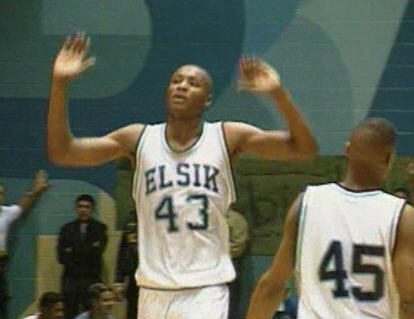

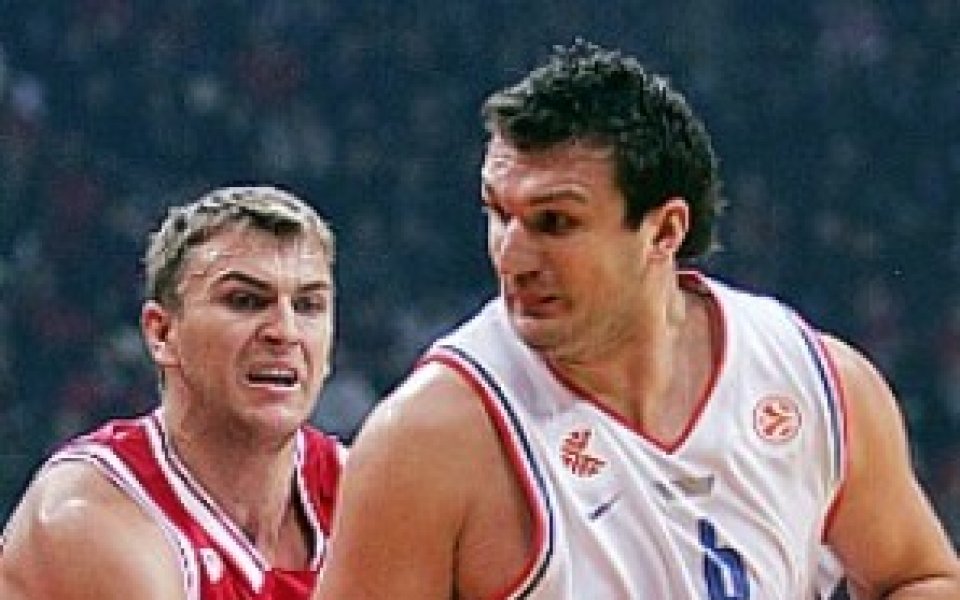


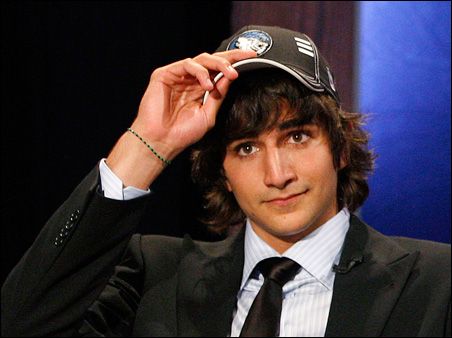

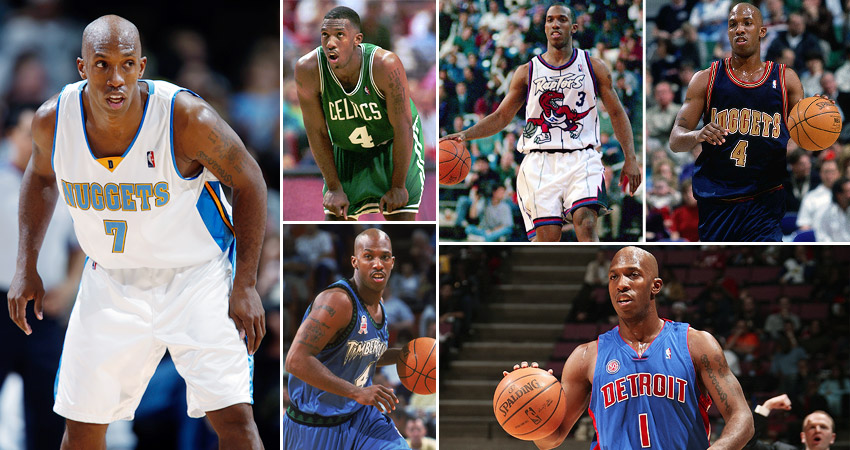


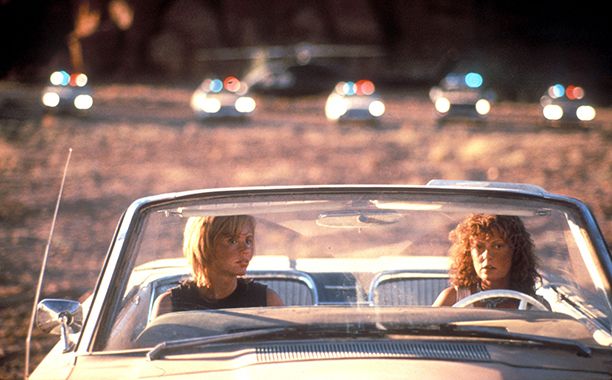
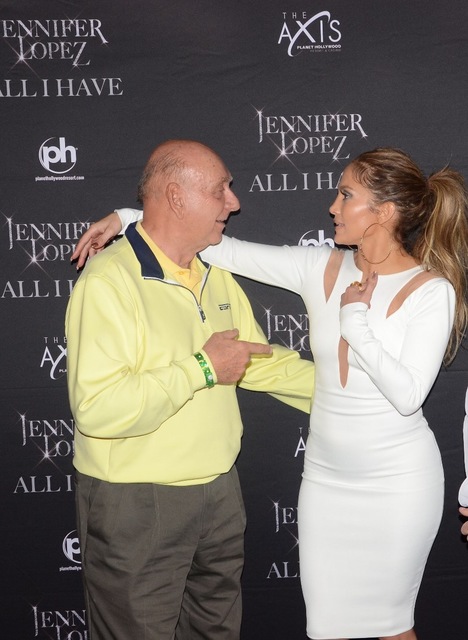
:format(jpeg)/cdn.vox-cdn.com/uploads/chorus_image/image/46812820/GettyImages-145833054.0.jpg)