Where Are They Now, 2009; Part 1
January 29th, 2008
It’s nearly the new year, so that makes it time to do something that’s nearly interesting. The “Where Are They Now?” series of posts – which last year landed me at least two job offers – are hereby making a spectacular return right here, in exactly the place that I said they wouldn’t be. Good times.
As ever, these posts will feature players on this website’s horizon, but not in the NBA. Bring the noise.
– In an anti-climactic opening entry, former Mavericks et cetera swingman Tariq Abdul-Wahad is doing exactly the same thing that he was last time we checked in on him – nothing that can be traced. Wikipedia suggests that he isn’t dead, though, so that’s got to be a positive. No news is good news, after all.
– Shareef Abdur-Rahim is now a Sacramento Kings assistant coach. His wife has also done something about the flu, while simultaneously rocking the greatest name this side of Cornelius McFadgon.
– San Diego State legend Mohammed Abukar’s career has taken a turn for the better, as he was unsigned until about 24 hours ago, when he was picked up by the Austin Toros of the D-League. Quietly, the San Antonio Spurs have managed to stash basically every one of their training camp signings on their D-League affiliate (which they own), as well as their former draft pick Marcus E. Williams. Owning your own affiliate seems to have some merit when the allocation players are handed out.
– Kenny Adeleke was playing with Bulgarian powerhouse Lukoil Akademik up until last week, when Lukoil decided to release he, Nenad Canak and Kevin Kruger, their three best players. This is because they got knocked out of the EuroCup (which is what the ULEB Cup is called now; it’s the second tier of European basketball after the EuroLeague) and wanted to save money. This is particularly unfair for Adeleke, who led the competition in rebounding, averaging 13 a game. From this, we can conclude that Kenny Adeleke is a good rebounder.
– Blake Ahearn is back in the D-League with the Dakota Wizards, and not signed by an NBA team. Ahearn is averaging 24.5 points and 7.5 assists in four games with the Wizards, including a game-winner, although we won’t talk about his turnover numbers.
– Deji Akindele is playing for Scavolini Pesaro in Italy. He is averaging 11.1 points, 7.1 rebounds and 2.2 blocks per game. I still don’t know if his name is actually Ayodeji or Jeleel, but on that subject, here’s an interesting piece of trivia – Cinderella’s real name was Ella. You can see what they did there.
– Akin Akingbala was signed a couple of weeks ago by Nancy of the French league, as a replacement for the little-used Rod Benson, of whom they had clearly had too much. Akin Akingbala also remains the most perfectly named basketball player in the world, apart from the largely unheralded Tommy Brilliantdunker.
– Cenk Akyol’s rights are still owned by the Atlanta Hawks, but they probably don’t want them much any more. Akyol can’t get off of the bench of Turkish team Efes Pilsen behind the starting guard pairing of Milos Vujanic and Charles “Spider” Smith. Akyol averages 4.3 points and 1.5 assists in the few minutes that he does get, perhaps still baffled by the positional identity crises that affects all 6’5 European point guards. (See also: Renaldas Seibutis, who we’ll come to in like five years.)
– Finally, the whereabouts of some players whose names are easier to spell (albeit just as good for your Scrabble score). Guards Cory and Courtney Alexander are both still out of basketball and haven’t played since their last NBA stints. For Cory Alexander, this was with the Charlotte Bobcats back in their inaugural season of 2005, and for Courtney Alexander, this was his short stint in the Denver Nuggets training camp back in 2006. I am perfectly willing to believe that both have abandoned the dream of professional basketball by now, although this is only a supposition.
Speaking of giving up, this post ends here.
With apologies to Dwight Howard
January 6th, 2008
In my season preview of the Orlando Magic, written back in October and located here, I wrote something that looks a bit stupid in hindsight. At this point, I’d quite like to try and weasel my way out most of it.
The following are some quotes that I stand by:
It would be very difficult if not impossible to provide a commentary on the Rashard Lewis sign-and-trade while also managing to take an interesting or unique viewpoint, or to say anything that hasn’t already been said. So I won’t. But I will recommend that you look at the figure that he signed for (listed above), and think long and hard about whether he is worth it. And if you come up with any answer other than “no”, keep looking at it until you do. In 2013, a 33 year old Rashard Lewis is going to be being paid nearly $22.7 million.
So now, ask yourselves whether the trio of Hill, Milicic and Diener (who should, without a doubt, have played over Carlos Arroyo all of last season, and who is now nicely lined up for a breakout season) is going to help any more than Rashard Lewis on his own. It’s a tough answer, but either way, the Magic’s player personnel did not improve much. If at all.
Last season’s mediocre performance suggests that the good run to end the 2005/06 season was nothing more than an aberration. With better coaching and better performance this season, the Magic have the opportunity to show that it was last season that was the anomaly instead. If Orlando gets breakout performances from one or perhaps a couple of young players (specifically looking in the directions of Jameer Nelson and J.J. Redick), they could contend for the open Southeast Division title.
If you only read those three passages, then I wrote a damn fine piece. However, I ended it like this:
Perhaps a more realistic expectation, though, would be for a low playoff seed once again.
Well, that’s proven to be wrong so far.
Currently, the Magic reside atop the Southeast Division, with a record of 22-13. Their nearest rivals in the division are the Washington Wizards at 16-15, who apparently just lost Gilbert Arenas for the rest of the season. And in third place are the Atlanta Hawks, who are trying to justify my playoff call with a 15-16 record and a damn tough schedule thus far.
The Magic are the third seed in the East thus far, which is no mean feat given how the top two teams (Boston and Detroit) are by far and away superior to the rest of the conference. Now obviously they’re inevitably going to lose this third to the mighty and surging Chicago Bulls (you heard it here first), but even so, they should still come fourth in the East. And that’s not a “low playoff seed”.
So somewhere along the line, barring dramatic implosion, I’ve made a boo-boo.
I stand by my views on the Rashard Lewis deal, as he hasn’t been even nearly worth it thus far. I also can’t be expected to have predicted the Keith Bogans Jumpshot Spectacular that’s bizarrely given unto us by the Lord this season, although I won’t be entirely surprised if he regresses to somewhere near his career norm any day now. The point guard play still isn’t great, although I did overlook the fact that Carlos Arroyo’s contract is expiring, which always leads to him giving forth more focused production. And I strongly admire the team’s efforts to sabotage their team’s good play with a poor trade, needlessly shipping Trevor Ariza to the Lakers for Maurice Evans and Brian Cook, two players who offer nothing that Orlando couldn’t have gotten from within.
But mainly, the prediction is my own fault, and it’s rather to simple to see why. I did not adequately account for the fact that Dwight Howard is, quite simply, really good. Whoops. Sorry, Dwight.
NBA Fans Do Not Suffice
December 17th, 2007
On Saturday afternoon, I went to a non-league football match. Football is a sport that we have in this country, which involves people kicking a ball with their foot (hence the name). It’s a tremendous sport of flair, innovation and foul language, which unites the whole entire world in its single-minded appreciation of how wonderful the beautiful game is.
(There is an American variant out there called “soccer”, but it is marred by terrible broadcasting, stupid gimmicks, and a bad standard of play. It is not recommended.)
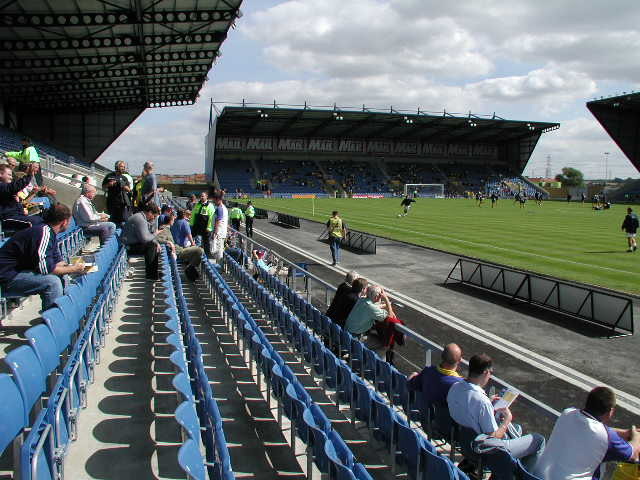
The game was between Tonbridge Angels and Oxford United, an F.A. Trophy first round match. Oxford United were at home, which meant for us Angels fans a day trip out to a 12,000 seater stadium. For those unaware, Oxford United were good, back in the day. Then they went bankrupt. A man named Kassam saved them, bailed out the finances, and built them a new stadium. But it hasn’t done the team much good, and they have since fallen out of the Football League (and also fallen out with Kassam, although they are stuck with the stadium named after him). They’re also now flat broke again.
Despite the team not befitting the stadium that houses them, the importance of the event and size of the stadium made it a highly entertaining day out for us visitors. The official attendance for the game was 1547, and if you don’t know what having 1547 people in a stadium that seats 12,000 looks like, then either watch the Florida Marlins at home, or look at the picture below:

Of the 1547 people to attend, about 220 were Tonbridge Angels fans who had travelled a hell of a long way to support their team. These 220 people gave great voice, and showed the world (or at least, the rest of the world that was there) quite what being a sports fan is about.
Chants were everywhere. The songs were not particularly intelligent, and a lot of them were not politically correct. But dammit, was it fun. Songs included “Tommy Warrilow’s Blue And Red Army”, “Your Support Is Fucking Shit”, “Did you sleep in until half time?”, “CRAAAAAAAACK!!!” (toward the Oxford goalkeeper Billy Turley, who once failed a drugs test), “Who needs Mourinho, we’ve got Tom Warri-low”, “Someone nicked your other stand” (in reference to the way that Oxford’s stadium has, bizarrely, only three sides), and the mighty “who are we? TONBRIDGE!” chant that aired regularly.
That selection is merely tip-of-the-iceberg type stuff. Songs were being invented on the fly, with about 50 invented in all. The Oxford supporters in the other two stands eventually chimed in, and a call-and-response got going, with the Tonbridge faithful ridiculing the dismal turnout of the Oxford fans which such seminal smashes as “We Forgot You Were Here” and the aforementioned slightly rude one about their support, while Oxford fans responded in kind with jibes at Tonbridge’s amateur status.
It was all good-natured fun, brought to you by people who actually care about the teams on show. They care so much that they willingly travelled for hours to get to the place, just to stand around outside in the frankly arctic weather, in a largely desolate stadium in the city’s ugly industrial suburbs, drinking Bovril out of a paper cup, and shouting for sustenance. The health and safety man may keep ordering you to sit down, but you don’t, because you’re enthused and genuinely interested in the action. He eventually relents. The old man alongside you with mild Tourette’s screams enthusiastically at any mildly interesting piece of action (usually random shouts of “Hey! Ho!”), and the ambitiously dressed middle-aged woman to his right hisses the word “shit!” in a really sinister way every time your team loses possession. At stoppages in play, you chant out your players names, daring them to signal acknowledgement of your chant. And when they do, you woop with joy. You cheer, wail, antagonise, ridicule, toot air horns, throw your apparel with pride, and just generally make your own entertainment, while always fixated on the action.
You don’t get any of that in the NBA.
Instead, you get arena music. *BOOM BOOM* “Defense!!!!!”, and the like.
You get signs telling you when to make noise, and ‘entertainment’ ushered onto and off the court with military precision every time play stops for more than 10 seconds.
You get an experience, but you don’t get to enjoy yourself. You do what you’re told, and you’re told to do everything.
There’s a reason that Golden State Warriors fans managed to put on such a spectacular showing during their first round playoff matchup against Dallas last year – it’s because they cared. And they didn’t care who knew it.
The NBA isn’t faaaaaaan-tastic until people start being fans. This means passion. And passion doesn’t generally involve sitting down, clapping appropriately.
Forget the family experience that the NBA looks for when selling tickets. Let’s start stocking these arenas with people who will actually want to be there, and who will follow the action without prompting. Instead of banks of seats filled with people sitting down eating, let’s have people up and cheering, singing, bringing atmosphere into a place that’s supposed to ooze it from every turnstile. Let’s not have 46 minutes of gentle appreciation and two minutes of giving a toss.
If you don’t think this is possible in a game of basketball, watch the EuroLeague some time.
30 teams in 56 or so days: Minnesota Timberwolves
November 9th, 2007
Players acquired via free agency or trade:
 Greg Buckner (acquired from Dallas)
Michael Doleac (acquired from Miami)
Antoine Walker (acquired from Miami)
Theo Ratliff (acquired from Boston)
Ryan Gomes (acquired from Boston)
Al Jefferson (acquired from Boston)
Sebastian Telfair (acquired from Boston)
Gerald Green (acquired from Boston)
Players acquired via draft:
First round: Corey Brewer (7th overall)
Second round: Chris Richard (41st overall)
Players retained:
None
Players departed:
Mark Blount (traded to Miami)
Ricky Davis (traded to Miami)
Kevin Garnett (traded to Boston)
Trenton Hassell (traded to Dallas)
Troy Hudson (bought out)
Mike James (traded to Houston)
Justin Reed (traded to Houston)
Bracey Wright (left unrestricted, signed in Greece)
Bobbins:
You probably want me, or expect me, to burn Kevin McHale in this space, as I have done in the past. But it’s not going to happen. I actually think he’s done a nice job this offseason, all things considering.
The reason I say “all things considering”, is that McHale has done a rather nice job of restructuring a team that, apart from New York, was about the hardest possible team to reconstruct. With multiple long and bad contracts, and also with first-round draft picks still owed to Boston and the Los Angeles Clippers, the Timberwolves were roundly screwed. With only a couple of young players worth a damn and with only superstar Kevin Garnett providing any value worth a damn, McHale had only one option – to trade Kevin Garnett and start again.
He could have gone the other way, signed a veteran, and made another playoff push, hoping that the impossible would occur and that the Timberwolves would suddenly have enough firepower to rival the West’s best teams. That would have been a stupid thing to do, though, It was also a stupid thing to do last year with the Mike James signing, and it was a pretty stupid thing to do the year before with the Mark Blount trade. So thankfully, they didn’t go this route again. If the Timberwolves had done so, euthanasia may have been justified.
Everyone seems to believe, though, that the Timberwolves did not get nearly enough in return for Garnett. KG’s value isn’t what it would have been had this move been made two years ago, but it was still very high. Critics, professional or otherwise, seem to believe that Minnesota did not get nearly enough in return for Garnett. They received Al Jefferson (one of the best young post players in the game, and incidentally, the upcoming winner of this season’s rebounding title), Gerald Green (wildly overhyped prospect whose option they did not then exercise, bringing the hype back down to Earth), Ryan Gomes (useful role player), Theo Ratliff (massive expiring contract), Sebastian Telfair (far smaller expiring contract with a very outside chance of being a Marcus Banks-type reclamation project), and two first-round picks, one of which was being returned to Minnesota after Boston got it in the Mark Blount/Wally Szczerbiak deal thing.
Let’s put that into context. In other recent superstar trades, here’s what transpired:
1) Miami trades Lamar Odom, Brian Grant, Caron Butler, first-round pick (used on Jordan Farmar) and a second-round pick (moved onto Dallas, turned into the insatiable Renaldas Seibutis) to the L.A. Lakers for Shaquille O’Neal (which would have been a decent return had the Lakers not then gifted Butler to the Wizards for Kwame Brown, a player who they didn’t need then nor now).
2) Houston trades Steve Francis, Cuttino Mobley and Kelvin Cato to Orlando for Tracy McGrady, Tyronn Lue, Reece Gaines and Juwan Howard (basically horrific for Orlando).
3) New Jersey trades Aaron Williams, Eric Williams, Alonzo Mourning and two first-round picks (one used on Joey Graham, the other dealt to New York and used on Renaldo Balkman) to Toronto for Vince Carter (unmitigated disaster regardless of circumstance).
4) Denver trades Joe Smith, Andre Miller and two first-round picks (one traded to Miami and used on Daequan Cook with Jason Smith going the other way, the other dealt to Portland and used on Petteri Koponen) to Philadelphia for Allen Iverson and Ivan McFarlin (um, OK).
Now you tell me what historical precedent tells us about superstar’s returning value in trades. It ranges from mediocre to awful.
And now tell me again why the package Minnesota got of a premium young player, big financial savings, two first-round picks and a couple of potentially useful peripheral parts is such a bad thing.
In addition to the big trade, Minnesota made several smaller ones. In trading Trenton Hassell for Greg Buckner, they traded a player who was reportedly a right moanarse in the locker room, who had a big contract and who wasn’t that good anyway, for a lesser player who doesn’t moan and who has a lot less guaranteed money coming his way for fewer years. Trading Mike James for Juwan Howard again got them a player with less guaranteed money over fewer years, and buying out Troy Hudson’s third partially guaranteed year again turned a three-year contract into a two-year one while losing no player of any significance (it’s been a theme). And in the Mark Blount and Ricky Davis to Miami trade, Minnesota managed to again trade a big contract with three years remaining (Blount) for one with only two left (Walker), while also getting a first-round draft pick in the deal.
It’s only a shame that they couldn’t swap Mark Madsen for Adrian Griffin or somebody. They could have then completed the set.
Next season:
If you’re going to flounder and die, you might as well do so with some purpose to it. Nothing about the Timberwolves’ recent history offered up much in the way of hope. Since the Wolves began disbanding the 2003-2004 team (arguably the league’s best team that year) with such heroic ineptitude – using such tactical masterstrokes as trading Sam Cassell and a first-round pick for Marko Jaric, and the previously mentioned Wally Szczerbiak trade – Minnesota has witnessed one subsequent year of frustrating mediocrity, and two years of something worse than that. In those two years, complete tank jobs have had to be pulled just so that the franchise was able to keep the pick it had originally given up to the Clippers for Jaric in the first place, and they won 65 games combined over the last two years for this reason.
It wasn’t going anywhere, and with two first-rounders owing and only two young players (Chris Smith and Randy Foye) worth a damn, they weren’t getting out of the 35ish-win range any time soon.
So they finally blew it up. And I’m glad. You should be, too.
It’s just gone so wrong for so long basketball wise, that it’s just refreshing to see things go rather well for a change. The dream of Garnett playing his whole career in Minnesota was still held by some, which has led to fall out, but it should have been shot up a long time before now. If it had, maybe those last two years need not have happened. In one offseason, Minnesota transformed itself from a team in transition going from bad to worse, into a team that may one day go places, starting with backwards.
Of course, they might not. But if they can stave off their compulsion to destroy everything (by the way, Two For The Money starring Al Pacino and Matthew McConaughey isn’t THAT bad of a film if you stop it at the hour mark), Minnesota might start headed places again some day soon.
There’s a good chance that this new look line-up tops out in a few years at the 40-win barrier that the franchise just traded Garnett to get away from. Still, they can but try.
30 teams in 56 or so days: Miami Heat
October 27th, 2007
Players acquired via free agency or trade:
Mark Blount (acquired from Minnesota)
Ricky Davis (acquired from Minnesota)
Smush Parker (signed, two years, $4,680,000)
Joel Anthony, Brian Chase, Devin Green, Penny Hardaway, Alexander Johnson, Jeremy Richardson and Marcus Slaughter (all signed to the minimum salary with assorted levels of partial guarantees. If you include holdovers Earl Barron and Chris Quinn, you have eight players on the bubble, four of whom are going to have to be cut.)
Players acquired via draft:
First round: Daequan Cook (21st overall, acquired in draft night deal)
Second round: None
Players retained:
Earl Barron (re-signed, unguaranteed qualifying offer)
Players departed:
Michael Doleac (traded to Minnesota)
Wayne Simien (traded to Minnesota)
Antoine Walker (traded to Minnesota)
Eddie Jones (signed with Miami)
Jason Kapono (signed with Toronto)
Gary Payton (put to sleep)
James Posey (signed with Boston)
Bobbins:
It seems fitting to “do” Miami next, given that they are a team recently in the news. If you are like me, and you’re the kind of person that tends to get so excited when a transaction is made that a little bit of wee seeps out, then you probably secreted when you learnt of the recent Miami/Minnesota trade. That move saw Miami trades Antoine Walker, Wayne Simien, Michael Doleac, a first-round pick and cash to Minnesota for Ricky Davis and Mark Blount, which potentially salvaged the offseason for Miami.
Despite previous protestations about how the team would never be a taxpayer, last year’s capitulation at the hands of the incomparably superior Chicago Bulls awakened Riley, Pfund and the like to the fact that their team just isn’t that good any more. The Heat had committed themselves financially to a core that had a championship window of exactly one year. They capitalised on that, winning the title in that one year of 2006, but they did so at a cost. The fallout from that left them with one young superstar and a heap of overpaid elderly codswallop. Codswallop, by the way, is a much underused word, especially in the NBA world. It means “nonsense”, “rubbish”, “crap”, and stuff to that effect. I have two big aims for the world of basketball this year – firstly, to get a complete scrub to the All-Star game by mass manipulation of the online ballot (who this will be has not been decided upon yet, it depends on who is on the ballot), and also to get the word ‘codswallop’ started on its long journey towards every day usage in the NBA world. Today, this day, this place, this paragraph, marks the start of that journey. Pay heed.
This elderly supporting cast was enough to get it done in 2006, but last year the Heat showed their age. Starting point guard Jason Williams may only be 31, but he was exposed as a weakness last year – while the heart and head were willing, the knees were not. His backup, Gary Payton, was perhaps the worst rotation player in basketball last year. His main rival for that title was teammate Antoine Walker, while veteran centres Alonzo Mourning and Michael Doleac did not do much to offset the loss of Shaquille O’Neal, who had the worst season of his professional career as 35-year-olds tend to do.
Needing to spend, and with permission granted from whoever it is that pays the bills, Miami then tried to get a bit of everybody. With starter Jason Kapono snapped up by Toronto within about 18 seconds of the free agency period starting, Miami let him leave unchallenged, rightly unwilling to pay that price tag. However, despite continuing to negotiate with James Posey, the Heat weren’t able to convince him to stay either, as he signed with Boston. And with Eddie Jones having already signed with Dallas, Miami was left in the rather awkward position of not having any wing players that could make an outside shot, and also with the frankly scary possibility of having Antoine Walker start at small forward next year.
In addition to looking for a wing player or two that didn’t suck, Miami was also seeking to upgrade their weak point guard position, and add a veteran big for insurance. These three separate chases led them to pursue all manner of free agents and trade possibilities, from such diverse names as Maurice Williams, Charlie Bell, Mickael Pietrus, Allan Houston, P.J. Brown, Sasha Pavlovic, Ime Udoka, Mike Bibby, Juan Carlos Navarro, Ron Artest, Jannero Pargo, Rafer Alston, Corey Maggette, Steve Francis, Matt Barnes, Morris Peterson, Steve Blake, Gerald Wallace, Sarunas Jasikevicius, James Singleton and Vitaly Potapenko – basically, everybody. Only one of those moves went anywhere, when Miami signed Bell to an offer sheet, that Milwaukee swiftly matched.
The anti-climactic feeling of it all hit home when Miami announced their first two prominent free agency signings as being Smush Parker and Penny Hardaway. The signings also summed up the bipolar nature of Pat Riley’s offseason pursuits: after harping on for ages and ages about wanting a young and athletic line-up (the signings of players such as Parker, Marcus Slaughter, Alexander Johnson and Jeremy Richardson help here), Riley also can’t seem to resist trying to sign every old guy that used to be any good (Jones, Hardaway, Houston), which seemed directly contradictory to the young athletes thing.
After the Bell move went wrong, nothing much happened. The Heat continued to pursue all kinds of trades and free agency possibilities, to no avail. They rounded out their roster with more young athletes, and went to camp still working the phones but accepting the fact that nothing may come of it. And when Shaq’s inevitable injury turned up and Dwyane Wade added in one of his own, the Heat were staring down a lottery spot.
Then just this past week, it got interesting, as Miami was finally able to do something. And the trade they made was a good one. They landed two of their probable top nine players in Davis and Blount while only giving up spare parts to do so. Losing Antoine Walker is a case of addition by subtraction, Davis gives them a useful scorer and athlete at the wing position which Miami had sought all offseason, and Blount gives them a centre whose limited face-up game is still useful when playing alongside Dwyane Wade, even if he does have a massive inability to catch.
All it really cost Miami was an extra year of Blount’s big salary over Antoine’s, and a first-round pick that won’t be high in an ideal world anyway. It’s a trade that has put Miami back into the playoff picture, although they still aren’t even nearly as good as their fans would like you to believe.
But who’s to say that they’ve finished yet?
Next season:
In my Bobcats post, I talked about how I had decided upon my eight Eastern seeds for the playoffs. Miami wasn’t one of them at the time. Now, they are.
It’s still a flawed team, with the worst point guard rotation around, and with the overrated Udonis Haslem still starting at power forward. The team is still dependent on how much Shaq is willing to give, and Miami is also still largely a two-man team dependent on Shaq’s health (and his continued descent towards mediocrity).
But that can be enough. The Cleveland Cavaliers, after all, are the epitome of a one-man team, and they made the NBA Finals. They used a hell of a lot of luck to get there, as their playoff matchups opened up wonderfully for them. But you can only beat who is in front of you, and that’s what Cleveland did.
Miami is far from the best team in the East these days, let alone in the NBA overall. Their supporting cast to the two stars is rather poor, and the Shaq/Wade duo are not exactly the best examples of durability. But if various circumstances all come good at the same time, Miami has themselves a team that can make inroads in the East. If they can scrape into the playoffs and maintain good health all around at the most crucial time, then they won’t be an easy matchup for whoever they play. Everyone said much the same last year, but they forgot two key things:
a) The Heat were never healthy.
b) Nor were they even nearly good enough.
This offseason, they’ve improved. They’ve cut out most of the crap, and added some talent. It’s a better team than it was.
But it’s not a title team. Not even close.
30 teams in as many days as it takes: Dallas Mavericks
October 24th, 2007
Players acquired via free agency or trade:
Brandon Bass (two year minimum)
Trenton Hassell (acquired from Minnesota)
Eddie Jones (two year, full BAE)
Players acquired via draft:
First round: None
Second round: Nick Fazekas (34th overall), Reyshawn Terry (44th overall, unsigned), Reinaldas Seibutis (50th overall, unsigned)
Players retained:
Jerry Stackhouse (re-signed, three years, $22,376,250, I think)
Devean George (opted out, re-signed, one year, $2,369,111)
Devin Harris (signed a five year extension)
DeSagana Diop (exercised team option)
Players departed:
Greg Buckner (traded to Minnesota)
Austin Croshere (signed with Golden State)
Kevin Willis (unsigned)
Pops Mensah-Bonsu (waived, signed in Italy)
Bobbins:
The Mavericks have one of the worst young cores in the NBA. With only Devin Harris, Juan Jose Barea and Maurice Ager as the only returning players under the age of 26, and with only one of those players able to crack any NBA team’s rotation, Dallas enjoys (if that’s the word) almost nothing in the way of prospects. There’s Josh Howard of course, but he’s 27 now, and while DeSagana Diop is still only 25, you’re an optimist if you think there’s some skills in there that he’s merely kept hidden for six years.
(Incidentally, did you know that Mavericks training camp signee Jamal Sampson is only 24 years old, despite being around for what feels like a million years, and that commonly-accepted youngster Diduer Ilunga Mbenga is about to turn 27? Me neither. These things are worth noting. That is, they are worth nothing if you’re pathetic like me. If you are, hooray! We should hang out.)
Dallas tried to add to this somewhat this summer. Without a first-round draft pick, they picked Nick Fazekas high in the second, thus once again ensuring that they have a tall forward who takes 85% outside jump shots and who doesn’t move well on defence. It’s a recent trend that began with Keith Van Horn and that was last year handled marvellously by Austin Croshere, who now passes the mantle onto Fazekas.
Fazekas figures not to play much, though, after the unheralded signing of Brandon Bass seems to have given the Mavericks a backup power forward worth a damn. After two years of nothingness with the Hornets, Bass was allowed to leave unchallenged when Dallas picked him up. Since then, despite it only being preseason, Bass has shown signs of being a capable player, and being only 22 he can join (or rather, “be”) Dallas’ young core.
But then, who cares about a young core when you’ve just won 67 games the season before?
To add young talent is nice, but all Dallas really needed to do was to keep the core that they had, maybe add one or two pieces, and try all over again. They did this, adding some perimeter defence in Eddie Jones and Trenton Hassell, while bringing back Devean George and Jerry Stackhouse for some more depth. The Mavericks can boast now one of the NBA’s deeper teams, and they still rock the core that resulted in the fifth-best record in NBA history last year (it was something like that, at least. I forgot what it was exactly).
They didn’t blow it up, and under no circumstances should they have done. Watch as they now decimate the roster in a trade for Kobe.
Next year:
Much has been made of the Mavericks’ historic capitulation to the Warriors in round one of the playoffs last year, which set all kinds of trends that I can’t remember. But what a lot of people tend to overlook was the sheer bad luck of it all. If any other team claims that eighth seed, Dallas polishes them off with no problem at all. Yet Golden State offered up by far and away the biggest matchup problem of them all, and it’s them who Dallas drew.
The Mavericks did not help themselves by somewhat wilting under pressure, and Avery Johnson by his own admission did not make the correct adjustments.
None of this, however, means that the right way for the Mavericks to go is to start thinking “yes, what we need right now is the sub-30% clutch shooting of Kobe Bryant”, or “we can never with win Dirk, let’s trade him”. They can win with Dirk. They just didn’t.
The Mavericks have a formula, and it’s one that works. It worked last year to the tune of 67 wins, and while regular seasons don’t account for anything in the playoffs (as Golden State showed), it does serve to prove that this Mavericks team can beat all comers. All, that is, but one.
To solve Golden State (and believe me when I tell you that I realise how stupid it is to imply that a team’s season rests on one match-up versus one solitary mediocre opponent), Dallas doesn’t need to revamp their roster, but make some adjustments and not get rattled. They didn’t, and so they lost. But were that situation to happen again, that’s all it takes to avoid that drama again.
Dallas is arguably the best team in the league. The Spurs have the title and claim that crown, but Dallas is up there. They should once again finish with the best regular season record and win the Western Conference.
This year, they just need a better stroke of luck, and a dose of fortitude. If that happens, they may win the title. They’re one of very few teams that are good enough.
30 teams in 524 or so days: Charlotte Bobcats
October 20th, 2007
Players acquired via free agency or trade:
Jason Richardson (acquired from Golden State)
Players acquired via draft:
First round: Jared Dudley (22nd overall)
Second round: Jermareo Davidson (36th overall)
Players retained:
Derek Anderson (re-signed, one year minimum)
Jeff McInnis (re-signed, one year minimum)
Matt Carroll (re-signed, six years, $26,900,000)
Gerald Wallace (re-signed, six years, $57,000,000)
Ryan Hollins (exercised team option)
Walter Herrmann (exercised team option)
Primoz Brezec (opted in)
Players departed:
Alan Anderson (signed in Italy)
Jake Voskuhl (opted out, signed with Milwaukee)
Brevin Knight (waived, signed with L.A. Clippers)
Bobbins:
In a recent debate with someone about who the eight playoff teams in the East are going to be this season, debate raged as to who would be the eighth team. We discussed the possibility of the eighth seed being Orlando, Washington, Milwaukee, and even Atlanta, before finally settling on one which I won’t mention (because it will spoil a later post).
Neither of us debated the possibility of Charlotte being the eighth seed. This is because we had both already pencilled them as the seventh, with absolutely no contention from each other.
There’s two possible conclusions that you can draw here. The first would be that the two of us basically don’t know what the hell we are talking about, which is a good point well made that I am unable to counter. The second would be to assume that, yes, Charlotte is a playoff-calibre team. And that point, I can defend.
The franchise got off to a slow start after expansion, as you would expect, but slowly the Bobcats picked up pieces along the way. Starting around Emeka Okafor and building outwards, nothing much has gone right for the Bobcats before this summer. Mired deep in the lottery, and bound by the salary cap limitations that the NBA seems to strangely enjoy putting onto new franchises, the Bobcats achieved little on-the-court success, struggling through the growing pains that expansion teams are somewhat mandated to go through. All the losing didn’t really pay off either, given the unsuccessful selection of Adam Morrison at #3 in last year’s draft.
Along the way, though, the Bobcats have slowly been assembling pieces. Despite only Gerald Wallace and Primoz Brezec remaining on the roster from their initial expansion draft (someone’s going to have to explain to me one day quite what the point was of selecting so many free agents that they then didn’t sign), Charlotte have picked some players up along the way for cheap, players that have helped their on-court product. Brevin Knight (recently waived, but we’ll come to that) added veteranness and that, and also played fairly well. Pick-ups on the cheap such as Matt Carroll and Walter Herrmann have paid dividends, and the Bobcats have added good young players through the draft such as Okafor and Raymond Felton (notice that I didn’t list Morrison).
This summer, they added the scoring punch that they sorely lacked, in obtaining Jason Richardson from Golden State for next to nothing. The move has its downsides – with contract extensions for Felton and Okafor coming up in the not-too-distant future, and with Gerald Wallace and Matt Carroll re-signing this summer to six-year contracts, adding the big salary of Richardson takes away the financial flexibility that Charlotte previously enjoyed. It commits them to this current core for at least the short term, whether it is good enough or not. And it also means that the awesome Carroll gets less court time, which is disappointing for all concerned. But it plugs the slightly important 20-point-a-game scorer that Charlotte has always lacked.
In addition to this, the Bobcats spend well in retaining most of their players from last year, and obtained two possible rotation players in Jared Dudley and Jermareo Davidson via the draft. I don’t really know any more about them than that, so I’ll leave that there.
Next year:
As I said above, Charlotte seemed like a strange choice for automatic inclusion into my predicted playoff seedings. They haven’t, to coin a phrase, done it yet. But despite being only a 33-win team a year ago, they have three big factors working for them:
a) They had a big infusion of talent this offseason, more so than most teams.
b) They have continued internal growth from their young core players.
c) They’re relatively healthy. Well, except Sean May.
To elaborate on point C, the Bobcats do have an injury-prone roster. Star big man Emeka Okafor has played in only 166 of the 246 games of his career, which is a poor ratio, and star forward Gerald Wallace set a career-high in games played last year with a rather uninspiring 72.
Everyone is healthy at the moment, apart from Sean May, who is to miss the season with more surgery on his cartilage-free knees, and who I’m willing to bet never plays more than 40 NBA games for the rest of his life. Despite the fact that injuries to the Bobcats are about as inevitable as a Jonny Gomes swing and a miss on a down and away curveball, they have the sort of depth right now that they have never had before, which will help them to overcome it. Last year’s starter Matt Carroll is now a key bench player, joining a deep wing rotation including Wallace, Richardson, Dudley, Morrison, and last’s year breakout player Walter Herrmann. Herrmann shined late last season filling in as an emergency power forward as the injuries piled up yet again, but he’s now faced with lengthy stays on the bench as Charlotte stocked up the wing positions this summer. It also appears that head coach Sam Vincent thinks it’s best to start Emeka Okafor at power forward alongside Richardson, Walace and either Primoz Brezec or Ryan Hollins at center, and we can only hope that it won’t take long for him to realise that it would be best to play Okafor at center with Wallace and Herrmann as the forwards. Walter needs his court time, dammit, if us neutrals are to have any interest in watching Charlotte this year.
The Bobcats are weak at the centre position though, in spite of their improved depth, and Jeff McInnis is the full-time back-up point guard. But it’s not really that important: the back-up point guard spot has never been important enough to be able to sabotage an entire season. After all, the San Antonio Spurs just won a title without a backup point guard worth a damn. By the way, someone (namely me) ought to point out the irony of waiving Brevin Knight for reported chemistry issues and locker room divisiveness, then re-signing Mr Chemistry 2007 McInnis to take his place. A strange one, that.
Nonetheless, the Bobcats plugged other gaps. To make the playoffs, the Bobcats only realistically need about eight more wins. Is adding a 20-point scorer for no real cost good enough to do that, especially when you factor in all the other stuff outlined above? Probably.
30 teams in 88 or so days: New Orleans Hornets
October 16th, 2007
Players acquired via free agency or trade:
Morris Peterson (four years, $22.4 million)
Melvin Ely (two year minimum)
David Wesley (acquired from Cleveland, to be waived)
Ryan Bowen (one year minimum)
Trey Johnson (two year minimum)
Players acquired via draft:
First round: Julian Wright (13th overall)
Second round: Adam Haluska (43rd overall)
Players retained:
Jannero Pargo (re-signed, two years, $3,806,400)
Players departed:
Brandon Bass (signed with Dallas)
Devin Brown (signed with Cleveland)
Marc Jackson (signed in Greece)
Linton Johnson (signed in Spain)
Desmond Mason (signed with Milwaukee)
Cedric Simmons (traded to Cleveland)
Bobbins:
It’s hard to see quite what New Orleans planned to do going into this offseason. If their intention was to surround Chris Paul with shooters, as it probably was and definitely should have been, then it’s a job well done. In retaining Jannero Pargo while bringing in Morris Peterson and Adam Haluska to replace Devin Brown and Desmond Mason, the Hornets’ outside shooting takes another step forward. And when combined with the returning Rasual Butler and Bobby Jackson, as well as the return from injury of Peja Stojakovic, the Hornets’ outside shooting will be a strength this upcoming season. The backcourt depth in general is pretty strong.
The frontcourt depth, however, is another matter.
New Orleans seems content to roll with only four recognised big men, two of whom are Hilton Armstrong and Melvin Ely. Ely’s pretty bad despite one season of decency (and a contract season at that, how coincidental), whereas Armstrong is coming off of an incredibly raw rookie year. This seems to me as though it should be more of a pressing concern to Hornets management, given that the two players they’re backing up (Tyson Chandler and David West) haven’t exactly been the poster boys for health at any point in their NBA careers.
Should injuries affect their frontcourt (and it will, because they’re the Hornets), New Orleans is left with the salivating prospect of having to play one of their six small forwards in a small ball line-up. This might not be too bad if Julian Wright proves himself able to defend most power forwards in this league, but if he can’t, Stojakovic may wind up having to do it. Which would be….carnage.
Why you would bring in Morris Peterson for such an amount of money when you already had Rasual Butler, all the while letting Devin Brown walk for $1.2 million and letting Linton Johnson fall out of the NBA, seems a bit dumbfounding. Peterson is better than all of those players, but it seems silly to spend your Mid-Level Exception on a medium upgrade from Peterson to Butler of what is basically the same player. Especially when you could clearly use a big man, just drafted a small forward, and also have the overpaid former All-Star Stojakovic for the role.
And why they then effectively sold their fifth big man who they had drafted not 18 months before (Cedric Simmons), trading him for an unguaranteed contract and nothing else, was flat out weird. Is it all finances already?
Nonetheless, despite my compulsory criticism, the Hornets did not lose a lot in these upgrades. Players such as Marc Jackson, Johnson and Brown made for some nice depth, but they weren’t rotation players in an ideal world anyway. And the Hornets rotation as it stands is quite good. It’s improved upon where it was, and this team would have been a playoff team last year with some better health.
But there’s still flaws here. The injuries are going to happen again, even if it’s to a lesser degree. You can’t assemble an injury-prone roster and then complain that injuries affect your season. You should know that in advance. The Hornets had it particularly rough last year with only Jannero Pargo playing more than 75 games, and he was supposed to be a third-stringer. But numerous injuries is a situation that is almost certainly going to happen again. That’s what happens when you spend big money on Bobby Jackson, Stojakovic and David West.
Also, there’s quite a bit of irony to be found in wanting to assemble a roster of shooters and then signing Ryan Bowen.
Next year:
So much – perhaps too much – of the season relies on the starting frontcourt trio of Stojakovic, West and Chandler. While Chris Paul is the star player around whom the team is rightly built, he needs plenty of help to do so. Assembling a team of shooters around Paul helps, and the starting frontcourt pairing of Chandler and West is young and somewhat dynamic. But those two are also the only plus rebounders on the team, and only Chandler and Armstrong provide much interior defence. To rely on such fragile players and minimal depth is open to question, and so that’s what I’m doing.
Having spent huge amounts of money on this trio last year, the Hornets didn’t get too great of a return. Chandler enjoyed a wonderful bounce-back season, but West and Stojakovic played only 65 games combined, leaving the Hornets short of offence for much of the season. That won’t cut it if the Hornets are to crack .500 and make the playoffs, something which they have the talent to do.
Chandler, especially, needs to have an epic (or at least comparable) season. His career to date has gone:
1st year – Poor
2nd year – Decent
3rd year – Poor (injury permitting)
4th year – Really good
5th year – Yeesh
6th year – Really good
Last year he emerged as a an elite rebounder, and rediscovered some of his lost offensive skill. His offensive skill always peaked at mediocre, based largely around the unattractive but effective flail towards the rim, and an extremely mediocre jump/free throw shot. After taking the 2005 offseason off, though, Chandler lost these skills, and his subsequent confidence in his abilities. They look to be on the way back, which bodes well for the Hornets, but he needs to end this cycle for the Hornets to succeed this year.
And they can do that. They’re not in the West’s elite, and they’re not all that young any more (West is now 27, and their wing players are all veterans). Nonetheless, it’s a playoff-calibre team, which isn’t finished, but one which has an identity and is fairly well-rounded.
They just need to stay somewhat healthy.
30 teams in 36 or so days: New York Knicks
September 29th, 2007
Players acquired via free agency or trade:
Zach Randolph (acquired from Portland)
Dan Dickau (acquired from Portland)
Fred Jones (acquired from Portland)
Players acquired via draft:
First round: Wilson Chandler (23rd overall)
Second round: Demetris Nichols (53rd overall, rights acquired from Portland, not yet signed)
Players retained:
Malik Rose (opted in)
Players departed:
Kelvin Cato (unsigned)
Channing Frye (traded to Portland)
Steve Francis (traded to Portland)
Bobbins:
If he has not done so already, Isiah Thomas needs to write an autobiography. Actually, he needs to write about three. One about his time as a player, one as a General Manager, and one for amusing miscellany. I can safely say without a shadow of a doubt that I would buy all three. Not even a moment’s hesitation needed. And I think the same applies to about half of you. Maybe give him his own TV channel, and just run endless documentaries on him. I’d watch them. There’s just too much stuff going on at all times where Isiah Thomas is concerned.
Win or lose (but normally lose), these Isiah-led Knicks have been an absolute fixture at the top of the NBA’s “did you hear this?” listings. From the moment he took over, ‘forfeiting’ the ‘future’ of the franchise by trading for Stephon Marbury (the notion that Milos Vujanic constituted most of the Knicks future is still funny), Isiah has continued to dumbfound, amaze and amuse in equal measures. Whether it be by making the type of trade for which they had to invent their own category (“A Trade Only Isiah Could Make”), or for one of many stories that come out about him (such as his role in instigating the brawl against Denver, or wanting to kill Bill Simmons, which is the Tarantino film they never made but should have done), Thomas and the Knicks in general always seem to rustle up something with which to entertain. You can’t help but disbelieve the roster moves that he makes, and you can’t help but believe the stories that you hear about him. He’s just that sort of person. Never say never with Isiah Thomas. (Or is that Mike Tyson? Hmmm. Anyway.)
This offseason, he went and did it again. Twice.
Apart from the occasional grumbling about potentially re-signing Allan Houston – a man Thomas tried to dump in any way possible when he first joined the Knicks, before Houston finally accepted a medical retirement, a decision he seemed to have reneged on – no news really comes out of Knicks land these days unless it’s about the Anucha Browne Sanders lawsuit. Everything that I know about the subject has come directly from Bill Simmons’s recap of the whole shebang, which answered many of my questions, and is there it is for you all to see.
Isiah’s other storyline came before the start of the trial (which seems so long ago now), when he made the biggest headlines on draft night, trading Channing Frye, Steve Francis and a future second-rounder to Portland for Zach Randolph, Dan Dickau, Fred Jones and the draft rights to Demetris Nichols. With an overflowing roster, it is entirely possible that only one of those last three makes the team this season, or none if Allan Houston is signed. So they’re not really factors here. Additionally, Francis was traded to Portland knowing that:
a) Portland would buy him out, and
b) Had New York been unable to deal him, they would have bought him out instead. Francis was merely salary filler.
The trade was essentially therefore just Frye for Randolph. When you put it that way, it sounds OK. But let’s look a little deeper.
The Knicks of last year were a talented, but ill-fitting group of players, with a lot of distinct weaknesses to address. A very good rebounding team in spite of having Eddy Curry at centre, the Knicks consistently had trouble defending the perimeter, ranking third-last in the league in three-point percentage against. They also turned it over way too much, ranking dead last in the league with 17.1 a game, whilst also ranking second-last in blocked shots per game with 3.1, a mark bettered (or worsened) only by Milwaukee.
Now to get rid of Francis goes some way to helping with these deficiencies, particularly those of the turnover rate and offensive stagnificationness that the Knicks would go through at times last year. The offence revolved around forcefeeding Curry, who responded with almost 20 points a game, but it wasn’t exactly the most inventive or successful strategy, and it was to cause problems whenever New York needed somewhere else to turn. Inefficient scoring from the perimeter players, plus the team-wide turnover woes, left New York as a one-dimensional offensive team. And that offence was rather easy to nullify with a bit of common sense and flopping, as Chicago demonstrated on more than one occasion last year. When combined with New York’s poor defence, it didn’t make for a very promising line-up, which was reflected in their final record – New York ended up 32-50, firmly entrenched in the lottery. And they didn’t get to keep their lottery pick, either.
Why, then, did they decide Zach Randolph would somehow solve these problems?
While far from an exact clone of Eddy Curry, Randolph and he do share similar weaknesses. Both are poor defensive players, with mediocre at best man-to-man defence and abysmal help defence. Both players also turn it over way too often, stagnate the offence due to their lack of passing skill and passing desire, and are also almost exclusively to be found in the paint or the post on offence (or that’s where Randolph should be, at least).
Also, New York has a relatively young core of players – is that really the kind of scenario in which you want to bring in Zach Randolph, Mr Locker Room Chemistry 2006? Portland certainly didn’t think so – they would rather pay Steve Francis $30 million to never ever turn up than they would have Randolph around their group of young players.
Then again, it’s only Channing Frye, so maybe it was worth a flyer. Maybe it’ll be so quirky that it works.
Next year:
One thing the Knicks on-court product of last season never lacked in was drama. If you were a Chicago fan rooting in your heart of hearts for the Knicks to lose, or just a Knick fan hoping in your heart of hearts that the Knicks would win, then you ran the full gambit of emotions throughout their season. Whether they won or lost, whether they were being blown out or were miles ahead, and whether they were playing a good team or a bad team, all Knicks games seemed to culminate with high drama finishes. Sometimes, they were on the winning end – see David Lee’s tip in versus Charlotte, Eddy Curry’s three-pointer vs Milwaukee, or Steve Francis’s three versus Washington. And sometimes, they were on the losing end, such as with Josh Howard’s game-saving block for Dallas early on, or Marbury’s missed final second free throw versus Seattle.
Whatever the result, it made for some entertainment. And that’s a good thing. This Knick team has got some fight, and some pride within them.
They just haven’t got the ability, nor the cohesion.
The old saying goes that ‘the whole is greater than the sum of the parts’. And it’s true. San Antonio proves this adage time and again, continuing to win championships with only three legitimate NBA players (I’m exaggerating, but you get the idea). New York Knicks teams under Isiah’s regime have proven much the same in the complete opposite way: continuing to add talented players time and again, it so far hasn’t helped any, as the Knicks continue to miss the playoffs.
Next year figures to be no different. Adding an extremely gifted player who is the total package of talent, attitude and contract while solving none of the team’s weaknesses and also consequently forcing arguably their best player to the bench doesn’t seem like a winning formula to me. It sure wasn’t when Isiah tried it with Steve Francis, or Stephon Marbury, or Jalen Rose.
But, I guess we’ll see. I’m a natural cynic, what would I know about anything anyway?
(Also, gambling tip for you gamblers out there – go and bet on Renaldo Balkman leading the Knicks in blocked shots per game next year. Because it’s going to happen. And it’s probably going to be around about 0.9 a game. Good fun.)
30 teams in 36 or so days: Memphis Grizzlies
September 28th, 2007
Players acquired via free agency or trade:
Andre Brown (one year minimum)
Casey Jacobsen (one year minimum)
Darko Milicic (three years, $21.06 million)
Juan Carlos Navarro (rights acquired from Washington, signed for one year and slightly above the minimum)
Players acquired via draft:
First round: Mike Conley Jr (4th overall)
Second round: None
Players retained:
Tarence Kinsey (exercised team option)
Players departed:
Dahntay Jones (signed with Boston)
Chucky Atkins (signed with Denver)
Lawrence Roberts (signed in Greece)
Junior Harrington (unsigned)
Alexander Johnson (waived, signed with Miami)
Bobbins:
Only three years ago, the Memphis Grizzlies surprised everybody (except me, and I can prove it in court) by winning 50 games in a season and making the playoffs, this ending the franchise’s entirely fruitless history up until that point. That year saw a line-up of General Manager Jerry West, head coach Hubie Brown getting his first full season with the team, and a 10-man rotation every night featuring some of my favourite players of all time: Jason Williams, Earl Watson, Mike Miller, James Posey, Bonzi Wells, Shane Battier, POW! Gasol, BO! Outlaw, Lorenzen Wright and Stromile Swift, with Jake Tsakalidis as the 11th man.
Frickin’ awesome, it was.
Now, apart from Pau Gasol and Mike Miller (and also Stromile Swift, who left but came back), it’s all change. From West to Watson via Brown and Bo, all of the above starlets have left the franchise, apart from those that haven’t.
The 10-man rotation was partly to blame. Despite its awesomeness, it led to alleged locker room discontent from those who felt slighted by the limited minutes that it gave them (namely Williams, Posey and Wells, although it also led to Stromile Swift signing with Houston). That discontent led to Hubie Brown resigning, and some players moves to be made over the course of the offseason and following season. Williams and Posey were dealt to Miami for Eddie Jones (a man who would never complain), and Bonzi Wells went to the Kings for backup guard Bobby Jackson. Watson and Swift were allowed to sign elsewhere, and Bo Outlaw was unexpectedly waived so that the team could keep Ryan Humphrey, a forward who went on to achieve nothing. Battier was traded to Houston in June 2006, and just like that, most of the 10-man team had been disbanded.
With it went the Grizzlies playoff days.
Last season saw the Grizzlies finish with the worst record in the NBA. Largely due to the broken foot sustained by superstar Pau Gasol, the Grizzlies also had some coaching drama, firing Mike Fratello shortly after Christmas. His replacement, the wonderfully-named and wonderfully-tailored Tony Barone, didn’t so much coach the team as he did the opposite. From the slow-paced micromanaging of Fratello, Memphis transformed almost overnight into a high-tempo running team, averaging 105.7 points per game for the final 52 games of the under Barone. It didn’t help them win any more, though, and neither did the return of Gasol, as Memphis limped to a 22-win season (or perhaps, it’s best called a 60-loss season).
The only way to make that worse would be to finish fourth in the draft, the worst position that Memphis could have. They achieved this, if that’s the right way to phrase it, missing out on Greg Oden and Kevin Durant, and drafted Mike Conley instead.
So in the end, all that losing was all for nought. Well, not for nought, but that’s how it must have felt after a long, slow season of futility. A bit like walking six miles home, in the rain, just to find that you’re locked out anyway. You can break into next door’s garage and sleep there for the night, but it’s not going to suffice, and you’re not going to be a happy bunny. And your neighbours will probably be pretty annoyed with you too.
Contrary to how I’ve outlined it above, though, it’s really not that bad of a situation in Memphis right now.
New GM Chris Wallace’s tenure in Boston was punctuated by his trade for former All-Star and alcoholic Vin Baker, a trade whose ramifications ended only this summer, when Boston could finally stop paying him. Having seemingly learnt from that mistake, Wallace decided to spend Memphis’s cap space this summer on Darko Milicic, a young talented big, rather than going balls out to sign someone like Stanislav Medvedenko (and don’t think he couldn’t do it, either). In addition to this, the Grizzlies traded a future first-round draft choice to Washington for the rights to Juan Carlos Navarro, whom they then signed to a one-year contract. This move, plus the drafting of Conley and the return from injury of Kyle Lowry, gives Damon Stoudamire a new reason to gripe, but more importantly it gives Memphis a decent guard rotation, something which they did not have last year. You can tell if a team has a good guard rotation or not by looking to see whether they have Junior Harrington on their roster. If yes, then that team does not have a good guard rotation.
Why they decided to sign Casey Jacobsen and Andre Brown prior to signing Navarro, severely limiting the amount of money they could give him (and therefore the number of years – Navarro’s actually losing money this season after paying his buyout, which is why he signed for only one year), I’ll never know. If they hadn’t done so, they probably wouldn’t be looking at having to spend part of all of their MLE next year on just keeping Navarro. In fact, why they waived Alexander Johnson just to replace him with Brown in the first place is also a mystery. But, you know, whatever.
Next season:
The additions of Milicic, Conley and Navarro add to a young core which already featured the harshly named Rudy Gay, the immensely decent (until his wrist broke) Kyle Lowry, the valuable if limited Hakim Warrick, and last year’s surprise Tarence Kinsey. That’s not to mention superstar power forward Gasol, and the uber role player himself, Mike Miller.
Memphis has many ingredients for a successful playoff team. They have a talented roster at every position, with plenty of offensive talent, improved if still poor defence, and more than enough athleticism. But their biggest hole is experience. Recent Memphis teams had successful regular seasons and made the playoffs, but the franchise has never won a playoff game in 12 years. Indeed, all the players on the roster have only won a combined 56 playoff games, with only seven playoff series won between them. Mike Miller has won two playoff games, Damon Stoudamire has won 21 games and four series, Jacobsen two games, and Darko Milicic has 31 games and seven playoff series won. Plus a ring.
Yet, given that Jacobsen didn’t play at all in his team’s playoff wins, that Milicic played mere garbage time in his entire spell at Detroit, that Miller’s lone two playoff wins came five and six years ago (and also come alongside 18 losses), and that Stoudamire probably won’t be with Memphis by the end of the season…it’s really not an impressive run-down. Especially since they have a rookie head coach.
Still, the Memphis roster has plenty of talent to go along with one of the best inside players in the game, one of the best young coaches in the game (apparently), and the super awesomeness of Mike Miller. They also have Brian Cardinal, who I thought I should mention, if only on the basis that I managed to name everybody except him at some point so far. It won’t be this season, and maybe not the one after, but barring unforeseen disaster, the Memphis Grizzlies aren’t too far away from their former 50-win selves, based on the talent that they have accumulated thus far and should continue to add to. And so maybe THAT’S why they didn’t trade Pau Gasol.
Who knows, maybe next time around, they’ll win some playoff games as well.
30 teams in 36 or so days: Seattle Supersonics
September 27th, 2007
Players acquired via free agency or trade:
Kurt Thomas (acquired from Phoenix)
Wally Szczerbiak (acquired from Boston)
Delonte West (acquired from Boston)
Players acquired via draft:
First round: Kevin Durant (2nd overall), Jeff Green (5th overall)
Second round: None
Players retained:
None
Players departed:
Danny Fortson (unsigned)
Mike Wilks (unsigned)
Randy Livingston (unsigned)
Rashard Lewis (signed and traded to Orlando for way too much)
Ray Allen (traded to Boston)
Andre Brown (signed with Memphis)
Bobbins:
It’s rarely the correct move for an NBA franchise to blow the doors of the thing, jack it all in, admit failure and begin again. It takes a special kind of situation to justify it, and the team has to be a victim of a number of extraordinary circumstances.
However, Seattle did exactly that this offseason. And entirely justifiably.
After their fluke season in 2004/05 (oh please, yes it was), Seattle endured two years of nothingness after that, winning 35 and 31 games respectively. In all that time, the prolonged soap opera of the team’s ownership and arena continued to play out – the team was sold to new owners in 2006, who invested in the on-court product (giving Nick Collison and Luke Ridnour extensions totalling seven years and $44.5 million, which seems a bit much), yet who have not particularly well-disguised intentions of moving the team to Oklahoma City. One of the minority owners said as much in August, drawing a big fine from the NBA, but telling us nothing that we didn’t already know. With off-court turmoil and on-court mediocrity, the Sonics weren’t going anywhere, and they weren’t getting there very fast.
But then in June, they won the #2 pick in the lottery.
Suddenly, things were looking up. In a two superstar draft, Seattle just lucked themselves into getting one of them. However, from the second the lottery was decided (if not prior to that), it was apparent that Portland was selecting centre Greg Oden with the #1 pick. That left Seattle stuck with the sloppy seconds that was Kevin Durant – not that there’s anything wrong with those particular sloppy seconds.
What that did do, though, was present a bit of a poser. For Durant plays small forward, the same position as Sonics star (but also Sonics free agent) Rashard Lewis plays.
So were the Supersonics to keep Lewis, keep Ray Allen, add Kevin Durant, and make a strong push out west with a young team with an aging star, a young roster and a loaded conference, or were they to blow it up and start again around Durant?
They chose the latter. And they were probably right.
Dealing Allen to Boston landed the Sonics the dead weight of Wally Szczerbiak, young combo guard Delonte West, and the #5 pick in the draft, which they used on Jeff Green. Whether that was the right pick or not, I couldn’t possibly comment, for I’ve never seen him play. I appreciate that that minor inconvenience shouldn’t stop me from having an opinion, as it certainly wouldn’t for the Charles Barkley types of this world. But maybe I’m just too stubborn to invent an opinion. All I will note, though, is that Green plays the same position (small forward) as does Durant. So unless one can move elsewhere, it seems a bit odd. But anyway, they did all that, and then watched as Lewis agreed to sign with Orlando.
Then, Seattle got a break.
For reasons that I don’t think we will ever know, Orlando decided to give Rashard $30 million more than they ever needed to. They were bidding against themselves, but, fearing that they might still somehow lose, Orlando asked Seattle to help them get Lewis some more money. With exactly $14,844,951 available in cap space after renouncements, the most that Orlando could offer Lewis was a five year, $86,100,713 deal. Strangely convinced that this wasn’t enough, Orlando asked Seattle to sign and trade Lewis to them for the nominal fee of a second-round pick (apparently Seattle wasn’t tempted by Orlando’s generous offers of Pat Garrity and Keyon Dooling), to a deal starting at $14,844,951 and six years in length. The final total was $112,753,504, and so Seattle’s generosity allowed Orlando to make a stupidly oversized deal into a truly insane one. So that was fun.
There was a purpose to it for Seattle, though. By signing and trading Lewis, Seattle got an enormous trade exception from Orlando, whereas in a straight-up signing they would have gained nothing. This trade exception was almost immediately put to good use: the Phoenix Suns, looking to dump salary for no return (unusually for them), traded Kurt Thomas and two first-round draft picks to the Sonics for the same token price of a mere future second-round draft pick.
And just like that, the Sonics’ future on-court prospects were turned around.
With improved financial flexibility for the future – Kurt Thomas’s $8 million expires this season, and the contracts of Szczerbiak and Chris Wilcox combine for $20 million next offseason should Seattle go that route – and some decent young players, Seattle’s future on the court has brightened considerably. It’s almost enough to make you overlook the whole relocation issue.
Almost.
Next season:
After all that had gone on, the future of the Supersonics franchise had improved noticeably from where it was four months ago, when the team was losing out to improve their lottery odds. However, the long-term future brings with it a serious short term cost – the Supersonics figure to be one of the worst teams in the league next season, if not the very worst.
All realistic projections have Kevin Durant pencilled in as a superstar right off the bat. But, as of right now, not a lot surrounds him. The point guard duo of Luke Ridnour and Earl Watson have struggled to be consistent on both ends of the floor, and neither emerged as the guy to run the team last year (the edge goes to Ridnour….but he wasn’t that good). The young centre trio of Johan Petro, Robert Swift and Saer Sene have shown flashes of decency, but are still raw and under-producing, with the added hinderance of Robert Swift’s knee surgery to deal with. The power forward spot sees good offence with the duo of Chris Wilcox and Nick Collison, but they offer little on defence (something of a team motif, there). And the off-guard rotation is the worst in basketball – Delonte West is decent, but there’s a wholllllle lotta nothing behind him.
A lot of the aforementioned players are young, and worth keeping. It is worthwhile for Seattle to go to war with these players (and lose), to see what they have for the future. Their future is somewhat rosy, after all – as described above, they have plenty of expiring salary to work with in trades, along with future picks and decent young players. They figure to have a high draft pick coming up in the next draft, and have a new ownership group that has already spent decent money to retaining the team’s younger players.
It does appear, though, as though they’re going to lose next year anyway. The last days of the Seattle Supersonics could well be fairly bleak. As the weakest team in the Western conference on paper, the Sonics need some breakout seasons and immediate impacts from the two rookies to avoid a 50-55 loss season. (And that’s should they even want that.)
The Oklahoma Sonics, though, will be worth waiting around for.
30 teams in 36 or so days: Denver Nuggets
September 27th, 2007
Players acquired via free agency or trade:
Chucky Atkins (three years, $9.72 million)
Steven Hunter (acquired from Philadelphia)
Bobby Jones (acquired from Philadelphia)
Players acquired via draft:
None
Players retained:
Anthony Carter (waived, then re-signed, saving about $800,000)
Eduardo Najera (opted in)
Players departed:
Reggie Evans (traded to Philadelphia)
Steve Blake (signed with Portland)
DerMarr Johnson (signed in Italy)
Jamal Samspon (signed with Dallas)
Words:
When you spend $162 million on only three players in one offseason, you’re generally making a commitment to those as core players. Denver did this last offseason with Nene, Carmelo Anthony and Reggie Evans, investing in two power forwards despite also having the massive contract of Kenyon Martin firmly entrenched at the position, as well as Joe Smith and Eduardo Najera on hand to stand around looking sheepish.
When you then trade your only significant expiring contract and both first-rounders this season (and Andre Miller) for soon-to-be-fading star Allen Iverson, you’re making a subsequent commitment to go for it all with what you have. You’re foregoing the few assets you have, placing yourself deep into luxury tax territory to try and put your team over the top.
It’s noble. And they could not realistically turn down the Iverson deal because of the small price tag. But, in the short-term at least, it hasn’t really worked.
Denver hasn’t had their shooting guard position solved for a number of years. The days of the Kiki Vanderweghe era saw such greats as Predrag Savovic and Vincent Yarborough blemish the position, and while Vanderwghe did pursue a number of options to fill the position (ranging from Manu Ginobili to Clyde Drexler, of all people), the best he could manage was a brief flirtation with Voshon Lenard. New GM Mark Warkentein picked up The Prodigy Formerly Known As J.R. Smith from Chicago as a potential solution to the problem, but all that brought Denver was a tidal wave of emotions: from amusing highs (a career-high 37 points vs Chicago) to some severe lows (being benched for stupidity during the playoffs, being called out by his coach, his friend’s death in a car accident). And the two-headed monster of Yakhouba Diawara and Von Wafer isn’t getting it done.
You would think that trading for Allen Iverson, one of the finest scoring guards of all time and still at the peak at his game, would solve the problem. Yet Denver is currently experiencing what Philadelphia had to figure out for all those years: it’s all right having Allen Iverson, but who do you put alongside him?
Iverson and Steve Blake made for an effective offensive pairing for their brief time together last season, with Blake’s pass-first nature complimenting the pass-last style of Iverson, and with Blake’s jump shot making a brief return after a half season away. But defensively, the duo combined to give Marcus Camby his inaugural Defensive Player of the Year award, unable to keep anybody in front of them and without the height to in any way trouble shooters.
So what did the Nuggets do to rectify this?
They lost Blake to Portland, and replaced him with the aptly named 5’11 Chucky Atkins, a man with Iverson-like ambitions but with Chucky Atkins-like ability.
Brilliant. There’s the needed compliment right there.
In their only other offseason move of note, Denver made another trade with Philadelphia (note to all GM’s out there – they’re onto something here. It’s good to trade with Philadelphia), swapping 85th-string power forward Evans (by the way, why did they pay their fourth stringer that much?) for Steven Hunter and Bobby Jones. Jones, should he make the roster, adds little of value, but he does have an unguaranteed contract, which could turn out to be a nice saving for a team mired deep into luxury tax territory. And Hunter, if nothing else, is a man capable of playing the centre position, even if he does play it only occasionally while rebounding without due care and attention. More importantly, they save on a year of salary, even if that saving is three years down the road. Every little helps, and all that.
Next season:
It would be nice if I was able to open this stanza with a comment along the lines of “A lot depends on whether star Kenyon Martin can bounce back from injury and finally fully realise his potential”. But I can’t. Because it’s not happening. Not only is Kenyon Martin not a star, but he’s also not getting back to where he was – microfracture surgery in each knee can do that to a man. A player who relied almost exclusively on explosiveness isn’t much good when you take that explosiveness away. If Martin can return as a rebounding role player, he can help the team. But if he doesn’t, he’s just dead weight. Very expensive dead weight, at that.
Still, only four years and $60 million to go.
Being without Martin didn’t hinder the Nuggets on-court progress, though, as Nene had something of a breakout season last year. Given a six-year, $60 million contract despite only having played three whole minutes the previous season – bad business that they’ve gotten away with so far – Nene performed well, putting up 12 points and 7 rebounds in only 26 minutes a game, while providing good interior post defence. The pairing of he and DPOY-winner Camby went some ways to counteracting the Nuggets’ porous perimeter defence, while also making for a decent offensive pairing.
If nothing else, the Nuggets can boast a starting line-up of Camby/Nene/Anthony/Iverson/whoever, one of the league’s most talented line-ups out there. Who the “whoever” is going to be, though, remains a concern. If it’s Atkins, they have problems – the man is a bench scorer, pure and simple. If it’s J.R. Smith, they have problems – the man is a liability, pure and simple. If it’s Yakhouba Diawara, they have problems – the man is not very good, pure and simple. And if it’s someone else, I’ll be amazed.
More important than who the fifth starter is, though, is the age-old question of whether Iverson and Anthony can co-exist (and by “age-old”, I mean “nine month-old”). This question was never definitely answered last year, and it’s the key to Denver’s entire future.
If they can co-exist effectively, and if the team stays reasonably healthy (they’ll never be truly healthy while they have Iverson, Camby and Martin, but, you know) they could drag a Denver team into a position to surprise a few people, winning homecourt advantage and maybe making some inroads in the playoffs.
But if they don’t bring the best out of each other, and if the Nuggets have their usual woe with injuries or worse, then this Nuggets franchise is again looking at a low playoff seed and a first round exit. And at that point, they’re possibly a season away from losing Iverson and starting again.
With a youth movement currently consisting of J.R. Smith and Linas Kleiza, they could do with avoiding that kind of mediocrity.
(Well, and Carmelo. He’s useful, I guess.)
30 teams in 36 or so days: Cleveland Cavaliers
September 25th, 2007
Players acquired via free agency or trade:
No one
Players acquired via draft:
No one
Players retained:
Ira Newble (opted in)
Players departed:
Dwayne Jones (left unrestricted, unsigned), Scot Pollard (signed with Boston)
Recap:
They didn’t do anything.
Next season:
So they’re still not good enough.
30 teams in 36 or so days: Chicago Bulls
September 23rd, 2007
Chicago Bulls
Players acquired via free agency or trade:
Joe Smith (two years, $10 million)
Players acquired via draft:
First round: Joakim Noah (9th overall)
Second round: Aaron Gray (49th overall), JamesOn Curry (51st overall)
Players retained:
Andres Nocioni (re-signed, six years, $45 million)
Players departed:
Malik Allen (signed with New Jersey), Michael Sweetney (left unrestricted, unsigned), P.J. Brown (unsigned), Andre Barrett (made restricted, unsigned, may yet return), Martynas Andriuskevicius (left unrestricted, signed in Spain)
Some words:
(The following entry may well be written with a small hint of bias. Or, alternately, it may be written with huge seething dollops of it. I’m a Bulls fan, just so’s you know.)
Has anybody ever told you that you need a dominant post scorer to win a title? If not, then you’re not a Bulls fan. Since the dawn of time (or since the Eddy Curry trade, whichever), this edict has been hurled at Bulls fans and management alike by people of all backgrounds and IQ levels, and never more so than in the immediate aftermath of the Pau Gasol trade-that-never-was at the last trade deadline. Forget the fact that Detroit managed this supposedly impossible feat just three years ago: these people remain steadfast in their opinion. And why shouldn’t they? People say it on the TV, after all, so it must be true.
After General Manager John Paxson did not pull the trigger on a deal for Gasol due to the excessive demands of Grizzlies GM Jerry West and the continued breakout of Luol Deng, talk of the Bulls’ need for a ‘dominant’ post scorer continued. “Experts” then shifted their attention to Kevin Garnett, ignoring for a moment the fact that such a move was never realistically possible due to the Bulls salary cap position. After that avenue also passed the Bulls by, people rolled their eyes, and widely discredited the Bulls offseason as something of a wash, given the lack of a big trade.
What seems to be overlooked, though, is that having a post-up, back-to-the-basket scorer isn’t nearly as important as having big men that can make shots. By that, I mean having big men that can hit shots from close in and mid range (or from further outside if possible). For example, in their championship seasons and ones subsequent, Detroit didn’t have a dominant post scorer. They had an inside scoring weapon with Rasheed Wallace’s fall-away from the post, but that accounted for about six points a game. What they did have was three offensively capable big men in Rasheed, Corliss Williamson and Mehmet Okur, who, despite being primarily face-up scorers, were scorers nonetheless, and whom could finish shots inside, even if they didn’t create much down low. Additionally, the team with the most wins in the NBA last year (Dallas) does not have a post-up scorer. They have a big man who is an elite scorer in Dirk Nowitzki, but that’s a different thing altogether. (Note – I know they lost in the first round. But that’s not why. They lost because they choked.)
In contrast, the Bulls last year had a slew of offensively inept big men. Their man options on that end where either the 41% shooting of reserve Malik Allen, who could only score via the pick-and-pop jump shot, or P.J. Brown who had exactly the same issues going on. Failing that, they had either the amazing inconsistency of Michael Sweetney to turn to, or they could give shots to Tyrus Thomas, who could not consistently hit anything outside of dunks all year. And let’s not mention Ben Wallace here, because we know what his finishing is like. The Bulls’ hotchpotch of big men featured no one who could consistently make a lay-up, and, apart from two decent mid-range shooters with nothing further to add, their big man offence constituted a whole lot of nothing. That is, unless you wish to include 6’7 outside shooter Andres Nocioni into the discussion. And that’s hardly nullifying the issue.
But Chicago still did not need a post-up, slow-the-game-down interior scorer. If they could realistically obtain one for a decent price, then it would have been a move worth doing, as long as that player was not Zach Randolph (but there’ll be more on him in the Knicks post at a later date). However, they could not. And obtaining a second- or third-tier one such as Al Harrington or Shareef Abdur-Rahim just really was not worth it.
What they needed was big men who could score the easy shots offered up within the flow, not get blocked by the rim, men who could break a zone defence, and who the guards could trust to pass to without their ears pricking up in anticipation of imminent danger.
Did they achieve this?
Well, not really. Not yet, anyway.
The Bulls did noticeably upgrade their big men, though. Replacing the foursome of Brown, Sweetney, Allen and Martynas Andriuskevicius was hard to do without upgrading, and therefore upgrade they did. Joakim Noah was drafted in the first round, a player who isn’t particularly consistent offensively and who was drafted in front of Spencer Hawes (a superior interior scorer), but who was drafted there due to his superior all-around game, which is something of a mantra for the Bulls. Joe Smith replaces the role P.J. Brown held last year, jigging around the mid-range area looking for some jump shots to clank, but who will do so with two added bonuses not previous brought by Brown: Smith is not completely immobile, and can get his lay-ups above the rim. Aaron Gray offers little offence, but you’ve never seen a man set backscreens better. And nobody replaces the spot once held by Andriuskevicius, so that’s a net positive.
Additionally, another need was addressed with the drafting and signing of Jimmy Curry. Behind the starters, the Bulls guards lacked offence and outside scoring. Every team needs a token chucker (see The Bench Player Handbook for more on that), and Curry provides Chicago with such a player. He won’t play much, but if he does, he could help.
That, aside from re-signing Nocioni to a marginally oversized deal (but one necessarily so due to an alarming amount of open market interest: namely, one team, Memphis), was all that Chicago did. It’s all that needed doing, really. Apart from signing Devin Brown, of course.
Next season:
While the Bulls changed basically all of their big man rotation, none of those players brought in are exceptional scorers. Joe Smith is a decent scorer, and Noah will be reasonably efficient in what few shots he takes. But while they have improved on the weakness of the previous season, it’s not by a large amount. They still don’t have a particularly adept group of offensive big men, and they didn’t improve their wing players any. Then again, they didn’t need to.
Improvement in this area has to come from within, namely from Tyrus Thomas. He, along with Ben Wallace, carries a load of the pressure in terms of how far the Bulls go this season. Both were inconsistent last season, Wallace due to a combination of nagging back/groin injuries and old age, and Thomas due to rookie rawness. Yet on the occasions that they played decent minutes together, the makings of a decent pairing were formed. Both are good passers and dribblers of the ball, fine rebounders and exceptional shot-blockers, and the duo’s versatility allows them to match up with any other frontcourt pairing out there – Wallace’s strength and Thomas’s speed being able to overcome any exaggeratedly-important height disparity. I may have made some words up there, but you get the idea.
The problem, though, was that neither could score well. And Thomas will have to be the one to correct that. It’d be more fun if it was Wallace that did, but…nah. I’m a gambling man, but I’m not taking those odds.
If Wallace is more consistent – or at least comparable to last year without any kind of gaping drop-off – and if Thomas continues to develop his offensive game whist reining in the fouls, the duo has the ability to tip the Bulls’ fortunes over the top, in spite of neither being the mythical post-up scorer that’s apparently such a necessity. Chicago still retains their backcourt core, with starters Hinrich, Gordon and Deng all still young and improving, and so it’s the frontcourt that holds the key to the Bulls season.
Regardless, they’re going to win the division. Blatantly. And then the East. And then the world. Maybe.
30 teams in 36 or so days: Golden State Warriors
September 22nd, 2007
Golden State
Players acquired via free agency or trade:
Austin Croshere (one year minimum)
Troy Hudson (one year minimum)
Kosta Perovic (previous draft pick, three years, $5.832 million)
Players acquired via draft:
First round: Brandon Wright (8th overall), Marco Belinelli (18th overall)
Second round: Stephane Lasme (46th overall)
Players retained:
Matt Barnes (re-signed, one year, $3 million), Kelenna Azubuike (re-signed, two year minimum)
Players departed:
Sarunas Jasikevicius (bought out, to sign in Europe), Adonal Foyle (bought out, signed with Orlando), Mickael Pietrus (unsigned, restricted, will probably re-sign but I didn’t know which category to put it in), Zarko Cabarkapa (left unrestricted, unsigned), Josh Powell (left unrestricted, signed with Clippers), Jason Richardson (traded to Charlotte)
Bobbins:
I would like to extend a hearty apology to Golden State Warriors Vice President of Basketball Operations, Chris Mullin. In the early part of his time as GM (I’m not typing “Vice President of Basketball Operations” every time, “GM” will do), I ragged on him somewhat mercilessly for his personnel moves. And it seemed justified. Inheriting a pretty poor team. Mullin did not do much to improve that, but did spend over a quarter of a billion dollars on re-signing his core players.
In an 18-month period from his hiring in April 2004 to October 2005, Mullin gave out enormous contracts to Mike Dunleavy Jr, Jason Richardson, Troy Murphy, Adonal Foyle and Derek Fisher, contracts which totalled a mindboggling $261 million for only five players, two of whom came off the bench. The only surprise was that he didn’t give a similarly insane contract to Erick Dampier, a free agent who did get an oversized contract, but with Dallas.
Mullin’s excessive spending forced him to then cut some salary, making moves such as having to deal a first-round pick along with Eduardo Najera to Denver for next to nothing, just to be able to avoid the tax threshold. He pigeon-holed himself into a corner, having to sacrifice assets to keep within budget, all for a late lottery team. Things were looking bleak, and some people questioned (harshly) whether Chris had gotten back on the drink. Those people will go to hell, partly for their poor ethics, but also for just not being funny.
But Chris Mullin and the Golden State Warriors will not go to hell. Somehow – and this surprises no one more than it does me – Mullin has turned the situation around. The contracts of all of the above players have been gotten rid of (while Foyle is still being paid for three more years, his buyout leaves the Warriors paying a not-too-excessive amount to him, and the 30%-ish savings make the buyout an entirely worthwhile venture), and the only questionable contracts remaining are those of Stephen Jackson, Al Harrington and Baron Davis. And in even, in all three instances there, a case could be made that each player is receiving market value, or only a small amount above it.
The Warriors now have the league’s 29th-highest payroll (not counting Pietrus), which, when phrased more sensibly, means that they have the second-lowest payroll around. Players such as Andris Biedrins and Monta Ellis still have big pay days yet to come, but Golden State is now in a position where they can pay the players that deserve big pay days, because they have freed themselves of the players that didn’t.
Not just shedding payroll, Mullin has continued to bring in quality players, making very good draft selections such as Biedrins and Ellis to go along with minimum salary finds such as Matt Barnes and Big Lenny Sambuca. He has cleaned out the dust that previously permeated his roster, and continued to pack it with prospects. It all began with the can’t-miss Baron Davis deal, in which Mullin traded Speedy Claxton and Dale Davis’s expiring contract to New Orleans for Davis, who has since had a rebirth of sorts under new Warriors head coach Don Nelson. Despite the occasional slip-up (drafting Patrick O’Bryant and the Mike Montgomery era to name but two), it’s been relatively all gravy since then, and the Warriors boast a young and noteworthy team with a future.
So well played, Mr Mullin sir. You join an elite group of GMs who can undo previous mistakes without making future ones.
Now that all that servility is out of the way, let’s use less general terms and stick to this past offseason.
A relatively tame one given the venom with which it began, Mullin added to his young talent on draft night by obtaining Brandan Wright, Marco Belinelli and Stephane Lasme, all of whom have joined the Warriors straight away. The big savings opened up by moving the salary of Jason Richardson – who was becoming largely expendable away – allow the Warriors more of the previously mentioned financial flexibility that they now enjoy. And as a result, the Warriors can boast a young core that rivals or surpasses that of most other teams in the NBA. They have at least one young talent at every position – often two – with a team crafted to be playoff-calbire now, yet even better in the future.
Most importantly, they retained Don Nelson. A frowned-upon signing at the time, Nelson gave the young Warriors team something that they never had before – an identity. They quickly became a fast-paced team with a flowing offensive system, not entirely unlike the system previously employed by Nelson during his time at Dallas. This team became one of the better stories in the NBA last year, and scored an upset for ages when they beat Dallas in round one, becoming the first #8 seed to beat a #1 seed in a seven-game series. Which was fun. Where I live, we have an expression for that: “creamed the bastards”.
It came apart in the second round, but it still marked a successful season for the franchise, the first for a long time.
This offseason was one of building upon that, to decent effect. The Kevin Garnett whispers came to nothing, but then, that was somewhat expected. You could say that it’s something of a disappointment as a fan to hear that Kevin Garnett might be coming to town, yet you wind up with Austin Croshere instead. It’s a fair point. But the Warriors have not disappointed in any way, improving their roster slightly and upgrading for the future, while keeping the coach that made last season one to remember.
And what’s more, they signed Troy Hudson. Wow!
(OK, so now I’m taking the mick. But the rest stands.)
Next season:
There is no real reason to suggest that the strategy that got the Warriors to the playoffs last season would not be successful once again. And with only one significant change in the rotation taking place, the Warriors have good continuity going into next season, not least from the return of Nelson. The loss of Jason Richardson should be reasonably offset by the continued improvement of Monta Ellis, the addition of Marco Belinelli (and no I’m not making the obvious surname comparison between him and Don Nelson), and the re-positioning of Stephen Jackson.
Whether the Warriors have the multi-dimensionalness to beat most teams in the playoffs is another question. The addition of Brandan Wright should help their rebounding problem (the Warriors sported the worst rebounding deficiency in the NBA last season, at -5.0), but they remain a poor rebounding and defensive team, once again relying too much upon Andris Biedrins’s foul situation to win games. And as any old fart will tell you, these things count double in the playoffs.
Still, win lose or draw, the Warriors and Nellieball will be as entertaining as ever. They won’t replicate the storybook nature of last season, but they figure to have a similar level of success, Still outgunned and outsized in the stronger West, the Warriors aren’t a home court advantage team, but they’re in a better situation for the future than most of their peers.
And it’s mainly down to Chris Mullin. That’s something I’d never thought I would say.
30 teams in 36 or so days: Orlando Magic
September 16th, 2007
Players acquired via free agency or trade:
Rashard Lewis (signed and traded from Seattle, six years, $112,753,504)
Adonal Foyle (two year minimum)
Marcin Gortat (two year minimum)
Players acquired via draft:
First round: None
Second round: Miroslav Rakovic (60th overall, unsigned)
Players retained:
Keyon Dooling (opted in), Pat Garrity (opted in)
Players departed:
Travis Diener (signed with Indiana), Grant Hill (signed with Phoenix), Darko Milicic (signed with Memphis), Bo Outlaw (unsigned, may yet return)
Bobbins:
In a seven-day period in February 2006, first-year GM Otis Smith made two trades. One saw the expiring contract of Kelvin Cato and a 2007 first-rounder (later parlayed into Rodney Stuckey) dealt to Detroit for Darko Milicic and Carlos Arroyo, and one saw falling star Steve Francis dealt to New York – in a trade only Isiah Thomas could make – for Trevor Ariza and the huge expiring contract of Penny Hardaway.
Within a week, the floundering Magic had been re-invigorated. Since the McGrady/Hill era had failed several years prior, the John Weisbrod era had made the Magic’s fortunes worsen further. Managing to do almost everything wrong, Weisbrod saw fit to end the McGrady in Orlando era by dealing him and Juwan Howard to Houston for Francis, Cato and Cuttino Mobley, a trade which vastly improved Houston but which didn’t do much for Orlando. Daring and skilled enough to somehow make the situation worse, though, Weisbrod subsequently traded Mobley to Sacramento for Doug Christie, a man who played only 21 games with Orlando, scoring 119 points. And that’s not to even mention the Varejao and Gooden for Battie deal with Cleveland that he also rustled up.
Weisbrod then resigned. Which seems fair.
Yet with these two trades in early 2006, Smith had managed to get some serious value for the two remaining pieces from the McGrady to Houston trade. Able to free himself of Francis’s enormous contract and burdensome play (if ever there was such a thing as addition by subtraction, this was it), Smith was setting his team up for big cap space in the summer of ’07 after Hill’s contract also expired, while also picking up two decent youngsters in Milicic and Ariza. And he obtained all that for peripheral pieces that he didn’t want or need.
The situation then got even better almost immediately after these deals. With a 19-34 record after losing on the night of the Francis deal, Orlando won only one of their next seven games, before winning 16 of the following 20. The streak saw the Magic’s younger players come into their own – Dwight Howard continued to be really good at stuff, and Jameer Nelson showed some terrific scoring efficiency. Darko Milicic’s first half-way decent run of playing time in his NBA career gave him the opportunity to show off what skills he had, and he showed himself to be a gifted shot-blocker and talented scorer, even if he couldn’t rebound. Carlos Arroyo’s first half-season as a Magic player made him look like a useful piece for a young up-and-coming team to have, while Hedo Turkoglu and Tony Battie looked like being good veterans to have around for a more concerted playoff push in 2006/07. Were it not for a similarly strong finish by the Chicago Bulls, the Magic’s terrific end of season run would have gotten them to the playoffs (maybe), quite a turnaround from a team that was as many as 20 games under .500. In 2006/07, Grant Hill was set to return, and Magic fans were happy.
It should have been so great. It wasn’t.
The 2006/07 began brightly enough, with Orlando pushing out to a 13-4 lead. But the injury bug soon bit, as it so often does to the Magic. Battie, Hill, Ariza and Keyon Dooling all got injured, and the Magic were left thin. Carlos Arroyo’s brief 2006 flirtation with decency ended quickly, as he regressed back to his what-is-a-playbook-and-where-did-I-put-my-jump-shot self. Nelson and Milicic also regressed: Nelson chucked with considerably less efficiency than the previous season and made few strides with his sub-par running of the offence, and Milicic scuttled about everywhere with a certain air of despondence. Grant Hill got injured, which you’d expect, and his namesake – head coach Brian Hill – did not find answers.
The Magic did make the playoffs, doing so with a sub .500 record, but it wasn’t worth much – they were quickly swept by the Detroit Pistons.
Still, all was not lost. The Magic still had some young pieces that were still waiting to leave the nest, along with one of the best young superstars in the game in Howard. And with Grant Hill’s contract finally expiring, the Magic also had near-max cap room if they chose to use it.
They used it all right. Jesus, did they ever.
It would be very difficult if not impossible to provide a commentary on the Rashard Lewis sign-and-trade while also managing to take an interesting or unique viewpoint, or to say anything that hasn’t already been said. So I won’t. But I will recommend that you look at the figure that he signed for (listed above), and think long and hard about whether he is worth it. And if you come up with any answer other than “no”, keep looking at it until you do. In 2013, a 33-year-old Rashard Lewis is going to be being paid nearly $22.7 million.
The move was made just that much more baffling when looked at in addition to quotes by Otis Smith before the start of the summer, on how he intended to obtain a much-needed scorer for the Magic while also having the resources and cap management to be able to keep the younger talent (namely, Darko Milicic). Smith’s response was that it would involve some “creative financing”. And in a sense, he was true to his word – Roget’s Thesaurus shows that “creative” has a synonym of “original”. And the Rashard Lewis deal was most certainly original, if nothing else.
In obtaining Lewis, the Magic have wildly overpaid, but also lost some talent. Restricted free agents Milicic and Travis Diener were renounced in order to bring in Lewis, and despite the apparent efforts of Smith, Seattle could not be persuaded to take back any salary from Orlando, meaning that all their cap space went on one player.
So now, ask yourselves whether the trio of Hill, Milicic and Diener (who should, without a doubt, have played over Carlos Arroyo all of last season, and who is now nicely lined up for a breakout season) is going to help any more than Rashard Lewis on his own. It’s a tough answer, but either way, the Magic’s player personnel did not improve much. If at all.
It was a situation that could well have been avoided had Tony Battie not been given an extremely presumptuous extension back in March 2006, and had the unnecessary signing of Keith Bogans not taken place. Those two players combined for a $7.64 million cap hit this summer, whereas Milicic and Diener signed for a combined $8 million. Which duo would you rather have?
(Oh, and there was also the Billy Donovan fiasco, but we’ll say no more about that. Embarrassing, but not debilitating.)
In the interests of fairness, I should mention the acquisitions of Adonal Foyle and Marcin Gortat. There, I’ve mentioned them.
Next season:
Given that things didn’t exactly pan out ideally in the free agent market, and without any players from the draft to speak of, a large part of the Magic’s future success rests on the shoulders of new head coach, Stan Van Gundy. And I promise you that this next stanza will include no references to Ron Jeremy.
If he can find a way to improve on Hill’s rotations (and it shouldn’t be that hard. Here’s a starting point – play Redick. He has his flaws, but he’s not Keith Bogans. That’s a big plus), and offensive sets (don’t just force feed Dwight Howard. Get him touches, but don’t go to him every time down. Mix up your plays, and let things flow somewhat. Especially when Jameer Nelson is your point guard), then things will be looking up. It would also be a big help if Van Gundy is somehow able to not alienate himself from the players and to preside over something other than an irreparably sour locker room, things that Brian Hill reportedly could not achieve.
Additionally, a lot depends on the play of Jameer Nelson. After a down year last season, tragedy struck this offseason when his father died in an accidental drowning incident. How this affects Nelson remains to be seen, but will soon be known. There are traditionally two ways to go here: one would be to become demotivated, á lá Michael Sweetney. The other way to be to take that adversity and build upon it to make himself a better player.
The first, of course, is understandable. But the Magic need the second one.
Last season’s mediocre performance suggests that the good run to end the 2005/06 season was nothing more than an aberration. With better coaching and better performance this season, the Magic have the opportunity to show that it was last season that was the anomaly instead. If Orlando gets breakout performances from one or perhaps a couple of young players (specifically looking in the directions of Jameer Nelson and J.J. Redick), they could contend for the open Southeast Division title.
Perhaps a more realistic expectation, though, would be for a low playoff seed once again. The Magic’s talent level is not yet comparable to that of the East’s elite teams. Peripheral players Arroyo, Dooling and Garrity combine for roughly $11.4 million of expiring contracts this offseason. The Magic would do well to capitalise on that. For they could use a further big infusion of quality. They didn’t get one this season, yet so badly need one to rejoin the top of the East.
A stopgap season then, if you will.
30 teams in 36 or so days: Milwaukee Bucks
September 15th, 2007
Players acquired via free agency or trade:
Desmond Mason (two years, $10.4 million)
Jake Voskuhl (one year, $3 million)
Awvee Storey (one year minimum)
Players acquired via draft:
First round: Yi Jianlian (6th overall)
Second round: Ramon Sessions (56th overall)
Players retained:
Maurice Williams (re-signed, six years, $51.263 million)
Players departed:
Ersan Ilyasova (signed in Spain, rights retained), Charlie Bell (unsigned, rights retained for now), Damir Markota (waived on general principle, see blog entry), Earl Boykins (opted out, unsigned), Jared Reiner (signed in Spain), Ruben Patterson (signed with Clippers), Brian Skinner (team option declined, unsigned)
Bobbins:
It’s difficult to convey how I feel about the Bucks offseason and recent past without stealing too much directly from my own recent blog entry. So that’s exactly what I’ll do.
After a poor 2004-05 season in which they finished with a disappointing 30-52 record, the Bucks beat long odds to win the lottery, and also had maximum cap room available to them. This offseason, they once again had potentially maximum cap room, and a high pick (#6) in a supposedly powerhouse draft.
And once again, they have not taken advantage.
2005’s offseason yielded Andrew Bogut with the first overall pick, one of the better players of a weak draft but far from the best. The cap space was spent on re-signing Michael Redd to a maximum contract (decide amongst yourselves whether it was worth it), signing the Most Improved Player of the previous season (Bobby Simmons) to a $46.4 million contract only to then see him miss one season and disappoint in the next, and re-signing Dan Gadzuric to a considerably overpriced deal, all while letting the younger, cheaper and better Zaza Pachulia sign with Atlanta, unchallenged.
This offseason brought much of the same. They signed another starting small forward in Desmond Mason, who figures to not only make the Simmons signing look that much worse, but who should also be roughly the equal of the man he is replacing – Ruben Patterson – and signed Jake Voskuhl to compete with/replace Gadzuric at the back-up centre spot. Voskuhl, too, figures to be the mere equal of the guy he has replaced, the unheralded Brian Skinner. (OK, so “unheralded” is a blatant embellishment. But you know what I mean.)
In addition to the disappointments in free agency, the Bucks also had an ongoing saga with their draft choice at #6, Yi Jianlian, whose agents and ‘people’ warned Milwaukee that their client did not want to play there, going as far as refusing to let Bucks personnel watch a private workout conducted by Yi. The Bucks took the risk and drafted him anyway, and much dalliance ensued. It ended reasonably amicably, as Yi has signed his rookie contract and will join the team as normal. But it is reported that he does so only after obtaining a minimum playing time guarantee. And that’s…..bizarre.
Charlie Bell, one of the few bright spots over the last two years (an under-the-radar find by General Manager Larry Harris, a man who is quite good at doing that), has been subjected to his own soap opera with the Bucks this offseason. A restricted free agent combo guard, Bell had to take a back seat as the Bucks prioritised the re-signing of unrestricted guard Maurice Williams (who, for what it’s worth, has the same agent as Bell), and also had no choice but to look on as Milwaukee spent the rest of their cap space on Desmond Mason and Jake Voskuhl (who, for what it’s worth, also has the same agent as Bell). This probably unsettled Charlie a bit – if a team spends the salary slot that they should be using on you to instead sign a 10 mpg backup centre, you’re entitled to interpret that as a bit of a kick in the balls.
Nevertheless, the Bucks kept Bell as a restricted free agent, not renouncing him as they did with everybody else (except Ersan Ilyasova), and continued to negotiate with him. Bell turned down all offers made to him by Milwaukee, but never signed an offer sheet with another club, despite playing the field a bit to try and force Milwaukee to increase their offer. Milwaukee didn’t – at least, not by enough for Bell, who turned down Milwaukee’s reported final offer of three years and $9 million. And now Bell’s all but gone, leaving Milwaukee with Lynn Greer, Ramon Sessions and David Noel as backup guards for next year. They can, they will and they should do something about that before the season starts, but with only the minimum salary to work with, that’s not a good result from what started out as near-maximum cap room.
All in all, something of a cock-up this offseason. Even the bits that went well only did so via a roundabout method.
Oh, and let’s not forget the Damir Markota experience. This was fun.
Next season:
The Bucks’ championship aspirations last season were marred by two rather important drawbacks:
a) Everybody seemed to get injured
b) They were a terrible defensive team.
The only Bucks players to play more than 68 games last year were Patterson and Bell. The only Bucks players to play much defence last year were Patterson, Bell and Brian Skinner.
Those three have all left the team.
Replacing them are Desmond Mason, a player that Milwaukee need not have ever lost in the first place were it not for the extremely poor Jamaal Magloire trade of October 2005, and a man scheduled to play Ruben Patterson’s former role to a lesser standard than Ruben Patterson did. Jake Voskuhl replaces Brian Skinner and, while he’s not a particularly good one, Jake has an outside chance at being the Bucks’ best defensive player this season. (If he sees the court, that is.) And as mentioned above, Charlie Bell and Earl Boykins have not been replaced, leaving the Bucks very thin in the backcourt behind the starters.
This rather unsuccessful shuffling of personnel leaves a lot of pressure and expectation on the Bucks’ young big man trio of Andrew Bogut, Charlie Villanueva and Yi Jianlian. In the coming season or two, one – or preferably more than one – of these players has to step up, break out, and assume the franchise mantle. Villanueva and Bogut have the talent to do so, but both suffered disappointing sophomore seasons in which they did not make particularly significant improvements to their games, albeit with both missing a lot of games due to injury. However, all the opportunity they can handle is once again available to them (unless you think Jake Voskuhl was signed to be a regular starter, in which case, you’re an idiot), and the Milwaukee franchise goes as far as they do. Milwaukee needs them to succeed for this current era to be going anywhere.
If they don’t, the Bucks will once again be an offence-only team, led by the perimeter games of Michael Redd and Maurice Williams, a team that can make the 6-8 seeds if all goes well, or a team which could once again end up in the lottery if their luck with injuries does not change.
Oh yeah, and Andrew Bogut cut his hair into a pony tail. I thought you should know.
30 teams in 36 or so days: Atlanta Hawks
September 12th, 2007
Atlanta Hawks
Players acquired via free agency or trade:
None
Players acquired via draft:
First round: Al Horford (3rd overall), Acie Law IV (11th overall)
Players retained:
None
Players departed:
Royal Ivey (unsigned), Slava Medvedenko (unsigned), Esteban Batista (unsigned)
Bobbins:
The Hawks got lucky, I think they would admit that. The Joe Johnson trade of 2005 left the Hawks owing two first-round picks to Phoenix. One of these had already been conveyed, and was used to select Rajon Rondo last year, whom Phoenix then stupidly sold to Boston. The other pick was still outstanding headed into this summer, and was only top three protected, meaning that Atlanta had to win a top three spot in the lottery.
They did this, despite only having the fourth-worst record and thus only the fourth-most chances of moving up (I say “only”, but that’s enough to make it a statistical improbability). For that, they should be thankful – had they not done so, they would have had a mediocre roster, with only an MLE and the #11 pick to work with to improve it. And that would not have been fun. Ironically, the three teams with worse records than Atlanta – Milwaukee, Boston, Memphis – all failed to move up, thus proving the worthlessness of statistical probability in the face of blind luck.
(Incidentally, the #11 pick itself was also subject to changes in the lottery – the pick was Indiana’s as a part of the Al Harrington deal last summer, and had top ten protection on it. Had Indiana moved up in the lottery, Atlanta would not have gotten it, and had Indiana moved up into Atlanta’s place moving Atlanta out of the top three, Atlanta would have had no first-rounder at all this year. Which would have been bad.)
Despite that little bit of sorely-needed good fortune, things could have been so much more profitable for Atlanta this offseason, were it not for a few things not quite falling their way. As welcome as it was to move up to the number three spot, the position is something of an anti-climax in this ‘two superstars’ draft: it only needed one more spot, and Atlanta had either Greg Oden or Kevin Durant to call their own. And if Billy Knight hadn’t decided last year that the holy trinity of Speedy Claxton, Lorenzen Wright and Anthony Johnson was so valuable that it was worth spending nearly $12.5 million on next year (and, in the case of Johnson, also costing the Hawks their 2007 second-round pick), Atlanta would also have had maximum cap room this offseason.
So that’s a bugger.
(That trio, by the way, combined to score 597 points on 658 shots for Atlanta last year, on a scintillating 39% shooting, topped off by 54% from the free throw line. And they aren’t there for their defence. Wright is now a third-string centre, and Claxton and Johnson are fighting it out for the third and fourth string point guard spots. Feisty!)
Still, regardless of what mistakes had been made prior, General Manager Billy Knight made the correct picks with his two first-rounders. Needing a young power forward/centre with an inside scoring game, and a point guard who could distribute the ball and play some defence, Knight chose Horford and Law. The two not only figure to be a good young tandem to add to an already highly talented young core of players, but they also sound like a very believable name for an accounting company. And that’s what matters, really.
Seemingly working to a budget, with both Josh Smith and Josh Childress to have their extensions (if signed) kick in next season, the Hawks haven’t made any roster moves outside of these draft picks. With 14 roster spots filled with guaranteed contracts, the Hawks didn’t have a lot of room to play around anyway. The only sub-plot to develop from the Hawks offseason has been surrounding the man himself, Esteban Batista.
Left unrestricted by the Hawks, Batista has attracted a modicum of interest around the league, largely based off of his performances in the FIBA Tournament this summer. It sure wasn’t for his performances in his first two seasons in the NBA – Batista played 576 minutes in his two seasons and 70 games with the Hawks, the majority of which came in garbage time. Given my undue and inexplicable love for deep bench basketball players and the garbage time in which they shine, I endeavoured to try and watch every single minute in which he played, and came fairly close to doing so. All Batista managed to demonstrate to NBA standard was his rebounding positional sense, and good strength. Everything else was lacking.
The NBA game looked too quick. And yet now, he’s hot property, due to his fine performances on the big stage as Uruguay’s personal one-man show. Maybe he got better or something. Or maybe I’m just wrong about stuff. That would a fair comment.
Next season:
Last season, I pencilled the Hawks in for roughly 38-40 wins. I did not document this anywhere, which was probably best, given that they missed this mark by the worryingly large margin of 10 games.
With the benefit of hindsight, it’s easy to see why they did so. Never a particularly deep roster to begin with, only one Hawks player managed to play over 72 games (Shelden Williams with 81), and even All-Star Joe Johnson’s consecutive games streak ending at 376, playing in only 57 contests for the year. Additionally, the unmitigated disaster that was the signings of Claxton and Wright did not help anyone, nor did the deadline trade for Anthony Johnson. Point guard play all season long was a massive weakness, as you would expect from any team which featured Tyronn Lue as its best, most consistent option at the position. And the back-up centre soap opera continued to disappoint with no real resolution to be found.
Despite all of what went wrong, though, I don’t believe that a similar prediction for next year would be too out of the question. Point guard remains a concern – Claxton’s knees may never be good again, and who knows how well or how quickly Law adjusts – but the Hawks should have more luck with injuries this year, and they also have an extremely talented roster, something often overlooked. With a line-up scheduled to feature Josh Smith, Joe Johnson, Shelden Williams, Horford + Law Ltd, Josh Childress, Zaza Pachulia and Marvin Williams, Atlanta boasts a young rotation full of talented players who continue to improve, and who have mostly been together for quite a while now. While as a team they continue to struggle for consistency, their talent level counts for quite a lot, and having young role players like Salim Stoudamire and Solomon Jones on hand too is a further bonus.
Although they’ve had to trawl through some hard times, some bad luck and some mismanagement to get there, the Hawks have wound up with a core of players that almost every team in the NBA, bar about six, would dearly swap with. And that counts for a lot.
It just should have been better.
30 teams in 36 or so days: Philadelphia 76ers
September 10th, 2007
Players acquired via free agency or trade:
Jack diddly
Players acquired via draft:
First round: Thaddeus Young (12th overall), Jason Smith (20th overall, acquired in draft night trade)
Second round: Derrick Byars (42nd overall, acquired in draft night trade, unsigned), Herbert Hill (55th overall, acquired in draft night trade, unsigned)
Players retained:
Louis Williams (exercised team option), Shavlik Randolph (exercised player option)
Players departed:
Joe Smith (signed with Chicago), Alan Henderson (unsigned, might yet return)
Bobbins:
Trivia question: Which player did Billy King either sign or re-sign this offseason for way too many guaranteed years and guaranteed money, as is his yearly custom to do at least once?
Answer: No one.
This is extremely unusual behaviour from the man who in recent years has given out or taken on the contracts of Aaron McKie, Allen Iverson, Chris Webber, Samuel Dalembert, Dikembe Mutombo, Todd MacCulloch, Greg Buckner, Kevin Ollie, Derrick Coleman, Marc Jackson, Keith Van Horn, Eric Snow, Steven Hunter, Jamal Mashburn, Glenn Robinson, Brian Skinner, Kenny Thomas, Corliss Williamson, George Lynch and Willie Green, amongst others. Years of piling on payroll and trying to manoeuvre his way out of previous personnel decisions have left his team with a big tab to pick up, and not much to show for it. This, it would appear, has stymied King’s spending habits, if only for a bit (next year, the Sixers’ payroll predicts to be about half of where it is now).
The offshoot from this, though, is that King has not improved his team in any capacity via trades or free agency. And this leaves him with all his eggs in one basket, having to address his team needs via the draft.
Historically, this is where King does his best work. Having not had much in the way of high draft picks during his tenure, on draft night King has acquired players such as Larry Hughes, Speedy Claxton, Nazr Mohammed, Kyle Korver and John Salmons, as well as Green, MacCulloch, Dalembert and Iguodala, the majority of whom turned in great value for their draft spot. This season, armed with three first-rounders as a result of the Iverson trade and also a second rounder, King figured to improve his roster notably in one hit.
In the 2006 Draft, King made a draft day trade that wound up with him selecting Rodney Carney in the first round. It was a strange pick – a backup at best with players in front of him, and with no standout skills to really speak of outside of his athleticism, Carney didn’t add much to a roster which, at that time (and even now), needed a big infusion of talent. The pick was made just that little bit more pointless when King then selected another small forward – Bobby Jones – in the second round. He also signed free agent small forwards Steven Smith and Louis Amundson at various points in the season.
You could say he has a thing for small forwards. And you’d be right – in this year’s first round, he saw fit to draft another one, selecting the phantasmogoric Thaddeus Young with his first pick.
His second first-round pick saw more of the strange duplication tactic going on. Already stuck with paying multiple years and a whole load of money to Dalembert and Hunter, King decided that he needed a third tall athletic shot-blocker with mediocre offence, drafting Jason Smith out of Colorado State. Whether Young and Smith go on to become good picks isn’t really the point – with a number of issues to address on his roster, King chooses to select another player who is predominantly a mere duplication of what he’s already got in place.
King’s other draft night moves involved swapping his third and final first-rounder (subsequently used on Petteri Koponen) for a mid second-rounder (subsequently used on Derrick Byars), with players such as Josh McRoberts, Glen Davis and Jermareo Davidson selected in between the two. And Philadelphia’s own second rounder – #38, used on Kyrylo Fesenko – was traded to Utah for their #55 selection – Herbert Hill – and “future considerations”.
Due to a roster spots crunch, it looks as though Byars and Hill will be coming to training camp to battle for only one spot, which isn’t exactly an efficient return when you consider that we’re talking about what began as the #30 and #38 picks in a deep draft. Oh and what’s more, Byars is a small forward, and Hill is a centre. So more duplication there.
After trading Allen Iverson to Denver fairly early during last season, and following that up by buying out Chris Webber, Philadelphia went from being a 5-18 team at the time of the trade to ending with a 35-47 record. For you maths fans out there, that’s a 30-29 record after the trade – above .500.
How they did this continues to baffle me. And why they did this is also dumbfounding. Perhaps it would have more fiscal – if somewhat irresponsible – to tank the blue blazes out of the remainder of the year, as was done by other teams, and try to win a top three lottery spot. They had the sufficiently bad team with which to achieve it, after all.
Still, in a sense, you have to admire them for trying to do the right thing, and play the right way. Yet, as one Philadelphia fan said to me towards the end of last season after I mentioned that I admired Philadelphia attempting to try and win games, “I want them to try as well! I just want them to fail.”
It’s a good point well made, and speaks to the questionable direction taken in recent times. When built to win, they lose. And when built to lose, they win.
In return for superstar Allen Iverson, Philadelphia received a half-year of Joe Smith, signed by Chicago in a particularly unspectacular bidding war (Joe didn’t even get the full MLE for the two years that he signed; gotta love teams that lose out on important players because they overspent less deserving players and ran out of budget). They received Andre Miller, a nice player, and the later two first-rounders, parlayed as described above into Jason Smith and Derrick Byars. And a bit of cap relief.
That’s all. That’s all they received back. For Allen Iverson. And given the way that they didn’t tank out the season, they wound up with Thaddeus Young over the Al Horford and Mike Conley types of this world. Or better, if they were lucky.
What a strange, strange year they had last season. And by “strange”, I mean “bad”. Here’s to more of Kevin Ollie as a backup point guard.
Next season:
As mentioned above, Philadelphia played basically .500 ball for the final two thirds of last season. And I don’t get it. The argument which states that it is the sum of the parts that equates to success rather than the value of the actual parts itself holds very true, and always has done. It certainly seems to have applied to the Sixers of last season, and to the neutral it was great fun to see an offence based largely around Kyle Korver succeed quite as it did.
But can it succeed again? If you’re a Sixers fan, you have to hope so, because little help has come from outside.
The starting backcourt is talented, but the backups are weak. Kevin Ollie is awesome, but terrible. Louis Williams still hasn’t shown an NBA-calibre game. And while Willie Green can score, he’s more inefficient than an American muscle car. This didn’t get addressed this offseason, other than to add the swingman Byars alongside Carney as crossover artists at the 2/3 spots. Outside shooting comes in the form of Kyle Korver and Green, yet not much from everyone else (Iguodala has his days, but it’s not a strength yet).
Frontcourt scoring isn’t particularly noteworthy, either. Shavlik Randolph will return, but Joe Smith departs, and no offence really replaces him. Jason Smith and Dalembert offer occasional yet inefficient offence at best, and Steven Hunter is bloody terrible.
They have the league’s worst power forward rotation, worsened since Smith left for Chicago, and they also don’t feature a particularly consistent or hardy centre spot.
There’s a lot of flaws on the roster, is what I’m trying to say,
But then again, there was a lot of flaws on the roster last year, and they played mostly .500 ball. I don’t know how they did it, but they did it, and circumstances have not changed much. They can do it again.
And besides, they’re still in the Eastern Conference. So they still have a playoff chance.
–
EDIT – Ok, so after I wrote this, the Sixers decided to have a quick flurry of action. Having done nothing for over two whole months, they waited until the short window that it took me to write and post this to do the damn thang. Thanks for that. Show me up, why don’t you.
The Sixers made three moves in this time. They signed Herbert Hill and Derrick Byars (albeit to unguaranteed deals), agreed to sign Calvin Booth, and traded Steven Hunter and Bobby Jones to Denver (apparently their favourite trading partner now) for Reggie Evans and the draft rights to Ricky Sanchez.
The trade opened up a roster spot, as Sanchez is unsigned (although only a fraction of Jones’s salary was guaranteed anyway, but whatever), and helps alleviate some of the duplication outlined above. Meanwhile, Reggie Evans may be perhaps the most one-trickish of all the one-trick ponies out there in the league today, as well as being quite overpaid. But he is, for what it’s worth, the superior player to Steven Hunter. It’s one extra year of salary, but hey, this is Philadelphia, who cares about that sort of thing?
But as for Calvin Booth – they traded the #30 pick for the #42 pick under the guise of saving money, and then go and spend that money on Calvin Booth? And Reggie Evans for that matter? You’re still the master, Billy King.
30 teams in 36 or so days: L.A. Clippers
September 9th, 2007
This is the first of 30 instalments that will serve the dual purpose of being both offseason recaps and poorly thought-out predictions for next season, for all 30 NBA teams. These will be done in an order: that order is the order that I choose to do them in. There won’t be an alphabetical approach, nor one based on standings. They’ll be truly random. Randomness is the future.
___________________________________________
Players acquired via free agency or trade:
Brevin Knight (two years, $3.3 million)
Ruben Patterson (one year minimum)
Josh Powell (three years, $2.6 million)
Guillermo Diaz (three year minimum)
Players acquired via draft:
First round: Al Thornton (14th overall)
Second round: Jared Jordan (45th overall, unsigned)
Players retained:
Quinton Ross (exercised team option)
Players departed:
James Singleton (declined team option, signed in Spain), Jason Hart (signed with Utah), Yaroslav Korolev (initially agreed to re-sign with the team right back at the start of free agency, but hasn’t done it yet, and now reports are flying about him signing in Europe instead), Daniel Ewing (waived, signed in Russia), Will Conroy (waived, signed in Italy)
Bobbins:
In amongst all the weird and strange things that have gone on throughout the league during this offseason, it seems to have escaped the attention of most people that the Los Angeles Clippers had one of the most economical and shrewd offseasons out there. After not getting ridiculously lucky and moving up in the lottery, the Clippers ended up drafting a consensus good pick, and also managed to draft a player in the second round who seemingly has trade value before he has even taken the court.
Not stopping there, the Clippers waited for a while as other teams overspent for players, before making their own free agency splashes. Somehow, in Knight and Patterson, they managed to acquire via free agency two players who could very realistically be in the top eight of the league’s best team, and who are fringe starters/quality backups anywhere in the league, all for only a combined price tag of three years and roughly $4 million.
That’s pretty amazing, really, given that this current NBA climate is one predicated on wildly overpaying for people who aren’t worth it, just so that you can get them. But more on that later. (Hint: Orlando.)
And yet, it’s likely all for nothing. No matter what they do in terms of bringing people in, the Clippers aren’t going to win anything this season, nor in the foreseeable future.
They may have been a mid-to-low seed playoff team, even in the strong Western Conference, had all of the above taken place in conjunction with a run of good luck with injuries. But that’s not what has happened: superstar Elton Brand is almost certainly out for the season with a ruptured Achilles tendon, and guard Shaun Livingston is also out indefinitely with all manner of bad times going on in his left leg. And by “indefinitely”, they really do mean indefinitely. Not the sort of “indefinitely” that seems to be labelled to people who are day-to-day with back spasms, in which scenario “indefinitely” is basically a byword for “we wouldn’t like to say when he’ll be back for fear of retribution, but it won’t be long”. This is the sort of indefinitely that is truly indefinite, where it’s far from definite that a return is even possible. He really did carnage up that thing.
Without those two, the Clippers aren’t going anywhere. OK, so that’s more of an endorsement of Brand than it is Livingston, but the point remains – the Clippers could have been a good team. But now, they won’t.
Indeed, it’s only because of the injuries that the Clippers were able to acquire Knight and Patterson in the first place. With Livingston down, the only remaining options at point guard left were the unsuitable Conroy, Ewing and Hart (all since allowed to leave or, in the case of Ewing, actively encouraged), and the aged Sam Cassell, who is entering what is probably his final season before he retires to tend to his colony. Even if it’s not on a very good team – a concept with which he is entirely familiar – this presented an opportunity for Brevin Knight to play good minutes, something that seems to be very dear to him. (Note: Knight signed after Brand’s injury had occurred, and its extent widely publicised. So apparently the playoffs weren’t that important to him.) Similarly, Patterson signed after Brand’s injury – unable to get a contract that he deemed sufficient from any other team this offseason, Patterson took the next best thing in big minutes and a probable starting spot filling in for Brand. (Who’s going to stop him starting? Tim Thomas? Paul Davis?)
For once, the Clippers were too competent for their own good.
None of the Clippers’ other moves figure to impact the lives of anything or anyone in the world today. They replaced a small guard with shoot-first tendencies (Ewing) with a small guard with shoot-first tendencies (Diaz), and swapped a 26-year-old tweener forward with some fairly decent all-around skills (Singleton) with a 24-year-old tweener forward with some fairly decent all-around skills (Powell). And once again, the Clippers will find that they don’t have minutes for either of them when at full strength, despite having signed the pair for a combined six years. The Powell signing, when combined with the drafting of Thornton and the Patterson signing, pushes their guy-who-can-play-either-forward-spot-but-who-is-probably-better-at-small-forward quotient back up to a healthy four people – we await news on whether Korolev will make this five. Given that they’re now out of roster spots, it is doubtful. There isn’t even a spot for Jared Jordan, unless he beats out Guillermo Diaz.
And they still have no one at backup centre. Hmmm. I think somebody overlooked this bit.
Next season:
Depends. If they keep things as they are with the current roster, this team probably limps to a 30-33 win season – even in spite of not having a power forward that is actually a power forward – and gives it another hearty go next year. Yet if they choose to go the other way and blow the doors off of this thing, then they could be the worst team in the league. It’s one of those. It’s one more significant injury and a Cassell buyout away from being a certain tank job.
If Elton Brand opts out next offseason – which he might – the Clippers will have max cap room. Corey Maggette also has an opt-out, and is perhaps the more likely of the two to do so. Should this happen, that leaves them with the majority of the remaining players under contract being doddering old farts (Knight, Thomas, Cuttino Mobley), and with not much of a youth moment. Given that they’re not going anywhere this year due to injury, and given that they’re staring down the barrel of a very unpleasant situation next offseason that is out of their current control, it’s a fair assumption to say that the roster that they will begin this season with, is pretty unlikely to be the one that they end it with.
Now watch as they stand pat and show me up. How spiteful.
Why aren’t NBA players loyal?
September 6th, 2007
Why aren’t NBA players loyal to their teams, such as how the fans are, and such as how the fans think that they should be?
Ask Fred Jones.
Jonesy signed with Toronto for three years and $9.9 million in July 2006, as a part of the Raptors’ cap room spending that season. The third year of the contract was a player option year, for $3.5 million.
Upon being traded in February of this year to Portland in exchange for Juan Dixon, Jones agreed to forego his player option year as a part of the trade, a decision that, once made, cannot be recanted. Jones explained his acceptance to do this as such:
“From seeing the team, knowing some of the players and knowing the direction they’re headed, I was more than happy to be a part of it”.
Bless him. How sweet. Such gallantry and chivalry will serve him well in future life.
Apparently, though, they aren’t good traits in this here NBA game. For it was barely four months later that Portland traded him once again, this time to New York as a part of the multi-player Zach Randolph deal.
Still currently in New York, Jones is faced with the very real possibility of being waived by the Knicks, due to their present roster spots crunch and their desire to keep both Jared Jordan and Demetris Nichols. Jones was only included in the deal for his expiring contract, as was Dan Dickau – Dickau has already been waived, which doesn’t bode well for Jones. And if Jones does wind up getting waived, training camps have begun and most teams have full rosters. Barring a stroke of luck, the earliest return Fred would be looking at would be in early 2008.
The irony is that Jones’ contract would not have even been expiring, had he not declined the player option 16 months before he needed to make a decision.
Therefore. Fred’s loyal move towards the Blazers, giving up a year of multi-million salary and a year of almost-certain employment just to be able to join them, has now left him perilously close to a situation in which he could be out of the league altogether, only 16 months after signing a three-year deal.
Wouldn’t happen in the real world. And that’s why the players are loyal to themselves first and truly foremost. Fred turned down $3.5 million in an act of charity, yet now, if worst comes to the worst, he won’t even earn $100,000 in the D-League next season, should he get stuck there.
Poor guy, in both senses of the word.
The NBA bench player handbook
August 19th, 2007
For those amongst you who, like me, have a strange fascination with transactions, both those finalized and those possible, this is a bad time of year for you. This is late August, the draft is long since gone, and most of the juicy bits of free agency have passed us by. Of the remaining free agents, only a select few are good enough to be starters in this league – Ruben Patterson to name……one – and merely the journeymen remain. This is the NBA’s equivalent of what it’s like to try and completely scrape clean an almost-empty pot of jam – you can try and try and try to clean every last morsel out of the jar, and occasionally strike it lucky with a decent-sized chunk. But most of the residual jam offers up stubborn resistance, and is not even worth your time – even if there was a practical way of getting it off there, you wouldn’t garner anything useful from it anyway.
Additionally, when writing these new player profiles for the site, I have had a very tough time trying to keep them interesting. How, for example, do you make the profile of JamesOn Curry read wildly different to that of Jannero Pargo or Salim Stoudamire, when they are similar players? It’s a quandary that has cropped up all too often. Too many players are too alike too many other players, and too many players conform to stereotypes.
So, let’s look at those stereotypes and give them broad definitions based around the pioneer – the trendsetter, if you will – of that particular stereotype. Every team needs their role players, after all.
1 – The Jerome Williams: The athletic forward whose main skill is the fact that they are an athletic forward. They’re too small to play power forward unless against others such as themselves, yet they have not the dribbling skills, jump shot or defensive footwork to play much small forward. They compensate by running around a lot and causing bother. A classic player-without-a-position situation.
Notable examples: Darvin Ham, Linton Johnson (although he’s nearly good enough to not qualify), Jerome Williams, Ryan Bowen
Pencil them in: Mike Harris
2 – The DeSagana Diop: They’re tall. They’re athletic. They’re often foreign. This perks your interest. It’s rarely worth it.
Notable examples: Boniface N’Dong, DeSagana Diop (the poster child), Peter John Ramos, Mile Ilic, Didier Ilunga-Mbenga
Pencil them in: Cheikh Samb
3 – The Esteban Batista: They’re tall. They’re strong. They’re far from athletic. They’re often foreign. They don’t do much else. This also perks your interest. It’s also rarely worth it.
Notable examples: Esteban Batista, Dalibor Bagaric, Mengke Bateer, Jake Voskuhl, Jared Reiner
Pencil them in: Aaron Gray, Marc Gasol, Kyrylo Fesenko
4 – The Zoran Planinic: Dedicated to those taller guards – often European – who are touted as being tall point guards, yet who are basically shooting guards (or, occasionally, small forwards) with slightly above-average dribbling skills. These players are generally exposed during any subsequent attempts to play point guard due to their lack of foot speed, and also aren’t exactly primed for the two guard position due to their decidedly temperamental jump shots. The old saying goes that your position in the NBA is defined by the position that you are best at defending, yet it wouldn’t go amiss for these players to get themselves a defined position on offence. For the “bit of one, bit of another” thing isn’t really working.
Notable examples: Zoran Planinic, Marquis Daniels, Thabo Sefolosha, John Salmons, Jiri Welsch, Sasha Vujacic
Pencil them in: Cedric Bozeman (in anticipation of a fairytale comeback), D.J Strawberry (sorta)
5 – The Eddie House: Small guards who come into a game solely for the purposes of putting up lots of long jump shots and running around enthusiastically. The genre is named after Eddie House himself, a man so perfectly awesome at this role that it defies any attempt of mine to explain it. If you’re short (or tall by normal human standards) and want to make it in the world of basketball, this is probably your best bet.
Notable examples: Eddie House (obviously), Jannero Pargo, Salim Stoudamire, Quincy Douby, Damon Jones
Pencil them in: JamesOn Curry, Guillermo Diaz, Robert Hite
6 – The Eric Piatkowski: A logical extension of the Eddie House type. Decent-sized perimeter players whose offence is largely limited to an extremely good outside jump shot, and whose defence is just plain limited. Something of a retro position that I cannot ever say enough good things about.
Notable examples: Eric Piatkowski, Casey Jacobsen, Voshon Lenard, Fred Hoiberg, Matt Carroll
Pencil them in: Adam Haluska
7 – The Pat Garrity: A further extension of the Eddie House genre, this role has similarities to the Jerome Wiliams genre above, in that the player concerned has no defined defensive position. They’re power forwards with no power to their game, forced to play the position due to their lack of speed. The other slightly massive difference between this group and group one is that this group of extremely unathletic players also happen to have fantastic outside strokes. These players tend to share other common traits – they are usually poor defensive players and weak rebounders. This group compromises the most one-trick ponyness of all the groups listed here. And yet, every year, one or two fresh faces pop up.
Notable examples: Pat Garrity, Steve Novak, Scott Padgett, Matt Bonner
Pencil them in: Nick Fazekas (not quite yet, but just you wait…….)
8 – The Malik Allen: One final twist to the one-dimension shooter saga. These guys are tall, with a centre’s size. And they can shoot. Yet they have issues to address at every other facet of the game. But, then again, it landed Troy Murphy a $58 million contract.
Notable examples: Troy Murphy, Malik Allen, Martynas Andriuskevicius, Kevin Pittsnogle, Damir Markota, Pat Burke, millions of others
Pencil them in: Kosta Perovic, Oleksiy Pecherov
9 – The Chuck Hayes: They may be undersized, but by God, that doesn’t mean that their rebound is not theirs. Not tall enough for traditional power forward/centre size in this league, and without the eye-popping vertical to overcome this, these players choose to go the other way – they beef up, and work harder than the other guy for the rebound. Try and take it off them, and they’ll kill you, no questions asked. This is especially true for Lonny Baxter, who has a thing for guns and shooting – if the White House doesn’t scare him, then neither will you.
Notable examples: Chuck Hayes, Craig Smith, Lonny Baxter, Brandon Hunter
Pencil them in: Chris Richard, Carl Landry
10 – The Bruce Bowen: Decent-sized reasonably athletic small forwards who play good defence on the perimeter, but who are contractually mandated on offence to stand in the corner and wait for an open three-point attempt. To attempt to do anything else would result in asphyxiation, death, or worse.
Notable examples: Bruce Bowen(the master), Ime Udoka, Jumaine Jones
Pencil them in: Thabo Sefolosha
11 – The Ibrahim Kutluay: Disenfranchised European player who was pretty good back on home soil but who is not good enough in the NBA to crack a rotation. Rather than accept this, though, they opt to play off of their misguided sense of entitlement, sulk, and invariably wind up being bought out for a minimal amount so that they can return to Europe and vent. A relatively modern genre that I’m truly enjoying.
Notable examples: Ibrahim Kutluay, Arvydas Macijauskas, Sergei Monia, Vassilis Spanoulis
Pencil them in: Viktor Khryapa, Sarunas Jasikevicius
12 – The Mateen Cleaves: If you’re not good enough to get into the game, you may as well act like you’re happy to have been given such good tickets to see it. This genre is for those players who like nothing more than to come flying enthusiastically off of the bench after a good play, smacking arse and waving towels, and acting like nothing could be more right with their life. And why shouldn’t they be happy? They get paid to sit down. I wish I did.
Notable examples: Mateen Cleaves, Ronny Turiaf, Eric Piatkowski, countless more
Pencil them in: Um, don’t know. Hopefully, everyone.
13 – The Kelvin Cato: “Why does no one want me? I’m tall, I used to be good, what gives? Come on, just give me a minimum salary, I’ll make it worth your while”.
Notable examples: Kelvin Cato, Bo Outlaw, Michael Olowokandi, Alan Henderson
Pencil them in: Michael Sweetney, Vitaly Potapenko, Danny Fortson
14 – The Gary Payton: The former star who still wants the ring really, really badly. They’ll forego their pride, their legacy and their reputation to sign for pittance just to try and get it. Named after Gary Payton, a man who has done this twice – once with the Los Angeles Lakers and once with the Miami Heat. Strangely, having won the ring, Payton still did not then retire, and eked out one more season for the minimum salary in a bid to win a second. He did not do so. Now, hopefully, that will be it.
Notable examples: Gary Payton, Alonzo Mourning, Kevin Willis, Chris Webber
Pencil them in: Reggie Miller (oh God I hope not), P.J. Brown, Jalen Rose
15 – The Jacque Vaughn: The “heady veteran” point guard who doesn’t run nearly as well as he used to, yet who continues to look for (and sometimes get) NBA work as an old timer whose “experience” will help the team’s younger point guards, and also provide a calming influence on the court. But basically they just aren’t rotation players any more and are out for what they can get.
Notable examples: Jacque Vaughn, Randy Livingston, Howard Eisley, Anthony Carter, Darrick Martin
Pencil them in: Jeff McInnis, Brevin Knight
16 – The Michael Curry: You have no idea what this guy is supposed to do, but the coach likes him.
Notable examples: Michael Curry, Michael Ruffin, Scot Pollard, Adrian Griffin
Pencil them in: Hopefully, no one.
These people are not to be overlooked, though. Not in any way. The defending champion San Antonio Spurs, for example, have two number 10’s including the poster child himself, a number 4, a number 6, a number 7, recently traded away a number 2, recently traded for a number 11 to go along with the one they already had, have THE number 15, and have themselves an extremely successful number 14 in Robert Horry.
Of course, they also have Tim Duncan, which counts for a lot. But do they really win their three recent titles without checking off a good half of the criteria thrown up by this list?
(Yes, probably.)
The Celtics compared to the Bucks
August 3rd, 2007
Consider what recent fortunes have been like for the Boston Celtics and Milwaukee Bucks.
Last year, both of these teams pulled the incredibly-unsubtle-tank-job routine, rivalled only in blatantness by that of the Minnesota Timberwolves. So obvious was it that then-Celtic Ryan Gomes essentially admitted to the tank job in an interview, saying, and I quote:
“I probably (would have played), but since we were in the hunt for a high draft pick, of course things are different,” Gomes said. “I understand that. Hopefully things get better. Now that we clinched at least having the second-most balls in the lottery, the last three games we’ll see what happens. We’ll see if we can go out and finish some games.”
Say what you really feel, Ry.
Both teams put most of their eggs in one basket, trying their best to lose out, hoping for one of the top two spots in this year’s draft, and thus a chance at Greg Oden or Kevin Durant. But both were the victims of bad karma, and failed to move up, ending up with the fifth and sixth picks respectively.
From there, Boston has gone on to trade for two All-Stars, one of whom is arguably the most talented player of his generation still in the back end of his prime. They are left with plenty of work to do, yet they have become instantly vaulted towards the top of the Eastern Conference and into title contention.
Whereas Milwaukee is mired in the middle of a soap opera.
Enough has been said about Boston and what they’ve done, but Milwaukee and GM Larry Harris seem to have been overlooked somewhat. After a poor 2004-05 season in which they finished with a disappointing 30-52 record, the Bucks beat long odds to win the lottery, and also had maximum cap room available to them. This offseason, they once again had potentially maximum cap room, and a high pick (#6) in a supposedly powerhouse draft.
And once again, they have not taken advantage.
2005’s offseason yielded Andrew Bogut with the first overall pick, one of the better players of a weak draft but far from the best. The cap space was spent on re-signing Michael Redd to a maximum contract (decide amongst yourselves whether it was worth it), signing the Most Improved Player of the previous season (Bobby Simmons) to a $46.4 million contract only to then see him miss one season and disappoint in the next, and re-signing Dan Gadzuric to a considerably overpriced deal, all while letting the younger, cheaper and better Zaza Pachulia sign with Atlanta, unchallenged.
This offseason brought much of the same. They signed another starting small forward in Desmond Mason, who figures to not only make the Simmons signing look that much worse, but who should also be roughly the equal of the man he is replacing – Ruben Patterson – and signed Jake Voskuhl to compete with/replace Gadzuric at the back-up centre spot. Voskuhl, too, figures to be the mere equal of the guy he has replaced, the unheralded Brian Skinner. (OK, so “unheralded” is a blatant embellishment. But you know what I mean.)
In addition to the disappointments in free agency, the Bucks also have an ongoing saga with their draft choice at #6, Yi Jianlian, whose agents and ‘people’ warned Milwaukee that their client did not want to play there, going as far as refusing to let Bucks personnel watch a private workout conducted by Yi. The Bucks took the risk and drafted him anyway, and now Yi is refusing to sign for Milwaukee.
All in all, something of a cock-up.
In between these two mismanaged offseasons, the Bucks traded T.J. Ford to Toronto for Charlie Villanueva, a can’t-miss trade that they somehow managed to miss on. They also made an extremely unsuccessful trade in dealing Mason and a first-round draft pick to New Orleans for Jamaal Magloire, a man not only coming off of serious injury but who also played the same position as Bogut, whom they had drafted only four months previously (Magloire then went on to disappoint mightily and was shipped out for spare parts at the start of last season). And Milwaukee also managed to compound their problems at the 2006 draft by needlessly trading their 2007 second-round pick to San Antonio for the ineffective Damir Markota – due to last year’s tank job, that pick went on to become as high as #33, meaning that Milwaukee missed out on Glen Davis and Josh McRoberts, amongst others.
The result of all this as things stand is a Bucks team that figures to be mired once again in mediocrity (or, at best, decency), and its place as a team that has more than ample opportunity to improve considerably more than it has done. Can anybody really see them as being anything more than a low seed/late lottery team, even if things begin to go their way for a change?
Larry Harris has made some good under-the-radar finds in his tenure as GM (Pachulia, Charlie Bell, Ersan Ilyasova), but perhaps he would do best to let someone else manage the financial side of things.