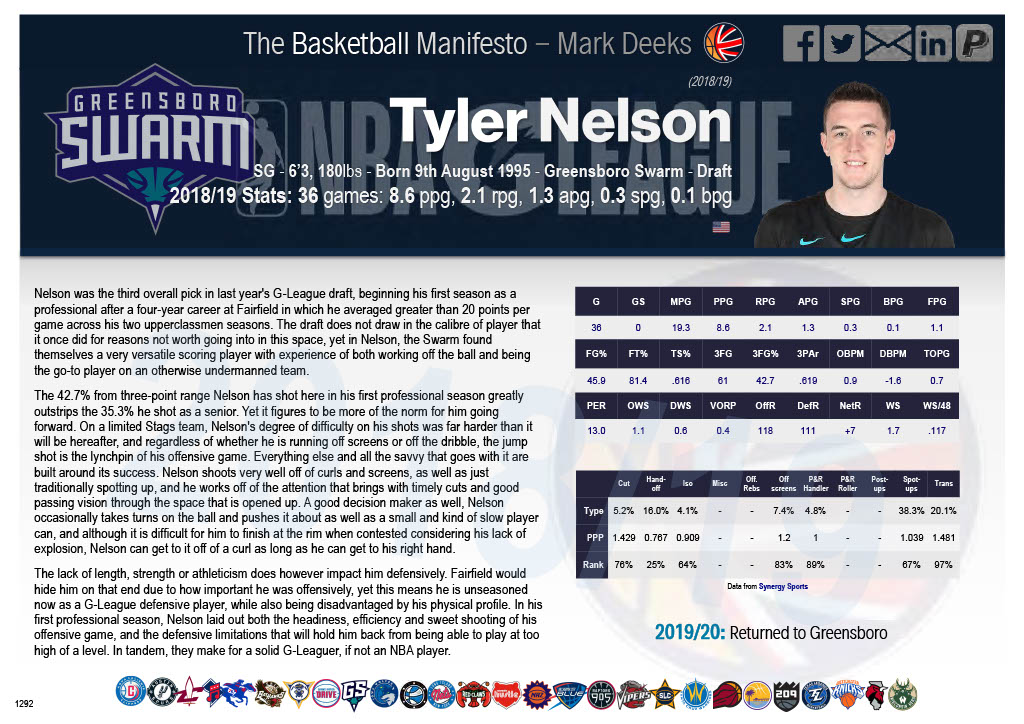
Nelson was the third overall pick in last year’s G-League draft, beginning his first season as a professional after a four-year career at Fairfield in which he averaged greater than 20 points per game across his two upperclassmen seasons. The draft does not draw in the calibre of player that it once did for reasons not worth going into in this space, yet in Nelson, the Swarm found themselves a very versatile scoring player with experience of both working off the ball and being the go-to player on an otherwise undermanned team.
The 42.7% from three-point range Nelson has shot here in his first professional season greatly outstrips the 35.3% he shot as a senior. Yet it figures to be more of the norm for him going forward. On a limited Stags team, Nelson’s degree of difficulty on his shots was far harder than it will be hereafter, and regardless of whether he is running off screens or off the dribble, the jump shot is the lynchpin of his offensive game. Everything else and all the savvy that goes with it are built around its success. Nelson shoots very well off of curls and screens, as well as just traditionally spotting up, and he works off of the attention that brings with timely cuts and good passing vision through the space that is opened up. A good decision maker as well, Nelson occasionally takes turns on the ball and pushes it about as well as a small and kind of slow player can, and although it is difficult for him to finish at the rim when contested considering his lack of explosion, Nelson can get to it off of a curl as long as he can get to his right hand.
The lack of length, strength or athleticism does however impact him defensively. Fairfield would hide him on that end due to how important he was offensively, yet this means he is unseasoned now as a G-League defensive player, while also being disadvantaged by his physical profile. In his first professional season, Nelson laid out both the headiness, efficiency and sweet shooting of his offensive game, and the defensive limitations that will hold him back from being able to play at too high of a level. In tandem, they make for a solid G-Leaguer, if not an NBA player.
– 20th June, 2019
This above is extracted from the following page in the The Basketball Manifesto, an entirely free 3,775 page, 1.2 million word-ish basketball reference book which contains reviews, strategies, ideas, opinions, and a whole lot of scouting on men’s world basketball.
– View tons more player profiles like this from the Manifesto here.
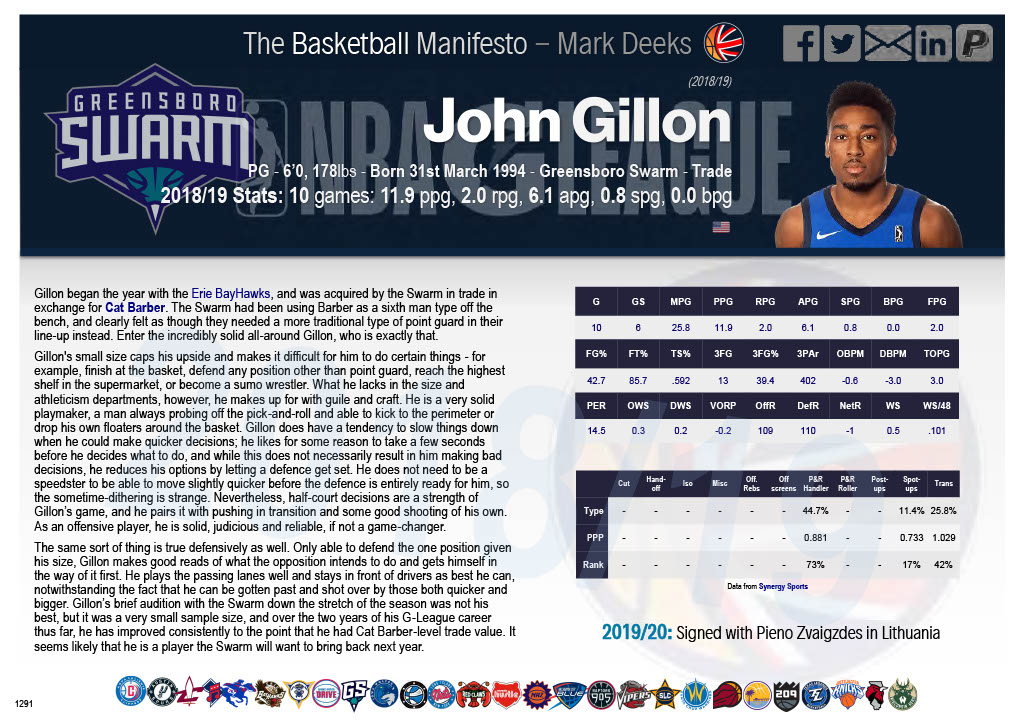
Gillon began the year with the Erie BayHawks, and was acquired by the Swarm in trade in exchange for Cat Barber. The Swarm had been using Barber as a sixth man type off the bench, and clearly felt as though they needed a more traditional type of point guard in their line-up instead. Enter the incredibly solid all-around Gillon, who is exactly that.
Gillon’s small size caps his upside and makes it difficult for him to do certain things – for example, finish at the basket, defend any position other than point guard, reach the highest shelf in the supermarket, or become a sumo wrestler. What he lacks in the size and athleticism departments, however, he makes up for with guile and craft. He is a very solid playmaker, a man always probing off the pick-and-roll and able to kick to the perimeter or drop his own floaters around the basket. Gillon does have a tendency to slow things down when he could make quicker decisions; he likes for some reason to take a few seconds before he decides what to do, and while this does not necessarily result in him making bad decisions, he reduces his options by letting a defence get set. He does not need to be a speedster to be able to move slightly quicker before the defence is entirely ready for him, so the sometime-dithering is strange. Nevertheless, half-court decisions are a strength of Gillon’s game, and he pairs it with pushing in transition and some good shooting of his own. As an offensive player, he is solid, judicious and reliable, if not a game-changer.
The same sort of thing is true defensively as well. Only able to defend the one position given his size, Gillon makes good reads of what the opposition intends to do and gets himself in the way of it first. He plays the passing lanes well and stays in front of drivers as best he can, notwithstanding the fact that he can be gotten past and shot over by those both quicker and bigger. Gillon’s brief audition with the Swarm down the stretch of the season was not his best, but it was a very small sample size, and over the two years of his G-League career thus far, he has improved consistently to the point that he had Cat Barber-level trade value. It seems likely that he is a player the Swarm will want to bring back next year.
– 20th June, 2019
This above is extracted from the following page in the The Basketball Manifesto, an entirely free 3,775 page, 1.2 million word-ish basketball reference book which contains reviews, strategies, ideas, opinions, and a whole lot of scouting on men’s world basketball.
– View tons more player profiles like this from the Manifesto here.
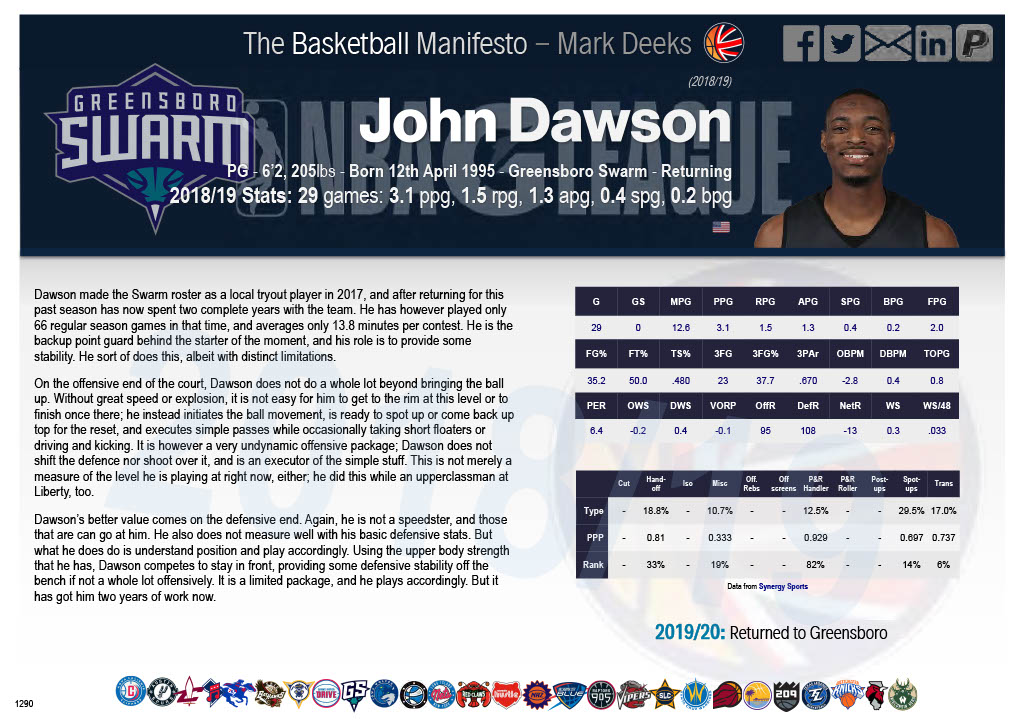
Dawson made the Swarm roster as a local tryout player in 2017, and after returning for this past season has now spent two complete years with the team. He has however played only 66 regular season games in that time, and averages only 13.8 minutes per contest. He is the backup point guard behind the starter of the moment, and his role is to provide some stability. He sort of does this, albeit with distinct limitations.
On the offensive end of the court, Dawson does not do a whole lot beyond bringing the ball up. Without great speed or explosion, it is not easy for him to get to the rim at this level or to finish once there; he instead initiates the ball movement, is ready to spot up or come back up top for the reset, and executes simple passes while occasionally taking short floaters or driving and kicking. It is however a very undynamic offensive package; Dawson does not shift the defence nor shoot over it, and is an executor of the simple stuff. This is not merely a measure of the level he is playing at right now, either; he did this while an upperclassman at Liberty, too.
Dawson’s better value comes on the defensive end. Again, he is not a speedster, and those that are can go at him. He also does not measure well with his basic defensive stats. But what he does do is understand position and play accordingly. Using the upper body strength that he has, Dawson competes to stay in front, providing some defensive stability off the bench if not a whole lot offensively. It is a limited package, and he plays accordingly. But it has got him two years of work now.
– 20th June, 2019
This above is extracted from the following page in the The Basketball Manifesto, an entirely free 3,775 page, 1.2 million word-ish basketball reference book which contains reviews, strategies, ideas, opinions, and a whole lot of scouting on men’s world basketball.
– View tons more player profiles like this from the Manifesto here.
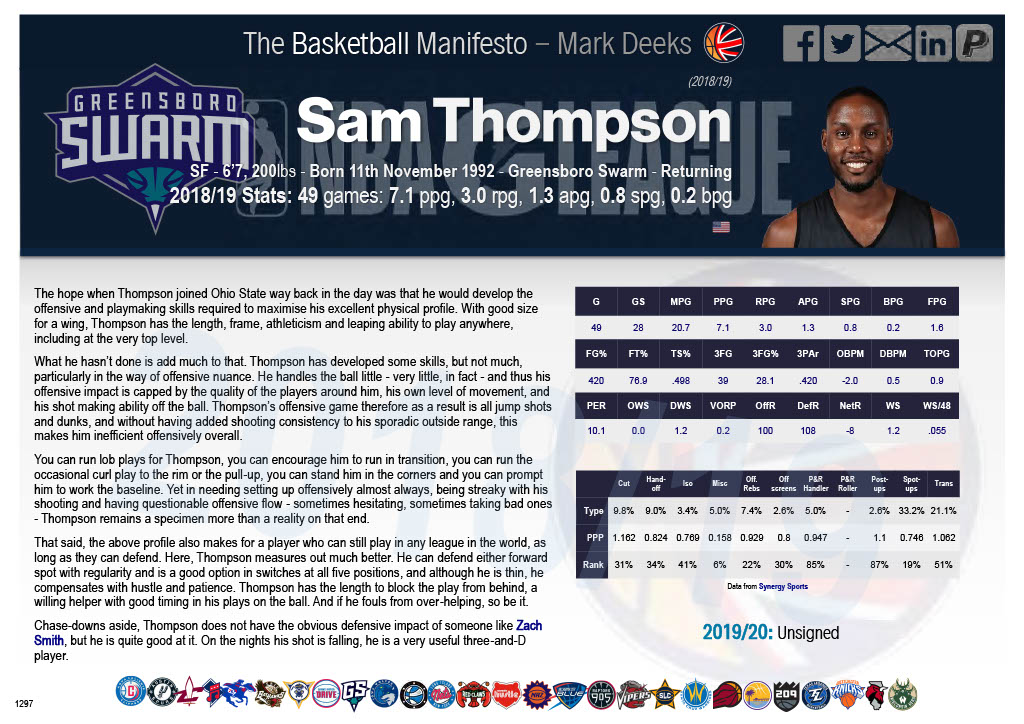
The hope when Thompson joined Ohio State way back in the day was that he would develop the offensive and playmaking skills required to maximise his excellent physical profile. With good size for a wing, Thompson has the length, frame, athleticism and leaping ability to play anywhere, including at the very top level.
What he hasn’t done is add much to that. Thompson has developed some skills, but not much, particularly in the way of offensive nuance. He handles the ball little – very little, in fact – and thus his offensive impact is capped by the quality of the players around him, his own level of movement, and his shot making ability off the ball. Thompson’s offensive game therefore as a result is all jump shots and dunks, and without having added shooting consistency to his sporadic outside range, this makes him inefficient offensively overall.
You can run lob plays for Thompson, you can encourage him to run in transition, you can run the occasional curl play to the rim or the pull-up, you can stand him in the corners and you can prompt him to work the baseline. Yet in needing setting up offensively almost always, being streaky with his shooting and having questionable offensive flow – sometimes hesitating, sometimes taking bad ones – Thompson remains a specimen more than a reality on that end.
That said, the above profile also makes for a player who can still play in any league in the world, as long as they can defend. Here, Thompson measures out much better. He can defend either forward spot with regularity and is a good option in switches at all five positions, and although he is thin, he compensates with hustle and patience. Thompson has the length to block the play from behind, a willing helper with good timing in his plays on the ball. And if he fouls from over-helping, so be it.
Chase-downs aside, Thompson does not have the obvious defensive impact of someone like Zach Smith, but he is quite good at it. On the nights his shot is falling, he is a very useful three-and-D player.
– 20th June, 2019
This above is extracted from the following page in the The Basketball Manifesto, an entirely free 3,775 page, 1.2 million word-ish basketball reference book which contains reviews, strategies, ideas, opinions, and a whole lot of scouting on men’s world basketball.
– View tons more player profiles like this from the Manifesto here.
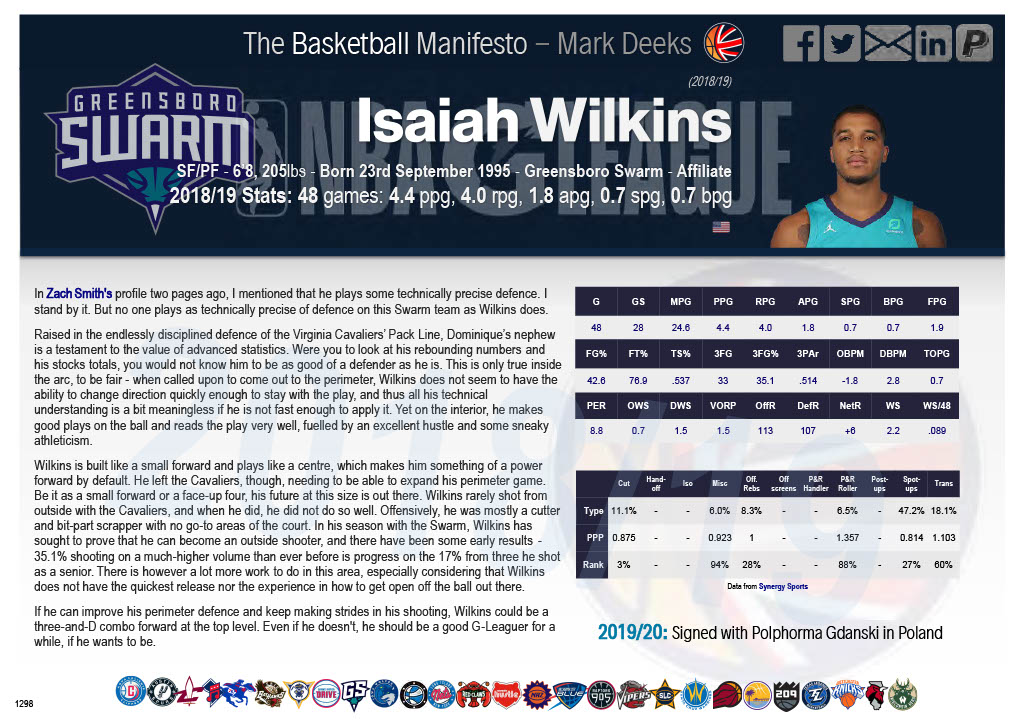
In Zach Smith’s profile two pages ago, I mentioned that he plays some technically precise defence. I stand by it. But no one plays as technically precise of defence on this Swarm team as Wilkins does.
Raised in the endlessly disciplined defence of the Virginia Cavaliers’ Pack Line, Dominique’s nephew is a testament to the value of advanced statistics. Were you to look at his rebounding numbers and his stocks totals, you would not know him to be as good of a defender as he is. This is only true inside the arc, to be fair – when called upon to come out to the perimeter, Wilkins does not seem to have the ability to change direction quickly enough to stay with the play, and thus all his technical understanding is a bit meaningless if he is not fast enough to apply it. Yet on the interior, he makes good plays on the ball and reads the play very well, fuelled by an excellent hustle and some sneaky athleticism.
Wilkins is built like a small forward and plays like a centre, which makes him something of a power forward by default. He left the Cavaliers, though, needing to be able to expand his perimeter game. Be it as a small forward or a face-up four, his future at this size is out there. Wilkins rarely shot from outside with the Cavaliers, and when he did, he did not do so well. Offensively, he was mostly a cutter and bit-part scrapper with no go-to areas of the court. In his season with the Swarm, Wilkins has sought to prove that he can become an outside shooter, and there have been some early results – 35.1% shooting on a much-higher volume than ever before is progress on the 17% from three he shot as a senior. There is however a lot more work to do in this area, especially considering that Wilkins does not have the quickest release nor the experience in how to get open off the ball out there.
If he can improve his perimeter defence and keep making strides in his shooting, Wilkins could be a three-and-D combo forward at the top level. Even if he doesn’t, he should be a good G-Leaguer for a while, if he wants to be.
– 20th June, 2019
This above is extracted from the following page in the The Basketball Manifesto, an entirely free 3,775 page, 1.2 million word-ish basketball reference book which contains reviews, strategies, ideas, opinions, and a whole lot of scouting on men’s world basketball.
– View tons more player profiles like this from the Manifesto here.
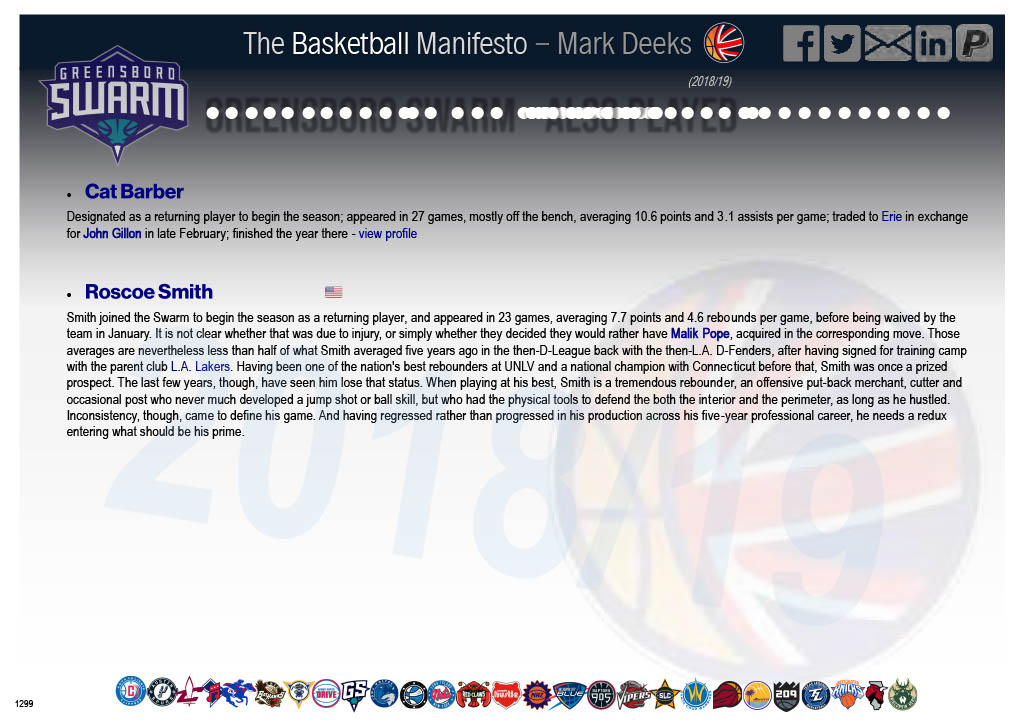
Smith joined the Swarm to begin the season as a returning player, and appeared in 23 games, averaging 7.7 points and 4.6 rebounds per game, before being waived by the team in January. It is not clear whether that was due to injury, or simply whether they decided they would rather have Malik Pope, acquired in the corresponding move. Those averages are nevertheless less than half of what Smith averaged five years ago in the then-D-League back with the then-L.A. D-Fenders, after having signed for training camp with the parent club L.A. Lakers. Having been one of the nation’s best rebounders at UNLV and a national champion with Connecticut before that, Smith was once a prized prospect. The last few years, though, have seen him lose that status. When playing at his best, Smith is a tremendous rebounder, an offensive put-back merchant, cutter and occasional post who never much developed a jump shot or ball skill, but who had the physical tools to defend the both the interior and the perimeter, as long as he hustled. Inconsistency, though, came to define his game. And having regressed rather than progressed in his production across his five-year professional career, he needs a redux entering what should be his prime.
– 20th June, 2019
This above is extracted from the following page in the The Basketball Manifesto, an entirely free 3,775 page, 1.2 million word-ish basketball reference book which contains reviews, strategies, ideas, opinions, and a whole lot of scouting on men’s world basketball.
– View tons more player profiles like this from the Manifesto here.
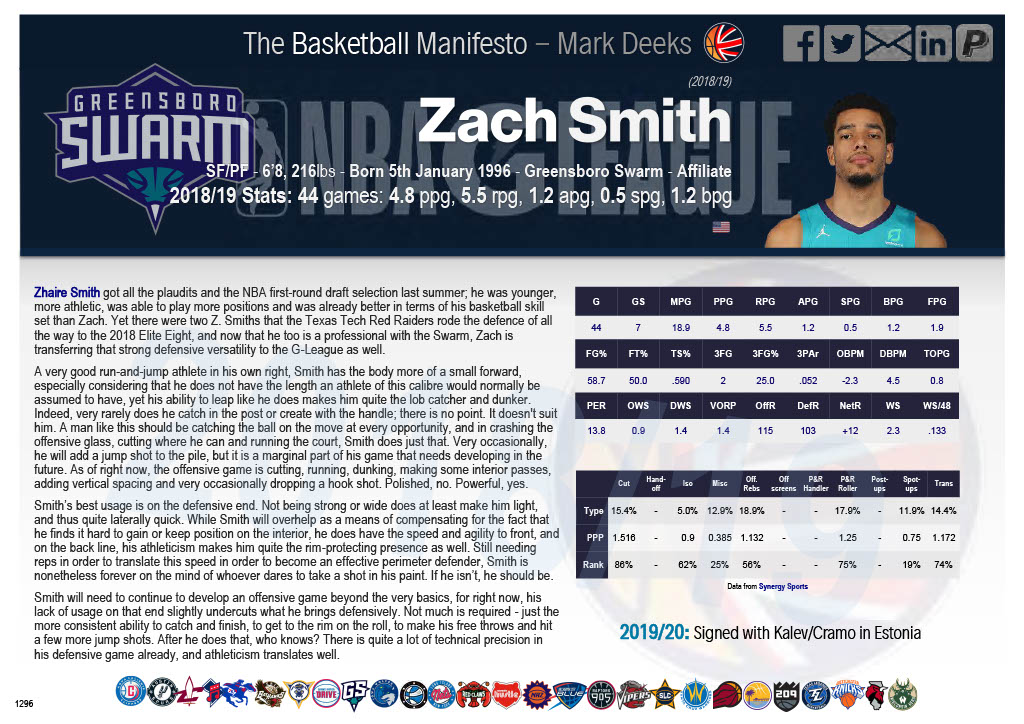
Zhaire Smith got all the plaudits and the NBA first-round draft selection last summer; he was younger, more athletic, was able to play more positions and was already better in terms of his basketball skill set than Zach. Yet there were two Z. Smiths that the Texas Tech Red Raiders rode the defence of all the way to the 2018 Elite Eight, and now that he too is a professional with the Swarm, Zach is transferring that strong defensive versatility to the G-League as well.
A very good run-and-jump athlete in his own right, Smith has the body more of a small forward, especially considering that he does not have the length an athlete of this calibre would normally be assumed to have, yet his ability to leap like he does makes him quite the lob catcher and dunker. Indeed, very rarely does he catch in the post or create with the handle; there is no point. It doesn’t suit him. A man like this should be catching the ball on the move at every opportunity, and in crashing the offensive glass, cutting where he can and running the court, Smith does just that. Very occasionally, he will add a jump shot to the pile, but it is a marginal part of his game that needs developing in the future. As of right now, the offensive game is cutting, running, dunking, making some interior passes, adding vertical spacing and very occasionally dropping a hook shot. Polished, no. Powerful, yes.
Smith’s best usage is on the defensive end. Not being strong or wide does at least make him light, and thus quite laterally quick. While Smith will overhelp as a means of compensating for the fact that he finds it hard to gain or keep position on the interior, he does have the speed and agility to front, and on the back line, his athleticism makes him quite the rim-protecting presence as well. Still needing reps in order to translate this speed in order to become an effective perimeter defender, Smith is nonetheless forever on the mind of whoever dares to take a shot in his paint. If he isn’t, he should be.
Smith will need to continue to develop an offensive game beyond the very basics, for right now, his lack of usage on that end slightly undercuts what he brings defensively. Not much is required – just the more consistent ability to catch and finish, to get to the rim on the roll, to make his free throws and hit a few more jump shots. After he does that, who knows? There is quite a lot of technical precision in his defensive game already, and athleticism translates well.
– 20th June, 2019
This above is extracted from the following page in the The Basketball Manifesto, an entirely free 3,775 page, 1.2 million word-ish basketball reference book which contains reviews, strategies, ideas, opinions, and a whole lot of scouting on men’s world basketball.
– View tons more player profiles like this from the Manifesto here.
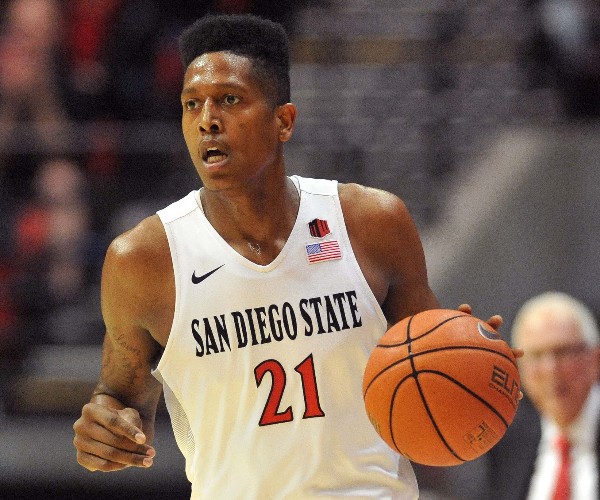
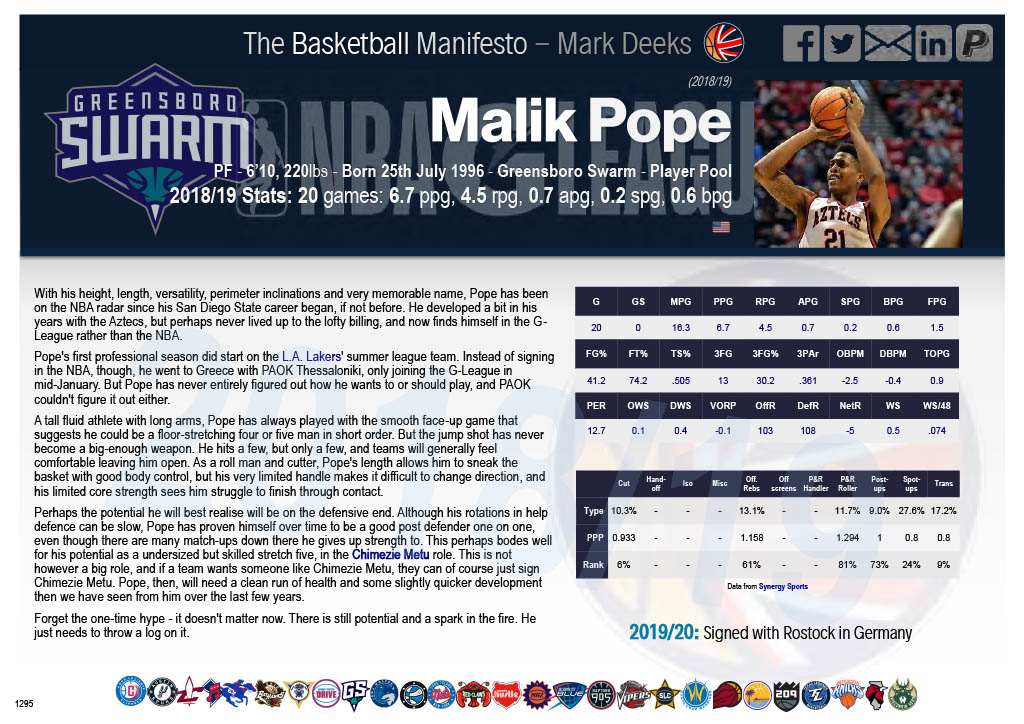
With his height, length, versatility, perimeter inclinations and very memorable name, Pope has been on the NBA radar since his San Diego State career began, if not before. He developed a bit in his years with the Aztecs, but perhaps never lived up to the lofty billing, and now finds himself in the G-League rather than the NBA.
Pope’s first professional season did start on the L.A. Lakers’ summer league team. Instead of signing in the NBA, though, he went to Greece with PAOK Thessaloniki, only joining the G-League in mid-January. But Pope has never entirely figured out how he wants to or should play, and PAOK couldn’t figure it out either.
A tall fluid athlete with long arms, Pope has always played with the smooth face-up game that suggests he could be a floor-stretching four or five man in short order. But the jump shot has never become a big-enough weapon. He hits a few, but only a few, and teams will generally feel comfortable leaving him open. As a roll man and cutter, Pope’s length allows him to sneak the basket with good body control, but his very limited handle makes it difficult to change direction, and his limited core strength sees him struggle to finish through contact.
Perhaps the potential he will best realise will be on the defensive end. Although his rotations in help defence can be slow, Pope has proven himself over time to be a good post defender one on one, even though there are many match-ups down there he gives up strength to. This perhaps bodes well for his potential as a undersized but skilled stretch five, in the Chimezie Metu role. This is not however a big role, and if a team wants someone like Chimezie Metu, they can of course just sign Chimezie Metu. Pope, then, will need a clean run of health and some slightly quicker development then we have seen from him over the last few years.
Forget the one-time hype – it doesn’t matter now. There is still potential and a spark in the fire. He just needs to throw a log on it.
– 20th June, 2019
This above is extracted from the following page in the The Basketball Manifesto, an entirely free 3,775 page, 1.2 million word-ish basketball reference book which contains reviews, strategies, ideas, opinions, and a whole lot of scouting on men’s world basketball.
– View tons more player profiles like this from the Manifesto here.
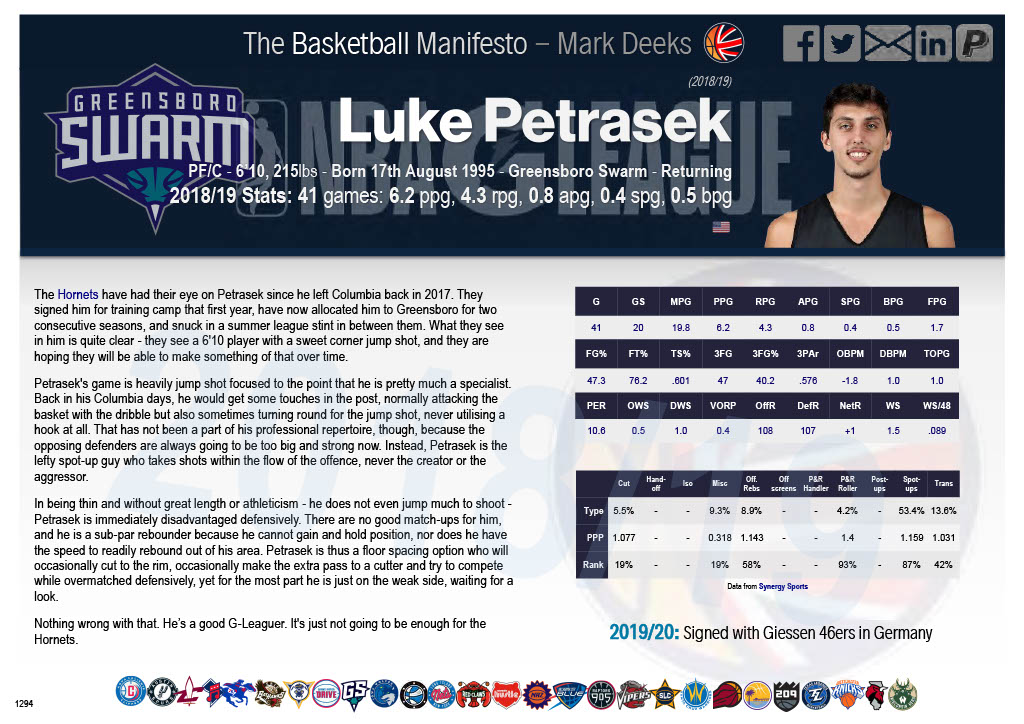
The Hornets have had their eye on Petrasek since he left Columbia back in 2017. They signed him for training camp that first year, have now allocated him to Greensboro for two consecutive seasons, and snuck in a summer league stint in between them. What they see in him is quite clear – they see a 6’10 player with a sweet corner jump shot, and they are hoping they will be able to make something of that over time.
Petrasek’s game is heavily jump shot focused to the point that he is pretty much a specialist. Back in his Columbia days, he would get some touches in the post, normally attacking the basket with the dribble but also sometimes turning round for the jump shot, never utilising a hook at all. That has not been a part of his professional repertoire, though, because the opposing defenders are always going to be too big and strong now. Instead, Petrasek is the lefty spot-up guy who takes shots within the flow of the offence, never the creator or the aggressor.
In being thin and without great length or athleticism – he does not even jump much to shoot – Petrasek is immediately disadvantaged defensively. There are no good match-ups for him, and he is a sub-par rebounder because he cannot gain and hold position, nor does he have the speed to readily rebound out of his area. Petrasek is thus a floor spacing option who will occasionally cut to the rim, occasionally make the extra pass to a cutter and try to compete while overmatched defensively, yet for the most part he is just on the weak side, waiting for a look.
Nothing wrong with that. He’s a good G-Leaguer. It’s just not going to be enough for the Hornets.
– 20th June, 2019
This above is extracted from the following page in the The Basketball Manifesto, an entirely free 3,775 page, 1.2 million word-ish basketball reference book which contains reviews, strategies, ideas, opinions, and a whole lot of scouting on men’s world basketball.
– View tons more player profiles like this from the Manifesto here.
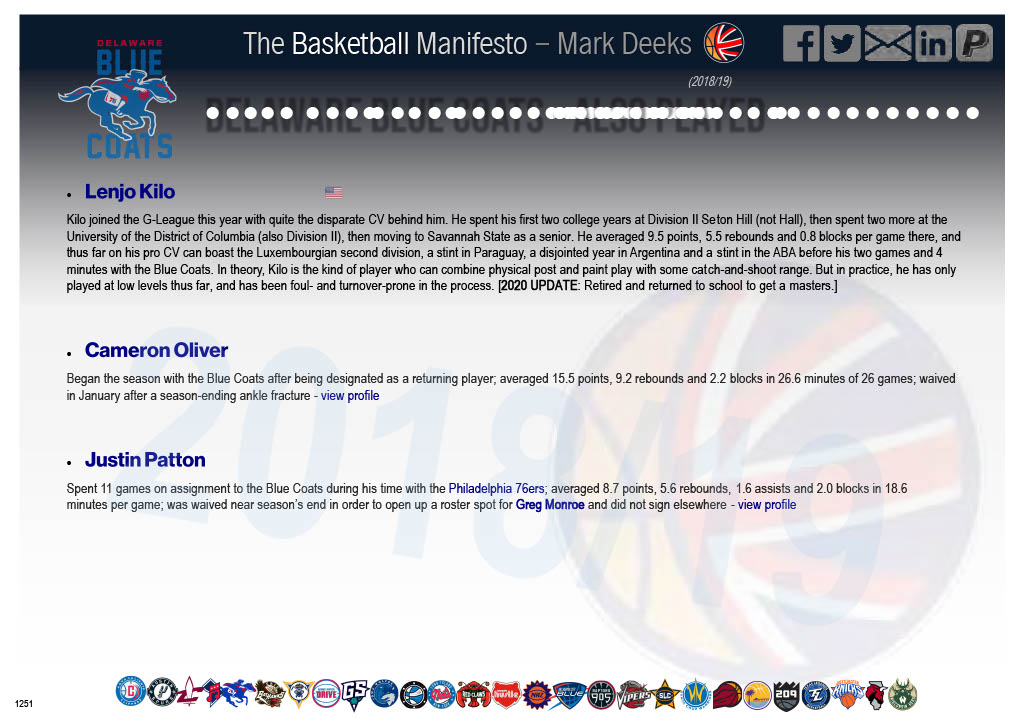
Kilo joined the G-League this year with quite the disparate CV behind him. He spent his first two college years at Division II Seton Hill (not Hall), then spent two more at the University of the District of Columbia (also Division II), then moving to Savannah State as a senior. He averaged 9.5 points, 5.5 rebounds and 0.8 blocks per game there, and thus far on his pro CV can boast the Luxembourgian second division, a stint in Paraguay, a disjointed year in Argentina and a stint in the ABA before his two games and four minutes with the Blue Coats. In theory, Kilo is the kind of player who can combine physical post and paint play with some catch-and-shoot range. But in practice, he has only played at low levels thus far, and has been foul- and turnover-prone in the process.
[2020 UPDATE: Retired and returned to school to get a masters.]
– 20th June, 2019
This above is extracted from the following page in the The Basketball Manifesto, an entirely free 3,775 page, 1.2 million word-ish basketball reference book which contains reviews, strategies, ideas, opinions, and a whole lot of scouting on men’s world basketball.
– View tons more player profiles like this from the Manifesto here.
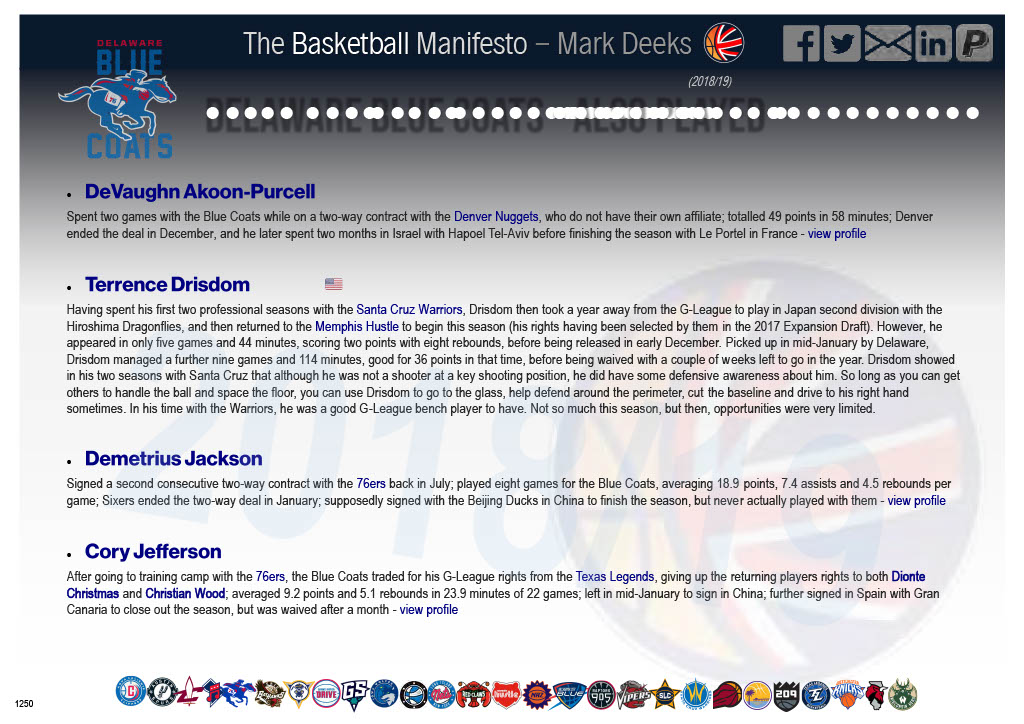
Having spent his first two professional seasons with the Santa Cruz Warriors, Drisdom then took a year away from the G-League to play in Japan second division with the Hiroshima Dragonflies, and then returned to the Memphis Hustle to begin this season (his rights having been selected by them in the 2017 Expansion Draft). However, he appeared in only five games and 44 minutes, scoring two points with eight rebounds, before being released in early December. Picked up in mid-January by Delaware, Drisdom managed a further nine games and 114 minutes, good for 36 points in that time, before being waived with a couple of weeks left to go in the year. Drisdom showed in his two seasons with Santa Cruz that although he was not a shooter at a key shooting position, he did have some defensive awareness about him. So long as you can get others to handle the ball and space the floor, you can use Drisdom to go to the glass, help defend around the perimeter, cut the baseline and drive to his right hand sometimes. In his time with the Warriors, he was a good G-League bench player to have. Not so much this season, but then, opportunities were very limited.
– 20th June, 2019
This above is extracted from the following page in the The Basketball Manifesto, an entirely free 3,775 page, 1.2 million word-ish basketball reference book which contains reviews, strategies, ideas, opinions, and a whole lot of scouting on men’s world basketball.
– View tons more player profiles like this from the Manifesto here.
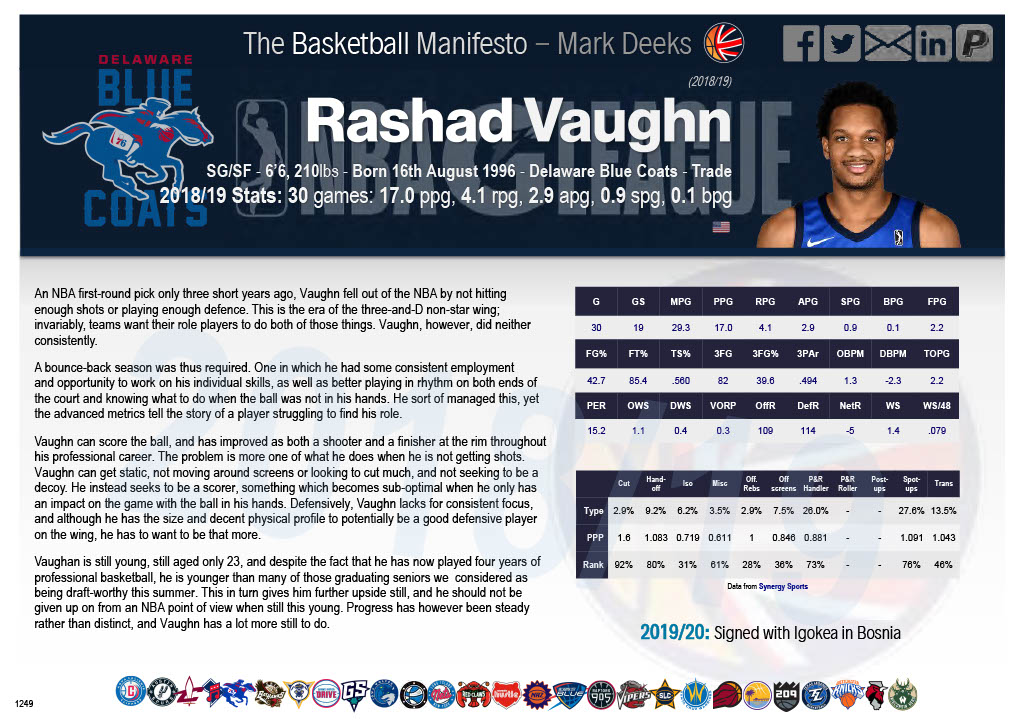
An NBA first-round pick only three short years ago, Vaughn fell out of the NBA by not hitting enough shots or playing enough defence. This is the era of the three-and-D non-star wing; invariably, teams want their role players to do both of those things. Vaughn, however, did neither consistently.
A bounce-back season was thus required. One in which he had some consistent employment and opportunity to work on his individual skills, as well as better playing in rhythm on both ends of the court and knowing what to do when the ball was not in his hands. He sort of managed this, yet the advanced metrics tell the story of a player struggling to find his role.
Vaughn can score the ball, and has improved as both a shooter and a finisher at the rim throughout his professional career. The problem is more one of what he does when he is not getting shots. Vaughn can get static, not moving around screens or looking to cut much, and not seeking to be a decoy. He instead seeks to be a scorer, something which becomes sub-optimal when he only has an impact on the game with the ball in his hands. Defensively, Vaughn lacks for consistent focus, and although he has the size and decent physical profile to potentially be a good defensive player on the wing, he has to want to be that more.
Vaughan is still young, still aged only 23, and despite the fact that he has now played four years of professional basketball, he is younger than many of those graduating seniors we considered as being draft-worthy this summer. This in turn gives him further upside still, and he should not be given up on from an NBA point of view when still this young. Progress has however been steady rather than distinct, and Vaughn has a lot more still to do.
– 20th June, 2019
This above is extracted from the following page in the The Basketball Manifesto, an entirely free 3,775 page, 1.2 million word-ish basketball reference book which contains reviews, strategies, ideas, opinions, and a whole lot of scouting on men’s world basketball.
– View tons more player profiles like this from the Manifesto here.
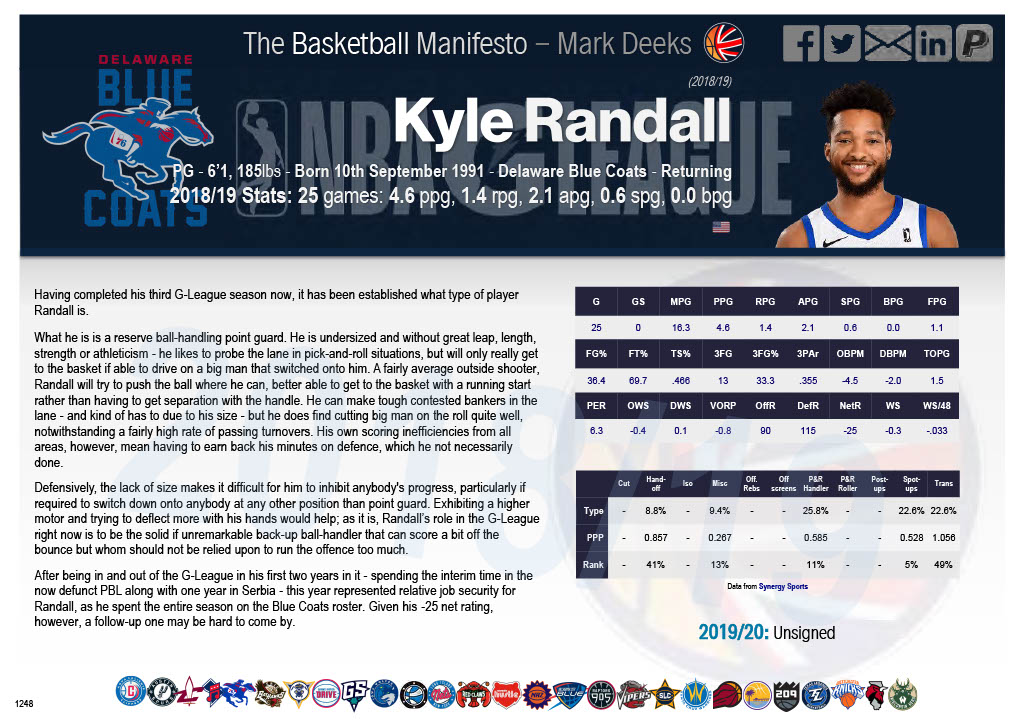
Having completed his third G-League season now, it has been established what type of player Randall is.
What he is is a reserve ball-handling point guard. He is undersized and without great leap, length, strength or athleticism – he likes to probe the lane in pick-and-roll situations, but will only really get to the basket if able to drive on a big man that switched onto him. A fairly average outside shooter, Randall will try to push the ball where he can, better able to get to the basket with a running start rather than having to get separation with the handle. He can make tough contested bankers in the lane – and kind of has to due to his size – but he does find cutting big man on the roll quite well, notwithstanding a fairly high rate of passing turnovers. His own scoring inefficiencies from all areas, however, mean having to earn back his minutes on defence, which he not necessarily done.
Defensively, the lack of size makes it difficult for him to inhibit anybody’s progress, particularly if required to switch down onto anybody at any other position than point guard. Exhibiting a higher motor and trying to deflect more with his hands would help; as it is, Randall’s role in the G-League right now is to be the solid if unremarkable back-up ball-handler that can score a bit off the bounce but whom should not be relied upon to run the offence too much.
After being in and out of the G-League in his first two years in it – spending the interim time in the now defunct PBL along with one year in Serbia – this year represented relative job security for Randall, as he spent the entire season on the Blue Coats roster. Given his -25 net rating, however, a follow-up one may be hard to come by.
– 20th June, 2019
This above is extracted from the following page in the The Basketball Manifesto, an entirely free 3,775 page, 1.2 million word-ish basketball reference book which contains reviews, strategies, ideas, opinions, and a whole lot of scouting on men’s world basketball.
– View tons more player profiles like this from the Manifesto here.
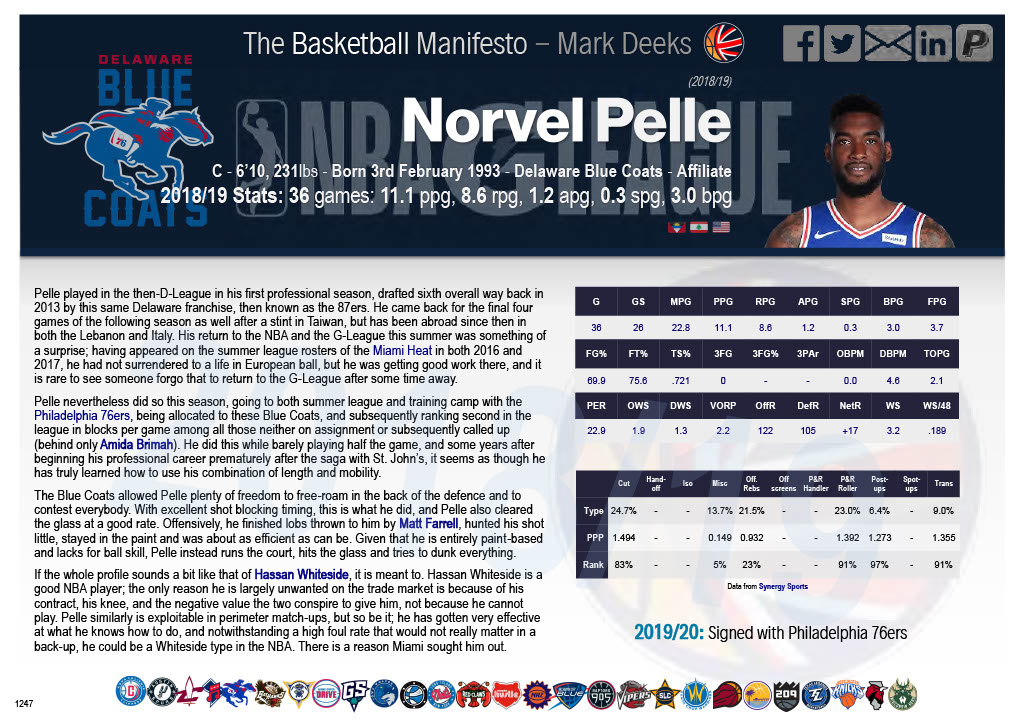
Pelle played in the then-D-League in his first professional season, drafted sixth overall way back in 2013 by this same Delaware franchise, then known as the 87ers. He came back for the final four games of the following season as well after a stint in Taiwan, but has been abroad since then in both the Lebanon and Italy. His return to the NBA and the G-League this summer was something of a surprise; having appeared on the summer league rosters of the Miami Heat in both 2016 and 2017, he had not surrendered to a life in European ball, but he was getting good work there, and it is rare to see someone forgo that to return to the G-League after some time away.
Pelle nevertheless did so this season, going to both summer league and training camp with the Philadelphia 76ers, being allocated to these Blue Coats, and subsequently ranking second in the league in blocks per game among all those neither on assignment or subsequently called up (behind only Amida Brimah). He did this while barely playing half the game, and some years after beginning his professional career prematurely after the saga with St. John’s, it seems as though he has truly learned how to use his combination of length and mobility.
The Blue Coats allowed Pelle plenty of freedom to free-roam in the back of the defence and to contest everybody. With excellent shot blocking timing, this is what he did, and Pelle also cleared the glass at a good rate. Offensively, he finished lobs thrown to him by Matt Farrell, hunted his shot little, stayed in the paint and was about as efficient as can be. Given that he is entirely paint-based and lacks for ball skill, Pelle instead runs the court, hits the glass and tries to dunk everything.
If the whole profile sounds a bit like that of Hassan Whiteside, it is meant to. Hassan Whiteside is a good NBA player; the only reason he is largely unwanted on the trade market is because of his contract, his knee, and the negative value the two conspire to give him, not because he cannot play. Pelle similarly is exploitable in perimeter match-ups, but so be it; he has gotten very effective at what he knows how to do, and notwithstanding a high foul rate that would not really matter in a back-up, he could be a Whiteside type in the NBA. There is a reason Miami sought him out.
– 20th June, 2019
This above is extracted from the following page in the The Basketball Manifesto, an entirely free 3,775 page, 1.2 million word-ish basketball reference book which contains reviews, strategies, ideas, opinions, and a whole lot of scouting on men’s world basketball.
– View tons more player profiles like this from the Manifesto here.
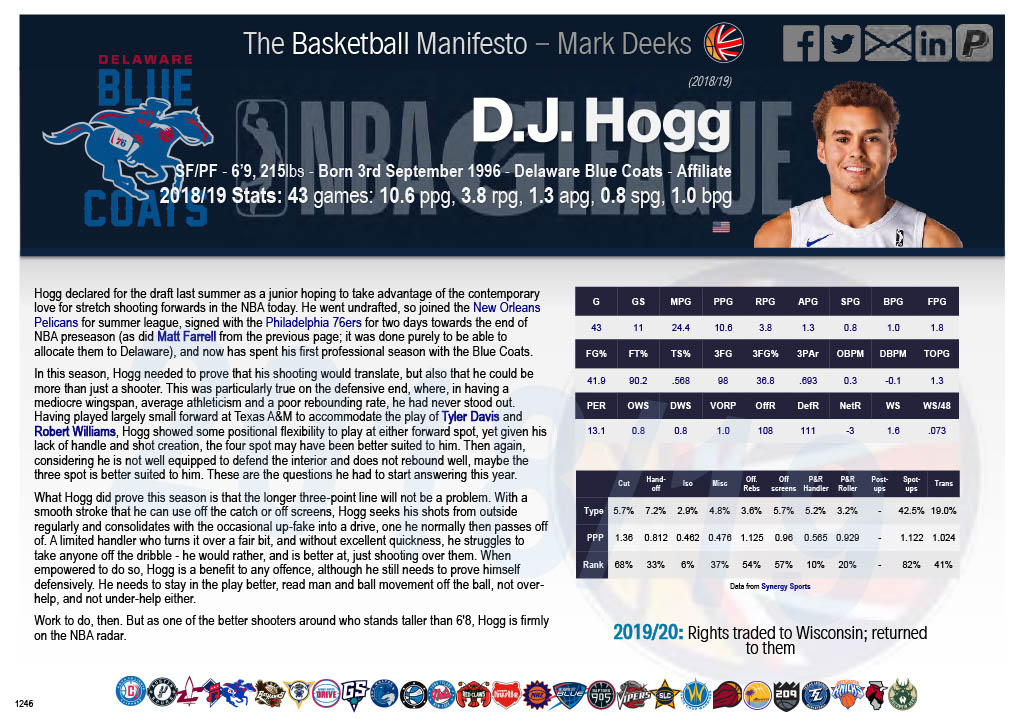
Hogg declared for the draft last summer as a junior hoping to take advantage of the contemporary love for stretch shooting forwards in the NBA today. He went undrafted, so joined the New Orleans Pelicans for summer league, signed with the Philadelphia 76ers for two days towards the end of NBA preseason (as did Matt Farrell from the previous page; it was done purely to be able to allocate them to Delaware), and now has spent his first professional season with the Blue Coats.
In this season, Hogg needed to prove that his shooting would translate, but also that he could be more than just a shooter. This was particularly true on the defensive end, where, in having a mediocre wingspan, average athleticism and a poor rebounding rate, he had never stood out. Having played largely small forward at Texas A&M to accommodate the play of Tyler Davis and Robert Williams, Hogg showed some positional flexibility to play at either forward spot, yet given his lack of handle and shot creation, the four spot may have been better suited to him. Then again, considering he is not well equipped to defend the interior and does not rebound well, maybe the three spot is better suited to him. These are the questions he had to start answering this year.
What Hogg did prove this season is that the longer three-point line will not be a problem. With a smooth stroke that he can use off the catch or off screens, Hogg seeks his shots from outside regularly and consolidates with the occasional up-fake into a drive, one he normally then passes off of. A limited handler who turns it over a fair bit, and without excellent quickness, he struggles to take anyone off the dribble – he would rather, and is better at, just shooting over them. When empowered to do so, Hogg is a benefit to any offence, although he still needs to prove himself defensively. He needs to stay in the play better, read man and ball movement off the ball, not overhelp, and not under-help either.
Work to do, then. But as one of the better shooters around who stands taller than 6’8, Hogg is firmly on the NBA radar.
– 20th June, 2019
This above is extracted from the following page in the The Basketball Manifesto, an entirely free 3,775 page, 1.2 million word-ish basketball reference book which contains reviews, strategies, ideas, opinions, and a whole lot of scouting on men’s world basketball.
– View tons more player profiles like this from the Manifesto here.
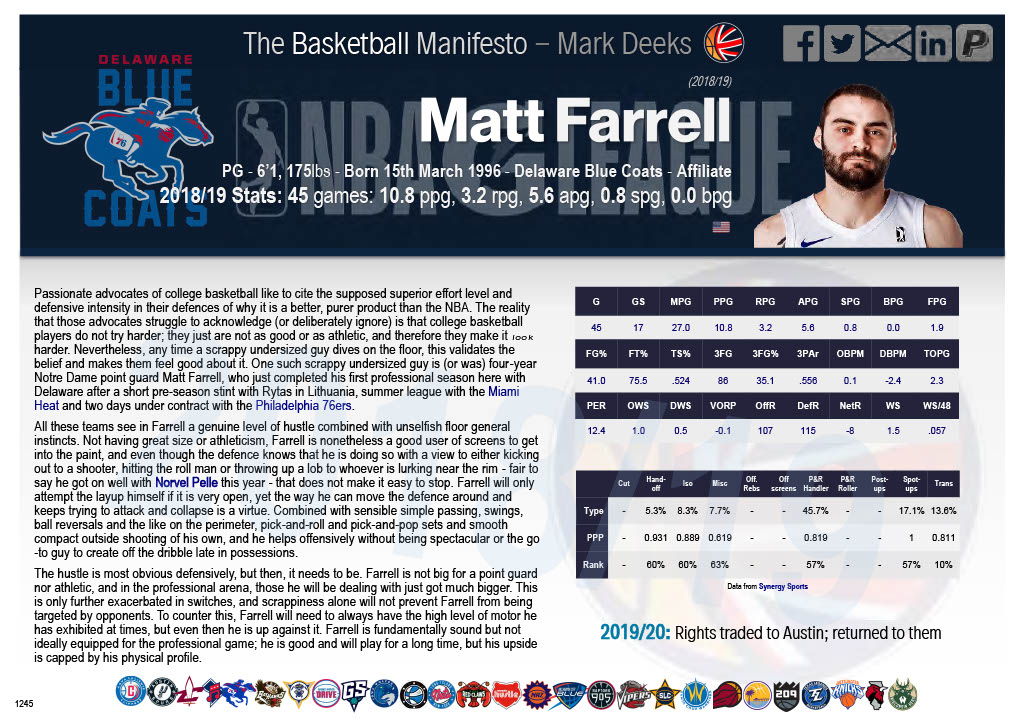
Passionate advocates of college basketball like to cite the supposed superior effort level and defensive intensity in their defences of why it is a better, purer product than the NBA. The reality that those advocates struggle to acknowledge (or deliberately ignore) is that college basketball players do not try harder; they just are not as good or as athletic, and therefore they make it look harder. Nevertheless, any time a scrappy undersized guy dives on the floor, this validates the belief and makes them feel good about it. One such scrappy undersized guy is (or was) four-year Notre Dame point guard Matt Farrell, who just completed his first professional season here with Delaware after a short pre-season stint with Rytas in Lithuania, summer league with the Miami Heat and two days under contract with the Philadelphia 76ers.
All these teams see in Farrell a genuine level of hustle combined with unselfish floor general instincts. Not having great size or athleticism, Farrell is nonetheless a good user of screens to get into the paint, and even though the defence knows that he is doing so with a view to either kicking out to a shooter, hitting the roll man or throwing up a lob to whoever is lurking near the rim – fair to say he got on well with Norvel Pelle this year – that does not make it easy to stop. Farrell will only attempt the layup himself if it is very open, yet the way he can move the defence around and keeps trying to attack and collapse is a virtue. Combined with sensible simple passing, swings, ball reversals and the like on the perimeter, pick-and-roll and pick-and-pop sets and smooth compact outside shooting of his own, and he helps offensively without being spectacular or the go -to guy to create off the dribble late in possessions.
The hustle is most obvious defensively, but then, it needs to be. Farrell is not big for a point guard nor athletic, and in the professional arena, those he will be dealing with just got much bigger. This is only further exacerbated in switches, and scrappiness alone will not prevent Farrell from being targeted by opponents. To counter this, Farrell will need to always have the high level of motor he has exhibited at times, but even then he is up against it. Farrell is fundamentally sound but not ideally equipped for the professional game; he is good and will play for a long time, but his upside is capped by his physical profile.
– 20th June, 2019
This above is extracted from the following page in the The Basketball Manifesto, an entirely free 3,775 page, 1.2 million word-ish basketball reference book which contains reviews, strategies, ideas, opinions, and a whole lot of scouting on men’s world basketball.
– View tons more player profiles like this from the Manifesto here.
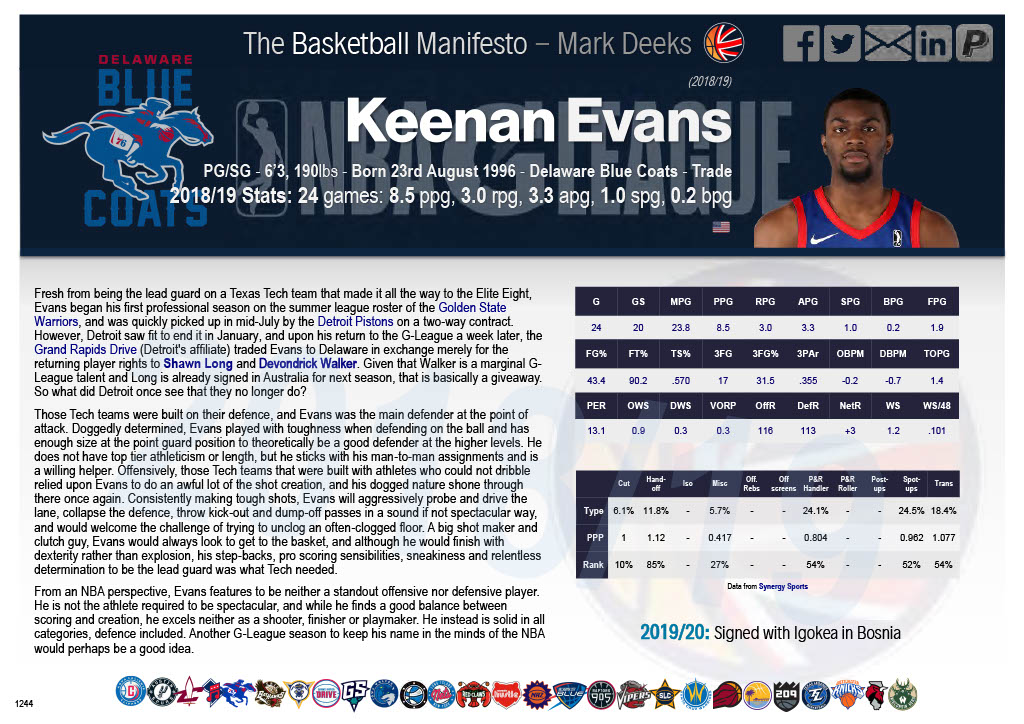
Fresh from being the lead guard on a Texas Tech team that made it all the way to the Elite Eight, Evans began his first professional season on the summer league roster of the Golden State Warriors, and was quickly picked up in mid-July by the Detroit Pistons on a two-way contract. However, Detroit saw fit to end it in January, and upon his return to the G-League a week later, the Grand Rapids Drive (Detroit’s affiliate) traded Evans to Delaware in exchange merely for the returning player rights to Shawn Long and Devondrick Walker. Given that Walker is a marginal GLeague talent and Long is already signed in Australia for next season, that is basically a giveaway. So what did Detroit once see that they no longer do?
Those Tech teams were built on their defence, and Evans was the main defender at the point of attack. Doggedly determined, Evans played with toughness when defending on the ball and has enough size at the point guard position to theoretically be a good defender at the higher levels. He does not have top tier athleticism or length, but he sticks with his man-to-man assignments and is a willing helper. Offensively, those Tech teams that were built with athletes who could not dribble relied upon Evans to do an awful lot of the shot creation, and his dogged nature shone through there once again. Consistently making tough shots, Evans will aggressively probe and drive the lane, collapse the defence, throw kick-out and dump-off passes in a sound if not spectacular way, and would welcome the challenge of trying to unclog an often-clogged floor. A big shot maker and clutch guy, Evans would always look to get to the basket, and although he would finish with dexterity rather than explosion, his step-backs, pro scoring sensibilities, sneakiness and relentless determination to be the lead guard was what Tech needed.
From an NBA perspective, Evans features to be neither a standout offensive nor defensive player. He is not the athlete required to be spectacular, and while he finds a good balance between scoring and creation, he excels neither as a shooter, finisher or playmaker. He instead is solid in all categories, defence included. Another G-League season to keep his name in the minds of the NBA would perhaps be a good idea.
– 20th June, 2019
This above is extracted from the following page in the The Basketball Manifesto, an entirely free 3,775 page, 1.2 million word-ish basketball reference book which contains reviews, strategies, ideas, opinions, and a whole lot of scouting on men’s world basketball.
– View tons more player profiles like this from the Manifesto here.
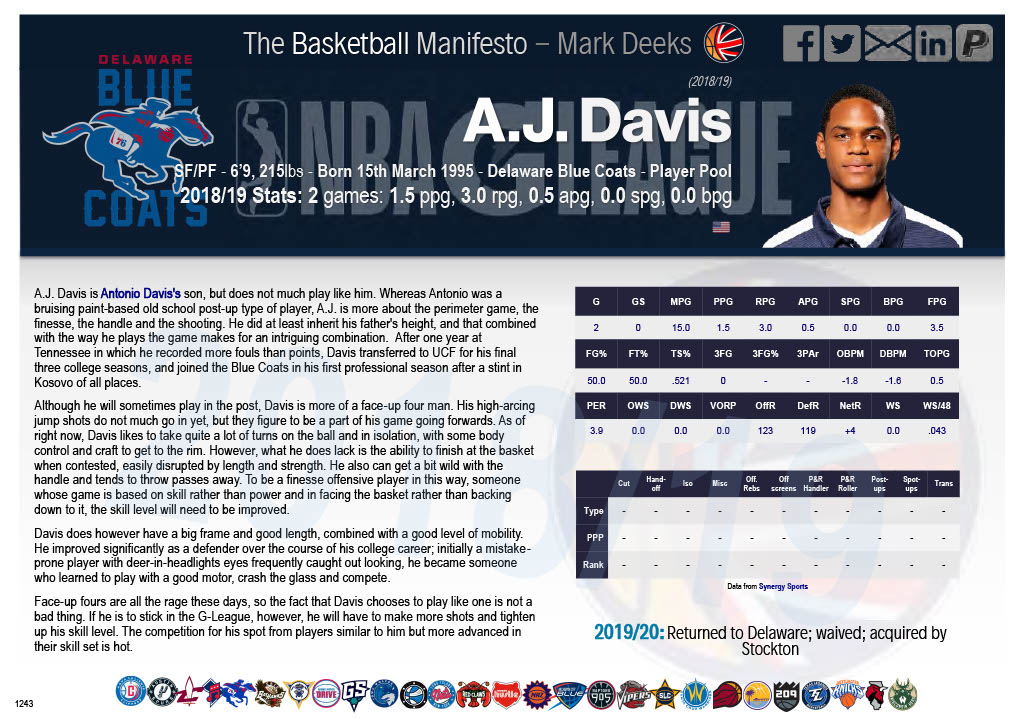
A.J. Davis is Antonio Davis’s son, but does not much play like him. Whereas Antonio was a bruising paint-based old school post-up type of player, A.J. is more about the perimeter game, the finesse, the handle and the shooting. He did at least inherit his father’s height, and that combined with the way he plays the game makes for an intriguing combination. After one year at Tennessee in which he recorded more fouls than points, Davis transferred to UCF for his final three college seasons, and joined the Blue Coats in his first professional season after a stint in Kosovo of all places.
Although he will sometimes play in the post, Davis is more of a face-up four man. His high-arcing jump shots do not much go in yet, but they figure to be a part of his game going forwards. As of right now, Davis likes to take quite a lot of turns on the ball and in isolation, with some body control and craft to get to the rim. However, what he does lack is the ability to finish at the basket when contested, easily disrupted by length and strength. He also can get a bit wild with the handle and tends to throw passes away. To be a finesse offensive player in this way, someone whose game is based on skill rather than power and in facing the basket rather than backing down to it, the skill level will need to be improved.
Davis does however have a big frame and good length, combined with a good level of mobility. He improved significantly as a defender over the course of his college career; initially a mistakeprone player with deer-in-headlights eyes frequently caught out looking, he became someone who learned to play with a good motor, crash the glass and compete.
Face-up fours are all the rage these days, so the fact that Davis chooses to play like one is not a bad thing. If he is to stick in the G-League, however, he will have to make more shots and tighten up his skill level. The competition for his spot from players similar to him but more advanced in their skill set is hot..
– 20th June, 2019
This above is extracted from the following page in the The Basketball Manifesto, an entirely free 3,775 page, 1.2 million word-ish basketball reference book which contains reviews, strategies, ideas, opinions, and a whole lot of scouting on men’s world basketball.
– View tons more player profiles like this from the Manifesto here.
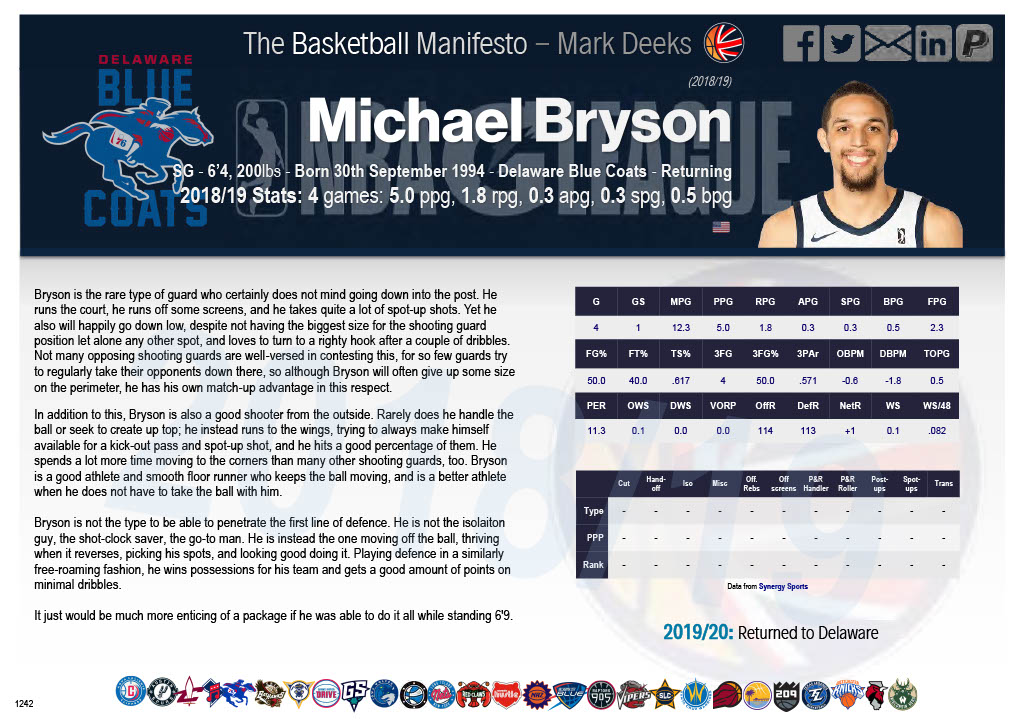
Bryson is the rare type of guard who certainly does not mind going down into the post. He runs the court, he runs off some screens, and he takes quite a lot of spot-up shots. Yet he also will happily go down low, despite not having the biggest size for the shooting guard position let alone any other spot, and loves to turn to a righty hook after a couple of dribbles. Not many opposing shooting guards are well-versed in contesting this, for so few guards try to regularly take their opponents down there, so although Bryson will often give up some size on the perimeter, he has his own match-up advantage in this respect.
In addition to this, Bryson is also a good shooter from the outside. Rarely does he handle the ball or seek to create up top; he instead runs to the wings, trying to always make himself available for a kick-out pass and spot-up shot, and he hits a good percentage of them. He spends a lot more time moving to the corners than many other shooting guards, too. Bryson is a good athlete and smooth floor runner who keeps the ball moving, and is a better athlete when he does not have to take the ball with him.
Bryson is not the type to be able to penetrate the first line of defence. He is not the isolation guy, the shot-clock saver, the go-to man. He is instead the one moving off the ball, thriving when it reverses, picking his spots, and looking good doing it. Playing defence in a similarly free-roaming fashion, he wins possessions for his team and gets a good amount of points on minimal dribbles.
It just would be much more enticing of a package if he was able to do it all while standing 6’9..
– 20th June, 2019
This above is extracted from the following page in the The Basketball Manifesto, an entirely free 3,775 page, 1.2 million word-ish basketball reference book which contains reviews, strategies, ideas, opinions, and a whole lot of scouting on men’s world basketball.
– View tons more player profiles like this from the Manifesto here.
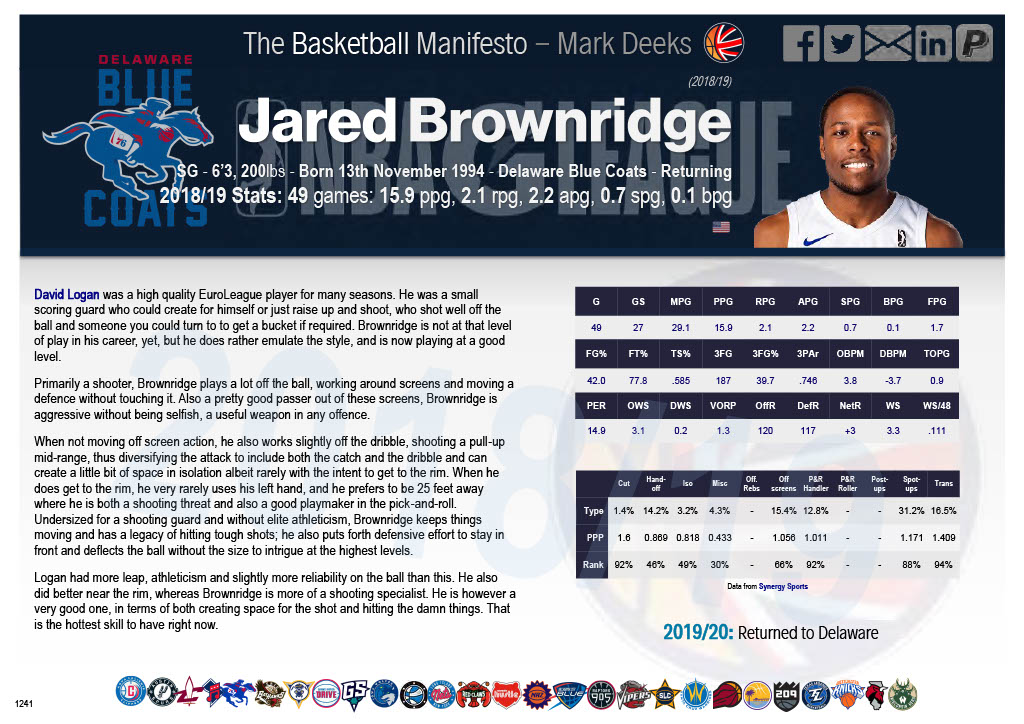
David Logan was a high quality EuroLeague player for many seasons. He was a small scoring guard who could create for himself or just raise up and shoot, who shot well off the ball and someone you could turn to to get a bucket if required. Brownridge is not at that level of play in his career, yet, but he does rather emulate the style, and is now playing at a good level.
Primarily a shooter, Brownridge plays a lot off the ball, working around screens and moving a defence without touching it. Also a pretty good passer out of these screens, Brownridge is aggressive without being selfish, a useful weapon in any offence.
When not moving off screen action, he also works slightly off the dribble, shooting a pull-up mid-range, thus diversifying the attack to include both the catch and the dribble and can create a little bit of space in isolation albeit rarely with the intent to get to the rim. When he does get to the rim, he very rarely uses his left hand, and he prefers to be 25 feet away where he is both a shooting threat and also a good playmaker in the pick-and-roll. Undersized for a shooting guard and without elite athleticism, Brownridge keeps things moving and has a legacy of hitting tough shots; he also puts forth defensive effort to stay in front and deflects the ball without the size to intrigue at the highest levels.
Logan had more leap, athleticism and slightly more reliability on the ball than this. He also did better near the rim, whereas Brownridge is more of a shooting specialist. He is however a very good one, in terms of both creating space for the shot and hitting the damn things. That is the hottest skill to have right now.
– 20th June, 2019
This above is extracted from the following page in the The Basketball Manifesto, an entirely free 3,775 page, 1.2 million word-ish basketball reference book which contains reviews, strategies, ideas, opinions, and a whole lot of scouting on men’s world basketball.
– View tons more player profiles like this from the Manifesto here.
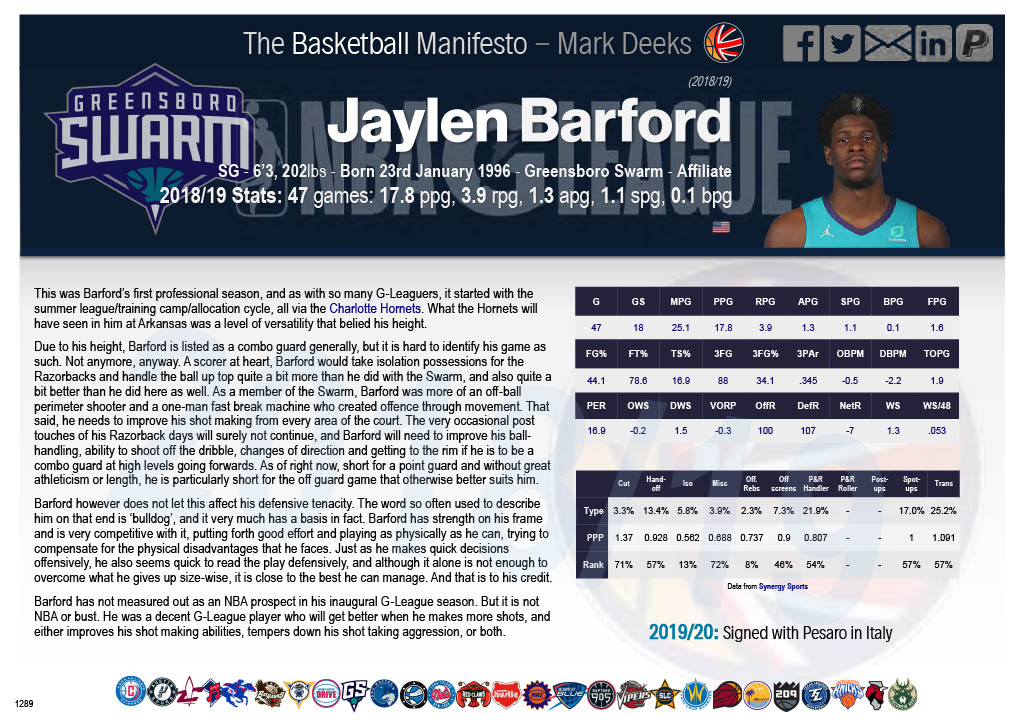
This was Barford’s first professional season, and as with so many G-Leaguers, it started with the summer league/training camp/allocation cycle, all via the Charlotte Hornets. What the Hornets will have seen in him at Arkansas was a level of versatility that belied his height.
Due to his height, Barford is listed as a combo guard generally, but it is hard to identify his game as such. Not anymore, anyway. A scorer at heart, Barford would take isolation possessions for the Razorbacks and handle the ball up top quite a bit more than he did with the Swarm, and also quite a bit better than he did here as well. As a member of the Swarm, Barford was more of an off-ball perimeter shooter and a one-man fast break machine who created offence through movement. That said, he needs to improve his shot making from every area of the court. The very occasional post touches of his Razorback days will surely not continue, and Barford will need to improve his ballhandling, ability to shoot off the dribble, changes of direction and getting to the rim if he is to be a combo guard at high levels going forwards. As of right now, short for a point guard and without great athleticism or length, he is particularly short for the off guard game that otherwise better suits him.
Barford however does not let this affect his defensive tenacity. The word so often used to describe him on that end is ‘bulldog’, and it very much has a basis in fact. Barford has strength on his frame and is very competitive with it, putting forth good effort and playing as physically as he can, trying to compensate for the physical disadvantages that he faces. Just as he makes quick decisions offensively, he also seems quick to read the play defensively, and although it alone is not enough to overcome what he gives up size-wise, it is close to the best he can manage. And that is to his credit.
Barford has not measured out as an NBA prospect in his inaugural G-League season. But it is not NBA or bust. He was a decent G-League player who will get better when he makes more shots, and either improves his shot making abilities, tempers down his shot taking aggression, or both.
– 20th June, 2019
This above is extracted from the following page in the The Basketball Manifesto, an entirely free 3,775 page, 1.2 million word-ish basketball reference book which contains reviews, strategies, ideas, opinions, and a whole lot of scouting on men’s world basketball.
– View tons more player profiles like this from the Manifesto here.
Ryan Anderson is one of the best offensive rebounding specialists in the game. This was not the case when he began his career at Boston College, with a 6.7% offensive rebounding percentage as a freshman. Yet that number skyrocketed up to 16.9% this year with the Blue Coats, and the resulting put-backs made up the majority of his otherwise limited offensive game.
Productive if unathletic, Anderson may not stand out offensively, but he is at least somewhat versatile. He is inefficient from every area except the point-blank range via the put-backs, yet he can at least get looks away from various spots on the court. In the post, Anderson has footwork and touch along with a hook shot over his left shoulder. He will occasionally drive from the open side of the floor on a defensive read, and is actually quite a decent face-up passer when given the opportunity.
Never being all that good of a jump shooter despite his persistent attempts to be, the idea that Anderson could add a pick-and-pop game to some slow pick-and-rolling has yet to come to fruition, and although it is to his credit that he takes his time, sometimes he takes too much. Anderson is not an athlete and thus struggles to play in the full-court game, and also struggles to cover ground defensively, where he uses elbows and tries to compete, taking charges where he can, but he is as below-the-rim on that end as he is offensively, and lacks for much shot-blocking instinct.
All of that information makes for a paint player who crashes the glass, finishes inefficiently (including a poor free throw stroke), who wins possessions for his team on the glass, competes, and adds a dimension that is not easy to add. All in all, a useful role player worth having, if not one with much upside.
– 20th June, 2019
This above is extracted from the following page in the The Basketball Manifesto, an entirely free 3,775 page, 1.2 million word-ish basketball reference book which contains reviews, strategies, ideas, opinions, and a whole lot of scouting on men’s world basketball.
– View tons more player profiles like this from the Manifesto here.
Rosters are mostly set after this summer’s free agency period, and teams are just mostly now nibbling around the edge. Aside from a couple of training-camp decisions, most players are now on the teams they will be with through at last January, as rarely do teams make mid-season changes prior to that.
Come January, though, and trade season will begin. Between then and the trade deadline at the start of February, many a player will be on notice, re-assignable at the drop of a hat as teams change and tweak directions based on the changing information throughout the first half. And then after that, in the time between the trade deadline and 1st March (a key date for player eligibility; if a player is on an NBA team’s roster at the end of that day, then that is the only team they can play for in the playoffs), some veteran players every season seem to get bought out, giving back money for the freedom to choose a team better suited for their needs, often going from a lottery team to a playoff team in the process.
There follows a look at some of the players who may fall victim to the latter practice.
Jeremy Lin, Atlanta Hawks
Lin was acquired by the Hawks into cap space, without much in the way of sweetener going the other way. Normally, players traded into cap space are either very good or highly unwanted, and with the latter, a first-round pick (or more) is usually traded with their contract as sweetener. Not so with Lin, onto whom the Brooklyn Nets stuck only a 2025 second-round pick in moving him to Atlanta. Lin is an unlikely Hawk, a now-veteran reserve point guard without upside or team control on his contract, who nevertheless replaces Dennis Schroeder as a more harmonious, cheaper alternative to push Trae Young’s career along.
Perhaps the answer to Lin’s perceived value lies in the secondary revenues he creates; by virtue of his Chinese heritage and the size of their increasingly passionate fanbase, Lin yields a ton of merchandise and apparel sales for whichever team he is signed to. However, by the time the trade deadline passes, all those Hawks Lin jerseys will already have been bought. Assuming he has only negligible trade value (which he will unless the Hawks are prepared to use him to take on salary, which would be highly out of character and out of kilter with the rest of the moves they have made of late), he becomes a logical buyout candidate. On a team not intending to win anything any time soon, what incentive is there to keep him?
Kenneth Faried, Jared Dudley and DeMarre Carroll, Brooklyn Nets
Acquired by the Nets along with picks in the deal that the Lin-acquiring Hawks should have done, Faried is an always-productive NBA player who has unfortunately lapsed into passed-around territory on account of both the size of his contract and the stagnation of his game. The Manimal was a valuable power forward back when power forwards who could not shoot jump shots were worth having, but while the game has developed around him, he has never developed his game, and a potential pairing with Nikola Jokic gave up far too many points defensively to ever work.
Carroll meanwhile is coming off a very strong bounce-back season for the Nets, posting career-highs in points, rebounds and assists one year after being acquired by the team in a salary dump. With this in mind, and considering the fact that his $15.4 million salary is expiring after this season as well, Carroll might have value in trade to a playoff-competitive team looking to shift a bad contract while also getting a player upgrade, even if only as a rental. (Think along the lines of Solomon Hill from New Orleans, or Brandon Knight from Houston.) Nevertheless, if the deal is not there, or if the Nets decided they would rather have the savings themselves for their own machinations next summer, Carroll becomes a buyout candidate on account of the fact that he will have suitors, which means money can be saved on a player likely leaving anyway.
The same is likely true of Dudley, albeit to a lesser degree. Acquired in the summer in yet another salary dump (coming paired with a lightly protected 2021 second-round pick on account of being a bit more expensive than Darrell Arthur, Dudley barely played for the Suns last year, appearing in career-lows of 48 games and 686 minutes. And when he did play, the always-slow Dudley looked particularly slow, unable to do much to get open or finish offensively and struggling to get to the spot defensively. But what Dudley is known for is an excellent basketball IQ, and of being able to read and call out plays, even if he cannot much be involved in defending them any longer. Veteran benches could always do with a wise, unselfish, heady and vocal player on their deep bench; the Nets could do so, too, but as Dudley’s earning window closes quickly, he may well want to spend the time he has left on a contender.
Bismack Biyombo and Tony Parker, Charlotte Hornets
Back with the team that drafted him after a bizarre summertime in trade (in which the Hornets were somehow able to get two second-round picks for swapping Timofey Mozgov’s $16 million salary for Biyombo’s $17 million), Biyombo will split time at centre with Cody Zeller and Willy Hernangomez. This is not an ideal situation for any of the three, who cannot foreseeably make for any power forward/centre combinations. As the most expensive and (amazingly!) oldest of the three, as well as the most recent and lowest-priced acquisition, Biyombo is the odd man out, the player offered rather than targeted. Hernangomez, one of the few youthful bright sparks on the team, will need opportunities on the court, and while yet another extended injury absence from Zeller would ease the rotation crunch, Zeller also needs to get good game minutes himself in order to realise his potential and/or rebuild his value on his own sizeable contract. More importantly, given how much they are paying to not go anywhere (and considering how they have so little in the way of expiring salary), the Hornets need to save money. And so if Biyombo would take a buyout and stretch, a la Luol Deng, in order to save on luxury tax this year and open up just a slither of a chance of being able to keep Walker next year, the Hornets would surely listen. Biyombo would definitely get another contract elsewhere, making it viable if unlikely at this time.
The same uncertainty surrounds Parker, and indeed any player on the Hornets’ roster. After the early move to remove Dwight Howard from the roster, the Hornets then did scant little else with their offseason other than sign Parker. They had more issues to address than the backup point guard situation; indeed, the starting point guard situation, and the future of Kemba Walker, is the biggest situation facing the team right now yet thus far remains unresolved. Should it become resolved via means of trade, which is very possible, so then may that of Parker, who would have no real purpose on a team out of contention and in need of both financial savings and roster spots with which to give late-season auditions to youngsters. A buyout of Parker could help with both of these.
George Hill, J.R. Smith and Kyle Korver, Cleveland Cavaliers
After LeBron’s departure, the Cavaliers have had a very quiet offseason. They extended Kevin Love to consolidate his value, but have otherwise largely stood pat, and the above three remain with the team despite their large contracts. Each of these contracts runs through 2020, yet each also has a very large expiring portion on their 2019/20 salary, making them essentially expiring if so desired. This in theory also gives them good trade value, as those salaries can be used to facilitate trades. Given their inaction, it remains to be seen what strategy the Cavaliers will choose to employ to find a path back to competitiveness; right now, it appears as though the aim is to tread water until next summer. And with that in mind, if any or all of these three make it beyond the February trade deadline with the team, they all become very strong candidates for March buyouts.
–
Robin Lopez, Chicago Bulls
In an era of the smaller, quicker, shootier centre, Robin Lopez remains a true paint player. The very occasional pick-and-pop three-pointer he shot to begin last season was an anomalous product of necessity that will not continue; instead, this is a man who thrives through hook shots, flat yet consistent elbow jumpers, and being within arm’s reach of the paint as a sneaky-reliable offensive player. Which is precisely what many contending teams may need. Chicago, however, will not be one such contender, and while there is an outside chance of them making a run at a low playoff seed next season, there is a far greater chance that this is not the roster that they will end the season with. And very few permutations of their future feature Lopez. Lopez is not a buyout candidate because he’s no good – instead, it’s because he is.
Wes Matthews and J.J. Barea, Dallas Mavericks
Considering they traded their 2019 first-round draft pick to the Atlanta Hawks as a part of the move up to get Luka Doncic, and thus have no real incentive to win next season (unless they are accidentally poor or heavily injury riddled and thus need to tank again to fit within the top five protection), Dallas will not be pawning players off for the sake of it. It is in their best interests to provide a culture of stability and veteran assistance, both on and off the court, to aid the first stages of Doncic and Dennis Smith. And both Matthews and Barea could be that.
That said, they also have to reconcile the reality of where the rest of the roster is. Dallas lacks for core talents beyond them two and much youth of note, and have spent a lot of money to not get far in recent seasons. Should a reasonable opportunity to save money and gain a roster spot avail itself with these two, then, a buyout is foreseeable. It is not usual Dallas MO, but then, nor was the Doncic trade.
Marcin Gortat, L.A. Clippers
Gortat is a Clipper now by virtue of an early-offseason trade that saw him sent from the Wizards (where he was openly unhappy) in exchange for Austin Rivers. But although he started the full 82 regular season games last year, and the year before that, and the year before the year before that, Gortat’s days as a starting NBA centre going forward are probably done. His impact finished significantly last season, as his long-declining defence took another hit, and his finishing abilities and stamina went too. This is not to say that he is no longer an NBA calibre player, though, and were he to be a free agent again, then, just like many other interior players on this list, he is good enough to merit work. The Clippers have an incredibly deep if starless roster, and could stand to parse it down somewhat, which may open up buyout talks for Gortat – there exists the possibility that they use his 2019 expiring as a vehicle for taking on assets in a salary dump, but, considering that they are also in play to potentially become a Kawhi Leonard-fuelled super team, this seems to be very unlikely.
Lance Thomas, New York Knicks
Although Thomas has now managed seven years in the NBA as a defensive-minded combo forward, who has become a decent-enough open shooter in that time, last season was not his best. The 40.7% three-point shooting drew the eye, but there was very little statistical output or impact on the game elsewhere, and the shooting was on a very low volume. That said, Thomas at his best has a end-of-the-rotation role as a Dante Cunningham, Luc Richard Mbah A Moute type, and if he would like to pursue that on a competitive team down the stretch of the season, the Knicks would surely facilitate that in order to save some money on his otherwise oversized contract. The very same Houston Rockets team that we theorised as being a good home for Luol Deng could perhaps find themselves a Deng-lite here.
Terrence Ross, Orlando Magic
Having dispensed with all of the anointed ‘core’ players in their previous rebuild with the possible exception of Nikola Vucevic, the Magic have yet to identify much in the way of a new core beyond perhaps the recently re-upped Aaron Gordon (for whom the extended sign-and-trade must be remembered as a possibility). Now aged 27, Ross is probably past being considered a part of it, and more important here is the fact that his six seasons in the NBA have all been pretty much exactly the same. The only difference is that he spent most of the last one injured; beyond that, Ross has been the same player who has developed little beyond the niche he fitted into from day one.
That said, Ross when healthy is a decent and useful player with the en vogue skill of shooting; he is a decent piece for Orlando to have, but considering his contract expires after this season, there is a foreseeable chance that he is bought out for the final third and joins a contender. It would make sense for him to do so, as an audition on a contender would do wonders for his earning power.
A few years in the doldrums have seen the Suns try out various young players, looking to identify core players, while also trying to flank them with veterans who can create the right culture and play with sufficient positional IQ to be able to help on the court as well. The results have been on the wrong side of mixed, though, and so as another era begins after their work on draft night, a few veterans remain on the team with little to tie them to the team for the year.
Arthur is only with the team as filler, swapped out for Jared Dudley above purely so as to be able to give the team enough room to trade for Richaun Holmes. He may add some value to the team as a veteran three-and-D frontcourt option, but in a front court with all of Holmes, Ryan Anderson, Deandre Ayton, Dragan Bender and T.J. Warren (assuming his future is mostly at power forward, which it should be) in it, that role will be so small as to be very dispensable. The same is true to a lesser degree of Chandler, a good player for a long time who can still rebound and move despite his age, although that same age makes him a very good buyout candidate. Considering the lack of roster space right now, and the assumed need to sign De’Andre Melton, either or both of these may happen sooner rather than later. To sign Melton will need both roster spots and cap space; the minimum salary exception and cap room mid-level exception, the two things remaining available to be used here, are both limited to a maximum of two years.
In the backcourt and on the wing, while Ariza was brought in on a one-year deal for a huge amount of money precisely to be a stabilising hand on a team short in all areas last season, it is nonetheless only a one-year deal. If things should go badly again on the court this season, Ariza, very much into the back half of his career, may seek to cash out and join a contender. If they see no chance of him returning next year, Phoenix might let him if he gives back the right amount. And as for Daniels – despite being a good shooter on one of the league’s worst shooting teams, he just isn’t all that helpful.
Zach Randolph, Iman Shumpert and Kosta Koufos, Sacramento Kings
The Kings’s strategy last summer to pair their young talents with savvy veterans on reasonable contracts did not work, and has mostly been disbanded. Vince Carter has already walked as a free agent, George Hill was traded to the Cavaliers for nothing of note just to be free of his deal, and although Randolph remains, his position must be vulnerable. Randolph can still play – it is not as though he had vital mobility to lose, and the Shaqtin’ A Fool-calibre three-point shooter of his past gave way to career-highs in attempts, makes and percentage last season, which if continued gives him some offensive value into his late 30s. Yet even if he does have a few seasons as a replacement-level offensive option still to give, there is not much reason to give them here in Sacramento.
Shumpert, the filler contract received back in the Hill deal, has yet to play for the Kings after a season riddled with injury. Even when healthy, he looked to have lost a lot from his peak, and only his contract binds him to the team still. If Shumpert and his agent can find another suitor, that can soon be fixed. Conversely, Koufos has been with the team for three years, is their second-longest tenured player (a mere two weeks behind Willie Cauley-Stein), is their second-best player if measured by PER (a mere 0.1 points behind Willie Cauley-Stein), and is their second-best player if measured by VORP (a mere 0.3 points behind Willie Cauley-Stein). These are all reasons why Koufos, a good and useful player, should be traded if possible. But if not, the buyout may happen.
Alec Burks, Utah Jazz
The Jazz should be good this year, thus making Burks something of an anomaly on this list. Rarely does the highly likely playoff team (which a strong, disciplined, defensive and deep Utah team should be even in the ever-improved Western Conference) have a possible buyout candidate – they are normally the ones looking to take on the depth. Nevertheless, there is an outside chance at such an eventuality in the case of Burks, a player who looks to have been squeezed out of a place with the Jazz. Burks’s knack for the acrobatic teams with his knack for the absurd to make for quite the enigma, someone far from reliable on the court (or indeed in his ability to even take the court considering his myriad injuries of late), but who, on a good day, can make a big impact once on it. He is the closest thing the league has to a second Lance Stephenson. And Lance Stephenson can be helpful.
Ian Mahinmi, Jason Smith and Jodie Meeks, Washington Wizards
Smith at the five spot and Meeks at off-guard represent deep bench depth for the Wizards, yet there is a reason both have been pushed out. In theory, both are shooting options on a team that could use some of those, particularly in the front court, but Smith lost his shot last season, and although he was relatively healthy all year, he barely featured in favour of two power forward line-ups. Meeks meanwhile featured a lot, but scored his fewest points and recorded his worst VORP since his rookie season, eight years ago. Troy Brown and Austin Rivers have been acquired to provide wing options for a reason, and while they are not the decent shooters that Meeks (normally) is, there is not enough in it to grant Meeks an automatic spot alone. With both players on expiring contracts and the Wizards considerably over the luxury tax thresholds, both seem unlikely to finish out these contracts; if they are not salary dumped, they will surely be bought out, and it is very likely they will actually endure both.
Mahinmi by contrast is not expiring, yet he like Biyombo above is a decent candidate for a Deng stretch. It is too late to stretch his salary for this season, and considering that doing so would have kept him on the books until 2023, it would not have been a good outcome for anyone involved other than the dodging of 2018/19 tax dollars (something that can be done in other ways if required, albeit with difficulty). He does however also have a large $15,450,051 salary for next season, fully guaranteed. It is already a large salary for a player who does not do many things, yet it is further made cumbersome by the fact that the Wizards have as-near-as-is $92.5 million committed already to John Wall, Bradley Beal and Otto Porter alone. At a time that they need to be financially prudent and to free up some spending money to improve a team that already looks fairly capped out, they are paying $15.5 million to a limited reserve. So if Mahinmi is prepared to give any of that back in order to speed up the stretching of his contract that seems quite likely to happen next summer anyway (and allow him to join a different, better team while remaining salary neutral), the Wizards will probably listen.
2018/19 EuroLeague previews: Milano have spent big money to build a competitor
September 7th, 2018
The 2018/19 Turkish Airlines EuroLeague season is coming around fast.
For the 16 teams taking part, preseason has already started, as teams work to gel their new rosters of players for the upcoming season in preparation for the first round of matches on October 2011. Teams new to the competition this year include Bayern Munich, Buducnost, Darussafaka and Gran Canaria, taking the places of Brose Baskets Bamberg, Crvena Zvezda, Unicaja Malaga and Valencia.
With rosters now mostly set, there follows over a series of posts here at GiveMeSport a look at all sixteen teams participating in the 2018/19 Turkish Airlines EuroLeague, in a preview of the upcoming season. It continues here with a look at Italian champions, Armani Olimpia Milano.
In: Mike James (from Panathinaikos), Christian Burns (from Cantu), Jeff Brooks (from Unicaja Malaga, Spain), Amedeo Della Valle (from Reggio Emilia), Nemanja Nedovic (from Unicaja Malaga)
In last year’s competition, Milano never got going. They lost their first three games, five of their first six, and nine of their first thirteen, ultimately finishing second-last with a 10-20 record. They were undone by having the competition’s worst overall defensive rating. And yet for whatever reason, they have sought to remedy that by adding offensive talent.
On the plus side, they have added some significant individual offensive talents. James and Nedovic are EuroLeague stars; creative, explosive, dynamic half-court talents who can get their own in isolation, get to the rim, finish, pull-up, work off of the scoring threat to find team mates, and save any possession with their individual shot-making talents. How they pair up remains to be seen, especially defensively considering their similarities. But having two players who can turn the outcome of a game should keep Milano relevant. In light of last season, that is required.
Beyond that pairing in the backcourt lies some shooting depth with Della Valle, whose shot was anomalously off last season yet who has turned in a decade now of heady off-ball movement and quick shooting off the catch, and Dairis Bertans, who has been doing much the same for even longer. Curtis Jerrells and Andrea Cinciarini return as ball handling depth (as can Bertans if needs be), with Cinciarini’s slow-footed surety as a playmaker and leader ever reliable in times of need, while Jerrells is similarly always good for some spot-ups, step-backs and pick-and-roll plays. Roster balance and multi-positional defence may be concerns going forward, but the backcourt is a strong one.
Up front, there is also change, with the slow but rugged centre pairing of Kaleb Tarczewski and Arturas Gudaitis (who was an advanced stats marvel last year, leading the competition with a 25.3 PER and ranking third in net rating with +28.0) to be paired at power forward with Brooks and Burns. Burns, a 33-year-old veteran with a much-needed Italian passport, brings some athletic rim-runs and rebounding tenacity to the team, retaining his leaping ability into the latter stages of his career while also serving as an occasional spot-up threat, while Brooks has been employing his long-armed tenacity for many years at this level, scrapping around the basket, defending both perimeter and interior, finishing with power, and improving throughout as a shooter. (Brooks, too, has just received an Italian passport after playing four previous seasons there.)
On the wing, Mindaugas Kuzminskas will be around for a full campaign, which will help, as the three spot was a weak point for the team last season. Incumbent starter Vladimir Micov struggles more and more defensively as he ages and slow, and while it is not a strength of Kuzminskas either, the two are very polished and savvy scorers both when driving to the rim and shooting from outside, Kuzminskas bringing some athleticism along with it. To provide depth at the position, Milano have replaced Abass (a much more athletic player who could never quite find his off-ball niche in the EuroLeague) with recalling Fontecchio from loan, a smooth if unexplosive 6’7 shooter and scorer.
In summation, then, Milano have added some depth. All the players who struggled last season – M’Baye, Kalnietis, Abass, Pascolo, Goudelock, Cory Jefferson in mid-season – have now gone, and the team has replaced them with two established stars. That is of note, even if they have not as obviously addressed their biggest team need. Between the back court additions of James and Nedovic, plus the rebuilt power forward spot, Milano have sought to become more athletic and dynamic around their two centres. Up to a point, it could work.
The defensive concerns are legitimate. But Milano should at least be fun.
2018/19 EuroLeague previews: Anadolu Efes look to bounce back from last place
September 6th, 2018
The 2018/19 Turkish Airlines EuroLeague season is coming around fast.
For the 16 teams taking part, preseason has already started, as teams work to gel their new rosters of players for the upcoming season in preparation for the first round of matches on October 2011. Teams new to the competition this year include Bayern Munich, Buducnost, Darussafaka and Gran Canaria, taking the places of Brose Baskets Bamberg, Crvena Zvezda, Unicaja Malaga and Valencia.
With rosters now mostly set, there follows over a series of posts here at GiveMeSport a look at all sixteen teams participating in the 2018/19 Turkish Airlines EuroLeague, in a preview of the upcoming season. First in the alphabetical series will be Anadolu Efes of Turkey.
Anadolu Efes
Out: Errick McCollum (unsigned), Vladimir Stimac (to Turk Telekom), Sonny Weems (unsigned), Derrick Brown (unsigned), Toney Douglas (to Sakarya), Zoran Dragic (unsigned), Berk Demir (to Darussafaka)
In: Adrian Moerman (from Barcelona), Rodrigue Beaubois (from Baskonia), Ahmet Tuncer (from Eskisehir), Shane Larkin (from Boston Celtics), James Anderson (from Khimky), Vasilije Micic (from Zalgiris), Tibor Pleiss (from Valencia), Sertac Sanli (from Besiktas), Metecan Birsen (from Sakarya)
–
By their own standards, Anadolu massively disappointed last year. The big spending Turkish team have not made it to a EuroLeague Final Four in the modern era, despite great expense and acquisition of name-recognition talent along the way, and yet lats year was a particularly troublesome one as they finished stone cold last in the regular season. To that end has come yet another significant overhaul, and a whole new load of import players, as, once again, Efes find themselves with a distinct lack of domestic talent on the team.
Being so reliant on imports and the short-term contracts they play on means to constantly have to work things out on the fly, as opposed to having long-term domestic lynchpins in the team around whom the action can be based and the pieces can be fitted. This also relies upon properly identifying import talents and how they will cohere, something which did not happen last season, when they seemed surprised that McCollum was primarily if not exclusively a scorer. They will therefore be hoping for solid deep-bench contributions from Turkish newcomers Tuncer (a solid young combo guard who probes, shoots, curls and makes plays on the perimeter), Sanli (a 6’11 pick-and-roll/pop finishing option who somehow has managed to increase his blocks rate throughout his career) and Birsen (a once-touted prospect yet to fully put it together but who offers size and athleticism which he uses to rebound and cut to the rim).
Efes also return holdovers Dogus Balbay (defensive specialist guard who almost never takes a turn on the ball) and Birkan Batuk (a once promising versatile young off-guard scorer who has become more and more of a shooting specialist with each passing year), to provide added quota-meeting guard depth. There are no big-minute Turkish players in the rotation, but Efes will be needing bench contributions from all. Overly relying on imports has not worked for years now.
In the middle, Bryant Dunston does at least buck that trend for roster turnover. Into what will now be his fourth season with the team, Dunston is a relative long-termer and remains one of the competition’s best interior anchors, leading the competition in blocks per game last season (1.7), and also contributing double-figures in points through a combination of rolling to the rim and paint touches. Dunston is physical, unafraid of anybody and an important combination of strength and leap inside. And while he will no longer be paired up with rebounding and hustle specialist Vladimir Stimac (eighth in the EuroLeague in rebounding last year at 5.8 per game), the sheer 7’2 size of Pleiss adds a new dimension to the team. Pleiss, always a talented scorer, is coming off a season in which he averaged 10.1 points in only 18.9 minutes per game of EuroLeague play for Valencia. Now he needs to hold his own defensively, as last season, the defence relied on Dunston far too much.
Elsewhere, it is all change at guard. Lamenting the lack of ball movement and shot creation last year, Efes replaced McCollum with Larkin, who prior to returning to the NBA last year had been a star EuroLeague guard. Larkin is small, but puts the work in on defence, and was an excellent lead guard for Baskonia two seasons ago. Quick and crafty, confident and committed, Larkin bounces around the court and brings the defenders with him. Behind him will be Vasilije Micic, formerly of Zalgiris, an error-prone but dynamic point guard in his own right. Micic has never been much of a defender or a shooter, two weaknesses of Efes last season, but he can pick a defence apart and create efficient looks, and should make a strong combination with Larkin.
At the other guard spot, McCollum’s replacement will be Beaubois, a player who got back to his best over the last couple of EuroLeague seasons with Valencia after a mid-career wobble, one not helped by injuries. Small though he may be, Beaubois is a furiously efficient scorer (.611% true shooting last year) on a high volume (11.7 points in 19.7 minutes per game), coming on a steady barrage of spot-ups, pull-ups and attacks into the trees. Efes need improved defence from last year, and Beaubois isn’t it, but they also needed to find a halfcourt scorer of some note to make up for what they lost in McCollum, and he certainly is that. Better, even.
The ineffective forward pairing of Weems and Brown will be replaced by Anderson and Moerman. Anderson is in the prime of his career, and although he projected in his youth as a three-and-D player, he has never excelled as either even now. Nevertheless, a bit of both plus some right-handed driving comes with some much-needed athleticism at the position, athleticism not so much provided by returning veteran Krunoslav Simon. Simon does a lot more with the ball in his hands, is crafty as anything and is an excellent extra passer, but last season, he never quite had his jump shot with him. With that back, he will be a key offensive contributor. Moerman meanwhile will bring his face-up, spot-up, post-up game to a forward rotation that hopes to offer more than just the athleticism of Brown, and should be an upgrade on Motum, a smooth and athletic face-up scorer who does much the same offensively as Moerman, but without rebounding.
The incoming players by themselves will not convey improved defence automatically. The only plus defender among them is Larkin. Nevertheless, while defence was Efes’s greatest weakness last season, it in turn was borne out by a stagnant, at times predictable offence. The changes should at least assuage that, providing better offensive dynamicism and outside shooting, and with a better run of luck with their collective health, Efes might make a low-seed playoff run this season.