Why Fans of Struggling NBA Teams Can Take Inspiration from the NFL
February 4th, 2026

The mainstream media has been calling it the “Underdog Super Bowl,” with others using similar names like “the Long Shot Super Bowl.” It, of course, refers to Super Bowl LX, where the New England Patriots will clash with the Seattle Seahawks in the climax of the NFL season.

The reasons for the nomenclature should be pretty apparent. Absolutely nobody would have picked these two to be the two Super Bowl teams at the start of the season. The Patriots were tagged as +8000 shots and the Seahawks +6000 to win the championship game with sportsbook football odds at the start of the season. It’s the biggest combined longshot Super Bowl in history.


The Patriots’ turnaround was historic

It was for good measure, too. The Patriots won four games across the 2024 NFL season; while the Seahawks won ten, they were not seen as elite. The latter added Sam Darnold and Cooper Kupp to the ranks, but few envisaged a run to the Super Bowl. The Patriots’ main change came in the coaching setup, with head coach Mike Vrabel, who was appointed in January 2025, showing that roster overhauls are not needed to transform losing teams into top contenders.

A lesson for some NBA fans? Maybe. Sports history is littered with examples of teams coming from nowhere to start winning again. The Celtics from 2006-2008, the Suns 2003-2005, and the Nets from 2000-2002 are examples of that. Of course, you can also argue that some of those teams added talent to the rosters to make the difference – certainly adding KG and Ray Allen was a dial-turner for the Celtics – but there were also tactical changes that made it possible.


Roster overhauls are not always necessary

Of course, nobody is saying that the Washington Wizards will suddenly become all-conquering ballers next season. The Wizards, like several other teams, require major surgery, but the NFL in 2025 taught us a lot about how patience with coaching plans and, indeed, front office tactics for acquisitions and roster-building paid off for several teams.

Indeed, the Super Bowl teams weren’t the only ones bouncing back from tough seasons. Others, ike the Chicago Bears and Jacksonville Jaguars, topped their divisions, making the postseason when it was fashionable to dismiss them at the beginning of the season.
What’s remarkable in our view is that there weren’t massive roster changes across the board, yet plenty of preseason favorites fell by the wayside early on. The Ravens, Chiefs and Lions had most of the same pieces in place as the 2024 season, with MVP-caliber quarterbacks, but they were swotted aside by teams who stuck to their plan and who stuck with their coaches.

It remains to be seen how much of a “fluke” the 2025 NFL season was. Perhaps those teams that rose up to the challenge will fall away again, and those big preseason favorites for the Super Bowl may show us that 2025 was just a blip, but it feels like a lesson that any team can turn their fortunes around with the right tactics, mindset and coaching.

Posted by at 2:55 AM

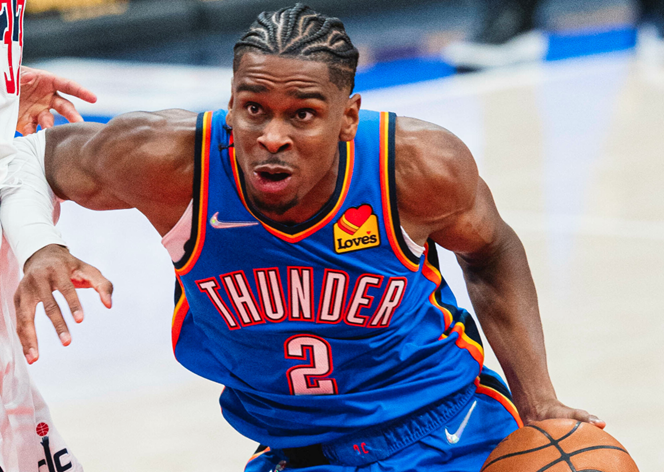
The Oklahoma City Thunder are Going to Singlehandedly Obliterate NBA Parity
February 4th, 2026

Say goodbye to the era of NBA parity. The Oklahoma City Thunder are about to kill it.

Seven different teams have won each of the past seven NBA titles. One cursory look through odds at the best NBA betting sites tells you the Association will not be getting an eighth straight non-repeat.

After hanging a banner for the 2024-25 campaign, Oklahoma City isn’t just heavily favored to win it all at the end of the 2025-26 campaign. It is comically, cosmically favored to be the first repeat champion since the Kevin Durant-era Golden State Warriors.

Yet, even as we say that, the Thunder may not be heavily favored enough. Most sportsbooks are still letting them pay out better than even money. That is absurd. It implies that the field has a chance. In reality, the field has no chance. Not this year.

And maybe not for the next few, either.


Oklahoma City is Built to Last

Juggernauts are not for everyone. Some fans appreciate variety in their championship-winners, a la the NFL with its Super Bowl champions. Then, of course, there are the fans who don’t want to watch an entire 82-game regular season if their team doesn’t have a puncher’s chance of dethroning the top squad.

Oklahoma City has the look and feel of an organization that is going to turn off those types of fair-weather fans. It has what would be a record-setting point differential, along with a realistic chance of breaking the NBA’s single-season 73-win mark, which was set by the 2015-16 Warriors.

But this is about more than just the 2025-26 season. It is about the future. The Thunder are built to dominate that, too.

In the Era of Aprons, no team’s reign is supposed to last very long. Roster-building restrictions are harder-line than ever as you get more expensive. And this says nothing of the luxury-tax penalties involved once your team crosses a certain threshold.

Even the most deep-pocketed organizations can’t stomach much time inside the dreaded second apron. The Los Angeles Clippers ran from it. Ditto for the Phoenix Suns. And the Boston Celtics.

The Thunder are different. They have the tools and resources to break the cycle of second-apron fears.

To be quite honest, if you have an ownership group willing to foot a luxury-tax bill, life in the second apron is a matter of stomaching roster-building restrictions. You can’t aggregate salaries in trades. Or take back more money than you send out. You can’t use the mini mid-level exception. If you spend enough time in the second apron, your draft picks seven years into the future get frozen out of trades and moved to the end of the first round.

This is incredibly problematic for teams that are not especially deep, young or stocked with other means of pipelining in cost-controlled prospects with higher upside. Oklahoma City doesn’t have this issue.

Not only do the Thunder have one of the seven youngest teams in the NBA, but they have the Association’s deepest rotation, bar none. More importantly, they have extra-draft picks galore. They will have no fewer than two first-round picks in every draft through at least 2029. So even if players price themselves out of town, they will have the means to develop younger players to replace them—the caliber of youngsters to whom no other contenders have access.


We Could Be Witnessing the Early Stages of an NBA Dynasty

We do not say this lightly: The Thunder could be the NBA’s next dynasty. We aren’t talking about a truncated window of dominance, like the Warriors enjoyed. We are talking about sustained excellence, similar to the San Antonio Spurs between 1998 and 2019, only potentially longer, and with more championships won.

Sure, this might sound inflammatory. But the Thunder’s brand of dominance and cache of assets speak for themselves.

Short of the mothership calling Shail Gilgeous-Alexander home, Oklahoma City is built to navigate every short- and long-term obstacle thrown in its way for the foreseeable future. This squad shouldn’t have to even think about knifing into its championship core for at least three years. And once they do, they have the pieces to fill in, augment and even upgrade the rest of the roster.

Put another way: Arrivederci, NBA parity. We’ll catch you again, at some point, a long time from now, if and when the Thunder allow it.

Posted by at 2:55 AM

NBA Finals Odds Shifts: Teams the Trends Favor for the 2025-26 Season
December 8th, 2025

Photo by simonkr from istockphoto.com

The 2025–26 NBA season has already delivered a dynamic mix of breakout performances, surprising early surges, and the continued dominance of established powerhouses. As teams settle into their identities and new storylines emerge, the futures market has been quick to adjust. Fans and analysts are watching closely as championship odds shift week by week, reflecting not only current records but also deeper indicators.

These early movements offer valuable insight into which franchises are positioned for long-term success. While the season remains far from decided, the trends forming now are often the ones that define the championship race by spring. In this post, we take a closer look at the teams whose odds are rising and the performance trends that are driving those shifts.


Oklahoma City Thunder

Oklahoma City holds the league’s best record at 20–1. Their start signals not only elite performance but the kind of consistent excellence required to defend a championship. The roster has remained focused and driven, and the team’s confidence is reflected in their NBA Finals odds.

The most significant factor behind Oklahoma City’s rise is the youth and versatility of its roster. The core featuring Shai Gilgeous Alexander, Jalen Williams, and Chet Holmgren continues to improve through natural development. Their adaptability in both offensive and defensive schemes allows the coaching staff to maximize matchups throughout the season. At the same time, their collective skill set gives the team the flexibility needed to counter any opponent.

Defense remains the defining trait of this team and reinforces their position as favorites. Their length and anticipation enable them to disrupt passing lanes on nearly every possession, which fuels their fast-paced transition attack. When the Thunder push the pace off turnovers, they apply consistent pressure that few teams can withstand, creating a championship-level profile that fully justifies their current odds.


Denver Nuggets

Denver remains one of the league’s most consistent contenders thanks to the continued dominance of Nikola Jokic. His scoring, rebounding, and playmaking elevate every possession and help the offense run smoothly. The team also improved its depth by adding Cam Johnson and Bruce Brown, two veterans who provide reliable minutes, postseason experience, and defensive flexibility that support the starting lineup.

The Nuggets’ system thrives because of Jokic’s rare versatility, allowing him to both score and create for others in ways defenses struggle to counter. His presence keeps shooters and cutters in rhythm and maintains Denver’s status as one of the league’s most efficient offenses. Oddsmakers remain confident in the Nuggets due to their star power, strengthened bench, and established identity. With a healthy roster, Denver is well-positioned for another strong postseason run.


Cleveland Cavaliers

Cleveland enters the season with a strong defensive identity and a roster built for sustained success. Their interior duo of Evan Mobley and Jarrett Allen consistently alters shots, protects the paint, and provides the stability needed for postseason basketball. This foundation allows the Cavaliers to control the pace of games and create matchups that favor their strengths.

The team also benefits from a highly analytical offensive approach that emphasizes efficient pick-and-roll actions and targeted three-point shooting. Their commitment to shot quality helped them rank last season’s offense No. 1, and they continue to refine their system for even better results. By focusing on high-percentage opportunities, Cleveland maintains a reliable, potent scoring attack.

Mobley’s emergence as the reigning Defensive Player of the Year adds another layer of credibility to Cleveland’s championship outlook. His versatility on defense, combined with Allen’s interior presence, limits opponents’ scoring options and raises the team’s overall ceiling. With a balanced blend of efficient offense and elite defense, the Cavaliers have firmly positioned themselves among the top Eastern Conference contenders.


Houston Rockets

Houston has made one of the biggest jumps in championship odds after adding Kevin Durant to its young core. His experience, scoring ability, and leadership immediately raise the team’s ceiling and attract defensive attention, opening opportunities for others. With Durant, Alperen Sengun, and Amen Thompson in the frontcourt, the Rockets now have impressive size and versatility that create matchup problems and strengthen their defensive presence.

The coaching staff has also leaned into an analytics-focused approach that improves spacing, shot quality, and overall efficiency. This combination of veteran star power and strategic structure has helped Houston become more consistent and competitive early in the season. As their chemistry continues to grow, the Rockets have positioned themselves as a legitimate contender, and their rising odds reflect growing confidence in their long-term potential.


Final Thoughts

The shifting odds across the league show how competitive and unpredictable the 2025 season has become. Teams climbing in the futures market tend to share key strengths such as strong defense, versatile rosters, and innovative analytic strategies. These qualities often define championship-level contenders and help them stand out from the rest of the field. Although injuries and trades may change the picture later in the season, the current trends provide a clear view of which teams are gaining momentum. Fans and bettors will continue watching closely as each contender proves how far its potential can take it.

Posted by at 6:57 PM

Favorites & Frontrunners: How NBA Championship Odds Are Already Shifting for 2025-26
November 13th, 2025

The new NBA season has only just begun, but early results and offseason moves are already changing how analysts and oddsmakers view the 2025–26 championship race. Preseason favorites are being tested, new contenders are emerging, and the market is quickly adjusting
to roster developments, injuries, and player performances. This overview looks at how several key teams have seen their title odds shift since the start of the season and what those changes suggest about the road ahead.


Oklahoma City Thunder

The Oklahoma City Thunder started the season as the favorite to win another championship at +240, and their strong play has already improved those lines to +210 according to current FanDuel NBA odds. The core trio of Shai Gilgeous-Alexander, Jalen Williams, and Chet
Holmgren continues to anchor one of the league’s most complete teams.

While other teams made big roster changes, the Thunder kept their group together. That stability has helped them look sharp early, with solid chemistry and balanced play across the lineup. They’ve shown that their success last season was no fluke.

Oklahoma City’s depth and teamwork make them the standard everyone else is chasing right now. If they stay healthy and focused, the Thunder have a real chance to repeat as champions.


San Antonio Spurs

If one storyline has captivated fans early, it’s Victor Wembanyama’s evolution. The 21-year-old phenom has taken a physical and mental leap, propelling the San Antonio Spurs from long shot status (+6500) to legitimate dark horse (+3000 to +3500).

The Spurs’ 2025–26 start has been electric, not only because of Wembanyama’s nightly highlight reel, but because the team is learning to win around him. The improved guard play and system cohesion are turning the Spurs’ rebuild into something far more immediate. They may not be ready to dethrone Oklahoma City, but they’re suddenly a team no contender wants to see in a seven-game series.


Houston Rockets

The Houston Rockets made one of the biggest moves of the offseason by trading for Kevin Durant. The addition immediately raised their profile in the Western Conference, but the early results have been mixed. Their title odds have slipped from +750 to around +1400–1500,
showing that success may take time.

Durant gives Houston a proven scorer and leader, joining a young group that includes Tari Eason, Alperen Şengün, and Amen Thompson. The offense has shown flashes of high potential, with plenty of spacing and creativity. When everything clicks, the Rockets look like
a team that can compete with anyone.

The challenge is consistency. Houston still needs to tighten up defensively and find the right balance between experience and youth. If Durant stays healthy and the group builds chemistry, the Rockets could become a dangerous playoff team by midseason.


Cleveland Cavaliers

The Cleveland Cavaliers have emerged as one of the East’s top-tier teams, even as injuries threaten to derail their rhythm. With Darius Garland and Max Strus sidelined, Cleveland’s odds have surprisingly improved from +900 to +650–750. That’s a testament to both market confidence and the squad’s ability to win ugly.

The Cavs’ core, led by Donovan Mitchell and Evan Mobley, remains elite defensively and increasingly confident in crunch time. If the team can weather its injury storm, it could be the East’s most balanced contender by spring.


New York Knicks

The New York Knicks have taken advantage of a shifting Eastern Conference landscape. Injuries to key players on rival teams have opened the door, and New York has positioned itself well. Their title odds have moved slightly from +750 to around +850–1200, but they
remain one of the most stable teams in the East.

Jalen Brunson continues to lead with strong play, and Karl-Anthony Towns is fitting in seamlessly after his trade from the Timberwolves. The Knicks’ offseason additions have added depth and balance, giving them more reliable scoring and defense off the bench. The roster looks more complete than it has in years.

If the Knicks can stay healthy and keep up their current pace, they have a strong chance to secure a top playoff seed. They may not be the flashiest team in the East, but their structure and discipline make them a serious contender.


Los Angeles Lakers

The Los Angeles Lakers are off to a solid start at 5–3. The Lakers have managed victories even without LeBron and, at times, Luka, thanks to improved team defense and better bench production. That depth will be essential as the season progresses and the team looks to stay
healthy.

If the Lakers can keep building chemistry and avoid major injuries, they have the tools to stay near the top of the standings. Their mix of star power and emerging role players gives them flexibility, but consistency remains the key to sustaining success through the long season.


Conclusion

The NBA season is a marathon, not a sprint. But if these early odds shifts are any indication, we’re in for one of the most unpredictable title chases in recent memory. Keep an eye on the risers; the future is arriving faster than anyone expected.

Posted by at 3:17 PM

Odds Boost Explained: Get More Value From Your Bets
October 7th, 2025

If you regularly place bets with a non GamStop bookmaker, you’ve probably already encountered the term: odds boost. You often see it in a brightly colored box above a match: “Boosted Odds!” or simply “Odds Boost.” And if you then look at the odds, you’ll indeed see that they’re higher than usual. Nice, right? More profit for the same stake.

But what exactly is an odds boost? And more importantly: how can you use it to your advantage? Our experts explain it all in a way that’s easy to follow, even without a math whiz.


Best Non GamStop Bookmakers With Odds Boost

Do you also appreciate a good deal when placing a bet? Then you’ve come to the right place. These non GamStop bookmakers regularly boost the odds, allowing you to win just that little bit more with the same bet. For a curated list of reliable options, check out the trusted non GamStop gambling platforms UK, where enhanced odds and secure betting experiences go hand in hand.

Bloody Slots

Orion’s Bet

Snatch Casino

GQ Bet

Check Bet

Beon Bet

Blaze Spins

Slots Paradise


What is an odds boost?

An odds boost is essentially a temporary promotion by a bookmaker where they slightly increase the odds of a bet. This can be seen, for example, with:

  • The result of a football match;
  • A combination of different outcomes;
  • A player who scores or receives a yellow card;
  • A combination bet on multiple matches.

Normally, you’d get 2.00 (even money) on such a bet. With an odds boost, that could suddenly increase to 2.50 or even 3.00. This means a higher payout for the same stake.


Different Types of Odds Boosts

Not every odds boost works the same way. Sometimes it’s simply a higher payout when you win, but sometimes there’s more to it. Here are a few variations you often see:

Types of Odds Boost Description
Classic Odds Boost The simplest form: a higher odds on a particular bet.
Odds Boost with Win Limit You’ll receive a boost, but you can only bet a maximum of €10, for example. Ideal for players on a tight budget.
Odds Boost with Free Bets You do not receive the extra winnings immediately in cash, but as a free bet that you have to wager again.
Boosted Combos Bookmakers create their own combination and increase the odds. For example: “City wins + Haaland scores.”

 How Do You Recognize a Good Odds Boost?

Not every boost is a golden opportunity. Sometimes it seems like you could make more profit, but it’s actually just clever marketing. These tips will help you see more quickly whether it’s actually paying off:

Compare with other bookmakers

Always check what the same bet without a boost is doing with other providers. Sometimes a boost seems like a good deal, while another bookmaker simply offers better odds as standard. Bookmakers without GamStop, in particular, can then offer surprisingly high odds because they have fewer restrictions and are keen to differentiate themselves.

Pay close attention to the conditions

Some boosts apply only to single bets, others only on mobile, or only to new players. So be sure to read the fine print to avoid any surprises.

Don’t just use it ‘just like that’

An odds boost is only valuable if you were already planning to place that bet. Don’t be fooled by higher odds on a bet you don’t actually believe in. Betting on something you don’t believe in doesn’t increase your chances of winning.


Odds Boost Smart Betting: Here’s How

A good odds boost can offer many advantages, if you approach it wisely. Here are some practical tips:

1. Apply it to smaller stakes

Odds boosts are perfect for small bets, as they offer a higher payout without any additional risk. This works well if you’re trying to capture value over the long term.

2. Leverage Boosts with Arbitrage or Matched Betting

Are you experienced? Then you can use boosts for arbitrage or matched betting. This means betting on both outcomes at different bookmakers. For example: a boost on team A at bookmaker X, and a standard odd on team B at bookmaker Y. This way, you cover both outcomes and still benefit from higher odds.

3. Save your boost for the right bet

You don’t have to use every boost right away. Some non GamStop casinos let you choose which bet you want to boost. So only use it if you’re truly confident in that bet.

Practical examples

To make the odds boost function a little clearer, we’ll give you some practical examples:

Example 1: PSV plays FC Twente and there’s a boost on “PSV wins 2-0” from 7.50 to 10.00. You were going to place that bet anyway, so a €10 stake earns you €100 instead of €75. That’s a nice bonus.

Example 2: During the European Championship, there’s a boost on “Cristiano Ronaldo scores + Portugal wins” from 3.00 to 4.50. But if Ronaldo is injured, it’s better to let that boost expire.


Conclusion: a useful bonus if you use it wisely

Odds boosts don’t guarantee big wins, but they can definitely make a difference if you know how to use them at the right time. Remember: a boost doesn’t change the odds of your bet being successful, but it does increase your odds if it works out. Think of it like a deal at the supermarket. If you wanted the product anyway, a lower price is a welcome bonus. But buying something just because it’s on sale? That’s usually a waste of money.

The same goes for sports betting. Only use an odds boost if you already had a good feeling about that bet, and not just because it looks appealing. Keep comparing non GamStop casinos and critically review what they offer. Always pay close attention to the terms and conditions. Some boosts are truly interesting, while others are best left unchecked.


Posted by at 1:53 AM

Betting Without Registration at Non GamStop Bookmakers
October 7th, 2025

Many players are looking for a way to bet without registering. With bookmakers without registration, you can still gamble despite registering in GamStop. These gambling sites also offer a wider selection and fewer restrictions. For those seeking reliable alternatives, our experts recommend trusted sports betting platforms outside GamStop, ensuring you can bet safely without registering.


Bet without registration at the best non GamStop casinos

Want to bypass GamStop and bet on your favorite sports right away? Then you’ve come to the right place. Our casino experts have selected the best bookmakers where you can bet without GamStop scheme.


Sports to bet on without registration

With bookmakers without registration, you can bet on a wide range of sports. Think of major football competitions like the Premier League, and Champions League, but also tennis, Formula 1, darts, basketball, MMA, and even esports. Live betting is almost always available, and often unique bets are also possible, such as on goalscorers, cards, or lap times.

British bookmakers prohibit certain bets. For example, you can’t bet on yellow or red cards, or corners. If you bet without registering at a foreign online casino, you do have access to all types of bets and sports. So you won’t miss out on any choice, except for the GamStop restriction. For a closer look at how these platforms perform in practice, check out the real user feedback on Aphrodite Casino, where players share their experiences with betting options, payouts, and overall reliability.

Here is an overview of the most popular sports at bookmakers without GamStop:

Sport Higher odds? Live streaming available? Special markets
Football Yes, often better than in the UK Yes, in top matches Goalscorers, cards, combos
Formula 1   Often limited Only major GPs
Tennis     Sets, games, live betting
MMA/UFC     Round, method of winning
Esports     First blood, map win, kills
Darts     Legs, highest finish

Bonuses at non GamStop bookmakers without registration

Bookmakers without registration offer various bonuses to players who enjoy betting on sports. The most common is the welcome bonus, often in the form of a deposit bonus that doubles your first deposit. For example, a 100% welcome bonus up to €100. However, you must first complete a deposit.

You’ll also often receive free bets. These are free bets you place without using any of your own money. You usually receive these free bets when you make a minimum deposit of, say, €20. You can then use the free bets on sports events with minimum odds.

Other popular bonuses at non GamStop bookmakers without registration are:

  • Cashback promotions;
  • Odds boosts and;
  • Special promotions.

With a cashback bonus of, for example, 10%, you get 10% of your losses back. This bonus is available weekly, daily, or as a one-time bonus. If you benefit from an odds boost, the payout odds are temporarily increased for certain matches. Some non GamStop bookmakers also offer loyalty programs or special promotions around major sporting events.


Reliability of non GamStop bookmakers without registration

As a player, it’s understandable to wonder how reliable casinos without GamStop are. These providers are not supervised by the British Gaming Authority. However, this doesn’t automatically mean they’re unsafe. These bookmakers are also strictly monitored by the local gambling authority. They therefore also hold licenses that impose strict requirements on fair play, payouts, and security.

Besides a reliable license, you can check a number of things to ensure a bookmaker is reliable:

  • Transparent conditions
  • Easily accessible customer service
  • Encrypted connection (SSL)
  • Positive experiences from other players
  • Leading software developers (Pragmatic Play, NetEnt, Hacksaw Gaming, etc.)

Betting without registration vs. Pay n Play casinos

Pay n Play casinos are sometimes confused with casinos without GamStop registration, but there are important differences. With a bookmaker without GamStop, you have to register and then make your deposit. With these bookmakers, you simply create an account with your email address and password. Sometimes you also have to submit documents for verification.

A Pay ‘n Play casino truly focuses on speed and convenience. You don’t need to create a traditional account. Instead, you log in and deposit money directly through your bank, and your identity is automatically verified using your bank details. Pay ‘n Play essentially means: instant play without an account, with fast payouts.


Advantages and disadvantages of betting without registration

Gambling without registration has both advantages and disadvantages. You’re not bound to the British exclusion register, which gives you more freedom. Even if you’re registered in GamStop, you still have access to foreign bookmakers with leading licenses. Furthermore, the game selection is often broader, you have more sports to bet on, and you gain access to all types of bets. Moreover, you often enjoy better odds and more international sports, and you can bet on esports.

A disadvantage of betting without registration is that you can’t contact a British regulator in case of a dispute.

Advantages

  • More sports to bet on
  • Access to all types of bets
  • Often sharper odds
  • More international sports and Esports

Disadvantages

  • Less support for responsible gaming

Conclusion: sports betting without restrictions

Betting without registration clearly offers you more freedom and options as a player, especially if you consciously choose to play outside the British system. You gain access to a wider range of games, higher odds, and unrestricted bonuses. However, this freedom is not without risk. Because you’re playing outside the supervision of the British Gaming Authority, you, as a player, have a greater responsibility to choose a reliable provider.

Want to be sure you’re choosing a reliable bookmaker? Then be sure to check out the online casino reviews compiled by our casino experts. This way, you’ll have all the information at a glance.


Posted by at 1:51 AM

The Basketball Manifesto
November 17th, 2020

The Basketball Manifesto is a 3,775 page, 1.2 million word-ish basketball reference book. And it is free to download.

It contains reviews, strategies, ideas, opinions, and a whole lot of thoughts on stuff. This document contains reviews, strategy, assessments, ideas and plans for every NBA team and every NBA player. It seeks to:

1) Look at the assets a team has to work with.
2) Look at what it already has.
3) Look at what it needs to address.
4) Lay out conceptual strategy for it all.
5) Discuss without preaching, except in some slightly preachier moments.

It does this 30 times for 30 NBA teams. Then it does the entire G-League, twice. Then it does the annual draft pool, twice. And then it does the EuroLeague…..twice. You get the idea, and if you don’t, you will do once you open it. It’s very, very densely full of content. All in all, it gets quite big.

This is a PDF file, and a live document. The links are navigable; the thing self-references. It is, I hope, a website you can download. And it is the pride of my life.

Download it at the link below, do please share it to all other basketball fans, email me your thoughts, and let’s have a conversation.

Thank you!

– Mark Deeks

DOWNLOAD THE BASKETBALL MANIFESTO HERE

BACKUP LINK BECAUSE APPARENTLY GOOGLE’S GOT A MARDY ON TODAY

.


Alternatively, if you want to just download separate sections of The Basketball Manifesto, rather than the whole shaboodle, use the following links:

  • 2019/20 G-League
Posted by at 9:34 AM

Prince Williams – 2018-19 G-League Player Profile
June 20th, 2019

Prince Williams

PG/SG – 6’5, 200lbs – Born 22nd August 1992

   Iowa Wolves   

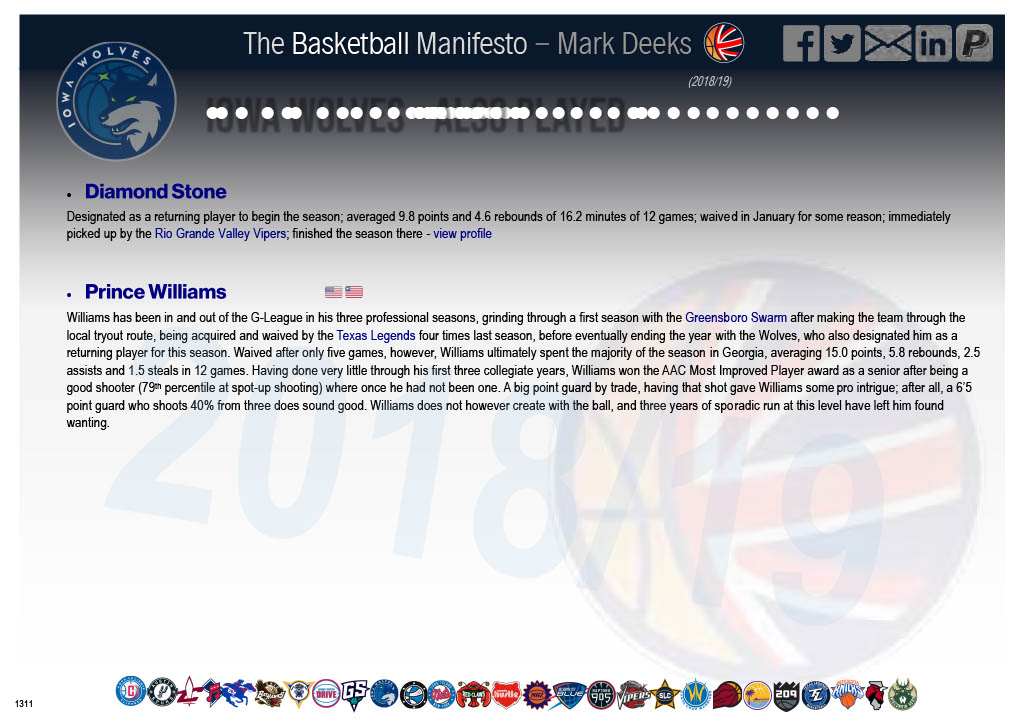
Williams has been in and out of the G-League in his three professional seasons, grinding through a first season with the Greensboro Swarm after making the team through the local tryout route, being acquired and waived by the Texas Legends four times last season, before eventually ending the year with the Wolves, who also designated him as a returning player for this season. Waived after only five games, however, Williams ultimately spent the majority of the season in Georgia, averaging 15.0 points, 5.8 rebounds, 2.5 assists and 1.5 steals in 12 games. Having done very little through his first three collegiate years, Williams won the AAC Most Improved Player award as a senior after being a good shooter (79th percentile at spot-up shooting) where once he had not been one. A big point guard by trade, having that shot gave Williams some pro intrigue; after all, a 6’5 point guard who shoots 40% from three does sound good. Williams does not however create with the ball, and three years of sporadic run at this level have left him found wanting.

– 20th June, 2019


  • This above is extracted from the following page in the The Basketball Manifesto, an entirely free 3,775 page, 1.2 million word-ish basketball reference book which contains reviews, strategies, ideas, opinions, and a whole lot of scouting on men’s world basketball.

– View tons more player profiles like this from the Manifesto here.

Posted by at 11:44 PM

Hakim Warrick – 2018-19 G-League Player Profile
June 20th, 2019

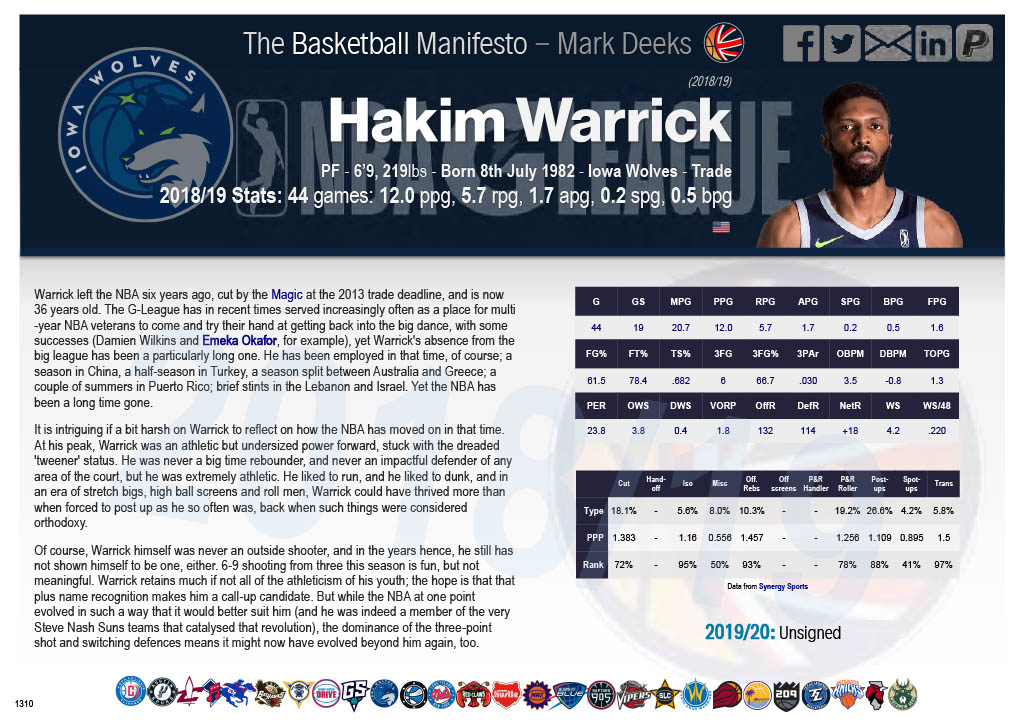
Hakim Warrick

PF – 6’9, 219lbs – Born 8th July 1982

   Iowa Wolves   

Warrick left the NBA six years ago, cut by the Magic at the 2013 trade deadline, and is now 36 years old. The G-League has in recent times served increasingly often as a place for multi -year NBA veterans to come and try their hand at getting back into the big dance, with some successes (Damien Wilkins and Emeka Okafor, for example), yet Warrick’s absence from the big league has been a particularly long one. He has been employed in that time, of course; a season in China, a half-season in Turkey, a season split between Australia and Greece; a couple of summers in Puerto Rico; brief stints in the Lebanon and Israel. Yet the NBA has been a long time gone.

It is intriguing if a bit harsh on Warrick to reflect on how the NBA has moved on in that time. At his peak, Warrick was an athletic but undersized power forward, stuck with the dreaded ‘tweener’ status. He was never a big time rebounder, and never an impactful defender of any area of the court, but he was extremely athletic. He liked to run, and he liked to dunk, and in an era of stretch bigs, high ball screens and roll men, Warrick could have thrived more than when forced to post up as he so often was, back when such things were considered orthodoxy.

Of course, Warrick himself was never an outside shooter, and in the years hence, he still has not shown himself to be one, either. 6-9 shooting from three this season is fun, but not meaningful. Warrick retains much if not all of the athleticism of his youth; the hope is that that plus name recognition makes him a call-up candidate. But while the NBA at one point evolved in such a way that it would better suit him (and he was indeed a member of the very Steve Nash Suns teams that catalysed that revolution), the dominance of the three-point shot and switching defences means it might now have evolved beyond him again, too.

– 20th June, 2019


  • This above is extracted from the following page in the The Basketball Manifesto, an entirely free 3,775 page, 1.2 million word-ish basketball reference book which contains reviews, strategies, ideas, opinions, and a whole lot of scouting on men’s world basketball.

– View tons more player profiles like this from the Manifesto here.

Posted by at 11:44 PM

Jonathan Stark – 2018-19 G-League Player Profile
June 20th, 2019

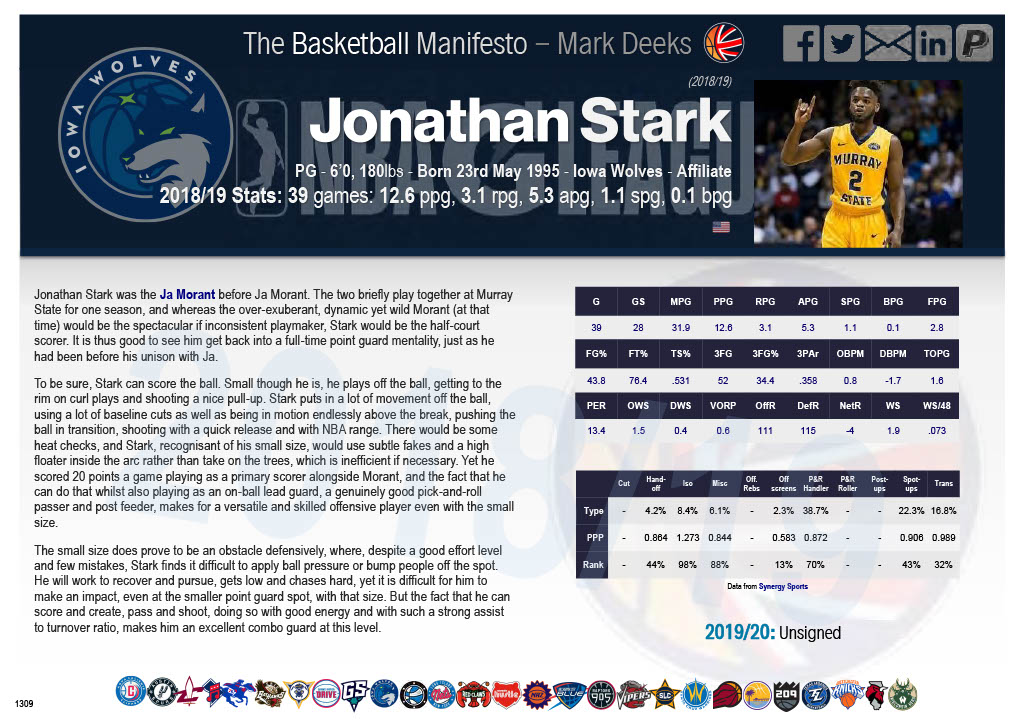
Jonathan Stark

PG – 6’0, 180lbs – Born 23rd May 1995

   Iowa Wolves   

Jonathan Stark was the Ja Morant before Ja Morant. The two briefly play together at Murray State for one season, and whereas the over-exuberant, dynamic yet wild Morant (at that time) would be the spectacular if inconsistent playmaker, Stark would be the half-court scorer. It is thus good to see him get back into a full-time point guard mentality, just as he had been before his unison with Ja.

To be sure, Stark can score the ball. Small though he is, he plays off the ball, getting to the rim on curl plays and shooting a nice pull-up. Stark puts in a lot of movement off the ball, using a lot of baseline cuts as well as being in motion endlessly above the break, pushing the ball in transition, shooting with a quick release and with NBA range. There would be some heat checks, and Stark, recognisant of his small size, would use subtle fakes and a high floater inside the arc rather than take on the trees, which is inefficient if necessary. Yet he scored 20 points a game playing as a primary scorer alongside Morant, and the fact that he can do that whilst also playing as an on-ball lead guard, a genuinely good pick-and-roll passer and post feeder, makes for a versatile and skilled offensive player even with the small size.

The small size does prove to be an obstacle defensively, where, despite a good effort level and few mistakes, Stark finds it difficult to apply ball pressure or bump people off the spot. He will work to recover and pursue, gets low and chases hard, yet it is difficult for him to make an impact, even at the smaller point guard spot, with that size. But the fact that he can score and create, pass and shoot, doing so with good energy and with such a strong assist to turnover ratio, makes him an excellent combo guard at this level.

– 20th June, 2019


  • This above is extracted from the following page in the The Basketball Manifesto, an entirely free 3,775 page, 1.2 million word-ish basketball reference book which contains reviews, strategies, ideas, opinions, and a whole lot of scouting on men’s world basketball.

– View tons more player profiles like this from the Manifesto here.

Posted by at 11:44 PM

Evan Smotrycz – 2018-19 G-League Player Profile
June 20th, 2019

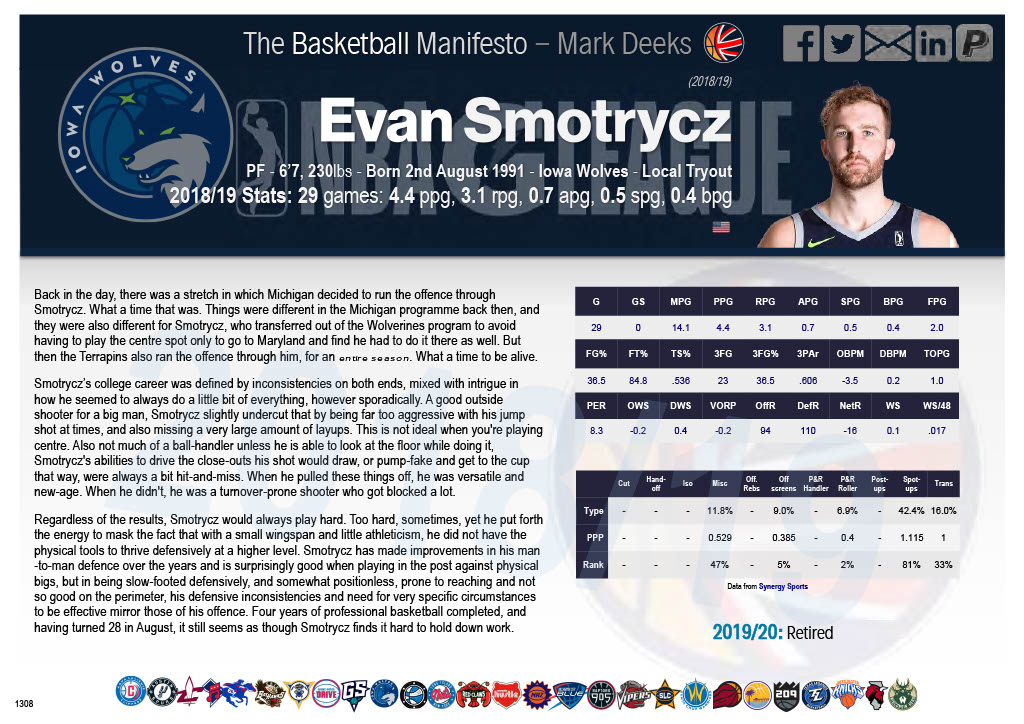
Evan Smotrycz

PF – 6’7, 230lbs – Born 2nd August 1991

   Iowa Wolves   

Back in the day, there was a stretch in which Michigan decided to run the offence through Smotrycz. What a time that was. Things were different in the Michigan programme back then, and they were also different for Smotrycz, who transferred out of the Wolverines program to avoid having to play the centre spot only to go to Maryland and find he had to do it there as well. But then the Terrapins also ran the offence through him, for an entire season. What a time to be alive.

Smotrycz’s college career was defined by inconsistencies on both ends, mixed with intrigue in how he seemed to always do a little bit of everything, however sporadically. A good outside shooter for a big man, Smotrycz slightly undercut that by being far too aggressive with his jump shot at times, and also missing a very large amount of layups. This is not ideal when you’re playing centre. Also not much of a ball-handler unless he is able to look at the floor while doing it, Smotrycz’s abilities to drive the close-outs his shot would draw, or pump-fake and get to the cup that way, were always a bit hit-and-miss. When he pulled these things off, he was versatile and new-age. When he didn’t, he was a turnover-prone shooter who got blocked a lot.

Regardless of the results, Smotrycz would always play hard. Too hard, sometimes, yet he put forth the energy to mask the fact that with a small wingspan and little athleticism, he did not have the physical tools to thrive defensively at a higher level. Smotrycz has made improvements in his man -to-man defence over the years and is surprisingly good when playing in the post against physical bigs, but in being slow-footed defensively, and somewhat positionless, prone to reaching and not so good on the perimeter, his defensive inconsistencies and need for very specific circumstances to be effective mirror those of his offence. Four years of professional basketball completed, and having turned 28 in August, it still seems as though Smotrycz finds it hard to hold down work

– 20th June, 2019


  • This above is extracted from the following page in the The Basketball Manifesto, an entirely free 3,775 page, 1.2 million word-ish basketball reference book which contains reviews, strategies, ideas, opinions, and a whole lot of scouting on men’s world basketball.

– View tons more player profiles like this from the Manifesto here.

Posted by at 11:44 PM

Xavier Silas – 2018-19 G-League Player Profile
June 20th, 2019

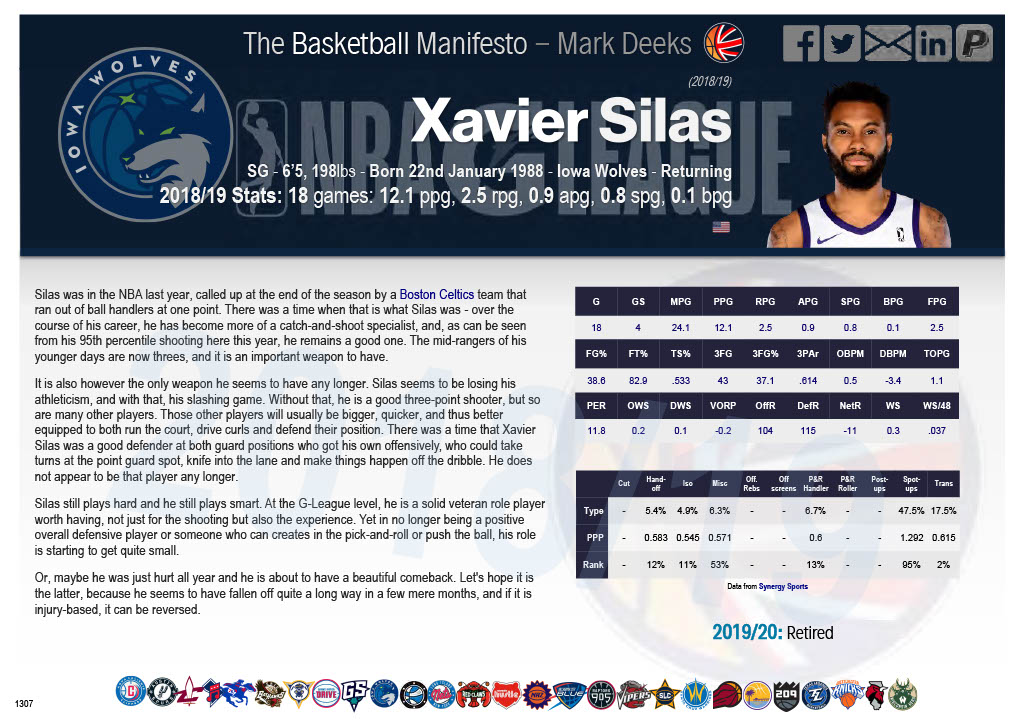
Xavier Silas

SG – 6’5, 198lbs – Born 22nd January 1988

   Iowa Wolves   

Silas was in the NBA last year, called up at the end of the season by a Boston Celtics team that ran out of ball handlers at one point. There was a time when that is what Silas was – over the course of his career, he has become more of a catch-and-shoot specialist, and, as can be seen from his 95th percentile shooting here this year, he remains a good one. The mid-rangers of his younger days are now threes, and it is an important weapon to have.

It is also however the only weapon he seems to have any longer. Silas seems to be losing his athleticism, and with that, his slashing game. Without that, he is a good three-point shooter, but so are many other players. Those other players will usually be bigger, quicker, and thus better equipped to both run the court, drive curls and defend their position. There was a time that Xavier Silas was a good defender at both guard positions who got his own offensively, who could take turns at the point guard spot, knife into the lane and make things happen off the dribble. He does not appear to be that player any longer.

Silas still plays hard and he still plays smart. At the G-League level, he is a solid veteran role player worth having, not just for the shooting but also the experience. Yet in no longer being a positive overall defensive player or someone who can creates in the pick-and-roll or push the ball, his role is starting to get quite small.

Or, maybe he was just hurt all year and he is about to have a beautiful comeback. Let’s hope it is the latter, because he seems to have fallen off quite a long way in a few mere months, and if it is injury-based, it can be reversed.

– 20th June, 2019


  • This above is extracted from the following page in the The Basketball Manifesto, an entirely free 3,775 page, 1.2 million word-ish basketball reference book which contains reviews, strategies, ideas, opinions, and a whole lot of scouting on men’s world basketball.

– View tons more player profiles like this from the Manifesto here.

Posted by at 11:44 PM

Jaylen Johnson – 2018-19 G-League Player Profile
June 20th, 2019

Jaylen Johnson

PF – 6’9, 230lbs – Born 7th August 1996

   Iowa Wolves   

Declaring for the NBA Draft after his junior season at Louisville in 2017, Johnson is still young and therefore still a project. In what would have been his senior season, he received a 10-day call-up from the Chicago Bulls – albeit without playing any game time, instead being one of several players they called up without playing so as to get more money to their G-Leaguers – and then went to summer league with the L.A. Clippers. He is on the NBA radar on account of having NBA athleticism. Further development to his skill set has been required, and having progressed in every major statistical category this G-League season compared to last, perhaps it has been forthcoming.

Johnson’s basic numbers are down across the board this season due to a big decline in his minutes per game. Yet in every efficiency metric, he improved. Johnson became a better and more efficient scorer from all areas, hit more jump shots, fouled less, turn the ball over far far less and ultimately was a big positive in a smaller role. His game is best defined by his athleticism, where his length and good frame make him an agile player who gets into a lot of space, and back when he was wild and unskilled, he was at least aggressive. Overly aggressive, but decisive nonetheless. Now that he has more poise and strength in his frame, Johnson is a stretch four with an unblockably high shot, doing so without losing his ability to score on the move or finish around the basket.

There are still areas of his game to work on. Johnson’s jump shot improvements are valuable, yet he does not seem to have put in the same work from the free throw line, and for one so athletic, you would think he would win more possessions defensively. As it is, Johnson has still yet to play with the energy required on that end, and this remains the next key area for him to grow in. Indeed, there is still quite a long way for him to go. But then, there is also quite a lot to work with.

– 20th June, 2019


  • This above is extracted from the following page in the The Basketball Manifesto, an entirely free 3,775 page, 1.2 million word-ish basketball reference book which contains reviews, strategies, ideas, opinions, and a whole lot of scouting on men’s world basketball.

– View tons more player profiles like this from the Manifesto here.

Posted by at 11:44 PM

Marquise Moore – 2018-19 G-League Player Profile
June 20th, 2019

Marquise Moore

PG/SG – 6’2, 208lbs – Born 22nd December 1994

   Iowa Wolves   

I love four things in this world. Sausage sandwiches, the lead singer out of The Interrupters (call me, Aimee!), 6’7 point guards who can’t shoot, and extremely undersized guards who rebound like centres. Here, then, is Marquise Moore, and I won’t hear a word said against him.

As a senior at George Mason, Moore averaged 10.9 rebounds per game. He did this while playing at the point guard position. That is tough to fathom. It should have course therefore be taken as a given that Moore plays with a tremendous level of energy, particularly on the defensive end. He is an athlete, certainly, but one with a furious level of determination. Moore goes after every loose ball and wins ones he should have no rightly business getting. Sometimes, smaller players grab a relatively high number of rebounds because they are essentially playing as undersized frontcourt guys – DeMarcus Gatlin from Sam Houston State is one that comes to mind, as is Javonte Green from Radford, because apparently that’s how my mind works (call me, Aimee! I can change!) – but Moore really is doing it while playing the point guard position. It is unique what he is doing.

Of course, this is a bonus rather than a requirement. What Moore needs is to be able to play the point guard position in every other way, or the shooting guard spot at least. With a distinctly below-average jump shot, Moore is not the most creative player with the ball in his hands either. He is instead better served when cutting off the ball for athletic finishes, attacking the rim and getting to the line. Yet playing a ball-handling spot does not much allow for that. If he is not to play a ball-handling spot, then he is going to have to succeed at defence more than just with the rebounding, as well as hitting more shots.

I have as much confidence in Moore as I can have in any generously listed 6’2 guard to be able to defend those bigger than him, and much more belief in him than I have that Aimee will ever call. But unless he improves offensively, it may never be enough.

– 20th June, 2019


  • This above is extracted from the following page in the The Basketball Manifesto, an entirely free 3,775 page, 1.2 million word-ish basketball reference book which contains reviews, strategies, ideas, opinions, and a whole lot of scouting on men’s world basketball.

– View tons more player profiles like this from the Manifesto here.

Posted by at 11:44 PM

William Lee – 2018-19 G-League Player Profile
June 20th, 2019

William Lee

PF – 6’8, 210lbs – Born 10th January 1995

   Iowa Wolves   

This was Lee’s first professional season out of UAB, and it began with a summer league stint with the Memphis Grizzlies. After not getting a training camp contract from them, he initially signed in Serbia with Dynamic Belgrade, yet left just before their season started, signed a one-day contract with the Minnesota Timberwolves and then was allocated to Iowa, where he spent the entire season. However, Lee did not translate the two-way game he had demonstrated with the Blazers previously, and found himself behind the pace offensively in particular.

An athlete, a dunker and a shot blocker, Lee has a very good professional projection based on that alone. Yet at UAB, he also was a 59th percentile spot up shooter. It was not much, yet given that Lee has a very limited handle on the ball and rudimentary post-up moves, it added an offensive dimension beyond merely cutting and rolling to the rim. When Lee is not able to dunk, he struggles to finish around the basket, even with all that athleticism – he tends to go up rather soft, and his lean frame does not take a bump well. The jump shot and the threat of it open up the court for him, giving him some room in which to drive. It only works though if he hits his shots. This year, he did not hit enough of them, and when combined with all of the things that he does not do offensively, this made him a distinct net negative on that end of the court. Consistent balance and release point on the shot will be key to him taking a lot of the variance out of his shooting game.

Lee made a portion of it back defensively with his quick leaping ability and good contests. The length and speed make him able to cover ground and be a help presence, as well as recover to those whom the rest of the defence missed. The lack of strength can again make him exploitable to those who prefer to play physically, yet Lee’s rebounding rate improved this season, which gives him some added value on the end. In a league looking for stretch fours who can defend multiple positions, Lee is on the radar, but he needs to be a lot more productive than this.

– 20th June, 2019


  • This above is extracted from the following page in the The Basketball Manifesto, an entirely free 3,775 page, 1.2 million word-ish basketball reference book which contains reviews, strategies, ideas, opinions, and a whole lot of scouting on men’s world basketball.

– View tons more player profiles like this from the Manifesto here.

Posted by at 11:44 PM

Darius Johnson-Odom – 2018-19 G-League Player Profile
June 20th, 2019

Darius Johnson-Odom

SG – 6’1, 220lbs – Born 28th September 1989

   Iowa Wolves   

Prior to his return this season, Johnson-Odom had been away from the G-League for four years. The vast majority of that time had been spent in Italy, where he had been amongst the country’s highest scorers, leading it outright last season with Vanoli Cremona. Johnson-Odom always has been and always will be a scorer, a prolific one by volume as well as efficiency. Of that, there has long been no doubt.

Johnson-Odom gets his points in pretty much every way conceivable. He is a ball-dominant player by trade, but if ever he is run off the ball, he has a very good spot-up shot he can use. When on the ball, he also shoots off the dribble, albeit not as well, yet he is primarily looking to get beyond the first line of the defence and make things happen. Johnson-Odom is very strong for his small size, and without having the greatest speed, he also pushes the ball wherever he can. If you need someone to get you a basket, he is always a good bet – he can drive both ways, finishes extremely well at the basket with his very strong upper body, makes excellent reads and never wavers in his confidence. Johnson-Odom, simply, is a workhorse.

Given his size, DJO is always going to be a defender of point guards. Or at least, he should be. Playing alongside Jonathan Stark and Marquise Moore this season saw him play a lot of shooting guard, a position well suited to his offensive game yet one at which he gives up a significant degree of size. It is thus not a surprise that he was an overall net negative as a defensive player considering that the Kellen Dunhams of this world can just shoot over him, and others who slash can just keep going at him, hoping to get him in foul trouble.

At the NBA level, these things would only be exacerbated further. In his prime years, DJO does not have upside anymore. The NBA window is closing as a result. But know that Johnson-Odom is absolutely and definitely an NBA calibre scorer.

– 20th June, 2019


  • This above is extracted from the following page in the The Basketball Manifesto, an entirely free 3,775 page, 1.2 million word-ish basketball reference book which contains reviews, strategies, ideas, opinions, and a whole lot of scouting on men’s world basketball.

– View tons more player profiles like this from the Manifesto here.

Posted by at 11:44 PM

L.G. Gill – 2018-19 G-League Player Profile
June 20th, 2019

L.G. Gill

PF – 6’8, 210lbs – Born 24th December 1994

   Iowa Wolves   

This season was Gill’s second in the G-League, one which began as a returning player with the Greensboro Swarm (whose roster he had made last season via the local tryout route) before immediately being traded to Iowa in exchange for the returning player rights to Terry Whisnant. Gill subsequently mostly came off the bench for the Wolves, filling in as a starter where required, and provided a decent burst of athleticism and occasional post-up play.

There is nothing spectacular about Gill’s game. He is an OK jump shooter, an OK post player, an OK transition player, yet very rarely a creator. He simply does not have that level of ball skill, footwork or shot-making talent, as evidenced by his free throw stroke. Any offence that Gill gets is situational rather than by design. He moves a little off the ball to get open and has some decent athleticism to go with his energy, but ultimately this is a underskilled player with no left hand, inconsistent finishing from all areas, bad hands and interior instincts with a wing’s frame. You don’t seek points from Gill – you just like the ones he gets for you out of the blue. And to change that, he needs to take and make more jumpers.

On the defensive end, Gill also plays with energy, but seems to somehow never win any possessions. He is not a rim protector, he is not a passing lane player, and he is not a rebounder, hindered by a lack of core strength versus his peers. He is instead an energetic player who moves his feet and keeps his hands up, rather than somebody who jumps to contest or reaches to win possessions. Gill is thus a fairly marginal talent from the G-League point of view, let alone from the call-up perspective. He does however have a role and plays it without complaining, so a third G-League season may be in order.

– 20th June, 2019


  • This above is extracted from the following page in the The Basketball Manifesto, an entirely free 3,775 page, 1.2 million word-ish basketball reference book which contains reviews, strategies, ideas, opinions, and a whole lot of scouting on men’s world basketball.

– View tons more player profiles like this from the Manifesto here.

Posted by at 11:44 PM

Canyon Barry – 2018-19 G-League Player Profile
June 20th, 2019

Canyon Barry

SG/SF – 6’6, 205lbs – Born 7th January 1994

   Iowa Wolves   

The latest from the production line of Barrys is Canyon, the first in a generation to unashamedly shoot the underhand free throw. This was his first G-League season after spending his initial professional campaign split between Finland, the Czech Republic and China; the Timberwolves signed him for about 25 minutes so that they could allocate him to Iowa, hoping he could develop into an NBA-calibre shooter.

The percentages Barry shoots suggests this is very possible. Barry has a quick release and works off the ball to get open, with the kind of shot that sets can be run for. He shoots with nice form and a high arc, running off the ball more than playing on it, but effective when he does given his judicious decisions on when to drive and when to reset. To look to Barry to be a creator, though, is to be overly ambitious; he is instead a spot-up guy and a floor runner who goes to the wings, dribbles and passes little (especially with his off-hand), and is there to do his one major skill. Sometimes he forces up shots and throws wild passes, but with a shooter of this calibre, you would rather he be overaggressive than passive.

Defensively, Barry exhibits good defensive reads and timing, although he does not have the best foot speed. Barry has decent size for the wing but is not an explosive athlete, therefore he has to rely on positioning and good reads to survive on that end. He just about holds his own, but he is the kind of player that an athletic ball-handling opposing wing would go at, and not someone you really want to have stuck in a switch.

Among all the G-League’s wing shooting call-up candidates, Barry ranks favourably, but is not top of the pile. Someone like Braian Angola-Rodas has the possession-winning ability on defence, even if he does not use screens as well offensively. Barry has played his way up from the College of Charleston to this point, aided by name recognition, but it will be difficult to get to the level higher than this.

– 20th June, 2019


  • This above is extracted from the following page in the The Basketball Manifesto, an entirely free 3,775 page, 1.2 million word-ish basketball reference book which contains reviews, strategies, ideas, opinions, and a whole lot of scouting on men’s world basketball.

– View tons more player profiles like this from the Manifesto here.

Posted by at 10:43 PM

Jovan Mooring – 2018-19 G-League Player Profile
June 20th, 2019

Jovan Mooring

PG/SG – 6’2, 205lbs – Born 14th December 1994

   Fort Wayne Mad Ants   

On a UNLV team built with finishers yet few shooters – Brandon McCoy, Tervell Beck, Will’s brother Kris Clyburn, the always-fun Shakur Juiston – Mooring was charged with the task in his two seasons as a Runnin’ Rebel to create offence and stretch the floor. Picked up by the Mad Ants in the middle of February, having begun the season drafted 13th overall in the G-League Draft by the Grand Rapids Drive and spending the first three months with them, Mooring had a similar role here. He contributed, up to a point, and certainly plays with effort. It is not however a role he is naturally adept at filling, particularly the floor-spacing part.

Mooring would prefer to run the court. He is in his best rhythm there, better at attacking an unset defence rather than trying to sneak through or shoot over an established half court unit. A small scorer by trade, Mooring’s game resides somewhere between the two guard spots; he is not big enough to just raise up from outside, nor a good enough shooter to do so, nor an isolation player from a standing start, instead being much more effective when catching the ball from outside. The Runnin’ Rebels as constructed rather relied on him to be the pick-and-roll ball-handler quite a bit anyway, and Mooring had some good moments, splitting doubles, using his decent speed, driving to dump to McCoy and Juiston around the basket and shooting a runner. That said, his offensive flow was never the best; Mooring could hit tough shots, but also took too many of them, would sometimes barrel into the lane without much of an idea of what to do when he got there, and yet was also too passive at other times.

Defensively, without the size of a stopper, Mooring nevertheless makes good reads on that end, or at least did in college. He pressed the issue offensively with the Mad Ants to the detriment of his defence, and to be sure, the off-guard position at the professional level is full of bigger players. Mooring can nonetheless be a change of pace reserve combo guard at this level, who brings some dynamicism and scoring into the game. It would very much help to cement his place if he could hit more jump shots. And if he sought to isolate a bit less.

– 20th June, 2019


  • This above is extracted from the following page in the The Basketball Manifesto, an entirely free 3,775 page, 1.2 million word-ish basketball reference book which contains reviews, strategies, ideas, opinions, and a whole lot of scouting on men’s world basketball.

– View tons more player profiles like this from the Manifesto here.

Posted by at 9:44 PM

Ike Nwamu – 2018-19 G-League Player Profile
June 20th, 2019

Ike Nwamu

SG/SF – 6’5, 205lbs – Born 3rd January 1993

   Fort Wayne Mad Ants   

Nwamu’s best skill is his dunking, and I don’t think anyone will dispute that. He is a very explosive leaper and a player who loves to finish with power at any opportunity; the Mad Ants will have known when they traded for him in January (along with Jordan Barnett, sending Elijah Stewart and the returning player rights to Alex Hamilton to the Wisconsin Herd) that they were getting a fun player, and a reasonably useful one. Nwamu’s skills development outside of that, however, seemed to stagnate this season.

Playing in the G-League for his third consecutive season, Nwamu’s main offensive value outside of the dunk is volume outside shooting, and while he will occasionally do some work off curls and the like to get open, he in large part camps out on the wings, waiting for reverses or kick-outs. He is a decent shooter who can have hot streaks, and the high volume counts for something, but the habit he has of tending to hold the ball for a bit after catching it does not help his efficiency. If he could shoot quicker and run more off the ball, he would only stand to benefit, because it is a nice stroke he has. Combining it with the dunks makes for a useful, and rare, two-pronged attack of skills.

As a pro, Nwamu has cut down on the turnovers that once plagued his game. Fairly rudimentary in his handle and right-hand dominant, Nwamu is more poised and considered on his drives to the rim, perhaps recognisant of the fact that he is much better served as a finisher than a creator. When it is not a dunk, he struggles to finish at the rim, so while more judicious offensive deployment is a good thing overall, it does mean fewer free throw attempts. The heavy focus on the offensive end of Nwamu’s game is deliberate, for he has never really stood out on defence, for better or for worse. Given his athletic profile, perhaps he ought. As it is, though, Nwamu fills a role in the G-League anyway given his two pronged attack, but not without teasing at the possibility that perhaps there is more in there still to be uncovered.

– 20th June, 2019


  • This above is extracted from the following page in the The Basketball Manifesto, an entirely free 3,775 page, 1.2 million word-ish basketball reference book which contains reviews, strategies, ideas, opinions, and a whole lot of scouting on men’s world basketball.

– View tons more player profiles like this from the Manifesto here.

Posted by at 9:44 PM

Jared Sam – 2018-19 G-League Player Profile
June 20th, 2019

Jared Sam

PF – 6’10, 210lbs – Born 17th May 1995

   Fort Wayne Mad Ants   

In his first three years at Southern University – and by the way, the commitment shown by the naming committee back in the formative days of that establishment is something we could all learn from – Sam was a low-usage player, whose highest usage rate was the 18.4% mark of his junior season, on which he shot a .655% true shooting percentage. As a senior, Sam was given a much bigger offensive role, thus shooting the usage rate up to 25.9%. The true shooting percentage, however, plummeted down to .520% accordingly.

The offensive diet did not change much in that time. There was still no perimeter ball-handling involved, and only a small increase in the number of spot-up jumper attempts; Sam was still almost entirely employed in the paint, with a high volume of post-up possessions, put-backs and looks off of cuts and dump-off passes. Specifically, the post-up was always a big part of things. You would think that Sam, a wiry 6’9 with good speed and mobility but without much core strength, would be the kind of player best served catching the ball on the move as much as possible, rather than arbitrarily being given the post-up role purely because he was the biggest player on the team (and because an excessive focus on post-up play is a legal requirement of college basketball playbooks, or so it seems). Alas, old coaching habits die hard, and thus Sam was regularly found with his back to the basket. So if he looked a bit unfamiliar with the more face-up, on-the-move role that the Mad Ants try to put him in, that will be because of the four years of different usage that he had at the imaginatively named place. Old playing habits die hard, too.

Sam, then, requires a lot of work. He is built like Omari Johnson while trying to play like Travin Thibodeaux, ultimately making himself neither. Sam has a good free throw stroke which alludes to jump shooting potential, but if that is coming, it needs to come fast, and defensively, he needs to figure out who he is and where his future lies. It is not as a paint protector.

– 20th June, 2019


  • This above is extracted from the following page in the The Basketball Manifesto, an entirely free 3,775 page, 1.2 million word-ish basketball reference book which contains reviews, strategies, ideas, opinions, and a whole lot of scouting on men’s world basketball.

– View tons more player profiles like this from the Manifesto here.

Posted by at 9:44 PM

Travin Thibodeaux – 2018-19 G-League Player Profile
June 20th, 2019

Travin Thibodeaux

PF/C – 6’8, 242lbs – Born 19th February 1996

   Fort Wayne Mad Ants   

In Thibodeaux’s first professional season, he added size, rebounding and some interior defence to a team that otherwise lacked for them. He was not spectacular in any area, but he was solid in all facets, which accorded with the CV he was brought in with.

Thibodeaux made the Mad Ants roster via the local tryout route, and stayed on it for the full season. He benefitted from a big increase in playing time and responsibility on the court when the Pacers waived Ike Anigbogu, and down the stretch of the season, being the leading frontcourt minutes getter by season’s end. In that role, Thibodeaux – who had led New Orleans in every leadable category as a senior the previous season – became more of an interior player and rebounder than as an upperclassman.

Having made his way coming up as primarily a post player, Thibodeaux expanded that over his Privateers career to begin exhibiting an inside/outside game; baseline jumpers became straight -away trailer threes, and post feeds became going out to get the ball. With a handle and some touch, he did better going to get it than in relying upon the team’s limited guard play to set him up. With the Mad Ants, however, and with the distinct leap in talent this meant, Thibodeaux forwent being ‘the man’ and became a role player. He set screens, used his physicality (with a decently strong frame), attacked the offensive glass and accepted a reduced offensive role.

In doing this, Thibodeaux made himself a good candidate to return in the future. It is always an adjustment going pro, and he made it, playing as essentially an undersized centre in a lowusage role very different to what he been just prior. There are no stand-out facets to Thibodeaux’s game; the jump shot shows progress but the sample size is not convincingly large yet, and while he was an effective post player in college, with decent footwork and a particularly good left hand, he was taking on smaller opponents often. That won’t happen any more. Nevertheless, hard work, a willingness to adapt, just enough size and just enough talent make for a useful combo. And that is what Thibodeaux is – useful.

– 20th June, 2019


  • This above is extracted from the following page in the The Basketball Manifesto, an entirely free 3,775 page, 1.2 million word-ish basketball reference book which contains reviews, strategies, ideas, opinions, and a whole lot of scouting on men’s world basketball.

– View tons more player profiles like this from the Manifesto here.

Posted by at 9:44 PM

Tra-Deon Hollins – 2018-19 G-League Player Profile
June 20th, 2019

Tra-Deon Hollins

PG – 6’2, 195lbs – Born 22nd August 1995

   Fort Wayne Mad Ants   

Hollins returned to the Mad Ants to begin this season, having played 41 games with them in 2017/18 in his first professional season out of Omaha. Last year, he was a bench player averaging 4.0 points, 4.5 assists and 2.1 steals per game, yet in an expanded role in 30 games this season, Hollins upped those numbers to 7.3 points, 7.9 assists, 2.5 steals and 0.5 blocks per game. He is a rather unique type of point guard; a slightly undersized player with decent quickness who pushes at every opportunity, and who is very unselfish, in large part because he sorely lacks for a jump shot of his own. Hollins also has excellent steals numbers, and while steals are not in themselves precise indicators of good defensive impact or not, they are always a good sign of effort, and Hollins puts it out there on that end. There is some passing lane defence, to be sure, but also good hands he always holds up, good reaches when helping onto big men, and a good understanding of where the next pass will be thrown. Offensively, pair him with some good shooters and a big man to run pick-and-roll/pop with, and he can find them. It is a limited yet rare package that helps a team in its own ways. It is a shame however that Hollins was waived after 30 games due to what the Journal Gazette reported as being failed drug tests. Je’Lon Hornbeak survived his suspension and stayed on the Mad Ants roster, but Hollins didn’t, and whatever the reasons behind that were, he has not the G-League job security to be risking it.

– 20th June, 2019


  • This above is extracted from the following page in the The Basketball Manifesto, an entirely free 3,775 page, 1.2 million word-ish basketball reference book which contains reviews, strategies, ideas, opinions, and a whole lot of scouting on men’s world basketball.

– View tons more player profiles like this from the Manifesto here.

Posted by at 9:44 PM

Stephan Hicks – 2018-19 G-League Player Profile
June 20th, 2019

Stephan Hicks

SG – 6’6, 200lbs – Born 2nd April 1992

   Fort Wayne Mad Ants   

If you come out of a mid-major school, the G-League is often the best way to get from there to the highest levels. As one of many examples, think on how David Nwaba went from Cal Poly to guaranteed NBA contracts via D-League tryouts. And this year, after four seasons with the Mad Ants, Hicks did the same when he received a thanks-for-sticking-around midseason 10-day contract from the Pacers, à la Trey McKinney-Jones last season. He never actually took the court, but it’s a big step.

Over his four years with the Mad Ants, Hicks has sought to expand his game. He arrived as a constant transition threat, off-ball cutter, athletic finisher, dunker and rebounder with decent spot-up shooting, and he still is that, yet he has tried to develop somewhat as a ball-handler, shooter and scorer. The release on the shot is not as smooth as the rest of his game, and he remains somewhat average as a shooter, yet Hicks plays within his role, makes few errors, still continues to leak out at every opportunity and knows his offensive role.

More than anything, Hicks has been asked to be very versatile defensively, playing a lot more power forward than before after a career hitherto as a wing. The rebounding tenacity comes in useful here, and the big wing has become a viable small-ball four man. Consistent, flexible and hard-working, Hicks has used the platform of the G-League to build a CV that should get him a long playing career. Given that he stands out neither a shooter or a defender, it is not likely to be at the NBA level beyond the occasional toe-dip, yet having come as far as he has, perhaps we should not rule it out.

– 20th June, 2019


  • This above is extracted from the following page in the The Basketball Manifesto, an entirely free 3,775 page, 1.2 million word-ish basketball reference book which contains reviews, strategies, ideas, opinions, and a whole lot of scouting on men’s world basketball.

– View tons more player profiles like this from the Manifesto here.

Posted by at 9:44 PM

Je’lon Hornbeak – 2018-19 G-League Player Profile
June 20th, 2019

Je’lon Hornbeak

PG/SG – 6’3, 190lbs – Born 1st May 1994

   Fort Wayne Mad Ants   

Hornbeak spent two years with Oklahoma, two years at Monmouth and now two years with the Mad Ants, which is pleasingly symmetrical. To have spent two full seasons with a G-League team, even if near to the end of the bench, is a decent achievement that not many manage in a league with such high roster turnover. And the fact that Hornbeak has done so speaks to the useful role that he plays, and his good contributions within it.

Whether he is playing the point guard or shooting guard spot is somewhat arbitrary, because offensively, his role is off the ball. Hornbeak may have the build of a lead guard, but not the handle; distinctly right-hand dominant, he lacks the ability to change direction or handle in traffic with any regularity. If asked to create with the bounce, Hornbeak struggles, as he can not create space, consistently get to the rim, or shoot off the dribble. Instead, Hornbeak’s offensive role is to spot up, leak out, keep the ball moving and be patient. It is a low-usage role many players can fill; nevertheless, with his 47.3% three-point shooting this season paired with two consecutive seasons above the 40% mark for Monmouth, it is one he fits well.

Hornbeak’s main value to the team comes defensively. He is a face-up, pressure defender in the backcourt, including on those bigger than himself. Hornbeak communicates, rotates, stays at home when he should and helps when he should. He is essentially a three-and-D undersized combo guard, then, and while he does not have the size, speed or skill to do so at the NBA level, he has made himself into a very solid G-League role player.

That said, Hornbeak also served a five-game suspension this season for violating the league’s Anti-Drug program. No one’s job security in the G-League is that good, so that can’t happen again.

– 20th June, 2019


  • This above is extracted from the following page in the The Basketball Manifesto, an entirely free 3,775 page, 1.2 million word-ish basketball reference book which contains reviews, strategies, ideas, opinions, and a whole lot of scouting on men’s world basketball.

– View tons more player profiles like this from the Manifesto here.

Posted by at 9:44 PM